
A winning trade should feel easier than a losing one, but many traders discover the opposite. Before entry, they willingly accept uncertainty because profit is only a possibility; once the trade is green, that uncertainty suddenly feels attached to money they can already see. The trade may still be working exactly as planned, yet normal movement begins to feel like something is being taken away.
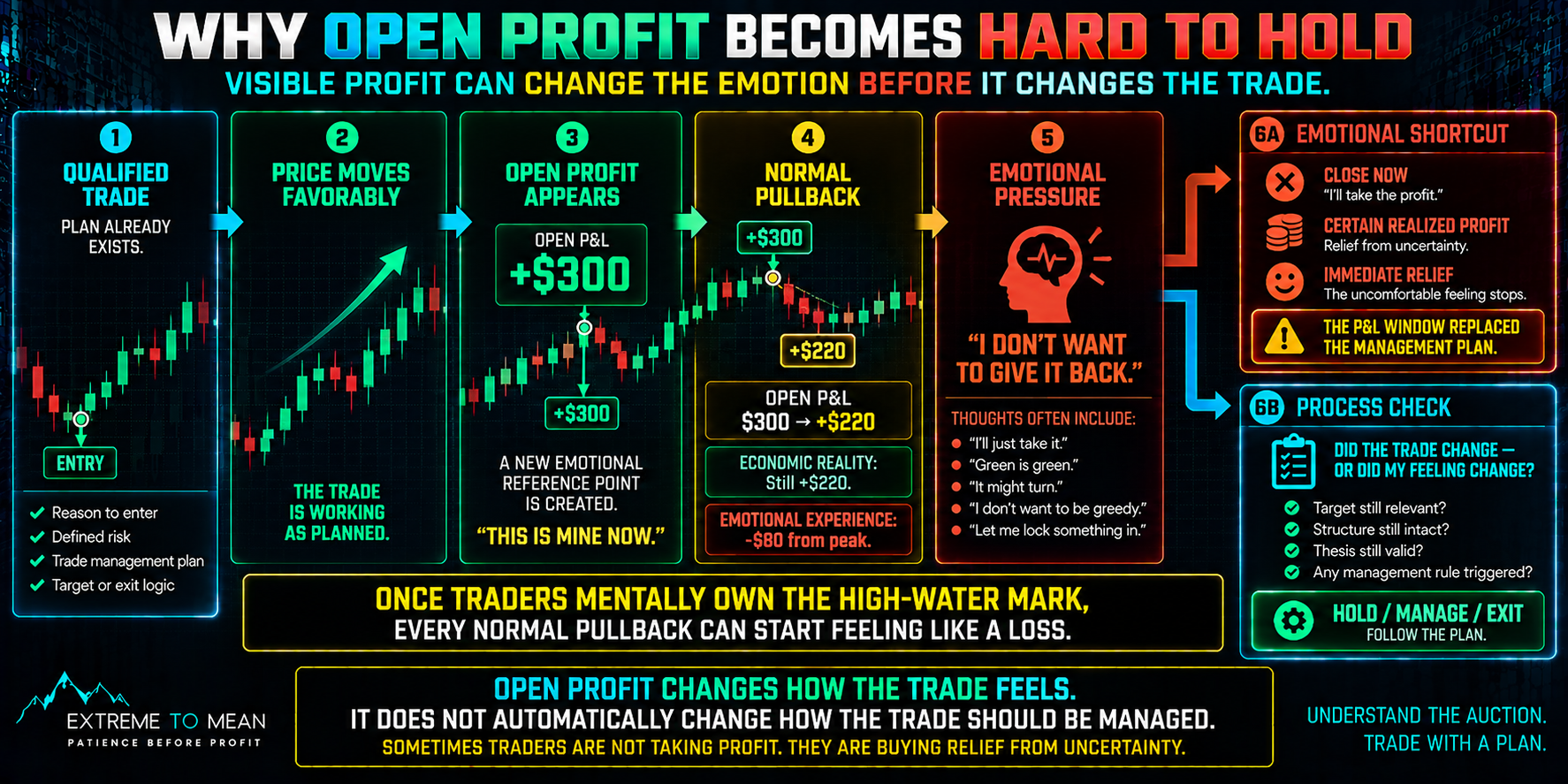
Open profit changes how the trade feels. It does not automatically change how the trade should be managed.
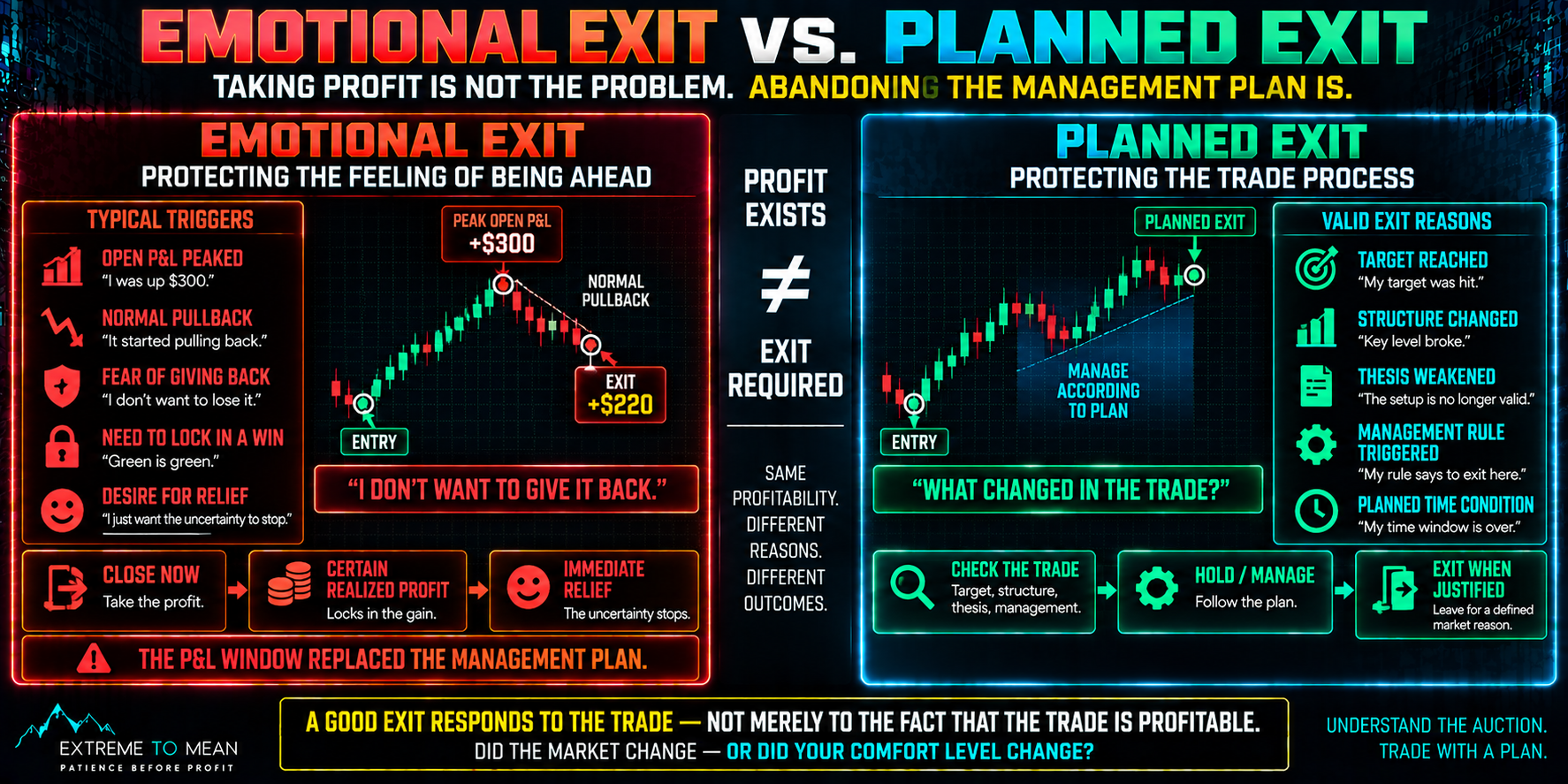
The central problem is not taking profit. It is allowing the emotional value of visible profit to replace the exit logic that existed before the trade became profitable. The useful question is: Did the market change—or did my comfort level change?
That distinction belongs inside the broader Trader curriculum because managing a winner is still a decision-quality problem. The trader's job is not to maximize every move or capture the highest unrealized number that appeared on the screen. It is to manage the position according to evidence and a predefined process rather than the emotional pull of the current P&L.
Why a Winning Trade Can Become Harder to Hold
Before entry, uncertainty is part of the deal. The trader knows the setup can fail, accepts a defined amount of risk, and enters because the opportunity appears worth testing. Once the position moves favorably, however, the emotional reference point can change from account balance + possible opportunity to account balance + visible open profit.
Suppose the trader is up $300 and price pulls back until the open profit reads $220. Economically, the position is still profitable by $220, but emotionally the trader may experience the move as an $80 loss because the mind has started measuring from the $300 high-water mark. Once traders mentally own the high-water mark, every normal pullback can start feeling like a loss.
That shift helps explain why gains and losses can be treated asymmetrically. Behavioral-finance research has documented a tendency in some investors to realize gains more readily than losses, often discussed as the disposition effect, although those findings should not be treated as a complete explanation for intraday futures management. The practical ETM point is narrower: visible profit can create a new emotional reference point, and that reference point can pressure the trader to realize a gain even when the trade evidence has not changed.
Sometimes Taking Profit Is Really Buying Relief
Closing a profitable trade does more than realize money. It also ends uncertainty, removes the possibility of giving the gain back, and creates an immediate sense of relief. That relief can become so valuable that the emotional goal quietly changes from manage the trade correctly to make this feeling stop.
The trader may say, “I'm taking profit because it's smart,” while the real motivation is, “I cannot tolerate watching this number move backward.” That does not make the trader weak; it reveals that the decision is being driven by a different objective than the original plan. Sometimes traders are not taking profit. They are buying relief from uncertainty.
This is why protecting your next decision matters even while a trade is winning. A premature exit can feel excellent in the moment because uncertainty disappears, but the immediate emotional reward can reinforce the habit of closing whenever open profit becomes uncomfortable. The process then begins training the trader to value relief more than consistency.
“Let Winners Run” Needs an Actual Exit Plan
“Cut losses and let winners run” sounds useful until the trader asks the obvious question: run until what? Without a defined answer, the phrase can become just as reckless as taking every small gain immediately. Holding forever, ignoring targets, or refusing to reduce exposure is not disciplined trade management.
A winner should be allowed to run according to a plan—not according to hope. Depending on the strategy, legitimate exit logic might involve a preplanned target, a structural change, a management rule, a time-based condition, or a planned scale-out. Different approaches can be valid, but the method should exist before open profit begins negotiating with it.
The best time to decide how to manage a winner is before you have a winner to protect. A trading plan made before the open can define the broad management logic before the trader becomes attached to the current P&L. Once the position is green, following an existing plan is easier than inventing one while every pullback feels personally expensive.
Breakeven and Early Scaling Can Become Emotional Shortcuts
One common response to a small open gain is, “Now I can't let this become a loss.” The trader immediately moves the stop to breakeven, price makes an ordinary pullback, the position closes, and the original move later resumes. Breakeven may sometimes be correct, but breakeven is a price; it is not automatically a safer decision.
The useful psychological question is whether market structure justified changing the stop or whether seeing green made loss emotionally unacceptable. The same distinction applies to scaling out. Planned partial profit can reduce exposure and preserve a runner, while repeated unplanned scaling can quietly remove so much size that almost nothing remains for the move the strategy was designed to capture.
Scaling out should solve a management problem—not merely make the trader feel better. Smaller position size can also make normal pullbacks easier to tolerate because each tick carries less emotional weight, but size alone does not fix weak management logic. If normal movement feels unbearable, the problem may not be the market—it may be how much the movement means to your account.
Cutting Winners Can Change the Economics of the Strategy
Exit behavior is part of a strategy's economics. Suppose a strategy was designed around controlled losses and fewer but meaningfully larger winners; if the trader repeatedly converts those winners into tiny gains, the realized payoff distribution can become very different from the one the strategy was built around. A higher percentage of green trades does not automatically repair that change.
For example, a strategy designed around roughly 2R winners cannot be judged fairly if the trader repeatedly turns potential qualifying winners into 0.4R gains simply to avoid watching open profit fluctuate. Those numbers are illustrative rather than an ETM target, but the principle matters: a green trade can still contain a management mistake.
The highest unrealized number you briefly saw is also not automatically profit your plan was supposed to capture. A trade that reaches +$400 and later trades at +$250 has not necessarily “lost” $150 in a process sense if $400 was never a planned exit. Peak P&L is information about what occurred; it is not automatically the target your strategy owed you.
Did the Market Change—or Did Your Comfort Level Change?
Giving back open profit can absolutely matter when the market itself changes. Momentum may fail, structure may break, a target may react, or a predefined management condition may trigger. The answer is not to call every pullback “normal” and hold blindly.
The distinction is between a market reason to exit and an emotional reason to exit. Market reasons include a target being reached, the thesis weakening, structure changing, a management rule triggering, or a planned time constraint. Emotional reasons sound different: “I don't want to give it back,” “green is green,” “I need a win,” or “I'll be furious if this becomes a loser.”
A good exit responds to the trade. A fearful exit responds primarily to the P&L window. Emotional awareness is useful because discomfort can alert the trader to pressure, but discomfort should not silently replace the management logic. The same trader who negotiates endlessly with a loser can become incredibly strict with a winner simply because profit is already visible.
Trader A Protects the Feeling; Trader B Manages the Trade
Imagine NQ produces a qualified long with structural invalidation below a defined level, a target at the next meaningful area, and a management plan that changes only if the structure changes. Price moves strongly in favor and Trader A sees +$180 of open profit. A small pullback reduces the P&L to +$130, and the thought appears: “I'm not giving this back.”
Trader A exits even though the target, structure, and management conditions remain unchanged. Price later holds structure and continues far enough that the move would eventually have represented roughly +$500 of open movement from the original entry. The mistake is not that Trader A should somehow have known the market would continue; the mistake is that the original exit logic was replaced by discomfort about losing unrealized profit.
Trader B feels the same discomfort but asks, “What changed in the trade?” Structure remains intact, the planned target is still relevant, and no management condition has triggered, so Trader B continues according to the plan. The target might be reached, or structure may later fail and produce an exit below the peak P&L; either outcome can still represent correct management because the plan—not the emotional high-water mark—made the decision.
The reverse matters too. A trader can be up $200, see the intended structure break, follow the management rule, exit, and later watch price resume higher. A later move does not retroactively invalidate an exit that correctly followed the plan. Management should be reviewed against the information and rules available at the time, not against the most profitable outcome visible afterward.
The “Why Am I Exiting?” Test
Before closing a profitable position, ask:
- WHAT CHANGED IN THE MARKET? — Be specific.
- WHAT MANAGEMENT RULE TRIGGERED? — If none, why are you exiting?
- DID THE THESIS WEAKEN OR DID THE P&L PULL BACK? — Those are not identical.
- AM I RESPONDING TO PRICE OR TO THE PEAK PROFIT I SAW?
- WOULD I EXIT HERE IF I COULD NOT SEE THE DOLLAR P&L?
- IS THIS EXIT PART OF MY PLAN OR AN ATTEMPT TO FEEL SAFE?
- IF I HOLD, WHAT EXACTLY WOULD MAKE ME EXIT NEXT?
That last question matters because “let it run” is not a management plan. If the trader cannot explain the next valid exit condition, the trade may be drifting without rules in the opposite direction. The goal is not to resist every exit; it is to know what information would justify HOLD / MANAGE / EXIT.
The ETM Plan → Progress → Check → Manage → Exit Framework
Use five stages:
- PLAN — Before entry, decide what would justify taking profit, changing the stop, scaling, holding a runner, or ending the trade.
- PROGRESS — The trade moves favorably. Recognize that open profit is information, not automatically an exit signal.
- CHECK — Ask: Did the market change, or did my emotional state change?
- MANAGE — Follow the predetermined logic: hold, adjust, or scale only for a defined reason.
- EXIT — Leave because the target, thesis, structure, time constraint, or management rule says the trade should no longer be held.
The framework rejects both bad extremes. Bad extreme one: take profit immediately because green might disappear. Bad extreme two: never take profit because winners are supposed to run forever. The ETM answer is to let a valid winner continue only as long as the evidence and the plan still justify letting it continue.
This is also where clear risk and management belong together. If a trader does not know why they entered, what would invalidate the position, or what would justify an exit, then unclear risk is a deeper issue than premature profit-taking. Management cannot remain consistent when the trade never had clear conditions to manage.
Final Thought
Taking profit is not a mistake simply because price later goes farther. The mistake is allowing the appearance of open profit to replace the exit logic that existed before the trade. Once a winner starts feeling like money already owned, even an ordinary pullback can feel like something is being taken away, and closing the position can provide immediate relief.
A better process defines the broad target, invalidation, scaling, and management logic before that pressure appears. Then the question stops being, “How much of this profit can I save?” and becomes, “Has anything changed that tells me this trade should no longer be held?” Let winners run only as long as the evidence and the plan still justify letting them run.
Educational content only. Trading involves substantial risk and is not suitable for everyone.