
A trader can make the correct decision, stay out of a move that never qualified, and still finish the next ten minutes feeling as if money was taken from them. The account may be unchanged, but the chart makes the road not taken painfully visible. That is where correct waiting can begin to feel like losing.
Missed profit is not realized loss, and a market move is not automatically a missed trade.
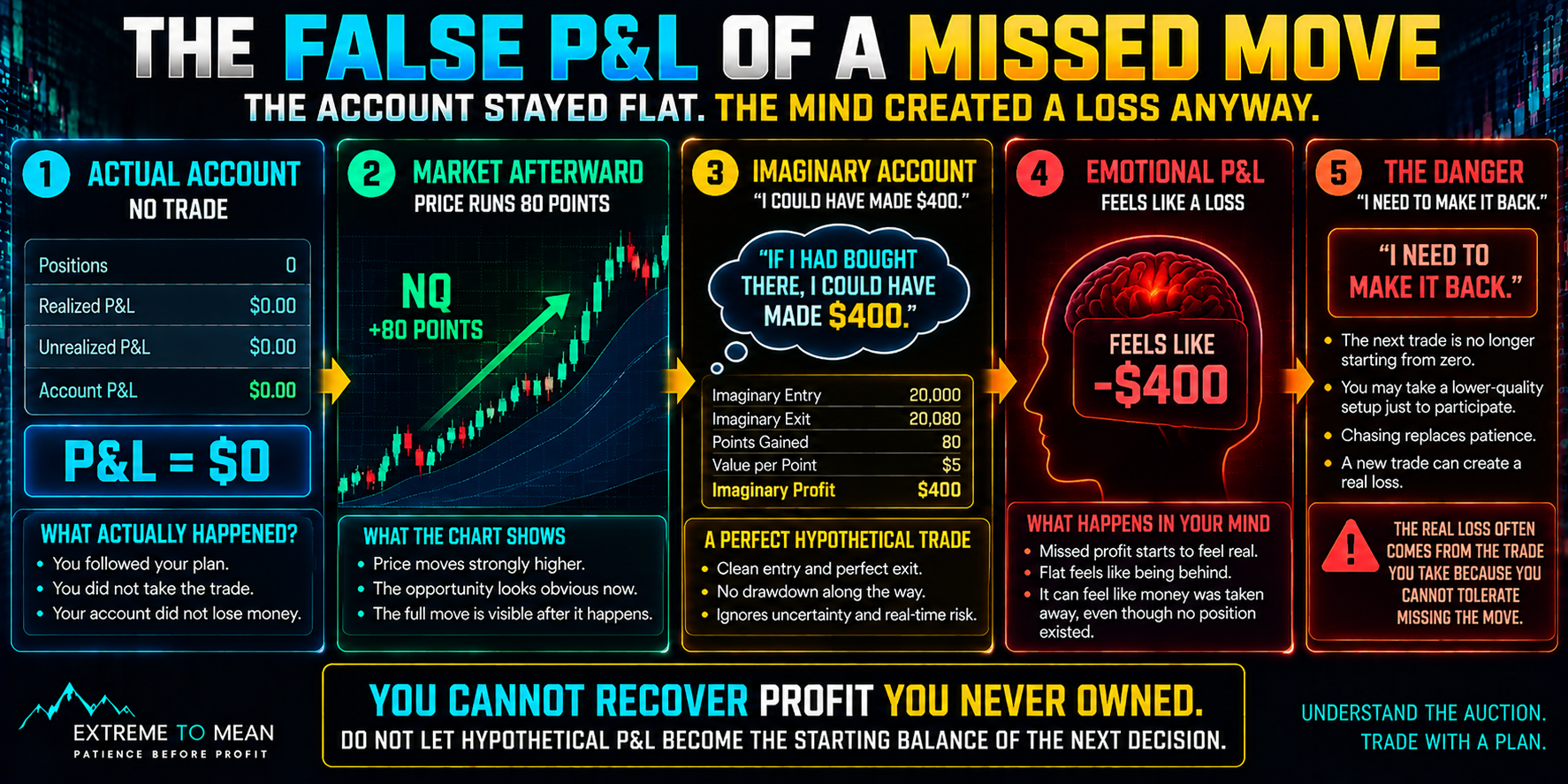
The emotional problem begins when the trader compares what actually happened with a perfect version of what could have happened. “I stayed out” gets placed next to “If I had bought there, I could have made $400,” and the difference starts to feel like a real debit. The market can create the feeling of loss without creating an actual trading loss.
That distinction matters inside the broader Trader curriculum because patience is difficult partly because the reward for waiting is often invisible. The trade you avoided does not show up as a saved loss, while the move you did not catch remains right there on the chart. Decision quality can therefore feel worse than activity even when the process was cleaner.
You Can Feel Behind Without Losing a Dollar
Suppose you spend the first hour of the session flat while NQ rallies sharply. Your account still shows zero for the period, yet your mind may start comparing that zero with the profit you imagine you could have made. Flat stops feeling neutral and begins feeling like you are behind.
That emotional shift is understandable because missed opportunities can create genuine regret. People do not need to lose something they already owned in order to feel the pain of an outcome that might have been better. But trading becomes dangerous when that emotional regret is converted into financial accounting.
The cleaner distinction is simple: actual P&L belongs to the account; hypothetical P&L belongs to review. If no position existed, the trade result was not minus $400 simply because the market later moved far enough to make $400 possible. You cannot recover profit you never owned.
Why the Chart Makes Missed Profit Feel Real
A completed chart is unusually good at making imaginary trades look perfect. After the move, you can point to an entry, measure to the high, choose a beautiful exit, and assign a dollar amount to a trade that never actually existed. The uncertainty that made the decision difficult in real time has disappeared.
That hypothetical trade also tends to remove everything inconvenient. It forgets whether you would really have entered, where the stop belonged, whether price moved against you first, whether you would have held the entire move, and whether your setup ever qualified. The missed trade you calculate afterward is usually cleaner than the trade you would actually have experienced.
This creates a false scoreboard. The actual account says $0, the market scoreboard says NQ moved 80 points, and the imaginary scoreboard says “I could have made $400.” When the trader emotionally turns that imaginary +$400 into a personal -$400, the next decision is no longer starting from zero.
A Market Move Is Not Automatically Your Trade
Every move is visible after it happens. Not every move was available to your process. Price can travel a long distance without reaching your planned location, producing your setup, offering acceptable risk, or remaining inside the market conditions your strategy is designed to trade.
This is why doing nothing can still be a trading decision. A trader may correctly reject a chase, avoid scheduled event risk, or stand aside because the required setup never formed. The fact that price later traveled 80 more points does not retroactively create a valid trade at the earlier moment.
A useful question is, “Did the market move without me, or did my process actually offer me a trade?” Those are not the same event. The first may require no correction at all, while the second can expose a real execution problem.
Why Other Traders Make Waiting Feel Worse
Comparison adds another layer because it removes even more of the missing context. You see someone post, “Caught the whole NQ move,” but you usually do not know their strategy, account size, entry criteria, stop, drawdown, consistency, or how many other trades they took. You are comparing your full process with somebody else's highlight.
Another trader's valid trade does not automatically become your missed trade. Different strategies can reasonably participate in different parts of the same session, and two disciplined traders can make different decisions from the same market because their rules are different. The existence of somebody else's profit does not prove your own plan required participation.
Social comparison becomes most dangerous when it changes the next decision rather than merely creating discomfort. A trader who was content to wait can suddenly feel late, slow, or less capable after seeing someone else's result. That feeling can turn a neutral market into a personal scoreboard.
When Correct Patience Gets Punished by the Next Candle
Markets can give immediate emotional rewards to poor process and immediate emotional punishment to good process. You consider chasing a move, refuse because the location is bad, and then watch price continue another 30 points. For the next several candles, the chart appears to tell you that the disciplined choice was stupid.
Meanwhile, another trader who chased may temporarily sit in open profit. One short-term outcome can therefore make reaction look intelligent and restraint look costly. But a single outcome cannot establish which decision process is more repeatable or better controlled.
This is where outcome and decision quality must be separated. Protecting your next decision means refusing to let the last candle rewrite the rule that kept you out. The market can reward the wrong behavior today and punish the right behavior today, which is why discipline cannot be graded one trade at a time.
The Difference Between a Missed Move and a Missed Trade
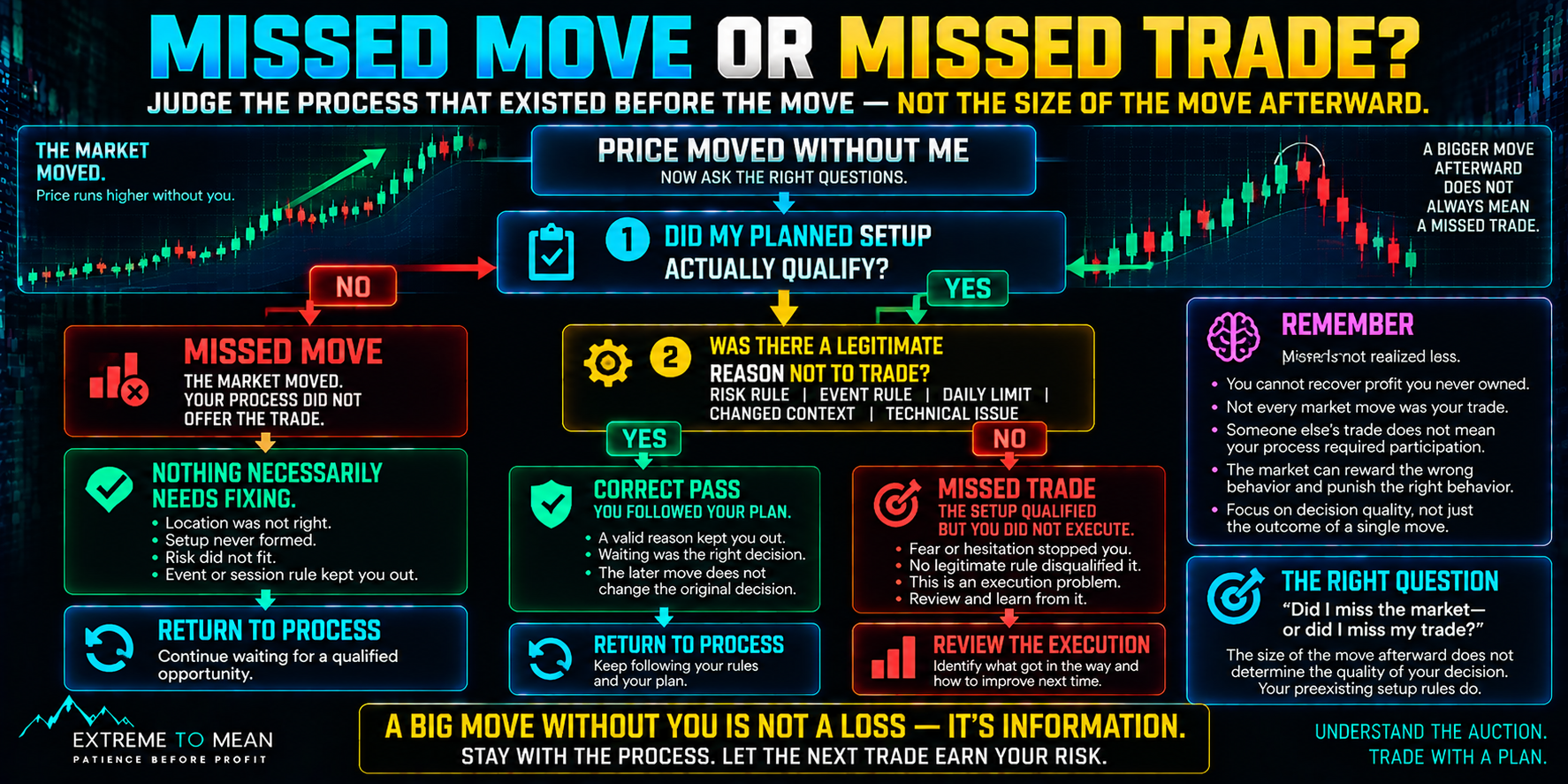
A missed move means the market moved and your actual setup never qualified. Perhaps location was wrong, risk did not fit, event rules kept you out, or the move simply happened without producing the pattern you trade. Nothing necessarily needs fixing.
A missed trade is different. Your planned setup qualified, risk fit, no legitimate rule disqualified the opportunity, and you still failed to execute because of an unplanned reason such as fear or hesitation. That deserves honest review because the process offered a trade and execution did not follow it.
This distinction prevents patience from becoming an excuse. The correct question is not, “Did price move without me?” Ask, “Did my setup arrive without my execution?” That question separates correct non-participation from a real execution failure.
Do Not Let Imaginary Loss Create Real Risk
Consider a clean morning example. Your plan requires meaningful location, a defined setup, clear invalidation, and acceptable risk, but NQ opens and immediately rallies without giving you any of them. You correctly stay out, and NQ runs another 80 points.
Now the internal scoreboard says, “I missed $400.” You open social media and see, “Easy long this morning,” and flat begins to feel like failure even though the account is unchanged. Twenty minutes later another upward burst begins from even worse location, and the thought appears: “I am not missing another one.”
You buy the second burst and it reverses immediately. The first move never damaged the account; the reaction to missing it created the real loss. The missed move is often not what damages the account. The trade you take because you cannot tolerate missing it may be.
That is the point where ordinary disappointment can become FOMO that feels like opportunity. The trader is no longer evaluating the new trade from zero because imaginary profit from the previous move has become the starting balance of the next decision. There is suddenly something to “make back” even though nothing was actually lost.
The ETM Waiting Reset
After a large move happens without you, use this sequence:
- MOVE — The market moved without me. Do not assign meaning yet.
- QUALIFY — Did my actual setup meet the rules?
- CLASSIFY — Was this a missed move, a correct pass, or a missed valid trade?
- RESET — Return emotional P&L to actual P&L.
- NEXT DECISION — Apply the original standard again: QUALIFY / WAIT / PASS.
The most important practical step is to stop calculating the perfect profit unless you are conducting a formal review with realistic entry, stop, and management assumptions. If no position existed, actual trade P&L from that move is zero. Your account does not debit you every time the market moves without you.
Then ask whether missing the move changed your next decision. Are you lowering the standard because you feel behind, chasing because you want participation, or taking a trade partly to recover imaginary money? If so, chasing the trade is no longer about the chart alone; it is being financed by a false emotional loss.
The reset is not designed to make you feel nothing. Disappointment can still be real, and a genuine missed trade should still be reviewed honestly. The goal is to keep emotion from changing classification: missed movement, missed valid trade, and realized loss are three different things.
Final Thought
Waiting feels like losing because the chart makes the road not taken visible. You can see the move, calculate the hypothetical profit, watch someone else participate, and begin treating an unrealized possibility as something the market took away. But missed profit is not realized loss, and every visible move did not necessarily belong to your process.
First ask whether your setup actually qualified. If it did not, you may have missed movement without missing a trade; if it did and you failed to act for an unplanned reason, review the execution problem honestly. Either way, do not carry imaginary P&L into the next decision—the next trade still has to earn your risk from zero.
Educational content only. Trading involves substantial risk and is not suitable for everyone.