
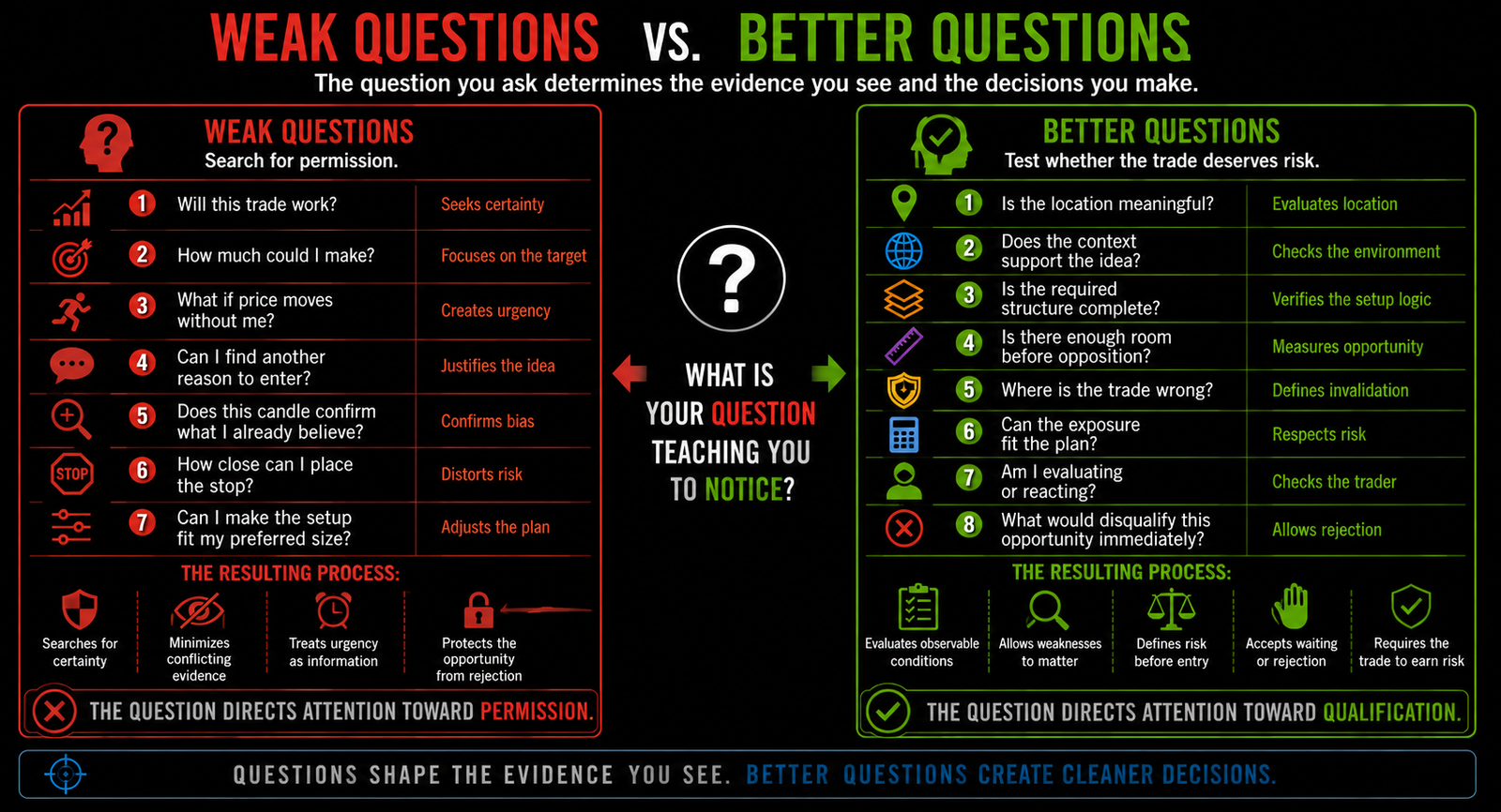
Many traders begin with a question the market cannot answer honestly: “Will this trade work?” The question feels natural because the trader wants confidence before accepting uncertainty. It also encourages the mind to search for evidence that supports the desired outcome. By the time the entry appears, the trader may be defending an answer rather than evaluating a trade.
The lessons in The Trader category emphasize that discipline is easier to follow when the process asks clear questions before pressure arrives. Questions determine what evidence receives attention, what weaknesses are allowed to matter, and what conditions can disqualify the idea. A vague or outcome-focused question creates room for emotion to fill in the answer. A specific process question gives the trader something observable to evaluate.
Questions Shape What the Trader Sees
A question acts like a filter. Asking whether price is about to rally directs attention toward bullish candles, possible targets, and reasons buyers may take control. Asking whether the location, structure, and risk justify a long trade directs attention toward both supporting and conflicting evidence. The second question does not eliminate uncertainty, but it produces a more balanced decision.
This is why two traders can view the same chart and reach different conclusions. One is searching for confirmation of a preferred direction, while the other is testing whether the opportunity meets a defined standard. The chart has not changed, but the decision process has. Better questions reduce the chance that the trader will confuse desire with evidence.
“Will This Work?” Is the Wrong Starting Question
The question “Will this work?” treats the trade as though the outcome should be knowable before entry. Because the answer cannot be known, the trader often replaces evidence with confidence, intuition, or recent experience. A winning streak may make the answer feel like yes, while a difficult session may make the same setup feel doubtful. The question therefore measures emotion as much as market quality.
A cleaner starting point is, “What must be true for this trade to deserve risk?” That question creates a sequence involving market context, location, structure, available room, invalidation, and personal readiness. It also allows the answer to be no without requiring the trader to prove that the market will move in the opposite direction. The trade is judged by whether it meets the standard, not by whether the trader can predict the result.
Ask Whether the Location Is Meaningful
Location changes the meaning of every setup. A bullish pattern at support, after a controlled pullback, is a different decision from the same pattern directly beneath resistance or in the middle of a range. A bearish trigger near a failed higher-timeframe area is different from one that appears after price has already fallen into support. The pattern may look familiar while the opportunity around it is completely different.
The better question is, “Is this a location worth trading from?” That question directs the trader toward the surrounding structure, nearby opposition, extension, and the amount of room available. It also prevents one attractive candle from becoming automatic permission. When location is weak, the setup may earn observation without earning participation.
Ask Whether the Context Supports the Idea
A setup operates inside a market environment that can support, weaken, or contradict it. Trend, range, chop, volatility, participation, and higher-timeframe structure all influence how the pattern is likely to behave. The trader does not need perfect alignment across every market and timeframe. The trader does need enough agreement for the trade’s logic to remain reasonable.
This is where the principle that good traders disqualify bad trades becomes practical. Instead of asking whether one signal looks strong, the trader asks whether the broader context removes the reason to participate. Weak follow-through, narrow participation, or repeated failed breaks may disqualify a continuation idea. Context should be allowed to reject the setup before the trigger creates urgency.
Ask Whether the Structure Is Complete
A trade should contain the structure required by its own logic. A breakout needs more than a brief move beyond a boundary, a pullback needs the larger trend structure to remain intact, and a reversal needs evidence that the existing pressure is weakening. The trigger can confirm the structure, but it cannot replace missing evidence. A clean signal inside an incomplete setup is still an incomplete trade.
The better question is, “What market behavior makes this setup valid right now?” The answer should identify the required response rather than repeat the name of the pattern. Price may need to hold above a level, reject an area, preserve a swing, or receive participation after the trigger. If the trader cannot describe the required behavior, the setup has not been qualified clearly enough.
Ask Whether There Is Enough Room
A trade can be directionally correct and still be poorly positioned. The entry may sit too close to resistance, support, a prior extreme, or another area where the opposing side is likely to respond. Limited room can make the potential destination unattractive relative to the required invalidation. The trade may work briefly without offering a complete decision that fits the plan.
The better question is, “Does this trade have room to develop before meaningful opposition?” That question forces the trader to evaluate distance, market structure, and the likely path rather than focusing only on the final target. It can also reveal that the entry is late even when momentum is strong. Passing because the available room is poor is a professional judgment, not fear of participation.
Ask Whether the Risk Is Clear
Risk should be understood before the order is placed. The trader must know what would make the idea wrong, where the protective stop belongs, and how the invalidation distance affects position size. A preferred dollar amount or contract size cannot determine where the market proves the trade invalid. The market logic defines the boundary, and the risk plan determines whether the position can fit.
This is why a trading plan is a promise made before the open. The better question is, “Can I explain the complete risk in one clear sentence?” If the answer depends on moving the stop later, hoping normal movement will not reach it, or adjusting size after entry, the trade is not ready. Clear risk does not guarantee a favorable outcome, but it gives the decision an honest boundary.
Ask Whether You Are Evaluating or Reacting
The trader’s emotional state can change the meaning assigned to the same evidence. Urgency can make average location appear acceptable, frustration can make a reversal feel necessary, and fear of missing out can make incomplete confirmation feel sufficient. The chart may be unchanged while the qualification standard quietly falls. Personal readiness therefore belongs inside the decision process.
The better question is, “Am I evaluating this opportunity, or am I trying to avoid a feeling?” The feeling may involve regret, boredom, the need to recover, or the discomfort of watching price move without participation. Naming that pressure does not automatically disqualify the trade, but it prevents the emotion from operating unnoticed. When the answer reveals reaction rather than evaluation, waiting may be the cleaner decision.
Build a Sequence Instead of One Final Question
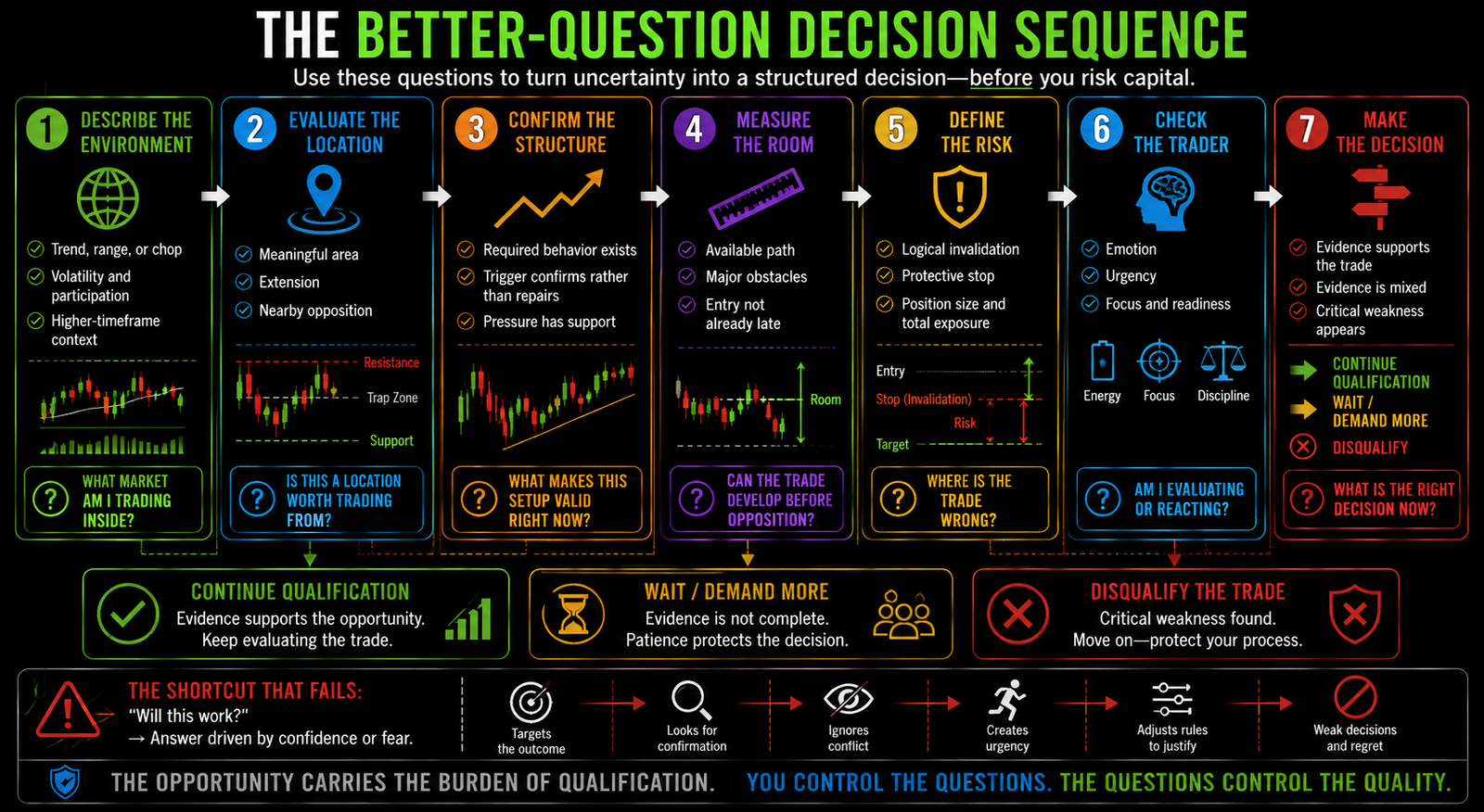
No single question can qualify every part of a trade. The trader needs a short sequence that moves from environment to location, structure, room, risk, and personal readiness. Each answer should either support continued evaluation, require more evidence, or disqualify the opportunity. The sequence keeps one attractive feature from overriding several serious weaknesses.
This process also helps protect the next decision. A trade rejected because the questions exposed poor context or unclear risk does not consume capital, focus, or emotional stability. Those resources remain available when a stronger opportunity appears. Better questions improve more than the current entry because they protect the complete decision sequence.
A Practical Better-Question Framework
Before acting, the trader can use a compact set of questions that follows the order of the decision. The goal is not to create an impossible checklist or eliminate uncertainty, but to apply a repeatable framework such as the Extreme to Mean system. It is meant to make the trade explain itself before urgency reduces the standard. One serious failure may be enough to stop the process:
- What market am I trading inside?
- Is the location meaningful or am I trapped in the middle?
- What structure makes this setup valid?
- Is current pressure supported by participation and follow-through?
- Is there enough room before meaningful opposition?
- Where is the trade wrong?
- Can the full exposure fit the risk plan?
- What evidence would disqualify the idea immediately?
- Am I evaluating the trade or searching for permission?
- Would I take this trade if I could not see the possible target?
- What would make waiting the better decision?
- What must remain true after entry for the original plan to stay valid?
The questions should produce one connected explanation rather than twelve unrelated answers. A strong explanation might state that the market is trending, the setup is forming at a meaningful pullback location, pressure is returning with participation, room is available, and invalidation is clear. A weak explanation often depends on the pattern name, the possible target, or the fear that price may move without the trader. The difference is whether the decision is supported by observable conditions.
The principle that doing nothing is still a trading decision becomes easier to apply when the questions produce a clear rejection. The trader is not standing aside because of vague fear or a lack of confidence. The trade failed to meet a defined standard, so withholding risk is the completed decision. Better questions make patience specific enough to follow.
Review the Questions, Not Just the Trade
Post-trade review should examine which questions were asked and which were avoided. A trader may have analyzed the target carefully while never asking whether the location was late or the risk was clear. Another trade may have failed even though every important question was answered responsibly. The review should separate the quality of the process from the result of one position.
The trader should also review rejected trades without allowing hindsight to rewrite the original decision. A skipped trade may later work, but the later move does not erase the weakness identified beforehand. Repeatedly useful questions should become part of the routine, while vague or redundant questions can be improved. The goal is a framework that creates clearer decisions, not a script that predicts every outcome.
Final Thought
Better trades do not begin with certainty. They begin with questions that direct attention toward what can actually be evaluated: context, location, structure, room, invalidation, exposure, and personal readiness. These questions can approve continued evaluation, demand patience, or disqualify the opportunity. Their value comes from improving the decision before the outcome is known.
The goal is not to ask more questions merely to delay action. It is to ask the few questions that prevent urgency, desire, and fear from becoming the hidden reasons for participation. A setup earns attention, but the complete trade must explain why it deserves risk. Better questions create better trades because they create cleaner decisions first.
Educational content only. Trading involves substantial risk and is not suitable for everyone.