
Bitcoin Gets Put in the “Risk-On” Box Too Easily
Bitcoin gets placed in the “risk-on” box because the pattern is easy to see. During many periods of improving market confidence, Bitcoin rises alongside technology shares and other volatile assets, while periods of stress can push them lower together. That observation is useful, but it becomes dangerous when traders turn it into a permanent rule. Bitcoin can behave like a high-beta risk asset without being permanently defined by that behavior. The lessons in The Market category treat this kind of cross-asset relationship as context to test, not a rule to memorize.
The historical record itself argues against a fixed label. Bitcoin’s relationship with stocks has varied substantially across different market environments, becoming stronger during some periods of shared liquidity and risk appetite and weaker when other forces dominate. The important lesson is that correlation changes with the environment rather than remaining constant forever. A relationship that worked during one regime does not automatically deserve the same weight in the next.
Bitcoin also carries several identities at the same time. It is a speculative asset, a liquidity-sensitive market, an institutional investment vehicle, a crypto-native monetary asset, and a highly leveraged market that trades continuously. One of those identities may dominate for weeks or months before another becomes more important. That is why a relationship that looks dependable can weaken quickly without either market behaving irrationally.
What “Risk-On” Actually Means
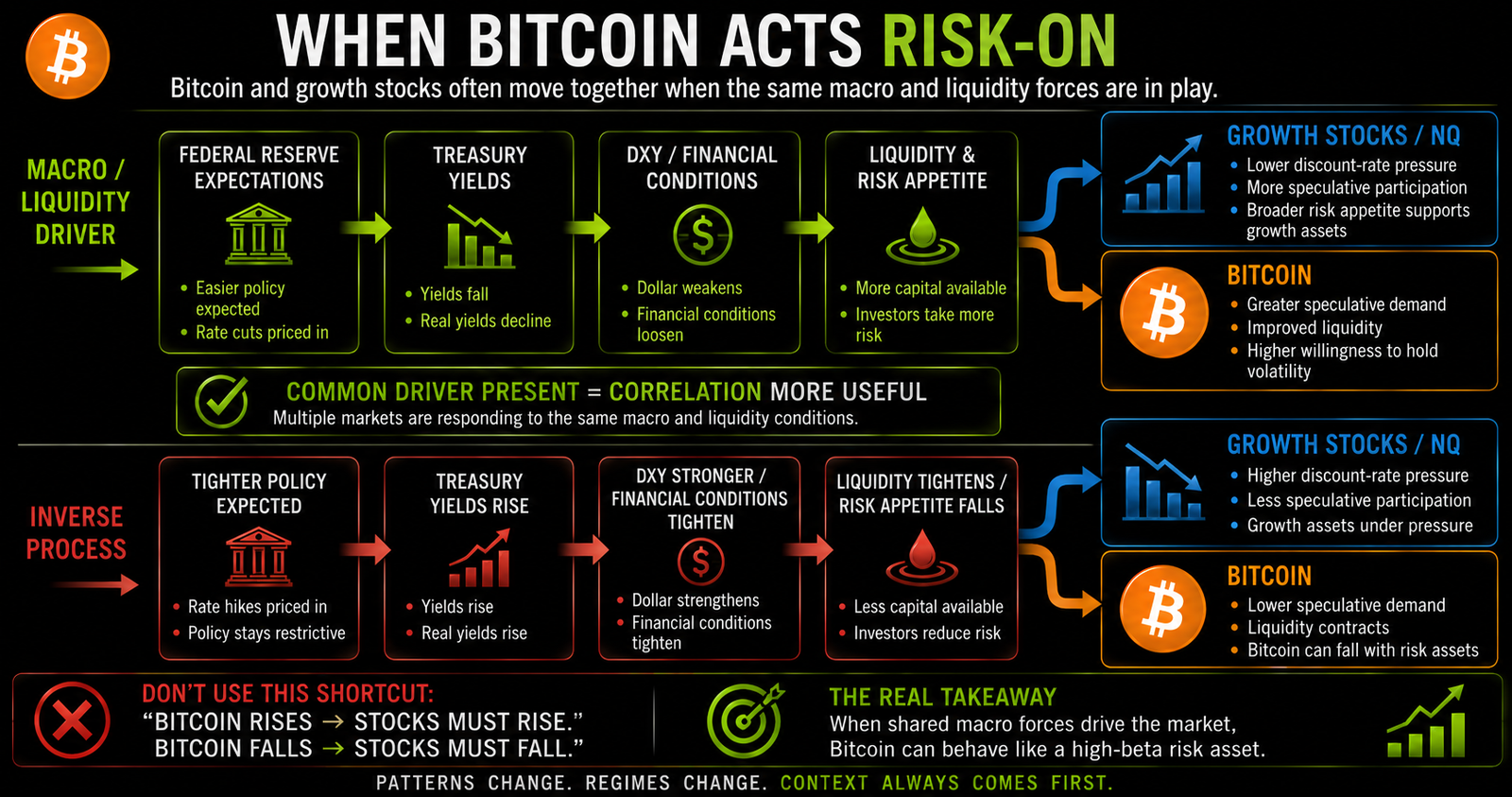
Risk-on is better understood as a market behavior than as a permanent asset classification. Investors become more willing to own uncertainty and volatility when liquidity is improving, policy expectations are becoming easier, financial conditions are loosening, or confidence in growth is increasing. Growth stocks, small caps, credit, and other speculative markets may all respond to that change. Bitcoin may participate because the same willingness to take risk is influencing several markets at once.
The reverse can occur when the environment tightens. Higher expected policy rates, rising 10-year Treasury yields, a stronger dollar, or deteriorating liquidity can reduce the appeal of long-duration and highly volatile assets. Bitcoin may fall alongside the Nasdaq because both are reacting to the same macro pressure rather than because one is mechanically leading the other. The relationship is strongest when the common driver can be identified.
The cleaner distinction is simple: Bitcoin behaving like a risk-on asset does not mean Bitcoin is always a risk-on asset. A label describes what the market is doing in the current regime, not what the asset must do in every regime. Traders should therefore ask whether Bitcoin is participating in a broad risk move before using it as confirmation. That question keeps the observation contextual instead of turning it into a signal.
When Bitcoin and Stocks Tend to Move Together
Bitcoin and stocks tend to move together most cleanly when monetary-policy expectations dominate cross-asset pricing. Easier expected policy can pull yields lower, weaken the dollar, improve liquidity expectations, and make speculative assets more attractive. Tighter conditions can pressure both crypto and equities through the same risk-taking channel. When the same rates-and-liquidity story is visible in both markets, Bitcoin can become useful confirmation.
Global liquidity creates another shared channel. When capital is plentiful and financial conditions are supportive, investors often move farther out on the risk curve and become more willing to own volatile assets. When liquidity contracts, markets that depend heavily on speculative participation can reprice quickly. The relationship described in DXY and the stock market can help determine whether dollar strength or weakness is reinforcing that broader liquidity message.
Broad participation matters more than Bitcoin alone. If NQ and ES are rising, credit is behaving well, volatility is easing, the dollar is stable or weaker, and Bitcoin is also strengthening, several independent markets are describing a similar environment. Bitcoin adds information because it agrees with evidence that already exists elsewhere. Its confirmation value comes from alignment, not from its ability to dictate the equity move.
Why Bitcoin Can Suddenly Stop Following Stocks
Bitcoin can decouple when crypto-specific forces become stronger than the macro forces affecting stocks. Institutional Bitcoin investment vehicles created a dedicated access channel that can generate large Bitcoin-specific inflows or outflows. A strong flow period can move Bitcoin even when the S&P 500 or Nasdaq is relatively quiet. In that situation, Bitcoin may be telling traders more about Bitcoin demand than about broad risk appetite.
Crypto-specific news can produce the same separation. Regulation, exchange problems, custody developments, government policy, major institutional purchases, security events, and industry-specific headlines can all change Bitcoin demand without changing the earnings outlook for the S&P 500. When one of those catalysts is clearly dominating, the equity-confirmation value of the Bitcoin move falls. The trader should identify the catalyst before attaching a macro meaning to the price change.
Leverage can make the separation even sharper. Crypto derivatives can carry significant leveraged positioning, and forced liquidations can accelerate moves once important levels are crossed. Cascading liquidations and forced sales can amplify price changes independently of equities. A violent Bitcoin move can therefore be a liquidation event rather than a new message about stocks.
Bitcoin also has its own supply-and-demand cycle. Miner behavior, long-term holder activity, institutional accumulation, exchange balances, and the asset’s fixed issuance structure can influence price independently of equity valuations. These forces do not make Bitcoin immune to macro conditions, but they can change which driver matters most at a particular time. The stronger the Bitcoin-specific driver, the less weight its equity correlation deserves.
Correlation Changes With the Market Regime
A better framework is to think in regimes rather than permanent correlations. In a macro-dominated regime, rates, inflation expectations, the dollar, and liquidity affect many markets at once, so Bitcoin and NQ may move closely together. In a crypto-dominated regime, ETF flows, regulation, leverage, or Bitcoin-specific demand can overwhelm the shared macro forces and create large divergence. A mixed regime sits between them, with Bitcoin sometimes confirming equities and sometimes following its own catalysts.
This framework changes the question a trader asks. “Does Bitcoin correlate with the Nasdaq?” looks for one permanent answer, while “How strongly is Bitcoin correlating with the Nasdaq in the current regime?” asks for present evidence. The second question encourages the trader to examine recent behavior, current catalysts, and cross-market confirmation. It also accepts that the answer can change without invalidating the broader framework.
The principle that context comes before the candle applies especially well here. A Bitcoin breakout means more to an equity trader when the move is supported by rates, the dollar, volatility, and index structure than when Bitcoin is reacting to a crypto-only headline. Correlation should therefore be treated as a condition to evaluate rather than a fact to memorize. The setup on the traded market still has to qualify on its own.
Bitcoin Can Confirm Risk Appetite—But It Should Not Define It
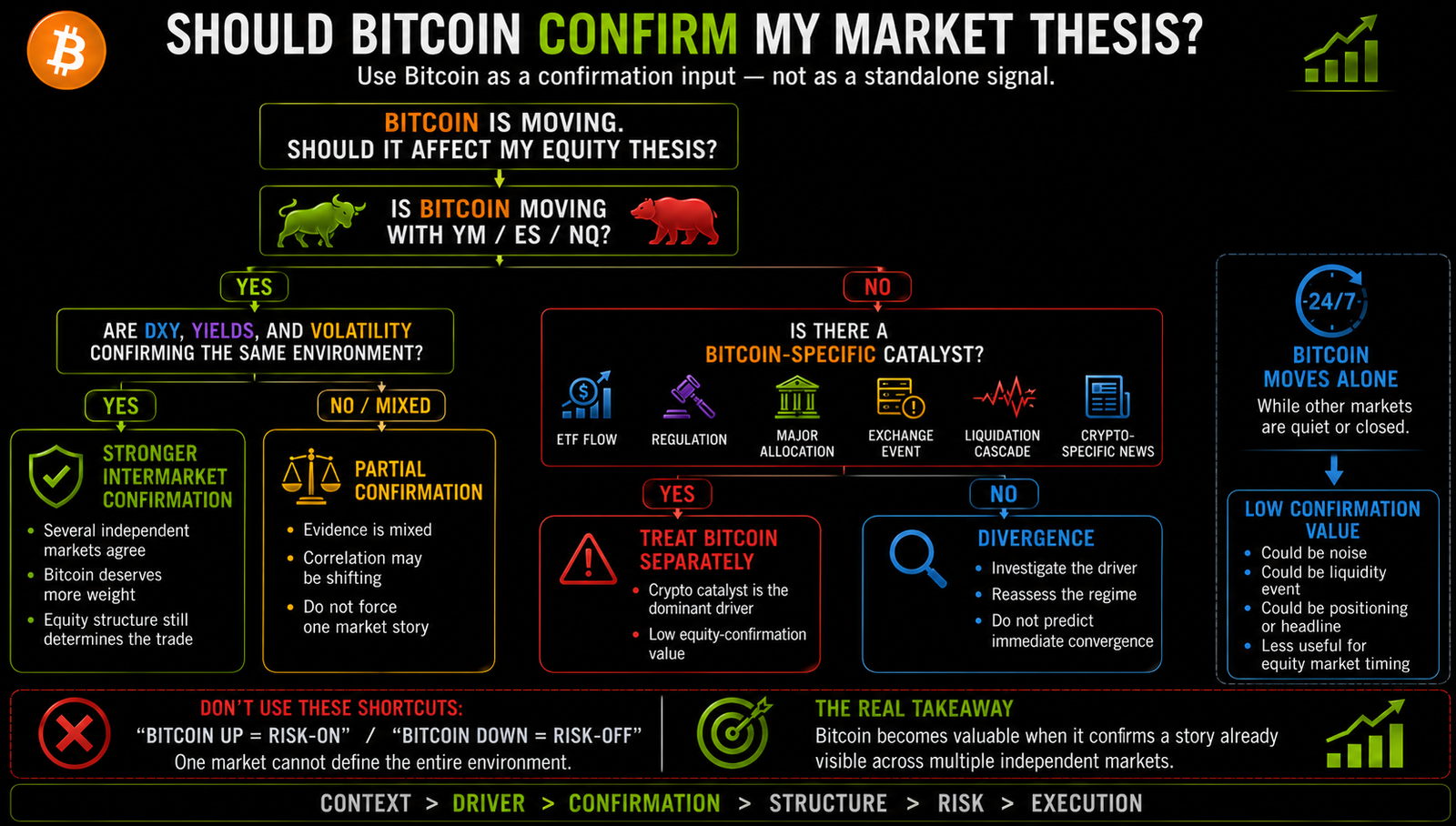
Bitcoin belongs inside a confirmation stack, not at the top of it. A broad risk-on read becomes stronger when NQ and ES are firm, DXY is weakening or stable, yields are controlled, the VIX is easing, and Bitcoin is participating. A broad risk-off read becomes stronger when the opposite pattern appears across several markets together. The more independent evidence agrees, the less the thesis depends on one asset.
Divergence is information too. If equities are rising while Bitcoin is falling, the divergence does not automatically invalidate the equity move or predict that stocks will reverse. It tells the trader to investigate whether speculative appetite is weakening or whether Bitcoin has a separate catalyst. Bitcoin becomes a question that needs context rather than an answer that overrides price.
Four Scenarios for an ETM Trader
One practical scenario is broad confirmation. YM, ES, and NQ are strengthening, Bitcoin is also breaking higher, the dollar is stable or weaker, yields are not surging, and volatility is contained. That combination suggests that speculative appetite may be part of a wider market move rather than isolated buying in one asset. The equity structure still determines whether an actual trade has location, room, and acceptable risk.
A second scenario is equity strength with Bitcoin weakness. The divergence may reflect weaker speculative participation, but it may also come from ETF outflows, regulation, a liquidation event, or another crypto-specific catalyst. The correct response is investigation rather than prediction. If the equity market remains structurally healthy and the Bitcoin weakness has a clear local cause, the divergence may deserve less weight.
A third scenario is a violent Bitcoin move with little response from equity futures. A five-percent move in Bitcoin around an ETF development, regulatory headline, weekend event, or liquidation cascade should not be treated automatically as a hidden signal for NQ. The lack of confirmation elsewhere is itself important information. A market moving alone should usually receive less weight in a cross-market thesis.
A fourth scenario is synchronized stress. Bitcoin falls, NQ and ES weaken, Treasury yields rise, DXY strengthens, and VIX expands at the same time. Now Bitcoin matters more because it is one part of a broad tightening or risk-off message rather than an isolated crypto move. That is the environment in which intermarket confirmation becomes most useful.
Bitcoin Is Especially Useful Before the Cash Open
Bitcoin is particularly interesting before the U.S. cash open because the crypto market operates around the clock. It can react during Asian and European trading, early U.S. premarket hours, and weekends when most U.S. cash equities are closed. That makes Bitcoin potentially informative during morning preparation, but longer trading hours do not make it a better predictor. Continuous trading provides more observations, not automatic foresight.
An overnight Bitcoin move should therefore be compared with the markets that are available at the same time. Equity futures, Treasury yields, DXY, and volatility conditions can show whether the move is part of a broader repricing or something concentrated inside crypto. A weekend Bitcoin selloff after a crypto-specific event may carry little information for Monday’s equity structure, while a weekend move tied to a major macro or geopolitical shock may deserve more attention. The source of the move determines how much confirmation value it earns.
The Better Question: What Is Driving Bitcoin Today?
The better morning question is not, “Is Bitcoin bullish or bearish?” It is, “What is driving Bitcoin today?” The answer can usually be organized around several broad categories. Once the dominant driver is identified, the trader can decide how much weight Bitcoin deserves in the equity thesis.
- Macro: Rates, Federal Reserve expectations, DXY, and liquidity.
- Broad risk appetite: Participation across equities and other speculative assets.
- Institutional flows: Bitcoin ETP flows and large allocations.
- Crypto catalysts: Regulation, industry developments, custody, exchanges, or security events.
- Market structure: Leverage, liquidations, positioning, and important technical levels.
This process also prevents confirmation from becoming cherry-picking. A trader should not notice Bitcoin only when it agrees with an existing opinion and ignore it whenever it diverges. The same framework should be applied whether Bitcoin supports or challenges the current market read. Consistent evaluation matters more than forcing every asset into one story.
Final Thought
Bitcoin is useful to equity traders precisely because its relationship with stocks is imperfect. When it confirms a story already visible in rates, the dollar, volatility, and equity structure, the evidence becomes stronger. When it diverges, the trader receives a reason to investigate the dominant driver instead of pretending the markets must immediately converge. When Bitcoin moves alone, its message about equities becomes weaker.
The goal is not to decide whether Bitcoin is philosophically a risk asset, a monetary asset, or something else forever. It is to determine which role is dominating now and whether that role contains useful information for the market being traded. Never build a thesis from one asset, one indicator, or one headline when independent confirmation is available. Readers seeking the broader monetary context can continue through The Monetary Revolution.
Educational content only. Trading involves substantial risk and is not suitable for everyone.