
Why More Indicators Do Not Automatically Create More Understanding
The common mistake is to turn every internal into a separate vote. Breadth becomes bullish, VIX becomes bullish, TICK becomes bullish, sector rotation becomes neutral, and the trader starts counting boxes instead of understanding the market. A dashboard is useful because each gauge answers a different question, not because it has more gauges.
Several indicators can also be saying almost the same thing. TICK, advance-decline data, and another breadth oscillator may all be measuring participation in different ways, so three green breadth readings are not necessarily three independent confirmations. The broader Market curriculum becomes more useful when we organize evidence by function rather than by how many charts agree.
What “Market Health” Actually Means
Market health does not mean “the market is bullish.” It means how well the activity underneath headline price supports the move we are trying to understand. A rising market can have broad or narrow support, while a falling market can be internally coherent if participation, volatility, and risk appetite all confirm the weakness.
Direction tells us where price is moving; market health tells us how well the environment underneath price supports that movement. A falling market with broad declining participation and expanding risk aversion can be better confirmed than a rising market carried by a small group of stocks. Healthy therefore does not mean up; it means internally consistent with the move being evaluated.
The Three Questions: Breadth, Volatility, and Risk Appetite
Breadth asks how much of the market is participating. Volatility asks how large, fast, and unsettled the movement has become. Risk appetite asks what kinds of exposure participants appear more willing to own or avoid.
Those questions are deliberately different. Breadth should not substitute for volatility, and volatility should not substitute for participation. Sector rotation and other risk-appetite clues add another dimension because they describe the character of the exposure being favored.
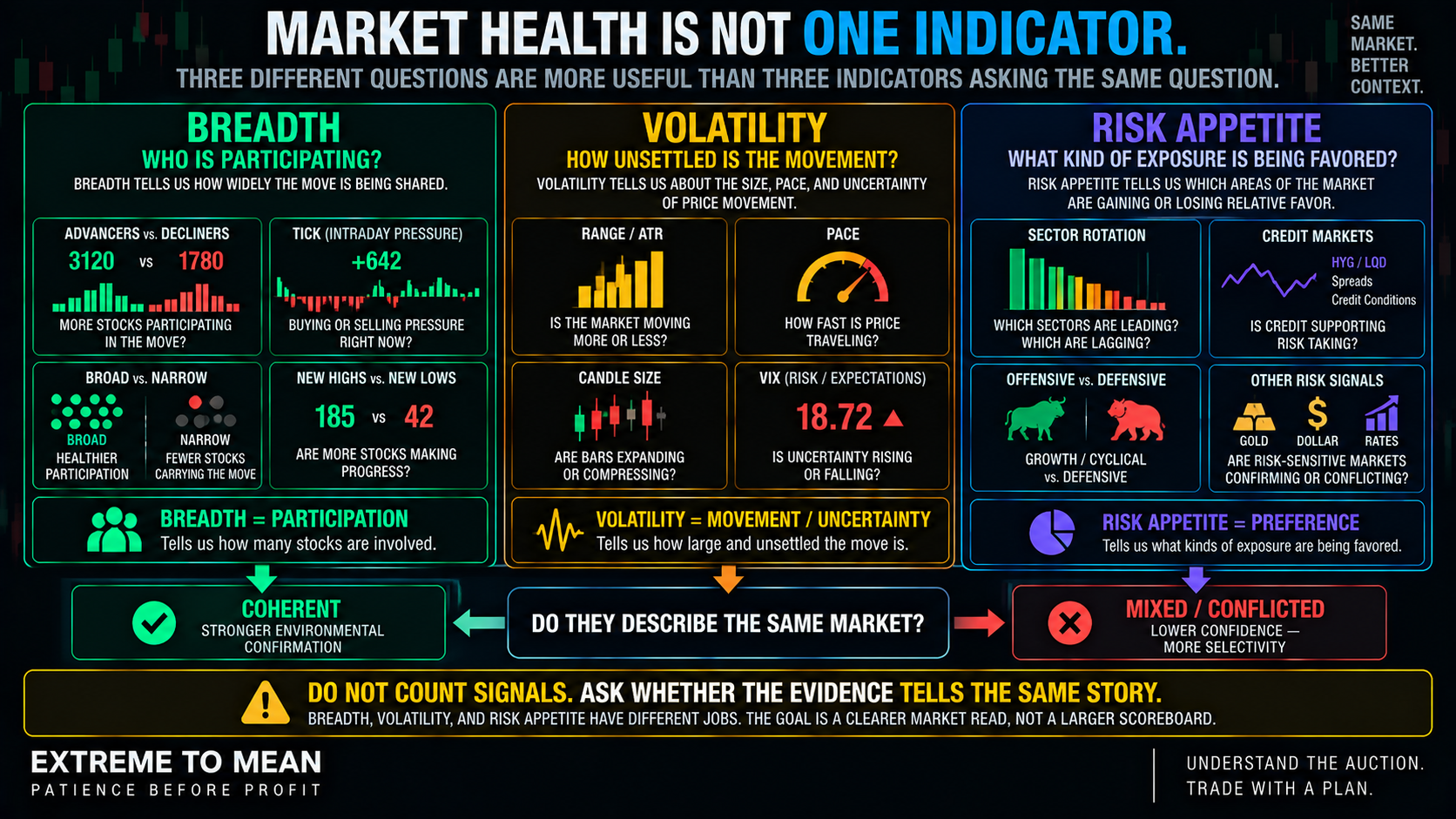
Breadth Tells Us How Widely the Move Is Being Shared
An index can rise while many stocks lag because an index is weighted rather than one-stock-one-vote. That does not mean the index is lying; it means the index and breadth answer different questions. The index measures the result of its weighting system, while breadth tells us how widely that result is being shared.
A broad advance means participation is spreading, while a narrow advance means a smaller group is carrying more of the move. Narrow leadership can persist much longer than traders expect, so weak breadth is not an automatic short signal. Breadth can weaken before price does, but price is not required to catch up on the trader's schedule.
Strong breadth is not an automatic long signal either. Improving participation does not create good location, a valid entry, clear invalidation, or enough target room. Breadth describes participation quality; it does not replace the setup.
Volatility Tells Us How Unsettled the Movement Is
Volatility helps us judge how much and how quickly price is moving and whether the environment is becoming calmer, larger, faster, or more unstable. Falling volatility can fit a calmer risk-on environment, but it is not a command to buy. Rising volatility can accompany falling prices, rising prices, or violent two-sided movement.
That is why volatility deserves its own framework. VIX can provide one implied-volatility lens, while realized range, pace, pullback size, and two-sided movement describe what price is actually doing. Volatility tells us how unsettled the movement is; the rest of the system helps tell us what kind of movement we are looking at.
Risk Appetite Tells Us What Kind of Exposure Is Being Favored
Risk appetite asks whether participants appear more willing to favor growth, cyclicality, credit risk, and higher-beta behavior or whether defensive exposure is improving. Sector rotation is one way to study that relationship, which is why sector leadership belongs in the context read. Credit relationships and other risk-sensitive markets can add information, but none should be treated as a universal switch.
Do Not Count Signals. Ask Whether the Evidence Describes the Same Market.
Suppose ES is rising, breadth is broad, offensive sectors are improving, and volatility remains orderly. Those independent dimensions describe a fairly coherent environment, which gives the move stronger internal confirmation. It still does not make every long entry good.
Now suppose ES is rising while breadth narrows, volatility expands, and defensive sectors climb the rankings. The index can continue higher, but the internal story is more conflicted. The correct conclusion is not “short now”; it is that the rally has weaker or more complicated environmental confirmation.
Conflict is useful information because markets do not always resolve cleanly. Breadth can improve while volatility remains elevated, or offensive sectors can strengthen while credit remains cautious. When the evidence conflicts, the conflict is part of the market condition rather than a problem to solve by opening more charts.
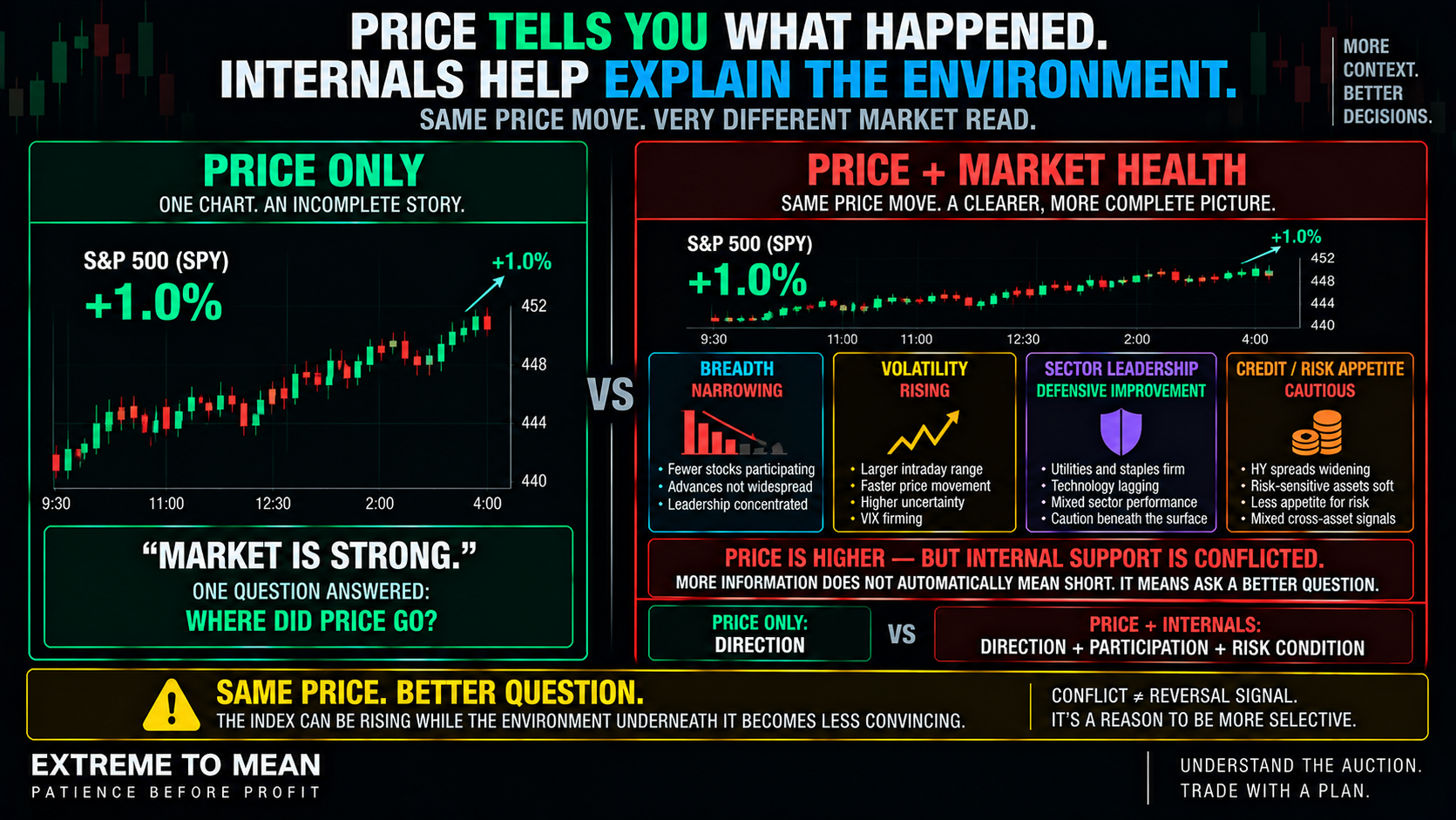
Independent Confirmation Matters More Than Repeated Confirmation
Three different questions are more useful than three indicators asking the same question. If four breadth indicators turn positive together, the trader may feel as though four independent pieces of evidence confirmed the move, but all four may simply be reporting improved participation. That is one dimension measured four ways.
Independent dimensions can conflict for legitimate reasons. Participation can be strong while volatility worsens and risk appetite becomes defensive, producing a richer read than “two bullish, one bearish.” A system is not a democracy where every indicator gets one identical vote.
Internals Describe the Environment. They Do Not Invent the Trade.
The wrong workflow is breadth strong, therefore buy ES. The cleaner workflow is price reaches a meaningful location, a setup begins to qualify, and the market-health read helps determine whether the broader environment supports or challenges that thesis. Internals belong mostly to the environment stage of the decision.
That is why the market comes first. Market health can increase or reduce confidence in how a qualified setup is expected to behave, but it does not create location, define invalidation, or guarantee follow-through. The internals should help answer whether the market deserves the trade—not invent the trade.
A coherent environment can still produce a losing trade, and a conflicted environment can still produce a winning one. The context framework is not validated or invalidated by one outcome because conditions change and individual trades remain uncertain. Better context improves decision quality; it does not turn probability into certainty.
The Market-Health Read Must Be Updated
The morning read does not own the entire session. Breadth can deteriorate, volatility can expand, and sector leadership can become defensive after a strong open, just as a weak opening environment can stabilize later. The pre-market read is a starting hypothesis; the market gets to revise it.
The ETM Market-Health Framework
The goal is to turn multiple pieces of evidence into one market question rather than one giant scoreboard. Start with price, then ask what participation, volatility, and risk appetite say about the environment surrounding that move. Only after that should the setup and risk decision enter the process.
- Price: What is the index actually doing—trend, range, breakout, reversal attempt, or extension?
- Participation: Is the move broad or narrow?
- Volatility: Is movement orderly, compressing, expanding, or unstable?
- Risk appetite: Are offensive areas gaining leadership, or are defensive areas improving?
- Agreement: Do these dimensions describe roughly the same environment?
- Conflict: If they disagree, what exactly is conflicting?
- Persistence: Is this meaningful change or temporary fluctuation?
- Environment: Is the market supportive, hostile, or mixed for the strategy?
- Setup: Does the actual trade still qualify?
- Risk: Does the current environment fit the proposed invalidation and exposure?
The condensed version is Price → Breadth → Volatility → Risk Appetite → Coherence → Setup → Risk. It keeps independent evidence organized without pretending that every input deserves equal weight. The trader's job remains evaluate → qualify → define risk → decide.
The better question is not, “How many bullish indicators do I have?” Ask, “Do price, participation, volatility, and risk appetite describe the same market—and if not, what does that conflict mean for this setup?” That is more useful than collecting another green box.
Final Thought
Breadth, volatility, and risk appetite are valuable because they answer different questions about the same market. Breadth tells us who is participating, volatility tells us how unsettled the movement has become, and risk appetite tells us what kinds of exposure are gaining relative favor. The value comes from the relationship among those dimensions, not from any one reading.
A coherent environment can strengthen the contextual case around a qualified setup, while conflicting evidence can justify more selectivity or lower confidence. Neither state predicts the next trade, and neither replaces price, location, invalidation, or risk. Market health is an environmental read, not an entry trigger.
Read the system first, then evaluate the setup inside the environment it is actually describing. If the evidence changes, update the read; if the evidence conflicts, accept the conflict instead of shopping for confirmation. That process-first hierarchy is part of the broader Extreme to Mean system.
Educational content only. Trading involves substantial risk and is not suitable for everyone.