
Break of Structure and Change of Character are popular market-structure terms, especially in Smart Money Concepts and ICT-style analysis, but they are not standardized exchange definitions. Traders and indicators can disagree about which swing matters, whether a wick counts, whether a candle must close through the level, and whether they are measuring internal or larger swing structure. Inside The Market, the cleaner approach is to define the trend, swing, timeframe, and break rule first, then judge what price does afterward.
Start With Market Structure, Not the Acronym
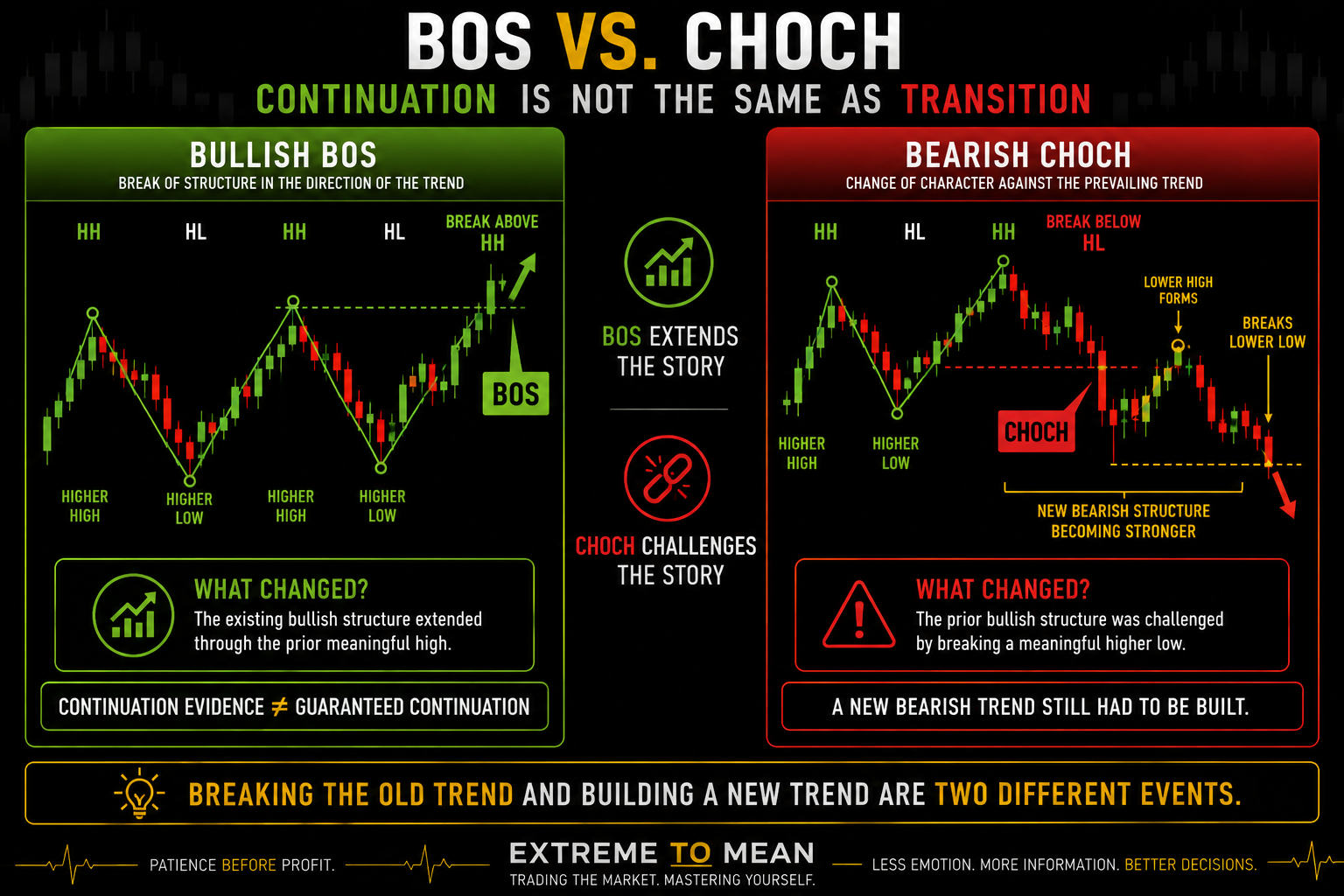
Suppose price has been producing higher highs and higher lows: HH → HL → HH → HL. That sequence describes bullish structural progression because new highs keep forming while important pullbacks hold above prior lows. Before calling anything BOS or CHOCH, the trader needs to know which part of that sequence the market is actually challenging.
If price breaks above the prior meaningful high, the move is occurring in the same direction as the existing bullish structure. Traders commonly label that a bullish BOS because the market extended the pattern already in place. If price instead breaks below a meaningful prior higher low, traders may label that a bearish CHOCH because the behavior supporting the uptrend has been challenged.
The mirror image applies in a downtrend. Lower lows and lower highs define bearish progression; a break below a relevant prior low can be labeled bearish BOS, while a break above a meaningful lower high can be labeled bullish CHOCH. The labels only become useful after the preceding structure is identified.
What a Break of Structure Actually Tells You
A Break of Structure generally describes price breaking a relevant swing in the direction of the prevailing structure. Imagine ES forms a higher high at 6,500, a higher low at 6,485, then a new high at 6,515 before pulling back to 6,498. If ES later closes above 6,515 under a predefined close-based rule, that can reasonably be called a bullish BOS.
What has been established is limited but useful: the existing bullish sequence extended through the prior meaningful high. What has not been established is that ES must continue higher, the next pullback must hold, or the breakout is automatically safe to enter. BOS confirms what price accomplished; it does not guarantee what price will accomplish next.
That distinction matters because a valid structural observation can still be followed by failure. Price can close beyond the high, satisfy the trader's BOS definition, and then fall back beneath the level one candle later. A broken level tells you what price just did; it does not tell you what price must do next.
What CHOCH Actually Tells You
CHOCH stands for Change of Character and generally describes the first meaningful structural break against the prevailing trend. In the ES example, suppose price later falls below the 6,498 higher low instead of preserving it. That break challenges the behavior that had been maintaining the bullish sequence.
The useful conclusion is not automatically, “The market is now in a downtrend.” CHOCH tells you the old bullish story may no longer be intact, but it does not yet tell you what the new story will become. This is similar to the broader distinction that reversion is not reversal: interruption of one pattern is not automatically proof of a complete directional transition.
Stronger bearish evidence would develop if ES then formed a lower high around 6,505 and subsequently broke another meaningful low. Now price is not merely violating the previous bullish sequence; it is beginning to build a bearish sequence of its own. Breaking the old trend and building a new trend are two different events.
For continuation, think Existing Trend → Pullback Holds → Relevant Swing Breaks → Follow-Through → Structure Remains Intact. For a possible reversal, think Existing Trend → Structural Failure → CHOCH → Stabilization / New Swing → Follow-Through → New Structure. The first extends the existing story; the second requires the market to begin writing a genuinely different one.
Which Swing Actually Matters?
Not every candle high or low deserves to become market structure. If every tiny pivot gets labeled BOS, CHOCH, BOS, CHOCH, the chart becomes a description of noise rather than a framework for decision-making. Swing significance should come from a consistent method that considers timeframe, movement away from the level, surrounding structure, and whether the swing actually contributed to meaningful progression.
This is where hindsight can quietly corrupt the analysis. A trader may call a small low irrelevant when it breaks, then later promote that same low to “major structure” because price reversed afterward. If you change which swing counts after seeing the result, you are not reading structure—you are rewriting it.
The better question is: Which swing would I have identified as relevant before I knew what happened next? That keeps the structural reference stable enough to review and test. It also prevents BOS and CHOCH from becoming labels that somehow always look correct after the outcome is known.
Timeframe Changes the Meaning of the Break
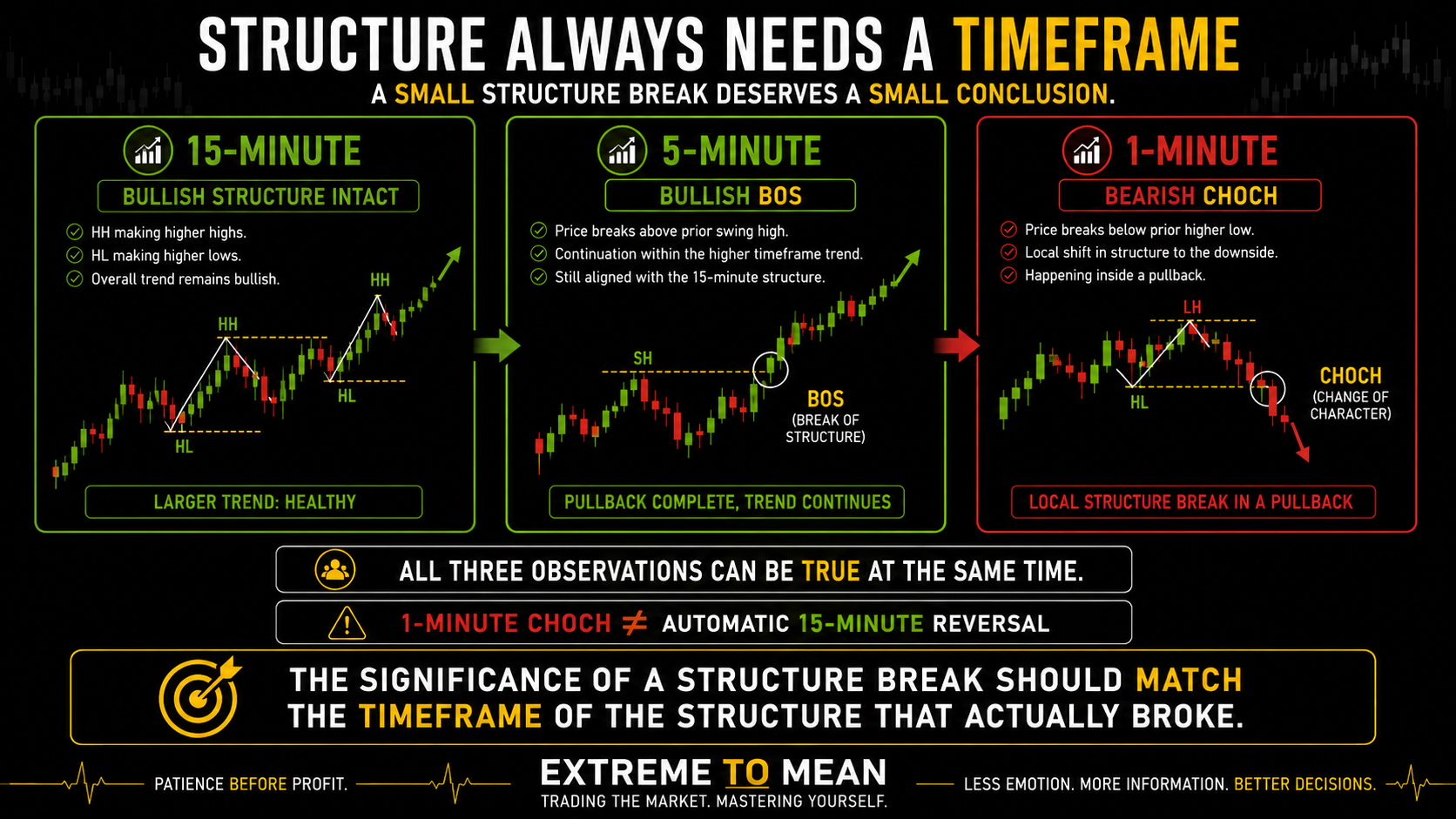
Market structure is hierarchical, so the same market can show different structural information on different timeframes without contradiction. A 15-minute chart may remain clearly bullish while the five-minute chart is pulling back and the one-minute chart prints a bearish CHOCH. The smaller break may simply describe short-term rotation inside the larger bullish environment.
That is why structure always needs a timeframe attached to it. Saying “the market had a bearish CHOCH” is less precise than saying “the one-minute structure broke bearish while the 15-minute bullish structure remained intact.” Context Comes Before the Candle for the same reason: the meaning of a local event depends on the environment surrounding it.
A small structure break deserves a small conclusion. If the trader uses a one-minute pivot to declare that an entire higher-timeframe trend has reversed, the conclusion is larger than the evidence. Timeframe should narrow or expand the claim you are willing to make.
Wick or Close: Define the Rule Before the Outcome
Suppose a relevant swing high is 20,000, price trades to 20,004 intrabar, but the candle closes back at 19,992. Some BOS/CHOCH methodologies count the trade through the swing, while others require a candle close beyond it. There is no single universally accepted rule that every trader or indicator follows.
For teaching consistency, using a close beyond a predefined meaningful swing is a clean convention because it reduces ambiguity in the examples. That does not make wick-based definitions wrong; it simply gives the trader one rule that can be applied consistently. The important part is deciding whether a wick or close counts before seeing whether the breakout succeeds.
The dangerous version is allowing the definition to move with the trader's bias. If a wick counts when the trader wants the breakout but a close is suddenly required when the trader dislikes it, the rule is no longer measuring structure consistently. Consistency matters more than pretending one convention is universally correct.
Even with a consistent break rule, distance and follow-through still matter. A close barely beyond a swing followed by an immediate return is different evidence from strong expansion and sustained trade beyond the level, but there is no universal five-point or one-candle threshold that makes BOS “valid.” Define the break consistently, then evaluate what happens after it.
BOS and CHOCH Can Both Fail
A bullish BOS can be technically valid under the trader's rules and still fail immediately afterward. That does not necessarily mean the original label was wrong; it means the trader was wrong if they converted the observation into guaranteed continuation. A valid observation can still lead to a losing trade if the trader turns observation into prediction.
CHOCH can fail in the same way. NQ might break a small lower-timeframe swing low, stabilize, reclaim the level, preserve the larger higher low, and then continue upward to another high. The CHOCH described a real short-term structural challenge, but the conclusion that a full reversal had begun was oversized.
This is why what happens after the break matters as much as the label itself. Follow-through, acceptance beyond the level, subsequent pullback behavior, and whether new structure develops all add information. BOS is continuation evidence, not continuation certainty, while CHOCH is a reason to reassess rather than an order to reverse.
A break that quickly rejects can also raise a separate question about a failed breakout or liquidity sweep, while an order-block label raises a different question about the zone that preceded the move. These ideas deserve their own analysis rather than being forced into the BOS/CHOCH framework. This article's job is to distinguish structural continuation from structural challenge, not to turn every level violation into one giant Smart Money Concepts signal.
Market State Changes How Useful the Labels Are
BOS and CHOCH are easiest to interpret when swing structure is relatively clean. Inside chop, highs and lows overlap, price repeatedly crosses prior pivots, and automated labels can flip rapidly from bullish to bearish and back again. The messier the market, the less useful hyper-precise structure labeling becomes.
Reviewing the three market states helps explain why. A trend tends to produce clearer directional swing relationships, while a rotational market can create repeated local breaks that have little importance beyond the immediate range. A technically correct label can therefore carry very different weight depending on the environment.
An indicator cannot solve that context problem by printing more labels. Pivot sensitivity, swing strength, close-versus-wick rules, and internal-versus-external structure settings can cause two tools to mark the same chart differently. The trader still needs to know what structure the tool is measuring and whether that structure matters.
Even a clean BOS or CHOCH still has to be evaluated as part of a trade rather than treated as the trade itself. Location, volatility, room, entry quality, and broader conditions remain important, because market conditions change the quality of a setup. Structure can strengthen the read without making the rest of the qualification process disappear.
Common BOS and CHOCH Mistakes
The labels become dangerous when they create a false sense that the chart has become objective simply because an indicator printed an acronym. A trader can still make inconsistent choices about swings, timeframe, confirmation, and context while believing the terminology itself has removed discretion. The cleaner process is to define those choices first and then use BOS or CHOCH as shorthand for the observation.
Common mistakes include:
- Calling every high break BOS
- Calling every low break CHOCH
- Ignoring the prevailing structure before the break
- Choosing the important swing after seeing the outcome
- Mixing one-minute structure with 15-minute conclusions
- Allowing a wick to count sometimes while requiring a close at other times
- Treating BOS as guaranteed continuation
- Treating CHOCH as confirmed reversal
- Entering immediately because an automated indicator printed a label
- Assuming a structure break identifies institutional intent
- Combining BOS, FVGs, order blocks, and liquidity into one automatic “smart money” signal
- Ignoring location and market conditions
- Forgetting that a technically valid structural break can still fail
A Practical BOS-vs.-CHOCH Framework
Use Trend → Swing → Break → Follow-Through → New Structure → Decision. The sequence forces the trader to establish what existed before the break and to wait for evidence afterward instead of reacting to an acronym. Structure is strongest when used to organize evidence and weakest when used to manufacture certainty.
- Trend: What structure existed before anything broke?
- Swing: Which prior high or low actually matters on this timeframe?
- Break: Did price violate that swing according to your predefined wick-or-close rule?
- Follow-Through: Did price continue beyond the level or immediately fail back through it?
- New Structure: Did the market begin constructing a genuinely different sequence?
- Decision: Does the evidence support continuation, caution, transition, or no clean conclusion?
| Question | BOS | CHOCH |
|---|---|---|
| Relationship to prevailing structure | With it | Against it |
| Primary interpretation | Continuation evidence | Transition warning |
| Guarantees next direction? | No | No |
| Requires a defined swing? | Yes | Yes |
| Depends on timeframe? | Yes | Yes |
| Entry signal by itself? | No | No |
The better question is not, “Did I get a BOS or CHOCH?” Ask, “What structure existed before the break, which swing actually mattered, and what has price done since violating it?” Then ask whether the conclusion you are drawing is proportional to the timeframe and the amount of evidence you actually have.
Final Thought
BOS and CHOCH are useful because they give traders concise language for two different structural events. BOS generally describes the market extending the structural pattern already in place, while CHOCH describes the first meaningful challenge against that pattern. Neither label removes the need to observe what happens next.
A trader still has to define the swing, timeframe, and break rule consistently, then evaluate follow-through and whether genuinely new structure develops. The goal is not to make every pivot sound important; it is to organize price behavior without adding certainty the chart does not provide. Do not label the break before defining the structure it supposedly broke.
Before acting on the next market-structure label, ask whether you are describing an observable change or using the acronym to justify a prediction you already wanted to make. That distinction is part of the broader context-first process developed throughout Decode the Market.
Educational content only. Trading involves substantial risk and is not suitable for everyone.