
A common order-block definition starts with a candle or price zone immediately before meaningful directional expansion. A bullish order block is often built around the final down-close candle before a strong move higher, while a bearish order block is often built around the final up-close candle before a strong move lower. Inside The Market, the cleaner approach is to separate the visible pattern from the story used to explain it.
That distinction matters because order-block terminology is not standardized by an exchange. Different ICT and Smart Money Concepts-style approaches disagree about whether displacement, a structural break, or an FVG is required, and they also disagree about whether the zone should use the candle body, full wick range, or another portion. The pattern can still be useful, but the trader needs a definition that exists before seeing the reaction.
What an Order Block Actually Is
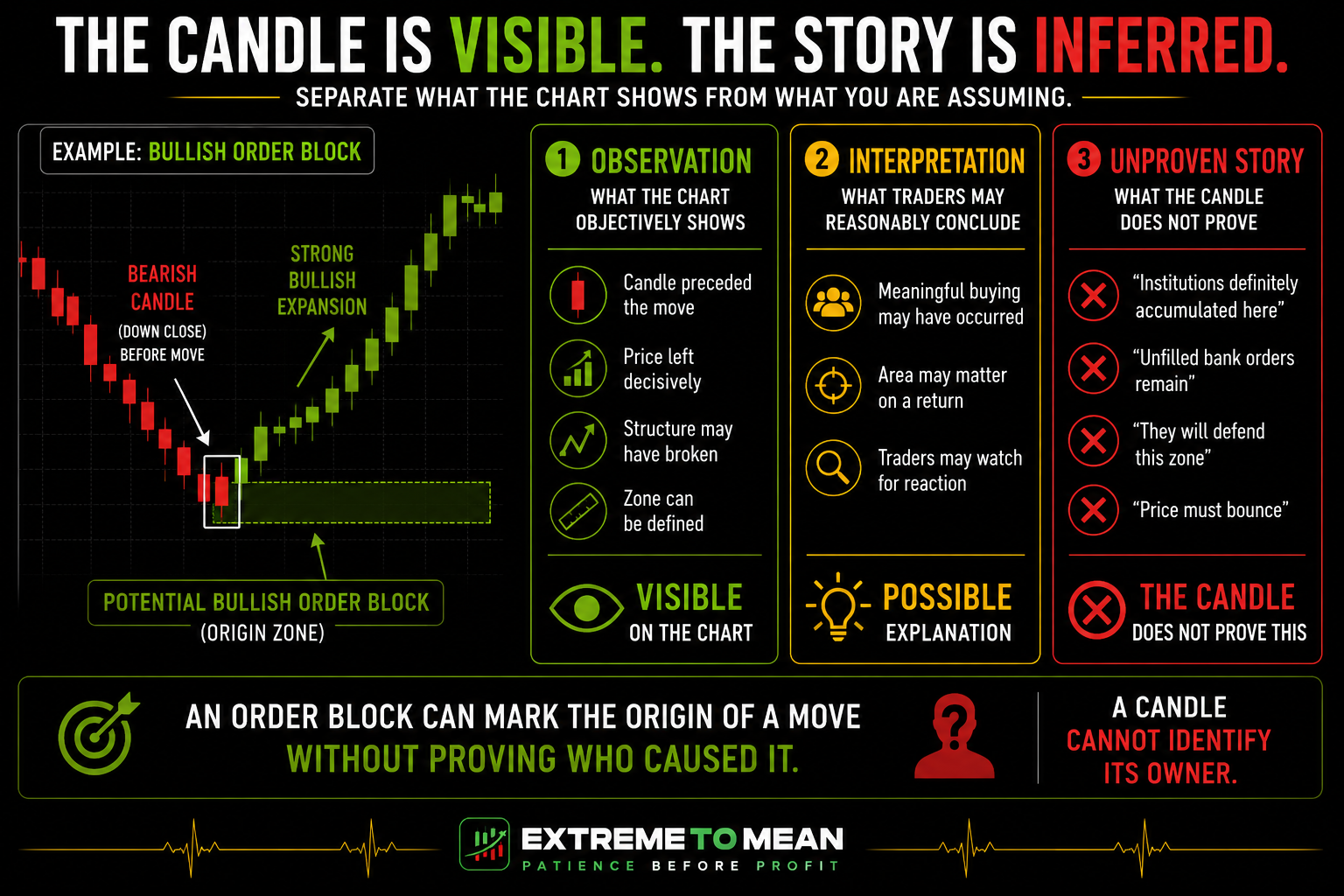
Imagine ES has been moving lower and prints one final bearish candle before reversing sharply, expanding upward, and breaking a meaningful prior swing. Under a common order-block convention, traders may mark that bearish candle or a predefined portion of its range as a bullish order block. What can be observed is straightforward: the zone preceded a meaningful upward move.
The bearish version is the mirror image. NQ may print an up-close candle, then sell off with strong directional movement and break meaningful structure beneath it; traders may classify the preceding up-close candle as a bearish order block. Again, the chart tells you where the move originated, not the identity of the traders who created it.
This makes an order block different from a claim about causation. The zone can be a useful reference because an important move began there, and price may later return to test that area. An order block can mark the origin of a move without proving the identity or intention of whoever traded there.
Every Opposing Candle Is Not an Order Block
Once a beginner learns the simplified definition, almost every chart seems full of order blocks. There are countless bearish candles before small rallies and bullish candles before small declines, especially on lower timeframes. If every opposing candle gets boxed, the label stops filtering anything.
That is why most serious order-block frameworks add some type of qualification, even though they disagree about the exact requirements. Traders may look for meaningful displacement, a structural break, important location, clear movement away from the zone, or some combination of those conditions. The key is not choosing one universal formula; it is defining the qualification before the retest.
The hindsight problem begins when the trader decides which candles mattered only after seeing the move that followed. A dramatic rally makes the prior bearish candle look important in retrospect, while hundreds of similar candles that led nowhere are forgotten. The move that makes the candle look important occurs after the candle, so hindsight identification should never be confused with forward predictive power.
The Candle Is Visible. The Institutional Story Is Inferred
A common explanation says an order block shows where institutions accumulated or distributed large positions. Institutional participation is certainly plausible in a liquid futures market, but a historical candlestick does not identify the participant, purpose, or order type behind the trading. The candle is visible; the institutional story is inferred.
CME Group’s Market by Order feed provides far more granular information than a candlestick, including individual anonymous orders, order size, full depth, and queue information. Even that exchange-level feed does not identify the customer or firm behind each order, which is a useful boundary for what traders should claim from much less detailed chart data. A candle cannot identify its owner. (cmegroup.com)
The same caution applies to claims that “unfilled institutional orders” remain inside the block. Orders can be filled, canceled, modified, refreshed, or replaced, while later participants may have completely different objectives from the traders who were active during the original move. A price area can matter without knowing the identity of the participants who make it matter.
Hindsight and Definition Matter
Order-block discussions often use the word displacement for the strong movement away from the zone. In plain English, that usually means decisive directional travel, expanding candle ranges, relatively limited immediate overlap, or another form of clear movement away. “Strong move” still needs an operational definition if the trader intends to test it rather than recognize it after the fact.
Some methodologies also require a Break of Structure before the preceding candle qualifies as an order block. A structural break can make the origin zone more interesting because price accomplished something meaningful after leaving it, but BOS still describes what price broke rather than who caused the move. The structural evidence is therefore supporting information, not proof of institutional activity.
Other approaches prefer an order block that also sits beside a Fair Value Gap. Those two observations can occur during the same directional expansion, but they are not the same pattern and neither logically proves the other. Confluence adds observations; it does not automatically validate the story used to explain them.
Zone width creates another definition problem. One trader may use the full candle high-to-low, another the body, and another a smaller open-to-low or open-to-high range, so the same historical candle can produce several different rectangles. A zone that changes size after the reaction is not a rule; it is hindsight.
| Concept | What It Describes | What It Does Not Prove |
|---|---|---|
| Order block | Origin candle or zone preceding directional movement | Institutional identity or future defense |
| Support / resistance | Prior area of market response | Why participants responded there |
| FVG | Three-candle non-overlap relationship | Who caused the move or that price must return |
| Liquidity sweep | Trade beyond a key high/low followed by rejection or failure | That an order block must exist |
| BOS / CHOCH | Price behavior relative to prior structure | Participant identity or guaranteed continuation |
Order Blocks Are Areas of Interest, Not Automatic Entries
The psychological attraction of order blocks is easy to understand. A trader sees a large move, draws a precise rectangle around its origin, and the chart suddenly feels explained: “That is where smart money entered.” The rectangle can be useful without requiring that stronger story.
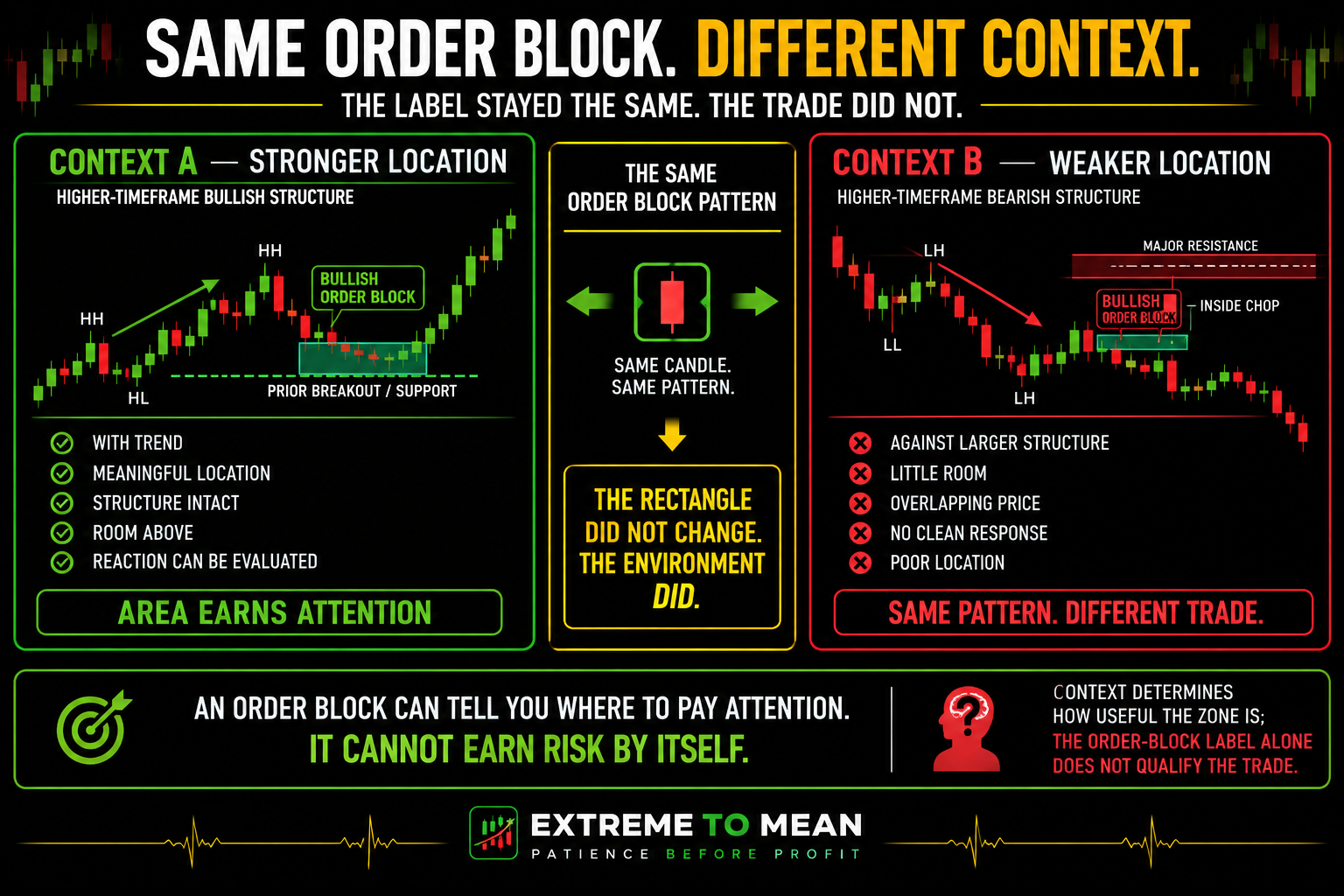
A previous origin zone may overlap with support or resistance, a breakout area, prior consolidation, an important swing, or another level that many participants can observe. That gives price multiple possible reasons to react there if it returns. The new label does not exempt the level from the same questions every level must answer: context, reaction, invalidation, and risk.
This is where market conditions change the quality of a setup. The same bullish order-block pattern can appear during an established higher-timeframe uptrend near a meaningful pullback, or in the middle of bearish chop directly beneath resistance with little room to move. The label stayed the same; the trade did not.
What Happens on the Retest Matters
Within order-block terminology, mitigation usually describes price returning to the previously identified zone. That word can describe the revisit without proving that a specific institution returned to fill old orders. The observable event is simply that price came back to the area.
The response can then take several forms: immediate rejection, deep penetration followed by recovery, repeated chop through the zone, or complete failure through it. All of those outcomes begin with the same statement that price returned to the order block. The retest gets your attention; the response gives you information.
The first touch also should not be treated as automatically superior. Traders often argue that a “fresh” or “unmitigated” block should be stronger, but that remains a testable hypothesis until the zone, touch, timeframe, instrument, market regime, and outcome are defined. Freshness is a hypothesis until the rules and data make it measurable.
Failure deserves the same discipline. If a zone met the trader’s predefined order-block rules and price later trades through it, the honest conclusion is that the expected reaction failed rather than that the block was never real. A failed reaction does not erase the pattern; it challenges the prediction attached to the pattern.
Order Flow Can Help Ask Better Questions
When price revisits an order-block zone, current Order Flow Trading information can help the trader evaluate what is happening now. The useful questions are whether aggressive buyers or sellers are producing price progress, whether activity is being absorbed or accepted, and whether the response strengthens or weakens the original thesis. That is more defensible than claiming order flow proves the same institution has returned.
Volume deserves the same restraint. High volume tells you that substantial activity occurred, but it does not identify whether one institution accumulated, another distributed, hedgers adjusted exposure, or short-term traders simply became more active. Activity is observable; participant motive requires more evidence.
This distinction keeps the analysis focused on the present. Order flow can help study the current interaction at the zone, while the original candlestick can only tell you what price did historically around that area. The trader’s job is to evaluate what the market is proving now rather than reconstruct an invisible story with certainty.
A Practical Order-Block Framework
Use Move → Origin → Context → Return → Response → Risk. The sequence keeps the order block in its proper place between identifying where a meaningful move began and deciding whether the returning market has created an actual trade. Mark the zone, then make the market earn the trade.
- Move: Was there actually meaningful directional movement?
- Origin: What predefined candle or zone qualifies as the order block?
- Context: Where does it sit within trend, structure, location, and current conditions?
- Return: Does price actually revisit the zone?
- Response: What does the market prove when it gets there?
- Risk: Has the area contributed to a qualified trade with clear invalidation, or is it still merely a rectangle?
The better question is not “Is this a valid order block?” Ask, “What is actually visible here, what part of my conclusion is interpretation, and what does price prove when it returns?” That question helps prevent a precise rectangle from creating a false sense of precise probability.
Testing also requires the definitions to be fixed before the outcome. A usable study needs to define displacement, whether BOS or FVG is required, which part of the candle forms the zone, what counts as a retest, what invalidates the block, and how failed or never-revisited examples are treated. The easiest order block to find is the one you discover after you already know the outcome.
Final Thought
Order blocks can be useful because they give traders a structured way to mark the origin of meaningful directional movement. A bullish or bearish block can become an area worth watching when price returns, especially when structure, location, and market conditions make the area relevant. None of that requires pretending the candle proves who created the move.
The danger begins when a useful area of interest becomes a certainty about invisible participants. The market does not become more predictable because the candle received a more sophisticated name, and stacking an order block with BOS, an FVG, or a liquidity sweep does not turn interpretation into fact. The farther you move from the candle toward the story, the more evidence you need.
Use the order block as a location, not a command. Define it consistently, understand the context, wait for the return, observe the response, and require a qualified setup with clear risk before acting. A useful level does not need an impressive story to be useful, which is part of the broader process developed throughout Decode the Market.
Educational content only. Trading involves substantial risk and is not suitable for everyone.