
You go long. Your stop sits just below the prior low. Price dips through it, your stop executes, and seconds later the market rallies without you.
The emotional conclusion is immediate: “They knew exactly where my stop was.”
Your stop may be hidden. Its likely neighborhood often is not.
The experience of being stopped just before a reversal is real. The leap from MY STOP WAS HIT to MY PERSONAL STOP WAS TARGETED is where the evidence usually disappears.
There are really three separate questions. Could a broker, platform or exchange know that an order exists? Potentially, depending on how the order is implemented. Is an untriggered native futures stop simply displayed to everyone in the public CME order book? No. Can sophisticated traders estimate where many stops are likely to cluster without seeing the individual stops? Absolutely.
That makes this a market-mechanics question before it becomes a manipulation question. The useful question inside the broader ETM lessons is not “Who came after me?” It is: What was visible, what was inferable, what orders became active, and what did price do afterward?
Can Anyone Actually See Your Stop Loss?
The clean answer is more nuanced than most trading-room explanations. Your broker, platform or exchange may have operational knowledge of an order depending on where the instruction is being held and how it is routed. That is different from saying the stop is publicly displayed to other traders.
CME's current futures-order education states that an accepted stop order does not immediately go on the book. It waits for its trigger condition; once activated, its behavior depends on the specific stop type.
That gives us the first critical distinction:
“Not publicly displayed” and “known by absolutely nobody” are not the same statement.
Depending on the broker, platform and order architecture, the stop instruction may be held outside the exchange until triggering or may exist as an exchange-supported conditional order. The implementation can vary. Order handling and public order visibility are two different questions.
What the Public Order Book Shows—and What It Doesn't
CME distributes market-depth information through feeds such as Market by Price and Market by Order. Market by Order can show individual resting orders, their anonymous OrderIDs and information useful for determining queue priority. CME explicitly says the data contains no customer-identifiable information, and individual orders are anonymous; firm IDs are not displayed.
That means order-level transparency is not account-level identity. Seeing a 50-contract bid does not tell a public participant who owns it, and seeing individual resting orders through MBO does not mean every conditional stop waiting to activate is exposed in the same way.
The simplest distinction is:
RESTING LIQUIDITY ≠ CONDITIONAL LIQUIDITY.
A public order book can reveal what is currently resting and displayed. It does not provide a public inventory of every untriggered protective stop that may become executable later.

A Stop Order Is Not the Same as a Resting Limit Order
A limit order can sit at its specified price and contribute displayed liquidity to the book. A stop waits for a trigger condition.
CME defines a stop as an order that does not immediately enter the book when accepted. A stop-limit order becomes a limit order when activated, while a stop with protection becomes eligible for execution according to its protection mechanics.
That gives us one of the cleanest mechanics lines in the article:
Before the trigger, the stop is a condition. After the trigger, it becomes executable order flow.
A trader who is long may use a sell stop below the market. A trader who is short may use a buy stop above the market. That basic geometry is one reason prior lows and highs can become obvious areas where protective orders may exist.
Why Stops Naturally Cluster Around Obvious Levels
Imagine 100 traders looking at yesterday's low. Many of them reach the same reasonable conclusion: “If that low breaks, my long thesis is probably wrong.”
Their exact stop prices may differ. Some may place them one tick below the low, some several ticks below, some farther away. But you do not need access to 100 private accounts to suspect that some protective sell stops may cluster in that general neighborhood.
The same logic works above a prior high. Short sellers may protect themselves with buy stops, while breakout traders may have buy orders that become active when the high breaks. If everyone can see the level, everyone can also imagine where risk may be placed around it.
This is not uniquely a retail problem. Professional traders use invalidation levels, risk limits, systematic breakouts and widely observed market structure too. Order clustering is a market-structure problem—not proof that one class of trader is uniquely naïve.
A Prior High or Low Is Not Just “A Pile of Stops”
Trading content often reduces an obvious level to the phrase “liquidity sits below the low.” That can be useful shorthand, but it becomes misleading when treated as though the trader can see a precise hidden inventory of stops.
Around a prior low, there may be protective sell stops, breakout sellers, passive buyers, profit-taking activity, algorithmic orders and hedge adjustments. Above a prior high, there may be short-covering stops, breakout buyers, passive sellers and profit-taking orders.
So a prior extreme is better understood as a place where multiple trading intentions may collide. Likely liquidity is an inference—not a visible inventory of every hidden order.
The market does not need a mystical motive to trade there. Aggressive orders interact with available resting liquidity; when a widely watched level is approached, trading interest can increase, displayed depth can change, and conditional orders can activate.
What Happens When a Stop Cluster Triggers?
Suppose protective sell stops are concentrated below a prior low. Price trades through the trigger area, those stops become executable sell orders, and breakout traders may also begin selling.
That can create a sudden burst of aggressive order flow. The first stops activate, price trades lower, more stops may activate, breakout participation increases, and the move accelerates. Stops can amplify movement after the level breaks even though they were not publicly displayed beforehand.
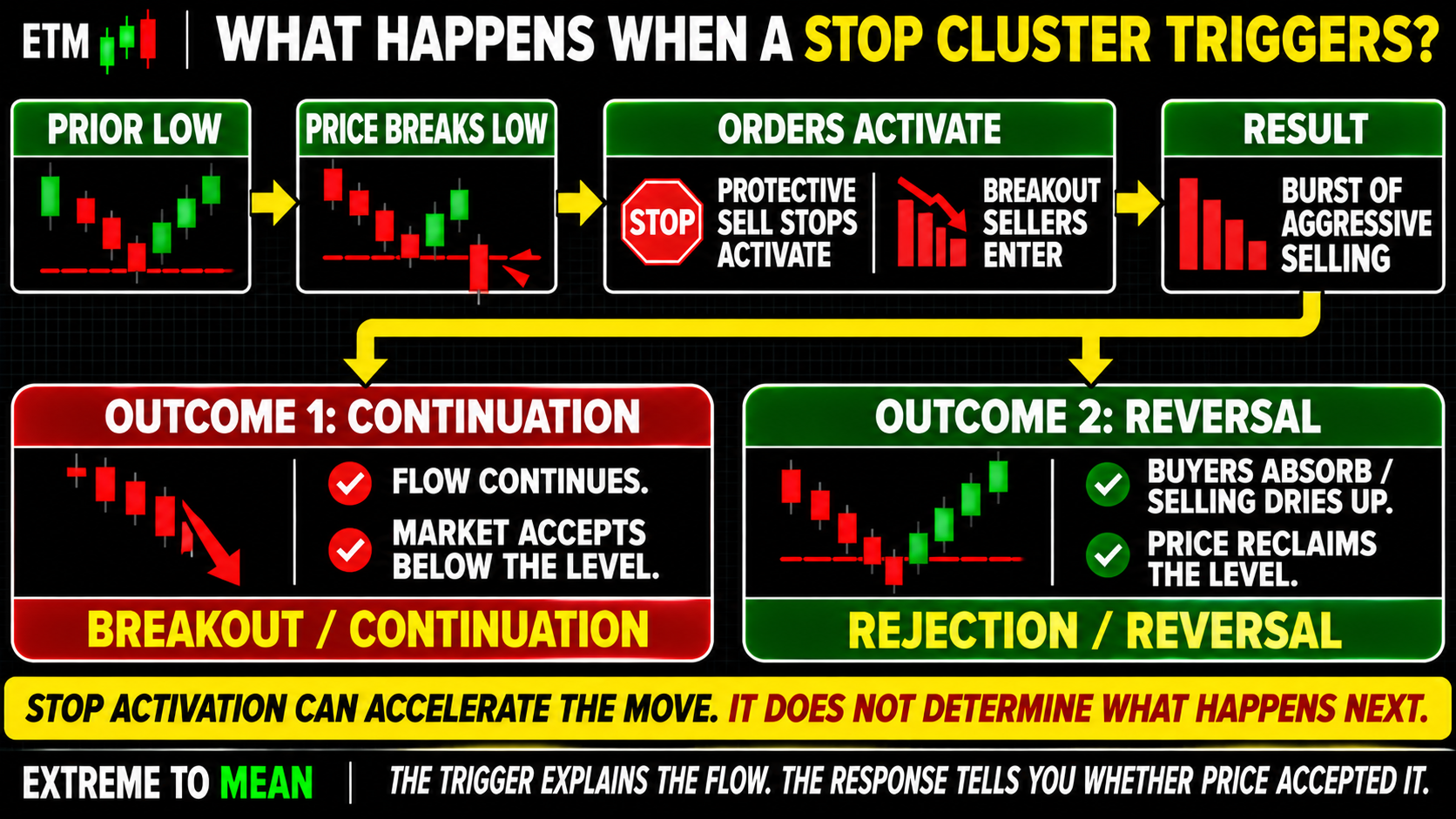
But the trigger explains the flow, not the eventual direction.
If the selling finds insufficient buying interest, price may continue lower and the breakout becomes accepted. If willing buyers absorb the selling—or the immediate sell flow simply dries up—price may stop falling and reclaim the level.
STOP ACTIVATION ≠ GUARANTEED REVERSAL.
Why Price Sometimes Reverses Right After Your Stop Executes
This is the part that feels personal. Your stop executes at almost the exact low, and then the market turns.
One possible explanation is completely mechanical. A burst of stop and breakout selling reaches willing passive buyers; aggressive selling is absorbed, new selling fails to continue, and the market rebounds. Another possibility is that the selling simply exhausts itself.
Those mechanisms are not identical, and a single wick does not prove which one occurred. The useful information may not be that stops fired; it may be how the market handled the orders after they fired.
Sometimes the level breaks and price continues another 50 or 100 points. That matters because the existence of stop orders below the low does not imply that executing those orders must produce a reversal. A sweep can reverse, continue or lead to consolidation.
Does That Mean Someone “Hunted” the Stop?
Not necessarily.
Suppose you entered ES long at 6005, the prior swing low was 5998, and your stop was 5997.75. Price trades 5997.50, triggers your stop, then rallies to 6020.
The emotional story is:
“They came for me.”
The mechanics-first explanation is simpler. The 5998 low was publicly visible. Many traders could reasonably use that level as invalidation. Stops and breakout orders may therefore have clustered around it. When the level broke, aggressive selling activated, buyers absorbed the flow, and price reclaimed.
The market only needed to find the level—not the trader.
That distinction is powerful because it moves the analysis from personal attribution back to observable market mechanics.
Sequence Is Observable. Intent Is Harder to Prove.
What can you prove from the chart?
Your stop was at 5997.75. Price traded below it. Your order executed. Price rallied afterward.
What cannot be established from that sequence alone is that another participant deliberately moved the market to 5997.50 for the specific purpose of triggering your individual stop.
Sequence is observable. Intent is harder to prove.
That is also why understanding how the stock market actually moves matters. Price is the result of interacting orders and available liquidity, not a scoreboard tracking individual traders who need to be punished.
Real Manipulation Exists—but a Wick Does Not Prove It
None of this means market manipulation is imaginary.
CME Rule 575 prohibits disruptive practices such as spoofing—entering orders with the intent to cancel them before execution in ways that can create misleading buying or selling pressure or artificial market conditions.
And this is not merely theoretical. In May 2026, the CFTC announced a settlement against a trader for spoofing in Treasury futures, finding repeated use of orders intended to be canceled before execution to influence related trading.
So the correct ETM position avoids both extremes:
“Manipulation never happens.” — false.
“Every wick through my stop was engineered against me.” — unsupported.
REAL MANIPULATION EXISTS ≠ YOUR STOP WAS TARGETED.
A wick is a price pattern. Manipulation is a conduct claim requiring evidence about behavior and intent.
Poor Stop Placement Can Feel Like Manipulation
A stop can be placed badly without anybody doing anything improper.
Suppose your stop is five points away, but the market routinely rotates 15 points inside ordinary noise. If that stop gets hit repeatedly, the explanation may simply be that the stop lives inside normal market movement. Market noise does not need to know your account number.
The same problem can begin with entry quality. If a trader enters too late, the structurally logical invalidation point may be uncomfortably far away. The trader then chooses a tight stop based on the amount they are willing to lose rather than where the trade thesis actually fails.
That is why the trade is not ready until the risk is clear. Risk tolerance should help determine position size; it should not force the chart to accept an arbitrary stop location.
But “just put the stop farther away” is not the answer either. A wider stop can simply lose more money. The better alignment is entry → invalidation → distance → size.
A Later Reversal Does Not Automatically Mean the Stop Was Wrong
This is where hindsight creates another trap.
If your thesis was that a particular low had to hold and the market broke sufficiently below it to invalidate the setup, exiting may have been completely reasonable. If price then reverses 15 minutes later, that later information does not retroactively prove the earlier stop was incorrect.
Before the break, price could also have continued another 100 points against you. You only know the eventual path because the market revealed it after your stop occurred.
The perfect stop becomes obvious only after the market shows you what happened next.
That is why protecting your next decision is more useful than relitigating every stopped trade through hindsight.
What to Study Instead of Blaming the Market
“They hunted my stop” tends to end the analysis exactly where the useful questions begin.
Ask:
What level broke?
What orders were likely to activate?
Did price accelerate after the break?
Did it accept below the level or immediately reclaim it?
Was aggressive flow absorbed?
Was the stop at structural invalidation or merely at a comfortable dollar amount?
Was the stop inside normal volatility?
Was the entry late enough that no reasonable stop location remained?
Those questions turn a painful result into information.
Explain what the market did before claiming to know why someone did it.
The Stop-Hunting Reality Checklist
When your stop gets hit and price reverses, ask:
- Was the order a conditional stop or a displayed resting order?
- Was the stop placed around an obvious high, low or round number?
- Was it based on genuine invalidation or merely my preferred dollar risk?
- Did the entry force the stop unnaturally close?
- Was the stop inside ordinary market movement?
- What happened when the level broke: acceleration, acceptance or rejection?
- Did price accept beyond the level or quickly reclaim it?
- Am I assigning intent to a price pattern?
- Do I have evidence of prohibited conduct—or only a painful outcome?
- Would I place the same stop there again if I did not know what happened afterward?
The last question is particularly useful because it removes hindsight. A stop should be judged by the information available before the outcome, not by whether price later happened to reverse.
The ETM Order → Level → Trigger → Flow → Response Framework
Use ORDER → LEVEL → TRIGGER → FLOW → RESPONSE.
ORDER: What type of stop is actually being used, and where does the instruction live before activation?
LEVEL: Why is the stop located there? Is it structural, arbitrary or simply obvious?
TRIGGER: What market event activates the order?
FLOW: What new executable orders appear when the trigger occurs?
RESPONSE: Does price accept the new area, reject it, or continue?
Then apply the governing rule:
MECHANICS FIRST → STORY SECOND.
The ETM free tools can help organize post-trade review, but the purpose is not to prove that “stop hunting” never happens. It is to stop converting every painful result into a causal story that the available evidence cannot support.
Final Thought
When a futures stop gets hit and price immediately reverses, the experience can feel personal. The mechanics usually are not.
CME's order rules distinguish untriggered stop instructions from orders resting in the public book, while public market data can reveal displayed liquidity without identifying individual customers. Traders can still infer likely stop areas because everyone can see the same prior highs, lows, round numbers and breakout levels.
When price reaches those areas, stops may activate, breakout orders may join, and the resulting burst of order flow can accelerate the move. Sometimes the market accepts the new price and continues. Sometimes the flow is absorbed or exhausts itself and price reverses.
Real manipulation and spoofing exist and are regulated. But a wick through your stop is not proof that somebody targeted you.
Your stop may be hidden. Its neighborhood often isn't. The market only needed to find the level—not the trader.
Educational content only. Trading involves substantial risk and is not suitable for everyone.