
Money is easy to take for granted because modern payments hide much of the machinery underneath them. A card tap, bank transfer, or dollar bill can complete a transaction without the buyer thinking about why anyone accepts the monetary unit in the first place. Earlier societies faced the same underlying problem with very different tools, including commodities, metallic coins, and paper claims redeemable for precious metal. Understanding those differences gives traders a better foundation for studying The Market and the monetary forces surrounding it. (federalreserveeducation.org)
The common mistake is to reduce the history to a morality play. Commodity money is sometimes described as automatically sound because supply is physically constrained, while fiat money is described as worthless because it is not redeemable for gold. The opposite simplification is equally weak: newer monetary technology is not automatically superior simply because it is easier to use or more flexible. A useful comparison asks what each system does well, what constrains it, and what new dependency appears when one constraint is removed.
Before Comparing Systems, Ask What Money Must Do
Economists commonly describe money through three basic functions: medium of exchange, unit of account, and store of value. A useful monetary form also benefits from characteristics such as durability, portability, divisibility, uniformity, limited supply, and broad acceptability. Different monetary systems satisfy those requirements in different ways. The trade-offs begin because maximizing one characteristic can make another harder to achieve. (federalreserveeducation.org)
Gold illustrates the tension well. It is durable, naturally scarce, divisible, widely recognized, and difficult to produce quickly, which helped precious metals become important monetary commodities across history. Yet substantial quantities of metal are expensive to transport, protect, verify, and settle, particularly as commerce expands across greater distances and transaction volumes. A material can therefore be strong as a monetary anchor while becoming cumbersome as the physical object used for every payment. (imf.org)
Commodity Money: Value Resides in the Commodity
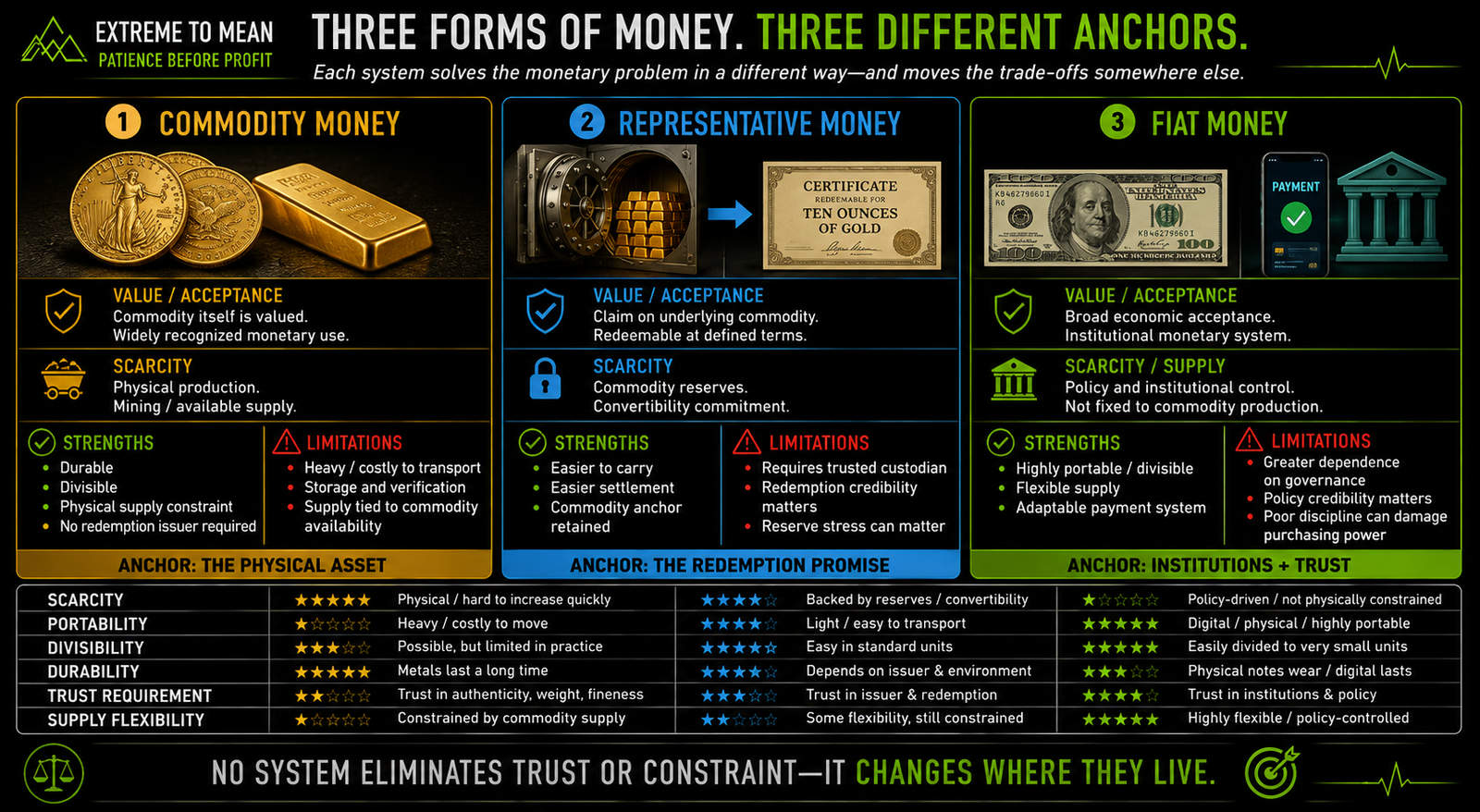
Commodity money is made from something that has value as a commodity apart from its monetary role. Gold and silver coins are familiar examples, although societies have used many other goods as money when those goods were sufficiently accepted. The monetary unit therefore has a physical scarcity mechanism: producing more money requires obtaining or producing more of the underlying commodity. That constraint can limit arbitrary expansion, but it also links monetary supply to the availability and production of the commodity itself. (federalreserveeducation.org)
Physical scarcity is one of commodity money's most attractive characteristics, but scarcity does not mean the supply is permanently fixed. Gold discoveries and changes in mining output historically altered the monetary stock, while bimetallic systems could also be affected by changing relative supplies and prices of gold and silver. IMF research on nineteenth-century monetary systems shows that shifts in bullion supply played meaningful roles in monetary conditions and transitions between standards. Commodity-based money constrains supply through the physical world rather than making monetary supply completely unchanging. (imf.org)
Representative Money: Keep the Asset, Move the Claim
Representative money separates the monetary claim from the physical commodity. Instead of carrying gold to complete each transaction, a holder can use a note or certificate that is redeemable for a specified amount of the underlying asset. Federal Reserve educational material describes representative money precisely this way: the commodity can remain in a vault while a more convenient certificate circulates in its place. This preserves a commodity anchor while improving portability and everyday usability. (federalreserveeducation.org)
The Bank of England describes a similar historical development in Britain, where goldsmiths stored coins and issued receipts that could be converted back into gold. Those receipts became increasingly useful as payments because moving the claim was easier than repeatedly transporting the metal itself. The system solved a genuine transactional problem, but it also introduced an additional layer of trust: the holder needed confidence that the issuer would honor redemption. The monetary system was no longer only about the commodity; it was also about the credibility of the institution holding it. (bankofengland.co.uk)
Convertibility Created Discipline—and Constraints
Under a gold standard or similar representative arrangement, the currency issuer promises conversion at a defined rate. In the United States, for example, the twentieth-century gold-standard framework required the Federal Reserve to maintain gold reserves against currency and convert dollars at the legally established gold price. That commitment helped anchor the monetary unit to something outside discretionary currency creation. It also meant that protecting convertibility could influence how much room monetary authorities had to respond to other economic pressures. (federalreservehistory.org)
The constraint becomes especially important during stress. Historical episodes show that concerns about gold reserves and convertibility could produce pressure to exchange notes for gold, while gold outflows could force monetary contraction or defensive interest-rate action. During the early 1930s, international and domestic strains around the gold standard interacted with severe banking and economic stress in the United States and elsewhere. A hard anchor can therefore provide discipline while also limiting flexibility when maintaining the anchor conflicts with other economic objectives. (federalreservehistory.org)
Fiat Money Removes Commodity Convertibility
Fiat money is not redeemable for a fixed quantity of gold, silver, or another commodity. Its usefulness comes from broad acceptance within an economic and institutional system rather than from the material value of the note or a contractual claim on metal held elsewhere. Modern money also extends well beyond physical notes and coins because bank deposits and electronic payments perform much of the economy's monetary work. The monetary unit survives because people expect other people and institutions to continue accepting it. (stlouisfed.org)
That does not mean fiat money is literally supported by nothing. Its functioning depends on a network of institutions, laws, payment systems, banking relationships, monetary policy, government obligations, and public confidence in the currency's continuing usefulness. The Bank of England emphasizes trust as central to modern money, while Federal Reserve education similarly emphasizes general acceptance and confidence. Fiat replaces a physical redemption promise with an institutional monetary framework. (federalreserveeducation.org)
Why Move Away From a Commodity Anchor?
One major advantage of fiat systems is greater flexibility of monetary supply. The Bank of England notes that fiat money can respond to changing economic conditions, whereas gold-standard money was ultimately constrained by the available gold stock. Removing commodity convertibility gives central banks more freedom to supply liquidity, influence financial conditions, and respond to disruptions without first satisfying a redemption commitment to a fixed quantity of metal. The trade-off is that monetary restraint must come from institutions and policy rather than from physical scarcity alone. (bankofengland.co.uk)
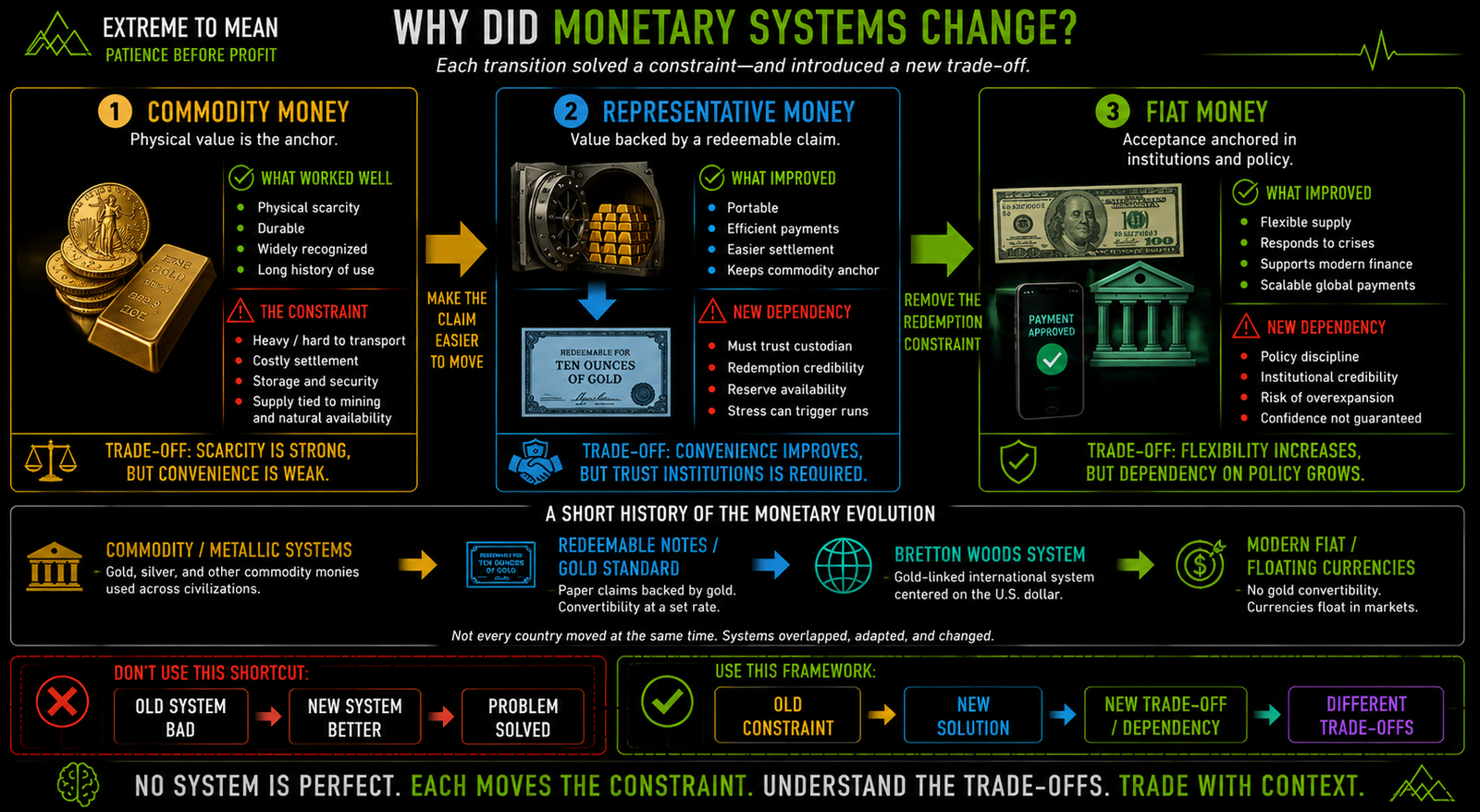
History did not move through one clean global sequence on one date. Commodity coins, redeemable notes, bank deposits, gold standards, gold-exchange standards, and fiat arrangements overlapped across countries and periods. The classical gold standard weakened around World War I, attempts at restoration struggled during the interwar years, and the postwar Bretton Woods system created another form of gold-linked international order centered on the dollar. The modern floating fiat framework emerged after the dollar's official convertibility to gold ended in 1971 and major currencies increasingly floated. (imf.org)
Every Transition Solved a Problem and Created a Dependency
The transition from commodity money to representative claims improved portability and settlement efficiency without initially abandoning scarcity anchored in the underlying commodity. The new dependency was redemption credibility: the paper claim mattered because holders trusted that it could be converted as promised. A failure of that trust could create stress even if the paper itself remained easy to transport. Greater convenience therefore came with greater institutional dependence.
The move toward fiat removed the requirement that monetary expansion remain tied to the stock of a particular commodity. That makes monetary systems more adaptable to changes in economic activity, financial crises, payment demand, and credit conditions. The vulnerability is equally important: supply discipline and monetary stability depend more heavily on policy frameworks, institutional credibility, and governance. Flexibility can be useful without being costless.
Commodity money has a different vulnerability. Its supply restraint can protect against discretionary monetary expansion, but the economy can also become exposed to commodity discoveries, shortages, international flows, hoarding, and the need to adjust prices or activity when money cannot expand with demand. IMF research on gold-standard history documents both long-run stability arguments and the adjustment pressures created by commodity anchors. No monetary design removes trade-offs; it relocates them. (elibrary.imf.org)
Scarcity and Trust Are Not Opposites
Commodity and fiat systems are sometimes framed as scarcity versus trust, but both contain elements of each. Commodity money depends on people trusting the authenticity, weight, fineness, custody, and acceptance of the commodity, while representative money adds trust in redemption. Fiat money depends much more heavily on institutional supply discipline, but its usefulness also creates a form of network-based scarcity because monetary units remain valuable only while their supply and acceptance remain credible. The balance between physical constraint and institutional constraint is what changes.
That distinction matters when traders encounter claims that one form of money is automatically immune to monetary failure. Commodity systems can experience banking crises, deflationary pressure, altered coinage, redemption stress, and policy changes, while fiat systems can experience inflation, currency depreciation, financial instability, and loss of confidence. The mechanism of failure differs because the monetary architecture differs. Understanding the architecture is more useful than starting with the conclusion.
Why This Matters for Market Analysis
Monetary systems influence how traders interpret inflation, interest rates, liquidity, exchange rates, government policy, gold, and alternative monetary assets. Yet the existence of a fiat system does not tell a trader what equities must do today, just as a gold-linked system would not mechanically determine every market outcome. This is another application of the market comes first: the monetary framework shapes the environment, while current pricing still reflects expectations, positioning, liquidity, policy, and new information.
The same discipline matters when monetary debates become ideological. A trader can understand the scarcity advantages of commodity money and the flexibility advantages of fiat money without assuming either characteristic settles every economic question. Context comes before the candle, and context also comes before the monetary slogan. The cleaner task is to identify which system feature matters to the current question and what the market is actually doing with that information.
Better Questions When Comparing Monetary Systems
A useful comparison begins by asking what problem each form of money is trying to solve. Then evaluate how it handles scarcity, portability, divisibility, durability, acceptance, supply flexibility, and trust. The goal is not to declare a universal winner because different monetary designs prioritize different constraints. A clearer comparison identifies where the discipline comes from and what happens when that discipline fails.
- What gives this form of money broad acceptance?
- Where does its scarcity or supply constraint come from?
- Can it be transported and divided efficiently?
- Is it redeemable for something else, or is the monetary unit final?
- What institution or mechanism must users trust?
- How easily can supply respond to changing economic conditions?
- What vulnerability was reduced compared with the previous system?
- What new vulnerability appeared in exchange?
- Am I comparing the systems by the same criteria, or changing the standard to support a preferred conclusion?
These questions make monetary history more useful for present-day analysis. Rather than reducing the transition to “gold was abandoned” or “fiat replaced outdated money,” the trader can identify the specific economic and institutional trade-offs involved. That produces a cleaner foundation for later discussions about inflation, monetary expansion, currency depreciation, government debt, gold, and Bitcoin. Better monetary context improves the quality of the analysis without predetermining the investment or trading conclusion.
Final Thought
Commodity money, representative money, and fiat money are different solutions to the same problem: creating something that people can reliably use to exchange value, measure value, and carry purchasing power through time. Commodity money anchors scarcity in a physical asset; representative money makes that asset easier to use by circulating claims against it; fiat money removes the redemption requirement and places more responsibility on institutions and monetary policy. Each transition improved certain characteristics while changing where the system's constraint and vulnerability lived.
The useful question is therefore not simply, “Which money is best?” Ask what the system is trying to accomplish, what limits its supply, what makes people accept it, and which trade-offs come with that design. For a deeper examination of how those trade-offs evolved and why they matter in the modern monetary system, The Monetary Revolution is the natural next step. Monetary systems change because societies keep trying to solve one set of problems without escaping the reality that every solution introduces another set of choices.
Within a fiat system, bank lending and deposit creation explain an important part of how money expands in practice.
Educational content only. Trading involves substantial risk and is not suitable for everyone.