
Two explanations of banking often appear to conflict. One says banks create deposits when they lend; the other says banks still need deposits, reserves, funding, and capital. Both are true because creating a deposit is one accounting event, while safely managing the expanded balance sheet is a broader funding and risk problem.
First, What Counts as Money?
Modern money has several layers. Households and businesses commonly spend commercial-bank deposits, while physical currency and central-bank reserves are forms of central-bank money used by different participants. A checking-account balance functions as money because it can be transferred to settle purchases and obligations without existing as banknotes in a vault.
| Type of Money | Created By | Mainly Used By |
|---|---|---|
| Physical currency | Central bank / official monetary system | Public |
| Commercial-bank deposits | Commercial banks | Households and businesses |
| Central-bank reserves | Central bank | Banks / eligible financial institutions |
Commercial banks can create deposit money, but they cannot independently create central-bank reserves. Those are different liabilities issued by different institutions. Keeping that distinction clear prevents “money,” “deposits,” and “reserves” from being treated as interchangeable terms.
What Actually Happens When a Bank Makes a Loan
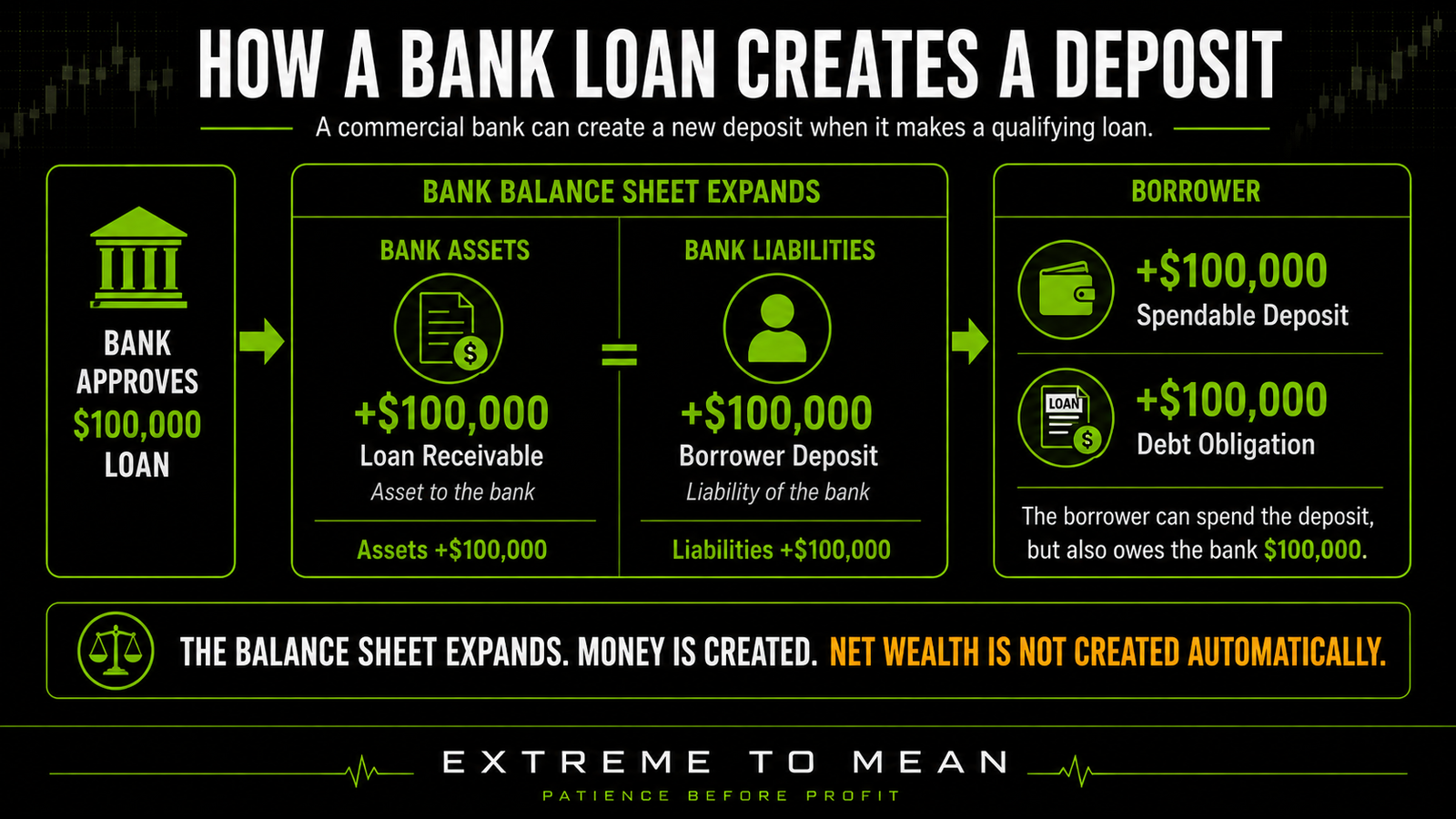
Suppose a bank approves a $100,000 business loan. The bank records a new $100,000 loan receivable as an asset and simultaneously credits the borrower with a new $100,000 deposit, which is a liability of the bank. The Bank of England, Bundesbank, ECB, and Federal Reserve all describe this basic loan-creates-deposit mechanism. (bankofengland.co.uk)
| Bank Balance Sheet | Before Loan | Change When Loan Is Made |
|---|---|---|
| Assets | ||
| Loan to borrower | $0 | +$100,000 |
| Liabilities | ||
| Borrower deposit | $0 | +$100,000 |
The balance sheet has expanded equally on both sides. The borrower now has $100,000 of spendable deposit money while owing $100,000 under the loan contract. The borrower gained a financial asset and matching debt rather than $100,000 of net wealth.
Why “The Bank Lends Someone Else’s Deposit” Is Incomplete
Banks use deposits as important funding, but an individual loan does not normally require locating a particular saver’s $100,000 and transferring that exact deposit. The loan asset and deposit liability can arise together when credit is booked. The Bank of England and Bundesbank therefore reject the idea that banks function only as intermediaries passing along pre-existing deposits. (bundesbank.de)
That does not make deposits unimportant. Deposits can provide relatively stable and cost-effective funding, and banks must manage the cost and composition of the liabilities supporting their assets. “Loans create deposits” and “banks need funding” describe different parts of the same process.
What Happens When the Borrower Spends the Money?
Suppose the borrower at Bank A pays a seller who banks at Bank B. The borrower’s deposit at Bank A falls, the seller receives a deposit at Bank B, and the banks must settle the payment between themselves. Central-bank reserves serve as a key settlement asset inside the banking system, so Bank A must be able to meet the liquidity consequences of money leaving its institution. (federalreserveeducation.org)
This is where the difference between deposit creation and settlement becomes practical. Bank A may create the deposit when it originates the loan, but it cannot simply ignore what happens once that deposit moves elsewhere. Funding and liquidity management become part of maintaining the expanded balance sheet.
Deposits, Reserves, Capital, and Liquidity Are Different
A commercial-bank deposit is a bank liability, while a reserve balance is central-bank money held by an eligible financial institution. The Federal Reserve distinguishes liquidity—resources available for near-term obligations—from capital, the cushion available to absorb losses. Banks therefore must manage both payment capacity and loss absorption. (federalreserve.gov)
This also explains why a bank does not need an equal amount of new reserves before every new loan, yet reserves still matter. The Bundesbank notes that excess reserves are not a necessary precondition for granting credit, but payments and withdrawals can create later settlement needs. The cleaner question is not “Did reserves come first?” but “What resources does the bank need to manage after the loan is created?”
What Actually Limits Bank Money Creation?
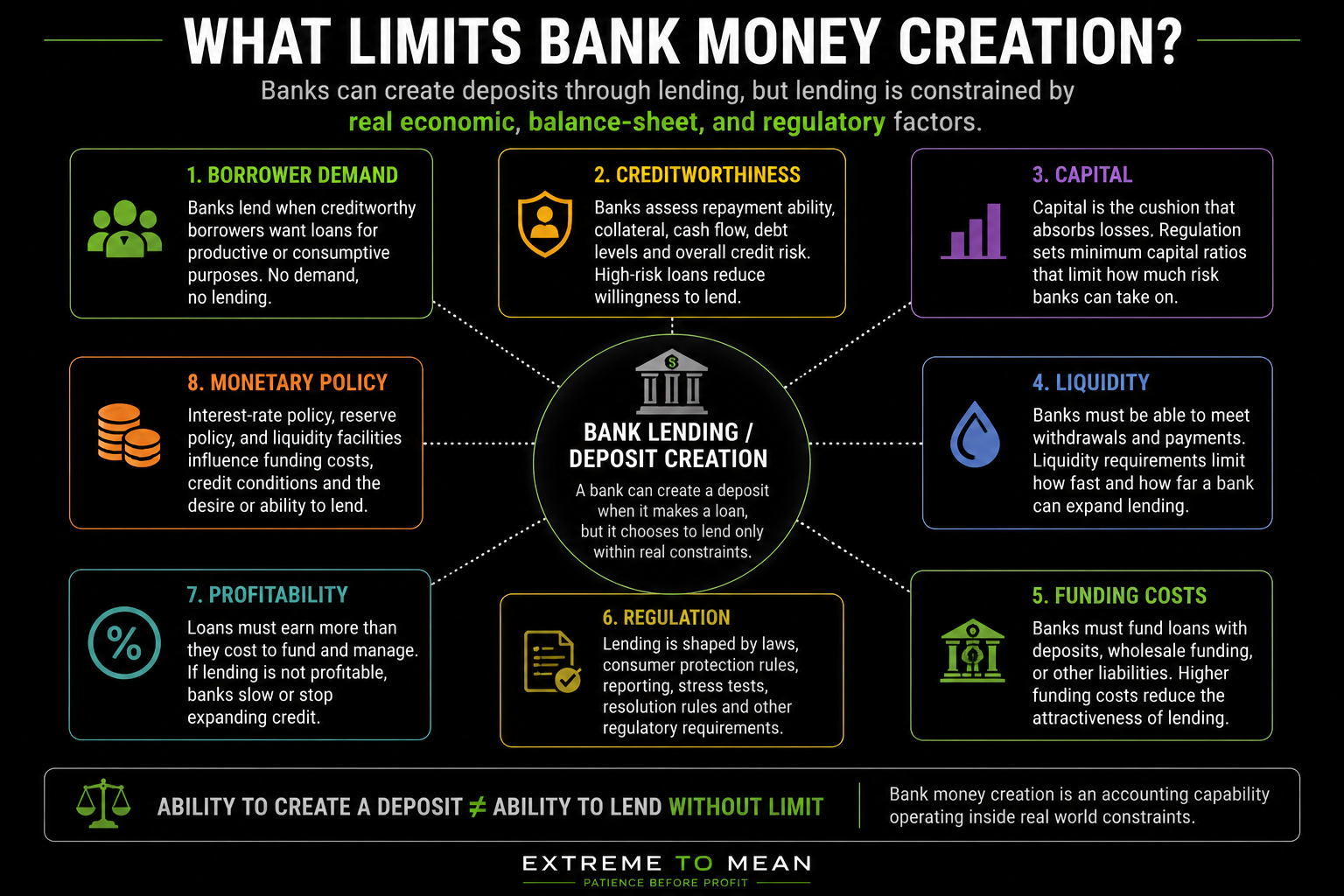
Creating deposits does not give banks unlimited lending power. Lending is constrained by borrower demand, creditworthiness, capital, liquidity, funding costs, profitability, regulation, and monetary-policy conditions. A loan that is too risky, costly, or inconsistent with balance-sheet requirements may not be worth making.
Interest rates influence several constraints at once, including loan demand, funding costs, expected loan performance, and the economics of expanding credit. Bank money creation therefore occurs inside a system of prices, risks, regulation, and balance-sheet constraints. The accounting ability to create a deposit does not remove those limits.
What Happens When the Loan Is Repaid?
Principal repayment reverses part of the original money-creation process. As principal is repaid, the outstanding loan asset declines and the deposit money used for that repayment is extinguished from the corresponding balance-sheet relationship. The ECB explicitly explains that when a loan is repaid, the commercial-bank money previously created through that loan disappears. (ecb.europa.eu)
Interest should be treated separately. Interest becomes bank income and interacts with expenses, wages, dividends, taxes, retained earnings, and other transactions rather than simply following the same path as principal. For a beginner, the important point is that principal repayment reverses the core loan-and-deposit creation mechanism.
Banks Create Money, Not Wealth
A new bank loan creates a new deposit, a new debt obligation for the borrower, and a new financial claim for the bank. It does not automatically create additional houses, machinery, skills, productive capacity, or other real resources. Creating money and creating wealth are therefore different economic ideas.
What the credit finances matters. Loans can support productive investment, housing, consumption, asset purchases, or speculative activity, and those uses can have very different economic consequences. Understanding the accounting mechanism does not tell you whether the resulting credit expansion is productive, excessive, inflationary, stabilizing, or destabilizing.
Does the Central Bank Create Money Too?
Yes, but through a different layer of the system. Central banks create central-bank liabilities such as reserve balances and issue physical currency, while commercial banks create deposit money through lending and certain asset purchases. The ECB explicitly distinguishes commercial-bank money from central-bank money rather than treating them as the same mechanism. (ecb.europa.eu)
That distinction is useful when traders hear that “the Fed printed money.” The phrase can hide several different monetary mechanisms. A better market-level monetary framework begins by identifying the institution, balance sheet, and type of money involved.
Where the Money Multiplier Fits—and Where It Misleads
The traditional money-multiplier model can be useful as a simplified classroom relationship among reserves, deposits, and banking-system expansion under certain assumptions. It becomes misleading when interpreted to mean that an individual modern bank must first receive a fixed quantity of reserves and then mechanically lend a predetermined fraction of them. The Bank of England specifically identifies that simple multiplier story as an inaccurate literal description of how money creation works in practice. (bankofengland.co.uk)
A cleaner operational sequence is Loan → Deposit → Payment → Settlement → Repayment. The loan creates the bank asset and customer deposit, the borrower uses the deposit, payment flows create settlement and funding needs, and principal repayment reverses the original creation. That sequence preserves the importance of reserves and funding without putting them into the wrong place in the story.
Why This Matters to Traders and Investors
Understanding bank money creation helps explain why credit conditions, interest rates, lending standards, liquidity, and bank stress matter to markets. Expanding and contracting credit can create different financial environments because financing affects households and businesses. The mechanism follows naturally after learning how commodity and fiat systems differ, because the next question is how deposit money enters the system.
The lesson also helps traders separate related monetary ideas. Deposit creation is not the same as inflation, which is why the distinction between inflation and currency debasement matters.
The same discipline applies to de-dollarization and the dollar’s reserve role: identify the mechanism before accepting the narrative.
A Practical Headline Filter
When someone says “money is being created,” convert the statement into a balance-sheet question. Identify who acted, what type of money appeared, what asset and liability changed, whether new credit was created, and what obligations follow. That keeps the analysis grounded in the mechanism rather than the slogan.
Ask:
- Who is creating it—a commercial bank, a central bank, or another part of the public financial system?
- What type of money is being created—commercial-bank deposits, central-bank reserves, or physical currency?
- What assets and liabilities changed?
- Was new credit or debt created at the same time?
- What funding, liquidity, capital, or settlement obligations accompany the transaction?
- What happens when the transaction reverses or the loan principal is repaid?
The better question is not simply, “Where did the bank get the money it lent?” Ask: What assets and liabilities were created when the loan was made, and what does the bank need to manage once that deposit is spent? A second useful question is: When someone says money was created, what type of money are they talking about?
Final Thought
Modern bank money creation becomes much easier to understand once the balance sheet replaces the slogan. A commercial bank can create a new deposit when it extends qualifying credit, but that deposit arrives with matching debt and expands a balance sheet that must still be funded, settled, capitalized, regulated, and managed for liquidity and credit risk. Banks are therefore neither passive pipes that merely pass along someone else’s deposit nor unlimited creators of costless money.
Creating deposit money is not the same as creating wealth, and a deposit is not the same as central-bank reserves. Those distinctions help explain credit conditions, bank stress, monetary policy, and the wider monetary architecture. Readers who want to go deeper can continue with The Monetary Revolution.
Educational content only. Trading involves substantial risk and is not suitable for everyone.