
Confidence matters in trading, but traders often confuse confidence with certainty. “I trust this setup” can quietly become “I know I am right,” and once being wrong starts to feel personal, the trade stops being only a market decision. Stops, size, new evidence, and even a small loss can begin feeling like judgments about the trader instead of information about one uncertain idea.
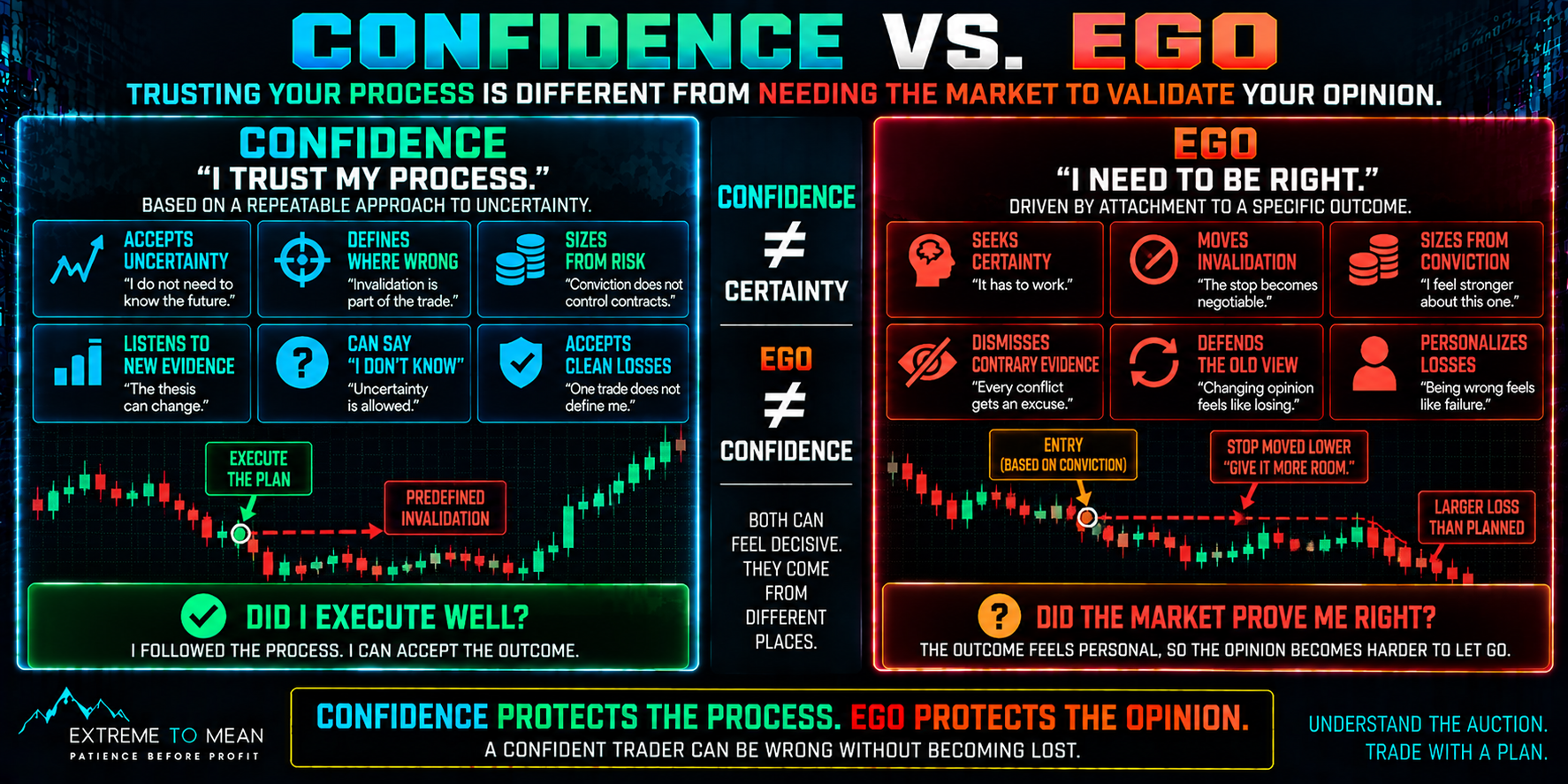
Confidence protects the process. Ego protects the opinion.
Healthy trading confidence sounds like this: “I trust my process enough to take this trade, define where it is wrong, and accept that outcome if it happens.” Ego sounds different: “I need this trade to work because being wrong feels like something about me.” Those two mindsets create very different relationships with uncertainty.
That distinction belongs inside the broader Trader curriculum because trading confidence should not require the market to validate you. Confidence allows a stop, a small loss, reduced size, changing conditions, uncertainty, and a revised view. A confident trader can be wrong without becoming lost.
Confidence Does Not Mean Knowing What Happens Next
A common version of trading confidence is, “I know this trade is going to work.” But that is not really confidence; it is a claim about an uncertain future. Even a strong setup can fail, and no amount of conviction changes that basic fact.
A more useful definition is: Confidence means I know what I will do whether the trade works or not. I know why I am entering, where the trade thesis becomes invalid, how much I am willing to risk, and what information would make me update. The confidence comes from being prepared to handle the outcome rather than pretending the outcome is already known.
That is why confidence does not remove uncertainty; it gives you a process for acting inside uncertainty. You can believe a setup is worth taking without believing the market owes you a win. You can also trust yourself while admitting, “I do not know what happens next.”
When a Trade Opinion Becomes a Personal Test
A normal thesis might be, “I think NQ may trade higher from this area.” Once ego becomes attached, the wording changes internally: “I said NQ was going higher, so now it needs to go higher.” The market idea has become connected to intelligence, competence, reputation, or identity.
That changes the meaning of new information. A failed level is no longer simply evidence against the thesis; it starts feeling like evidence against the trader. The moment the market has to validate you, information becomes harder to read honestly.
The trader may then stop asking, “What is the market showing now?” and begin asking, “How can I still be right?” That is a dangerous shift because analysis becomes defense. Protecting your next decision sometimes means allowing the current opinion to die without allowing your confidence in yourself to die with it.
Why Ego Changes Stops, Size, and Risk
For a process-confident trader, a stop is the point where the trade thesis no longer justifies the risk. It is not punishment, and it is not the market issuing a verdict about the trader's intelligence. It is simply the place where the original reason for holding the position has failed.
Ego can make the same stop feel completely different. STOP becomes “price proving me wrong,” so the trader begins negotiating: “Give it more room,” “That level does not really matter,” “It is probably just a liquidity sweep,” or “I will move it below the next low.” When being stopped out feels like being judged, the stop becomes surprisingly easy to move.
That is especially dangerous when invalidation was already part of the original trade plan. The trade is not ready until the risk is clear, and once that risk has been accepted, conviction should not rewrite it simply because the trade moves against you. Moving the boundary only because the loss is uncomfortable does not strengthen the thesis.
Ego can affect position size in a similar way. A trader says, “I am extremely confident in this one,” and begins treating that feeling as evidence that more contracts or more risk are justified. But confidence does not change tick value, stop distance, or account exposure; your strongest opinion should still have to pass the same risk calculation as your weakest one.
Confidence Can Say “I Don't Know”
Ego often wants an answer: bullish or bearish, long or short, right or wrong. Confidence can tolerate a less satisfying answer: “I do not have enough evidence yet.” It can also say, “My earlier read is no longer reliable,” or simply, “I was wrong.”
That is adaptability rather than weakness. A trader who cannot say “I don't know” will eventually invent certainty where none exists. Once certainty has been invented, every conflicting piece of evidence becomes something that needs to be explained away.
The same principle applies when an earlier view needs to change. Suppose the trader starts bullish, but support fails, momentum weakens, structure deteriorates, and the broader context changes. A disciplined response is, “The information changed,” because consistency means following the same process—not defending the same opinion.
Being Right Can Teach the Wrong Lesson
Losses are not the only place ego develops. Imagine a trader breaks the plan, oversizes, moves the stop, survives a large adverse move, and then gets rescued by a reversal for a $500 profit. The account shows a win, and the trader thinks, “See? I knew it.”
That outcome can be more dangerous than a clean loss because it rewards the exact behavior that should have been reviewed. A lucky rescue can teach the ego exactly the wrong lesson. Outcome can validate the account balance without validating the decision that produced it.
Now compare that with a trader who takes a fully qualified setup, sizes correctly, respects invalidation, and loses $100 exactly as planned. P&L alone would call the first trade better, but decision quality may say the opposite. Success needs review just as much as failure because a winning result can reinforce poor reasoning when luck and process are confused.
How Needing to Be Right Gets Expensive
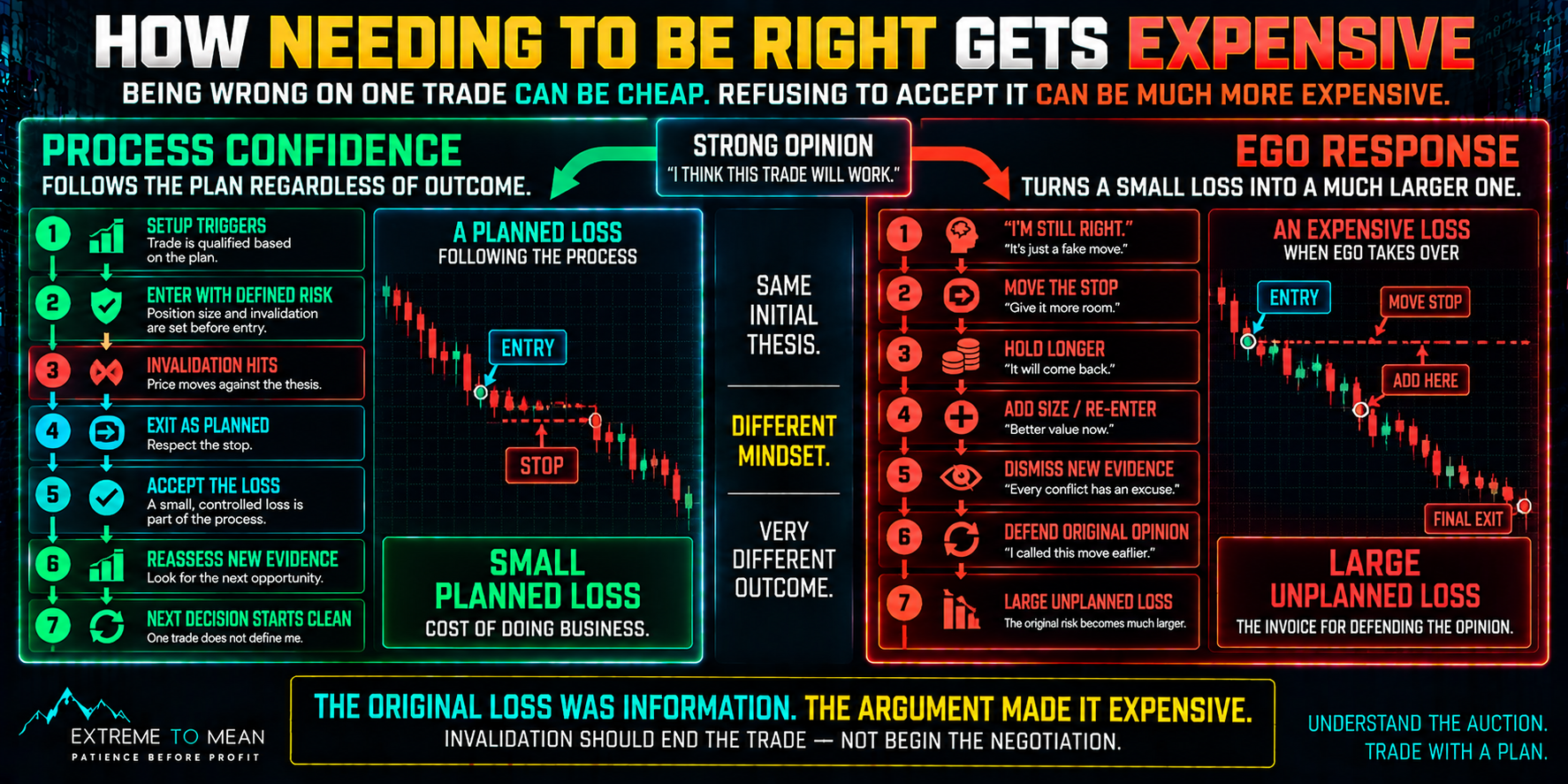
The title becomes concrete when a small planned loss begins turning into something larger. The original risk might be manageable, but ego says, “I am not wrong yet,” so the stop moves, the trader holds longer, another contract gets added, or a second revenge trade follows. What began as the normal cost of testing a thesis can become account damage.
The market may charge you a small amount for being wrong. Ego can turn that invoice into something much larger. The loss becomes expensive not merely because price moved against the trader, but because the trader refused to let invalidation do its job. The original trade may already be gone while the trader continues defending the original prediction.
Ego can turn losses into arguments after the fact too. Instead of asking, “Did I follow the plan?”, the trader may need a story: “They hunted my stop,” “That was manipulation,” or “I was still right because price reversed later.” Markets can be messy and price can absolutely reverse after a stop, but if every loss needs an excuse, the trader never has to update.
Build Confidence From Process, Not Recent P&L
A fragile confidence model looks like this:
WIN → confident
LOSS → unconfident
That makes the trader's self-trust depend on the most recent outcome, even though any individual trade contains uncertainty. After several winners, confidence can become excessive; after several losses, a perfectly valid process can suddenly feel broken.
A stronger model asks whether the process was followed. A losing trade can actually strengthen trust when the setup qualified, risk fit, execution was clean, and invalidation was respected. If confidence depends on the last trade winning, it isn't confidence yet; it is recent P&L.
This also changes the meaning of taking a stop. People sometimes imagine that a confident trader holds conviction longer, but process confidence can make exiting easier because the trader does not need this one trade to prove the method works. Confidence protects the process. Ego protects the opinion.
Trader A and Trader B Start With the Same Long
Imagine both traders develop the same bullish NQ thesis before the open. NQ reaches the planned area, the setup forms, structural invalidation is clearly below a defined swing, and both traders enter long. Up to that point, both decisions can be legitimate examples of confidence.
Price then breaks the structural invalidation. Trader A thinks, “This is just a fake breakdown,” moves the stop lower, and watches NQ continue down; now the trader decides the lower price is “even better value” and adds another contract. The original trade has already failed, but the trader is still defending the original opinion.
Eventually Trader A exits with a much larger loss. Later that afternoon, NQ rallies, and the trader says, “See? I was right.” Perhaps the eventual directional idea was right, but the trader was not right about timing, invalidation, risk, or the construction of the original trade.
Trader B takes the exact same initial long and exits when the defined invalidation breaks. The response is: “My long trade was wrong. That does not tell me what the next trade is.” Trader B then reassesses from clean information instead of requiring the market to repair the first opinion before another decision can begin.
The Confidence vs. Ego Test
Before or during a trade, ask:
1. WHAT WOULD PROVE THIS TRADE WRONG? If the answer keeps moving, ego may be negotiating.
2. IF I AM STOPPED OUT, WILL I STILL BELIEVE I CAN TRADE WELL? If not, too much identity may be attached to one outcome.
3. WOULD I TAKE THE SAME POSITION SIZE IF I FELT LESS CERTAIN? If not, conviction may be controlling risk.
4. WHAT EVIDENCE WOULD MAKE ME CHANGE MY VIEW? If the honest answer is “nothing,” that is not confidence.
- AM I DEFENDING THE PROCESS OR DEFENDING THE PREDICTION?
6. DO I NEED THIS TRADE TO WIN FOR A REASON OUTSIDE THE SETUP? Reputation, a daily goal, a previous loss, proving a thesis, or social validation can all quietly change the decision.
- CAN I SAY “I WAS WRONG” WITHOUT IMMEDIATELY TAKING THE OTHER SIDE?
Four behaviors deserve special attention: the stop starts moving because the loss is uncomfortable; size starts increasing because conviction feels stronger; contrary evidence keeps receiving an excuse; or the trader's language becomes absolute—“It has to,” “It can't,” “There is no way,” “I know.” None proves ego by itself, but several appearing together should trigger reassessment.
A simple comparison makes the distinction easier:
| Confidence | Ego |
|---|---|
| “This setup qualifies.” | “I know I'm right.” |
| Defines invalidation | Moves invalidation |
| Sizes from risk | Sizes from conviction |
| Accepts uncertainty | Seeks certainty |
| Can change view | Defends original opinion |
| Reviews wins and losses | Explains away losses |
| Trusts repetition | Needs this trade |
| Says “I don't know” | Needs an answer |
| Takes a clean loss | Turns loss into argument |
| Protects process | Protects identity |
The ETM Thesis → Invalidation → Update Framework
Use this sequence:
- THESIS — What do I currently believe? Keep it specific and provisional.
- INVALIDATION — What observable condition tells me this particular trade is wrong?
- RISK — How much am I willing to pay to test the thesis?
- EVIDENCE — What is the market actually showing after entry?
- UPDATE — If the evidence changes, choose HOLD / EXIT / REASSESS.
The shorter mental model is:
BELIEVE → DEFINE WRONG → RISK SMALL → LISTEN → ADAPT
A trading plan made before the open helps because invalidation and risk are easier to respect when they were defined before identity became attached to the result. If the trader cannot identify where the idea is wrong at all, unclear risk matters more than how confident the prediction feels.
The goal is not to stop believing in yourself. It is to relocate confidence from “I am right about this trade” to “I know how to handle this trade whether I am right or wrong.” That kind of confidence can survive a stop, update with new evidence, and begin the next decision without carrying the previous trade's argument into it.
Final Thought
Trading confidence should not require certainty. It should come from knowing that you can identify a qualified setup, define the risk, take the trade, accept the stop, and update when the evidence changes. A confident trader can admit uncertainty and still act decisively because the confidence lives in the process rather than the prediction.
Ego asks something much more expensive from the market: validation. Once being wrong begins to feel personal, stops become negotiable, conviction can begin controlling size, and conflicting information becomes easier to dismiss. You do not need the market to prove you right to trade with confidence; you need a process strong enough that being wrong on one trade does not change who you are on the next one.
Educational content only. Trading involves substantial risk and is not suitable for everyone.