
Inside The Setup, that distinction should be made before entry rather than discovered afterward. A continuation trader expects existing directional behavior to persist or resume, while a reversal trader expects enough of that behavior to fail that movement in the opposite direction becomes tradable. If you cannot explain what price must do next for the trade to make sense, the trade probably is not defined yet.
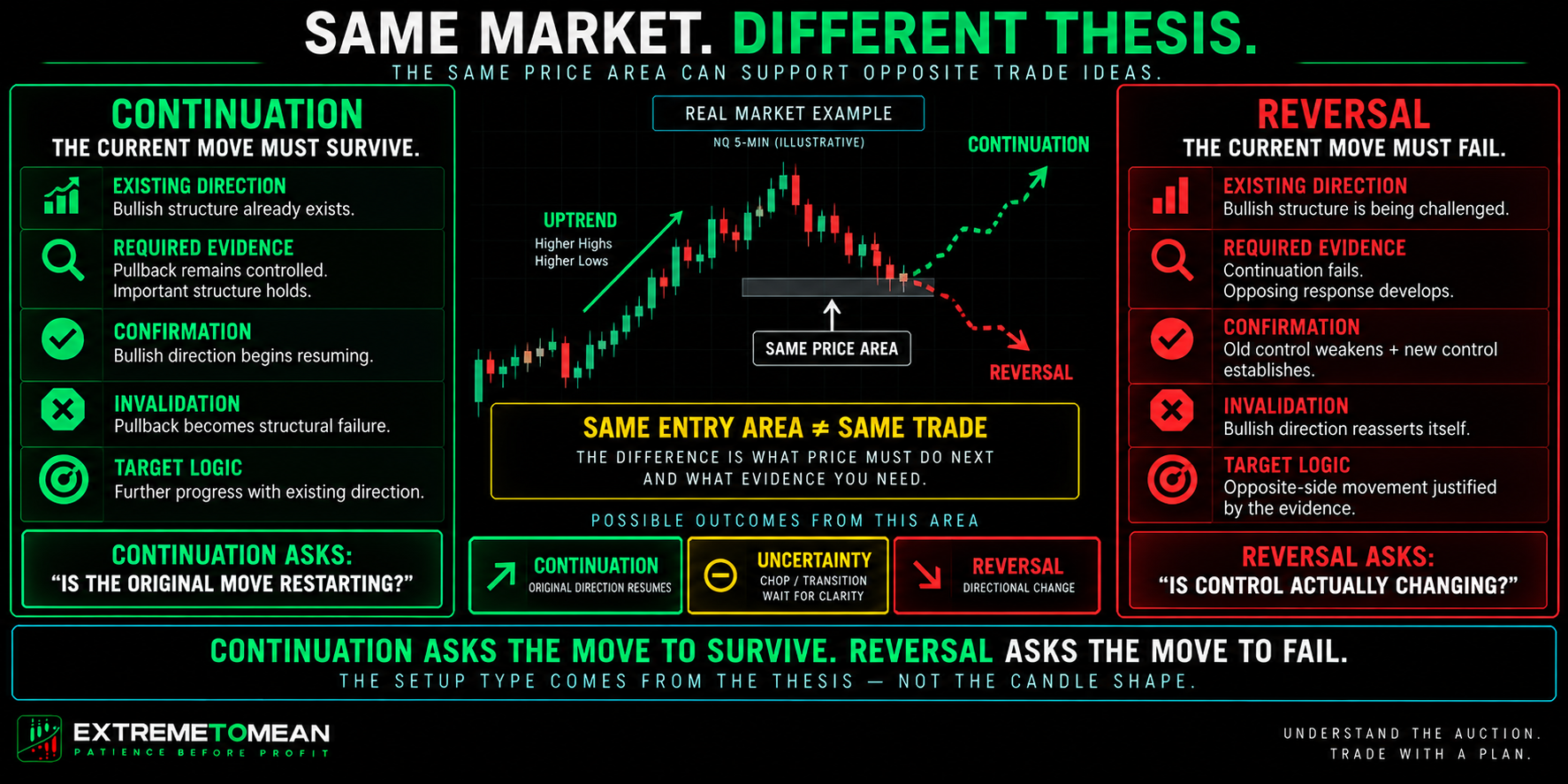
The confusion is understandable because the same candle, pullback, support area, or resistance level can appear in both plans. What separates them is not the shape of the entry candle; it is the thesis behind the trade, the evidence required to support it, and what would prove that thesis wrong. The setup type comes from the thesis—not from the candle shape.
Continuation and Reversal Make Opposite Claims
A continuation trade says that the directional behavior already present remains valid. The trader may be entering after a pullback, pause, breakout, consolidation, or retest, but the common assumption is that the existing direction still has enough structure to produce another leg. Continuation does not mean buying or selling wherever the trend is visible; it means finding a place where that direction can reasonably resume.
A reversal trade makes a larger challenge to the current move. The trader is not merely participating against the trend for a short reaction; the thesis is that the behavior supporting the dominant direction is weakening or changing enough that the opposite direction may establish itself. Being opposite the trend is not a reversal strategy—the trend has to give you evidence that its control is changing.
Consider NQ pulling back toward support inside an established uptrend. One trader may view the same location as a continuation long because bullish structure remains intact, while another may prepare a reversal short because they believe that pullback is developing into a larger bearish change. The price can be identical, but the required evidence, stop logic, and target should not be.
Countertrend, Mean Reversion, and Reversal Are Not the Same Trade
Trading against the current directional move does not automatically mean the trader is forecasting a new trend. A countertrend trade may seek only a temporary reaction, while mean reversion may seek movement from an extreme back toward balance without requiring the larger directional structure to fail. The broader lesson on why reversion is not reversal matters here because the size of the claim changes what the market needs to prove.
Suppose NQ is trending higher, becomes meaningfully extended, and a trader shorts for movement back toward a central reference. That reversion can succeed even if the larger bullish trend remains intact and later resumes, while a reversal short would be making the stronger claim that the bullish directional condition itself is changing. A reversion can happen inside a trend; a reversal changes the trend thesis itself.
This distinction also protects targets from expanding after entry. A trader who entered for a modest countertrend move can watch the position work and suddenly decide, “Maybe this is the top,” turning a limited thesis into a much larger one without receiving the evidence that larger claim requires. Do not upgrade the trade thesis simply because the position is working.
Continuation Needs Trend Integrity
A continuation trader should be able to explain why the original directional argument still deserves trust. Depending on the market, that may involve intact swing structure, controlled retracements, successful defense of meaningful areas, continued directional progress, failed countertrend attempts, or acceptance away from prior balance. The point is not to create one universal formula; it is to establish that the behavior being continued still exists.
This is where market state matters. The three market states help distinguish a directional environment from rotation or chop, because a continuation thesis requires some behavior capable of persisting in the first place. A continuation setup becomes much weaker when the trader is asking a rotational market to behave like an organized trend.
Confirmation for continuation therefore asks a fairly specific question: Is the original move resuming? A pullback may defend structure, a retest may hold, price may reclaim a level, or directional progress may restart, but the evidence should support the idea that the interruption was temporary. Continuation confirmation asks whether the existing argument is restarting—not whether any bullish or bearish candle has appeared.
Reversal Requires More Than the Old Move Pausing
A five-minute pause, one opposite candle, a wick, one lower-timeframe structure break, or an extreme indicator reading does not automatically establish reversal. Those observations may show that continuation slowed, but slowing and reversing are different conditions. A pause means the move temporarily stopped progressing; a reversal requires evidence that control is actually changing.
The useful sequence is often continuation weakens → opposing response develops → structure changes → reversal thesis becomes more credible. Failure of the old direction is important because a bullish trend cannot reverse bearish without first losing some ability to continue bullishly, but that failure answers only half of the question. The old move failing is necessary for reversal; it is not sufficient by itself.
That distinction leaves room for a third outcome: uncertainty. Buyers losing control does not automatically mean sellers have gained control, and sellers losing control does not automatically create bullish dominance; the market may simply enter balance or transition. The end of continuation does not require the immediate beginning of reversal.
Continuation and Reversal Need Different Evidence
The two trade types can be compared directly because their confirmation is trying to prove different things.
| Question | Continuation Trade | Reversal Trade |
|---|---|---|
| Existing direction | Expected to survive | Expected to weaken or change |
| Pullback / pause | Usually temporary | May be early evidence of deterioration |
| Important structure | Should remain sufficiently intact | Often needs to weaken, fail, or change |
| Confirmation asks | Is the original move resuming? | Is old control failing and new control developing? |
| Invalidation asks | Did the correction become structural failure? | Did the old direction regain control? |
| Target logic | Further progress with existing direction | Opposite-side movement justified by the evidence |
| Common mistake | Chasing continuation too late | Calling every pause a reversal |
Reversal often deserves a larger burden of evidence because continuation begins with an existing directional argument while reversal is challenging it. That does not make continuation inherently safer, nor does it mean a reversal trader should wait until the entire new trend is obvious. The reversal needs enough evidence to justify the thesis—not so much evidence that the trade has already happened.
That tradeoff exists on both sides. Reversal trading lives between predicting the turn too early and confirming it too late, while continuation trading lives between anticipating resumption before the pullback is finished and chasing after resumption is already extended. Every setup trades some entry quality for some information quality.
Invalidation and Targets Have to Match the Thesis
A continuation trade becomes wrong when the structure or behavior supporting continued direction no longer holds strongly enough for that setup. The important question is not whether the trader feels uncomfortable, but whether the supposed temporary interruption has become something more damaging to the original directional argument. This is why the trade is not ready until the risk is clear before the order is placed.
Reversal invalidation asks the opposite question. If the old trend reasserts itself, reclaims meaningful structure, or otherwise demonstrates that the reversal evidence failed, then the trader needs a predefined point where the old direction has disproved the new thesis. A reversal stop belongs where continuation has proven the reversal idea wrong—not where the trader becomes nervous.
Targets also need to reflect the claim being made. A continuation trade may logically seek another directional objective, while a reversal trade may initially justify only movement toward balance or the first meaningful opposing structure unless broader evidence supports a larger directional change. Your target should match the size of the directional claim your trade is making.
Do Not Let One Trade Secretly Become Another
One of the most damaging planning errors occurs after entry when the original thesis begins failing and the trader invents a replacement. A continuation long goes against them, so they change the timeframe or create a new reason to hold; a small reversion begins working, so it suddenly becomes a prediction of a major trend reversal. A losing trade does not earn permission to become a different trade.
This is trade-thesis drift: the reason for holding changes because the trader no longer likes what the original reason implies. Flexibility is different because genuine new information may justify exiting, adjusting, or later taking a new setup in the opposite direction, but that should be treated as a new decision. A new thesis deserves a new decision—not a rewritten explanation for the old position.
This is also why a setup is not a signal. The entry candle does not own the trade thesis, and the P&L should not be allowed to redefine it after the trader is emotionally involved. Name the trade before you take the trade.
Timeframe Changes the Label
Continuation and reversal only make sense relative to the structure being evaluated. A five-minute chart can reverse lower while the thirty-minute chart remains in a perfectly intact bullish trend, making the same move a lower-timeframe reversal and a higher-timeframe pullback. There is no contradiction because the two labels describe different horizons.
Before entry, the trader should therefore know which timeframe owns the thesis. A higher timeframe may establish the environment, the trading timeframe may define the setup, and a lower timeframe may help with timing, but the trader should not move between them simply to protect an existing position. A reversal on one timeframe can be nothing more than a correction on another.
Market condition adds another layer. Strong directional environments generally provide more existing evidence for continuation and create a higher evidentiary hurdle for reversal, while ranges can produce repeated directional changes that are better described as rotation than as full reversals. Not every change in direction is a reversal; sometimes price is simply rotating inside balance.
The ETM Continuation-or-Reversal Framework
Use Direction → Thesis → Evidence → Confirmation → Invalidation → Target → Risk → Decision. The framework does not predict which outcome will occur; it makes the trader state exactly what the planned trade requires before capital is committed. Know what the market has been doing, know what you need it to do next, and know what proves you wrong.
- Direction: What meaningful directional move currently exists?
- Thesis: Am I planning continuation or reversal?
- Evidence: What makes that thesis reasonable in the current condition?
- Confirmation: What does price now need to show?
- Invalidation: What proves the thesis wrong?
- Target: What size of move does the evidence reasonably support?
- Risk: Can the structural stop and appropriate position size fit the plan?
- Decision: Trade, wait, or pass.
A compact pre-trade check can reduce the framework even further: Type, Requirement, Failure, Objective. What type of trade is this, what must price do next, what proves the idea wrong, and what realistic destination matches the claim? If the trader cannot name all four, the setup may still be a story rather than a defined trade.
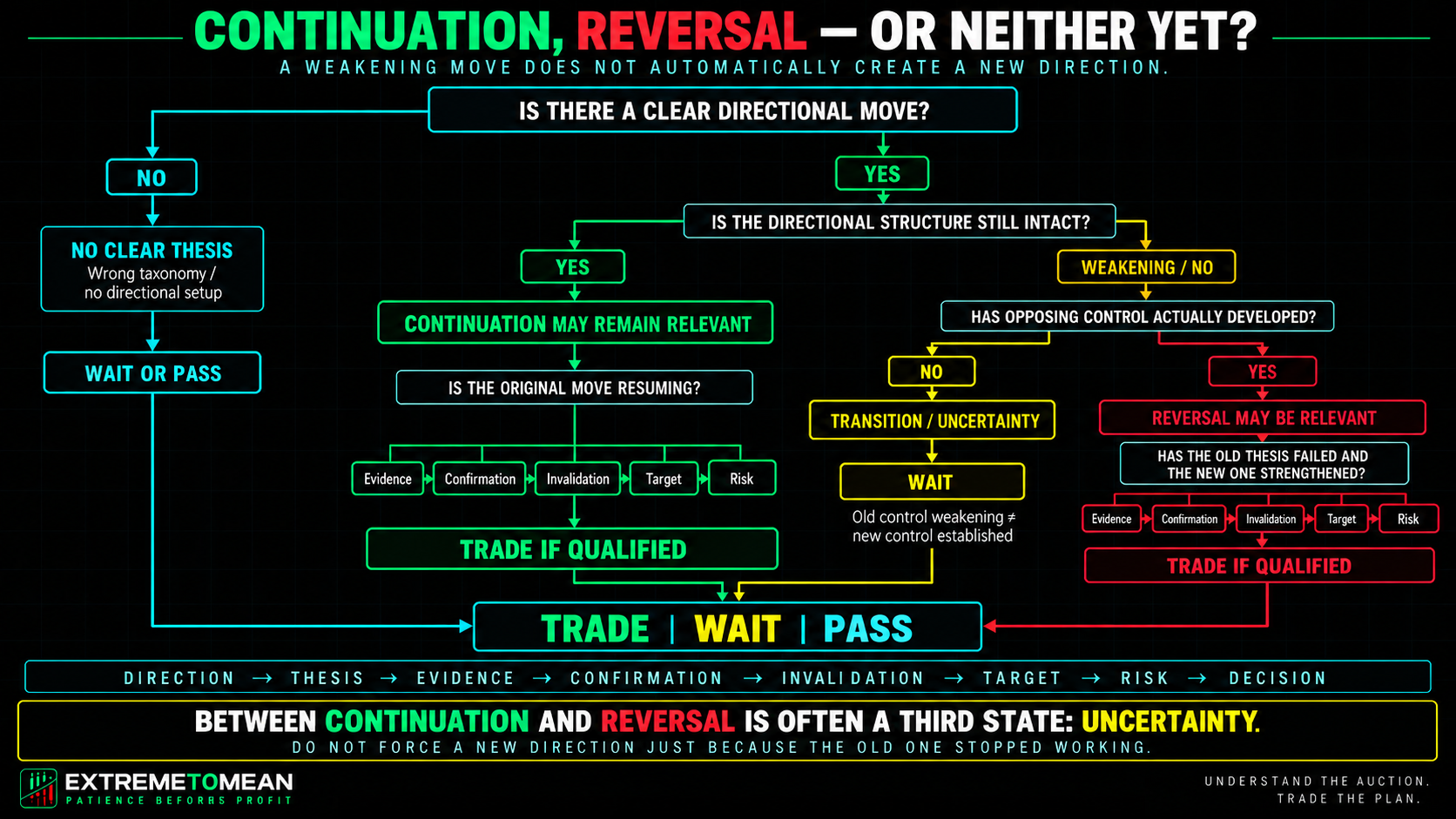
The better question is not “Do I think this market is about to reverse?” Ask: “Am I asking the current move to survive or asking it to fail, and what evidence would each claim require before I risk money?” Between those two answers is a perfectly legitimate third state: neither yet.
Final Thought
Continuation and reversal are not two labels to apply after price has already moved. They are two different trade plans making different claims about the future behavior required for the setup to work, which means they need different evidence, different failure logic, and often different target expectations. The trader's job is to define that claim before entry rather than allowing outcome or emotion to name the trade afterward.
Continuation deserves respect while the directional evidence remains intact, but it does not deserve loyalty after that evidence changes. Reversal deserves attention when continuation weakens, but weakness alone does not automatically hand control to the other side. Patience means allowing the market to move from one state to the next without forcing the transition before the evidence exists.
Define the existing direction, name the thesis, require the appropriate evidence, and decide where that thesis fails before taking risk. Sometimes the result will be continuation, sometimes reversal, and sometimes uncertainty that deserves no trade at all. That context-first approach is part of the broader decision discipline developed throughout The Patience Principle.
Educational content only. Trading involves substantial risk and is not suitable for everyone.