
Why a Good Setup Is Not Automatically a Good Trade
A setup is the market condition or technical pattern that makes an opportunity worth investigating. It may involve structure, extension, rejection, continuation, a failed break, or some other behavior defined by the trader’s process. In the Setup curriculum, that recognition should earn attention, but it should not automatically earn capital.
A trade is a larger decision. It includes the setup, but it also includes where the trader can enter, where the thesis is wrong, how much room remains, what the market environment looks like, how much size can be carried, and whether the plan can actually be executed. Technical validity is therefore necessary, but it is not sufficient.
This is why a setup is not a signal. Seeing the pattern does not mean the decision is finished; it means the qualification process can begin. The mistake is treating recognition as permission.
What Makes a Setup Technically Good
A technically good setup meets the rules the trader has defined for that particular idea. The market may be in the right structure, price may be interacting with the intended location, and the expected behavior may be beginning to appear. Those conditions can all be present without answering whether the trade is worth taking.
That distinction prevents the trader from constantly redefining the pattern after the fact. A setup can be objectively valid according to its rules while the trader still chooses not to participate because the complete opportunity is poor. Rejecting the trade does not require pretending the setup itself was bad.
The reverse is equally important. A weak or incomplete setup does not become high quality merely because the trade eventually makes money. A profitable outcome and a well-qualified decision are not interchangeable measurements.
Location and Timing Can Change the Opportunity
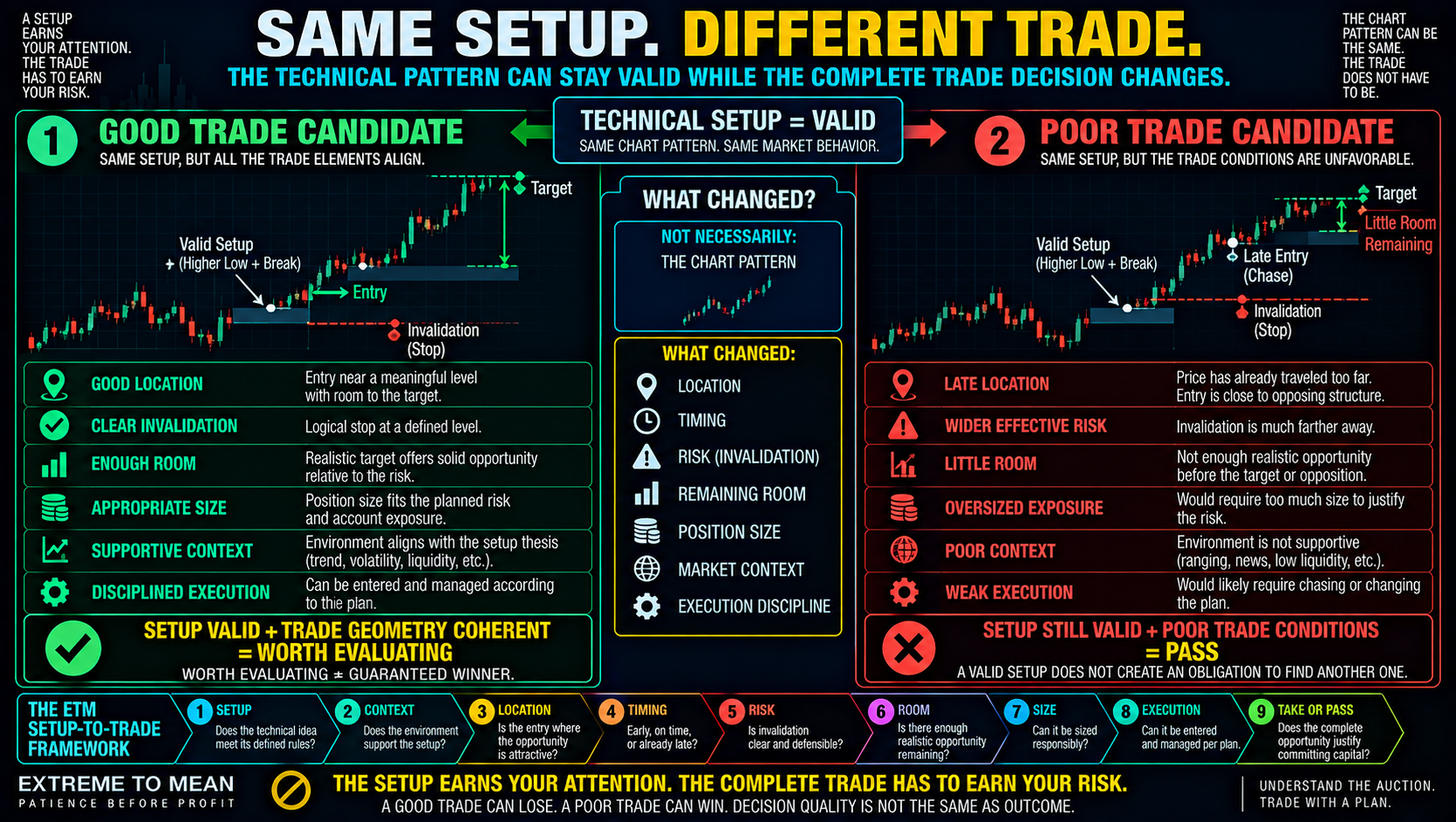
Consider the same technical setup appearing in two circumstances. In Trade A, the entry remains near useful structure, invalidation is clear, opposing structure is far enough away to leave meaningful room, and the setup is developing in supportive conditions. In Trade B, the identical technical pattern is visible after price has already traveled much farther, the entry sits close to opposition, and the original invalidation now requires much more distance.
The chart pattern can be the same while the trade is completely different. This is why where you enter matters more than what you predict: timing and location determine the geometry from which the trader actually participates. A correct idea taken from poor location does not inherit the quality of the earlier opportunity.
P064 makes the late-entry version of this problem especially clear, but timing can fail in both directions. A trader can enter too early before the setup has qualified or too late after much of the useful movement has already occurred. The technical idea may survive either mistake while the actual trade deteriorates.
Risk Must Be Clear Before the Setup Becomes a Trade
A good setup is not ready for capital until the trader can identify where the thesis is genuinely wrong. If invalidation is vague, hidden inside normal market noise, or so far away that the resulting exposure cannot be carried responsibly, the pattern may still look attractive while the trade remains unfinished. Risk definition is part of qualification, not paperwork added after the entry.
That is why the trade is not ready until the risk is clear. A trader who cannot explain what disproves the idea cannot accurately evaluate the distance to the stop or the financial exposure created by position size. The setup has earned interest, but not yet risk.
Clear invalidation does not guarantee a good trade either. The stop may be logical while the distance from the available entry makes the trade unattractive. Qualification asks whether the entire risk structure works together, not whether one isolated component looks reasonable.
Available Room and Target Matter
The opportunity side of the trade matters just as much as invalidation. A technically strong setup can occur directly beneath opposing structure, after most of the expected move has already happened, or in a location where the realistic destination is simply too close to justify the exposure. Technical quality does not override poor trade geometry.
A useful target should come from the actual market opportunity rather than the amount of profit the trader wants. Once the realistic destination is identified, the trader can compare the remaining room with the risk required from the current entry. If that relationship is unattractive, moving the target farther away does not improve the trade.
This is one of the clearest differences between recognizing a setup and qualifying a trade. The setup answers whether a particular market behavior exists; the trade decision asks whether enough of that opportunity remains to make participation reasonable. Sometimes the technically correct conclusion is that the setup is good and the trade should still be passed.
Position Size and Market Context Matter Too
Position size is another reason the same setup can produce different trade decisions. A market opportunity may fit one trader’s allowable exposure at modest size while becoming irresponsible when the trader multiplies the position far beyond what the stop distance and account can support. The chart does not change, but the decision does.
Market environment can change the meaning of the pattern as well. The same structure can behave differently in trend, balance, compressed volatility, expanding volatility, thin liquidity, or immediately around important news, which is why market conditions change the quality of a setup. A pattern should be interpreted inside the environment producing it rather than treated as an isolated signal.
This does not mean every factor must be perfect before a trade can be considered. Trading always involves uncertainty, and qualification is not an attempt to construct a flawless checklist that eliminates losing trades. The goal is to identify whether the complete opportunity is coherent enough to justify the specific risk being considered.
Execution Can Still Ruin a Good Decision
A trader can complete the analysis correctly and still degrade the trade during execution. Chasing several points beyond the planned entry, widening the stop after entry, moving the target impulsively, or adding size outside the plan changes the trade that was originally qualified. The decision that deserved risk can become a different decision once execution begins.
That does not mean every deviation from the initial plan is automatically wrong. Markets change, and some strategies explicitly include predefined adaptation or trade-management rules. The distinction is whether the adjustment belongs to the process or whether the trader is rewriting the trade because the original outcome is becoming uncomfortable.
Trade quality therefore includes execution discipline as well as pre-entry analysis. A strong setup and sensible plan do not excuse poor implementation, just as flawless execution cannot rescue a trade whose location, risk, and opportunity were unacceptable from the beginning. The whole decision matters.
The ETM Setup-to-Trade Framework
The purpose of the framework is to prevent setup recognition from becoming automatic entry permission. Work through the market evidence first, then ask whether the current opportunity, risk, and execution plan actually fit together. Only after that process should the trader decide whether the setup has become a trade candidate.
- Setup — Does the technical idea meet its defined rules?
- Context — Does the current market environment support the type of behavior the setup expects?
- Location — Is the entry still occurring where the opportunity is attractive?
- Timing — Is the trader early, appropriately timed, or already late?
- Risk — Is invalidation clear and defensible?
- Room — Is there enough realistic movement available before meaningful opposition or the planned destination?
- Size — Can the position be sized responsibly around the valid risk?
- Execution — Can the trade be entered and managed according to the plan?
- Take or pass — Does the complete opportunity justify committing capital?
The condensed framework is Setup → Context → Location → Timing → Risk → Room → Size → Execution → Take or Pass. None of those factors turns a trade into a guaranteed winner, and they should not be reduced to a secret scoring formula. Their purpose is to force the trader to evaluate the entire decision rather than allowing one attractive chart pattern to dominate everything else.
The better question is no longer simply, “Is this a good setup?” Ask, “Is this a good trade from here, under these conditions, with this risk?” That change in language reflects the larger shift from pattern recognition to decision quality.
Final Thought
A technically valid setup can deserve attention without deserving a trade. Poor location, late timing, unclear invalidation, insufficient room, excessive size, weak context, or undisciplined execution can all turn valid market evidence into an unattractive decision. The setup is one layer of the trade, not the entire trade.
A good trade does not mean a winning trade. A well-qualified, responsibly sized, properly executed decision can still lose, while a poorly constructed trade can occasionally make money. The purpose of qualification is to improve the quality and clarity of the decision before the outcome is known.
The setup earns your attention. The complete trade has to earn your risk. That is the distinction the broader Extreme to Mean system is designed to reinforce: recognize what the market is offering, evaluate the complete opportunity, and take risk only when the trade—not merely the pattern—makes sense.
Educational content only. Trading involves substantial risk and is not suitable for everyone.