
How to set a realistic target before entering shows how available room, structure, and volatility should shape that destination.
New traders often begin with the entry because it feels like the moment when analysis becomes action. They recognize a pattern, notice a level, or see price beginning to move and immediately ask where they can get in. That question matters, but it addresses only the first part of the trade.
An entry without a stop leaves the failure point undefined, while an entry without a target leaves the opportunity unclear. The trader may know how to open the position but not whether the risk is acceptable or whether enough room exists for the trade to justify that risk. Once money is exposed, those missing decisions are often replaced by hope, fear, impatience, or denial.
This lesson belongs in the broader setup and risk curriculum because a setup is more than a recognizable pattern. The trader must convert the pattern into a structured decision before clicking. Entry, stop, and target provide the basic framework for doing that.
The Entry Defines Where Participation Begins
The entry is the price or area where the trader intends to open the position. It may be based on a pullback, breakout, rejection, retest, or another condition required by the strategy. The entry can be one planned order price, but it may also be a zone in which the trader waits for specific behavior before participating.
A useful entry should have a reason grounded in the market. The trader should understand why the location matters, what evidence is required there, and why entering at that point is preferable to entering earlier, later, or in the middle of uncertain movement. The entry should connect the setup to a meaningful part of the chart rather than simply marking the place where the trader first noticed the move.
This is why location should be the first filter. Suppose price is pulling back toward support after an orderly advance. The trader may become interested as price enters the area, but the final entry may still require selling pressure to slow, buyers to respond, or another confirmation defined by the plan.
The location therefore earns attention, while the entry condition determines whether risk is actually accepted. Reaching support, resistance, a moving average, or another reference does not automatically create a trade. The entry occurs only when the evidence required by the strategy is present.
The Stop Defines Where the Idea Is Wrong
The stop identifies the price or condition that tells the trader the original reason for entering is no longer valid. It should be based on the failure of the setup rather than on the amount of discomfort the trader begins to feel. A structural stop gives the trade a clear boundary by connecting the exit to the market behavior that supported the idea.
If a long setup depends on support holding, the trade may become invalid when price breaks beneath that support and fails to recover. If a breakout trade depends on price being accepted above resistance, the idea may fail when the market quickly returns below the level and sellers regain control. In each case, the stop represents a change in the evidence rather than an arbitrary number placed near the entry.
Without that boundary, the trader is left negotiating with the market after the position is open. A small loss may be tolerated because the setup still “looks close,” and a larger loss may then be tolerated because price could recover. Eventually, the position may no longer have any connection to the original reason for entering.
The lesson on why the trade is not ready until the risk is clear explains why invalidation must be understood before participation begins. A trader should be able to state what market behavior would prove the idea wrong and where the position is intended to be closed if that behavior occurs. Until that answer is clear, the trader has an entry idea rather than a complete setup.
A stop order does not guarantee an exit at the exact expected price. Fast movement, gaps, thin liquidity, and slippage can cause the actual fill to differ from the planned level. The stop still performs an essential planning function by defining where the trader intends to stop participating when the trade no longer makes sense.
The Target Defines the Realistic Destination
The target is the price area where the trader expects to reduce or close the position without killing the winner if the idea develops favorably. It should come from market structure rather than from an arbitrary amount of money the trader hopes to make. Prior highs, lows, support, resistance, range boundaries, and other meaningful areas may help identify where the move could reasonably slow, reverse, or complete.
The target does not promise that price will reach the area. It gives the trader a realistic destination against which the opportunity can be evaluated before risk is accepted. A trade may look attractive at the entry while offering very little usable room before price encounters opposing structure.
Suppose a trader plans to buy near $50 and the idea becomes invalid below $48. The next meaningful resistance sits near $51, so the trade requires approximately $2 of price risk to pursue only $1 of available movement. The market may still rise, but the structure does not offer much room relative to the exposure being accepted.
Changing the target to $56 does not repair the trade when no evidence supports that destination. A target should describe where the market could reasonably travel, not where the trader needs it to go to make the numbers appear attractive. When the next obstacle sits too close, the better decision may be to wait for a better entry or reject the trade.
A useful target therefore answers a practical question: if the idea works, where is the next realistic area that could interrupt or complete the move? That destination may later be adjusted according to a defined management plan, but the trader should understand the available room before entering. Without that information, the possible reward remains an assumption rather than part of a structured decision.
Entry, Stop, and Target Must Work Together
Entry, stop, and target should not be planned as three unrelated prices. The entry determines the distance to the stop, that distance influences the position size and total risk, and the target reveals whether enough realistic opportunity exists to justify the exposure. Changing any one of the three changes the complete trade.
Suppose a trader plans a long entry at $50, a stop at $48, and a target at $54. The trade contains $2 of price risk and $4 of potential movement to the planned target. That relationship can be evaluated before the order is placed.
If the trader hesitates and enters at $52 instead, the structural stop may still belong at $48 while the realistic target remains near $54. The risk has increased from $2 to $4 per share, while the remaining movement to the target has fallen from $4 to $2. The market idea may be unchanged, but the actual trade has become much less attractive.
The trader may try to repair the numbers by moving the stop closer, extending the target, or reducing the position size. A closer stop may sit inside normal movement, while a farther target may lack structural support. Reducing size can control the account risk, but it cannot restore opportunity that disappeared because the entry was chased.
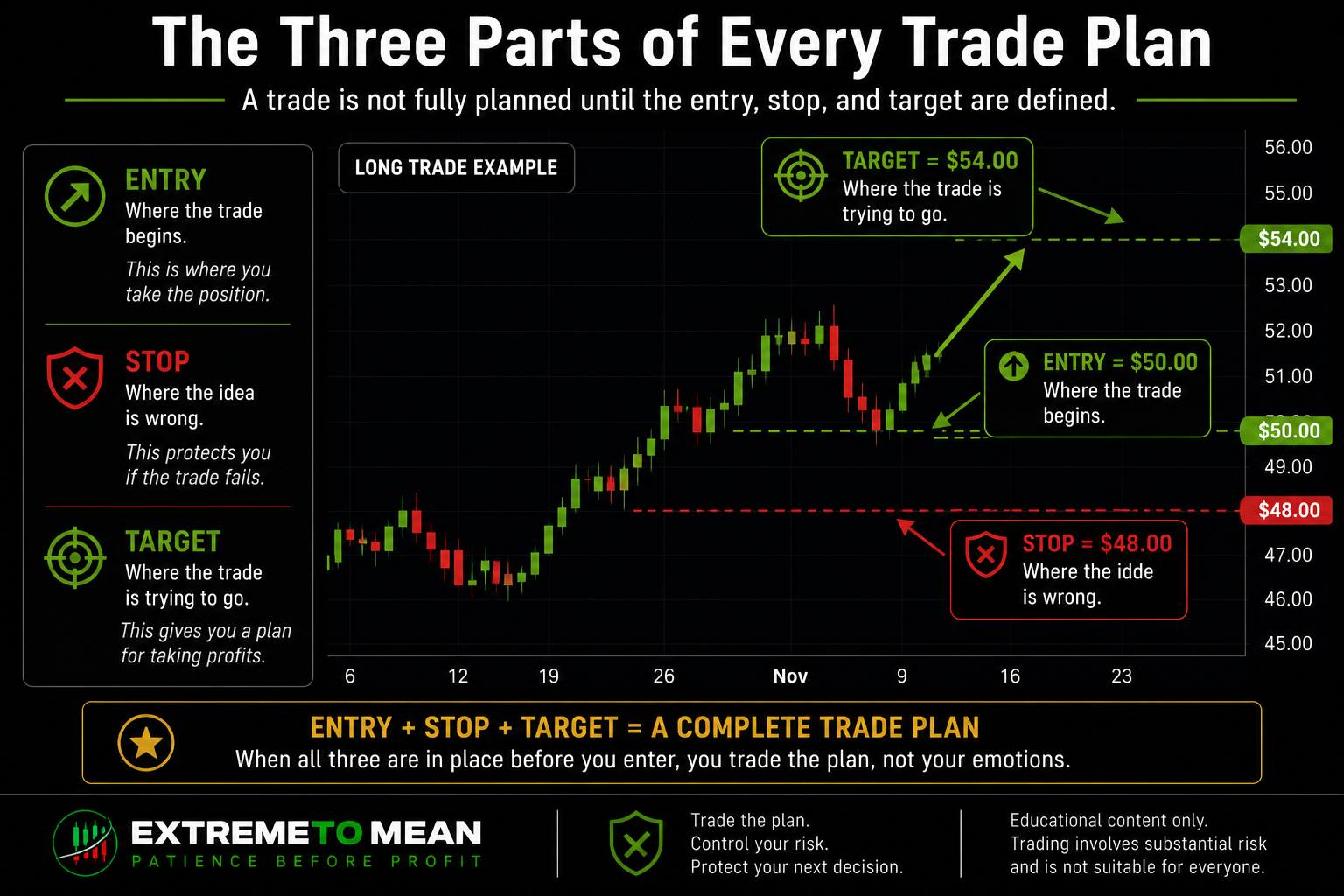
A complete plan allows the entry, stop, and target to support one another. The trader should understand what evidence triggers participation, what behavior invalidates the idea, and what realistic destination provides the opportunity. When those parts do not fit together, the setup may deserve attention without deserving a trade.
Stop Distance Determines Position Size
Once the entry and invalidation are defined, the trader can calculate the price risk. For a long trade, this is generally the entry price minus the stop price; for a short trade, it is generally the stop price minus the entry price. That distance shows how much is at risk per share, contract, or other unit.
Suppose a trader plans to buy at $50 and use a structural stop at $48. The price risk is $2 per share. If the trader is prepared to risk $40 on the idea, the basic position size would be:
$40 planned risk ÷ $2 risk per share = 20 shares
The position size was chosen to fit the required stop and the trader’s acceptable account risk. The stop was not moved closer to accommodate a preferred number of shares. This order matters because the market structure should determine where the idea fails, while the trader controls exposure by adjusting size.
Reversing the process weakens the trade. A trader may decide to hold 100 shares because the potential gain looks attractive, then place the stop unusually close so that the planned dollar loss appears manageable. If that stop sits inside ordinary movement rather than beyond genuine invalidation, the trade may be exited even though the original setup has not failed.
The correct sequence is to identify the entry, define the structural invalidation, calculate the distance between them, and then choose a position size that keeps total exposure within the plan. The lesson on why position size and account size are different explains why this calculation must also be considered in relation to the trader’s available capital.
Planning Before Entry Reduces Emotional Management
A trade without a defined stop or target forces the trader to make important decisions while profit and loss are changing. The open position creates urgency, and every price movement can begin influencing what the trader wants to believe. Rules that were unclear before entry may then be invented in response to fear, hope, or temporary discomfort.
When the position moves against the trader, the stop may be widened, removed, or replaced with a new explanation for remaining in the trade. When the position moves favorably, the trader may exit too quickly because the open gain feels fragile. The opposite problem can also occur when a trader refuses to take a reasonable gain because the market could continue and then watches the position reverse.
These choices can feel reasonable in the moment because the trader is responding to real movement and real emotion. The problem is that the management rules are being created after the outcome has already begun influencing the decision. The trader is no longer evaluating the same plan that existed before entry.
Defining the entry, stop, and target does not eliminate emotion or guarantee perfect execution. It reduces the number of essential decisions that must be invented while the position is active. The trader may still respond to unusual behavior, but those adjustments can be judged against a plan rather than against an empty space that emotion is free to fill.
A Complete Trade Example
Consider a trader watching a stock pull back toward meaningful support near $50. The trader plans to enter only if price stabilizes and buyers begin responding in the area. The setup becomes invalid if price breaks below $48 and fails to recover, while the next meaningful resistance sits near $54.
The initial structure is:
Entry: $50
Stop: $48
Target: $54
The price risk is $2 per share, while the available movement to the target is $4 per share. If the trader’s maximum planned loss is $50, a position of 25 shares would create approximately $50 of price risk before possible costs and slippage:
$2 risk per share × 25 shares = $50 planned risk
If price reaches the $54 target, the gross movement would be $4 per share, or approximately $100 across the 25-share position before trading costs. Those numbers do not guarantee that the market will reach the target or that the stop will fill at exactly $48. They allow the trader to understand the planned exposure and opportunity before accepting them.
Price may fail immediately, move partway toward the target, reach the target, or behave differently from what the trader expected. The value of the plan is not certainty; it is clarity. Before entering, the trader knows where participation begins, where the idea fails, what destination is being pursued, and how much exposure the position creates.
When One Part Is Missing
A trade with an entry but no stop has no defined failure point. The trader may remain exposed long after the original setup has stopped making sense because there is no agreed condition for ending the idea. The open position can then become a hope that price eventually returns rather than a trade being managed according to evidence.
A trade with an entry and stop but no target defines the downside without determining whether enough opportunity exists. The trader may accept a wide loss boundary to pursue a small or unclear destination. Without reviewing the available room, the trade can appear controlled while still offering an unattractive relationship between risk and potential movement.
A trade with a target but no structural stop focuses on the possible reward while leaving the downside undefined. The trader knows what they hope to gain but not what market behavior would require the position to be closed. This creates a plan for success without a plan for failure.
Even a clearly marked entry, stop, and target can produce a poor trade when the levels are chosen without context. The three parts must come from meaningful location, realistic invalidation, and available room rather than being placed on the chart simply to complete a template. The framework does not replace analysis; it forces the analysis to become specific.
That is why a setup is incomplete when the risk cannot be defined. A recognizable trigger, favorable bias, or attractive location may earn attention, but the trade still needs boundaries. Entry, stop, and target turn that attention into a decision that can be accepted or rejected.
Review the Complete Decision Before Clicking
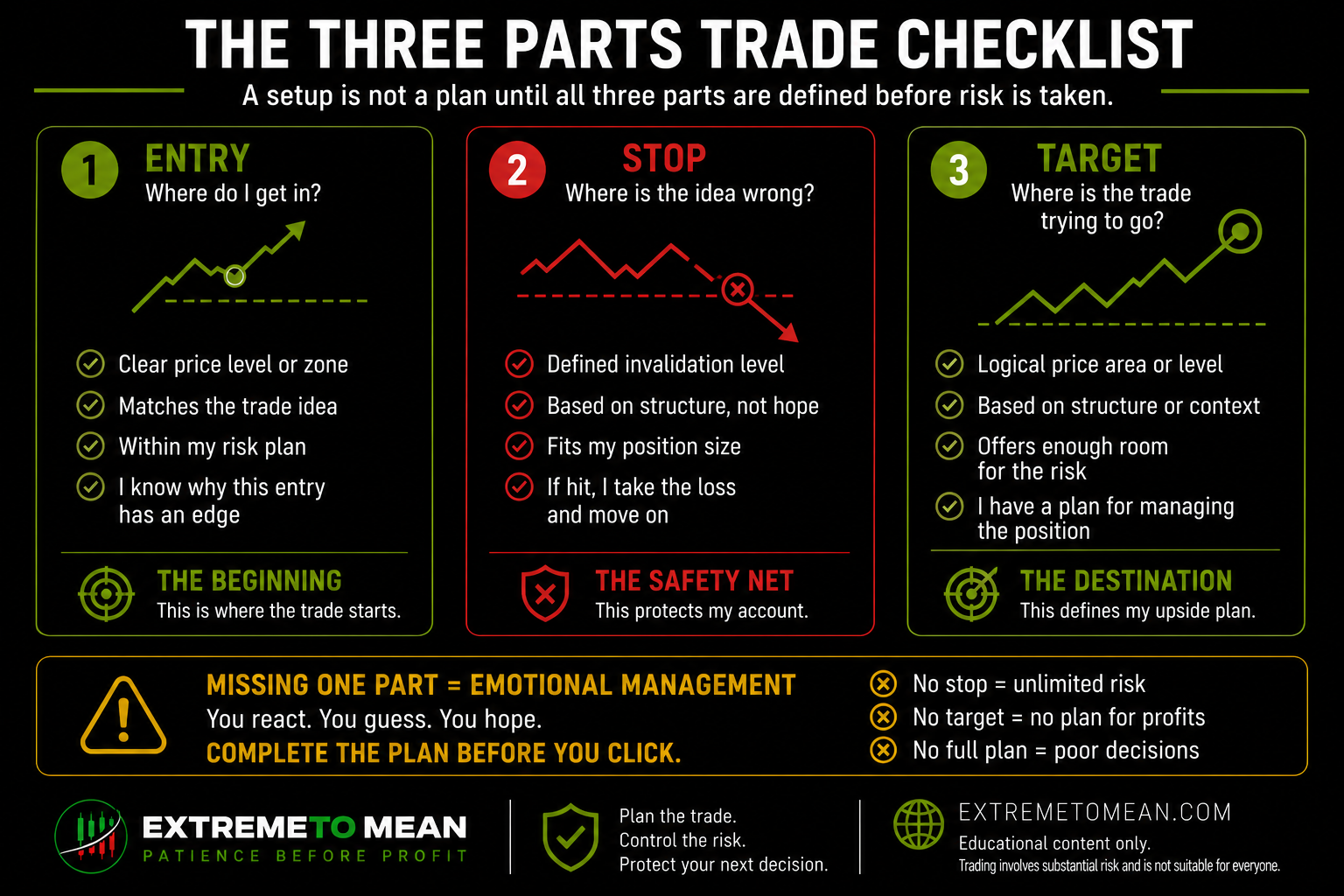
Before placing an order, the trader should be able to explain the complete trade in plain language. The entry should be connected to a meaningful location and a defined trigger, while the stop should represent the failure of the setup rather than the trader’s emotional tolerance. Position size should then reflect the distance to that invalidation and the amount of account risk the trader is prepared to accept, following the same risk-first sequence of defining invalidation before sizing the trade.
The target should come from a realistic market destination, and enough room should exist between the entry and that area to justify considering the trade. The trader should also understand how current volatility, spread, liquidity, and possible slippage may affect the result. A trade that looks acceptable under ideal execution may become less attractive when those conditions are included.
Management rules should also be settled before the position creates pressure. Some plans may allow a partial exit, an early exit when market behavior changes, or a stop adjustment after meaningful progress. Other plans may require no intervention until the stop or target is reached.
A practical pre-trade review should confirm:
- Entry: What location and behavior will trigger participation?
- Stop: What market behavior proves the original idea wrong?
- Target: Where is the next realistic destination or obstacle?
- Position size: How much total account risk does the stop distance create?
- Management: What adjustments, if any, are allowed after entry?
The purpose of the review is not to make the trade predictable. It is to make the decision complete before money is exposed. When one of these answers is missing or unsupported, the trader should continue planning rather than continue toward the order button.
The free trading tools and checklists can help organize the entry, invalidation, target, size, and management rules before risk is accepted. A written framework makes it easier to distinguish a qualified plan from a familiar-looking setup that has not yet been fully evaluated.
Final Thought
Every trade needs an entry, a stop, and a target because each part performs a different job. The entry defines where participation begins, the stop identifies where the idea is no longer valid, and the target establishes the realistic destination the trade is attempting to reach. Together, they create one structure rather than three unrelated prices.
The distance from entry to stop determines the price risk, which influences position size and total account exposure. The distance from entry to target reveals whether enough realistic movement exists for the trade to deserve consideration. When the three parts do not support one another, the trader may have an interesting setup without having a useful trade.
A planned trade can still lose, and a target may never be reached. The purpose of the framework is not to make the market predictable; it is to make the trader’s decision clear before emotion begins managing the position. Define all three before clicking.
Once those three parts are defined, risk-to-reward can be judged in context instead of treated as a ratio that qualifies the trade by itself.
Traders who need a faster pre-entry review can compress the same logic into a 60-second trade readiness check.
Educational content only. Trading involves substantial risk and is not suitable for everyone.