
Many new traders focus heavily on entries. They want to know where to buy, where to sell short, and how to recognize the moment a trade may begin. That focus makes sense because the entry is the most visible starting point, but entering a position does not make the risk disappear.
A trade becomes more complete when the trader knows where the original idea is wrong. That is the purpose of a stop loss: it creates a defined boundary beyond which the trade should no longer be treated as acceptable. The stop may be placed as an actual order or begin as a planned exit level, but its purpose is the same—risk must be considered before the trade is allowed to continue indefinitely.
At Extreme to Mean, this belongs in The Basics lesson library because traders need to understand downside before pursuing better entries or more advanced setups. A stop loss is not a magic shield, and it does not promise that the market will provide a perfect exit. It is a tool for defining where action should occur if the trade does not behave as expected.
A Stop Loss Defines Where the Trade Is No Longer Acceptable
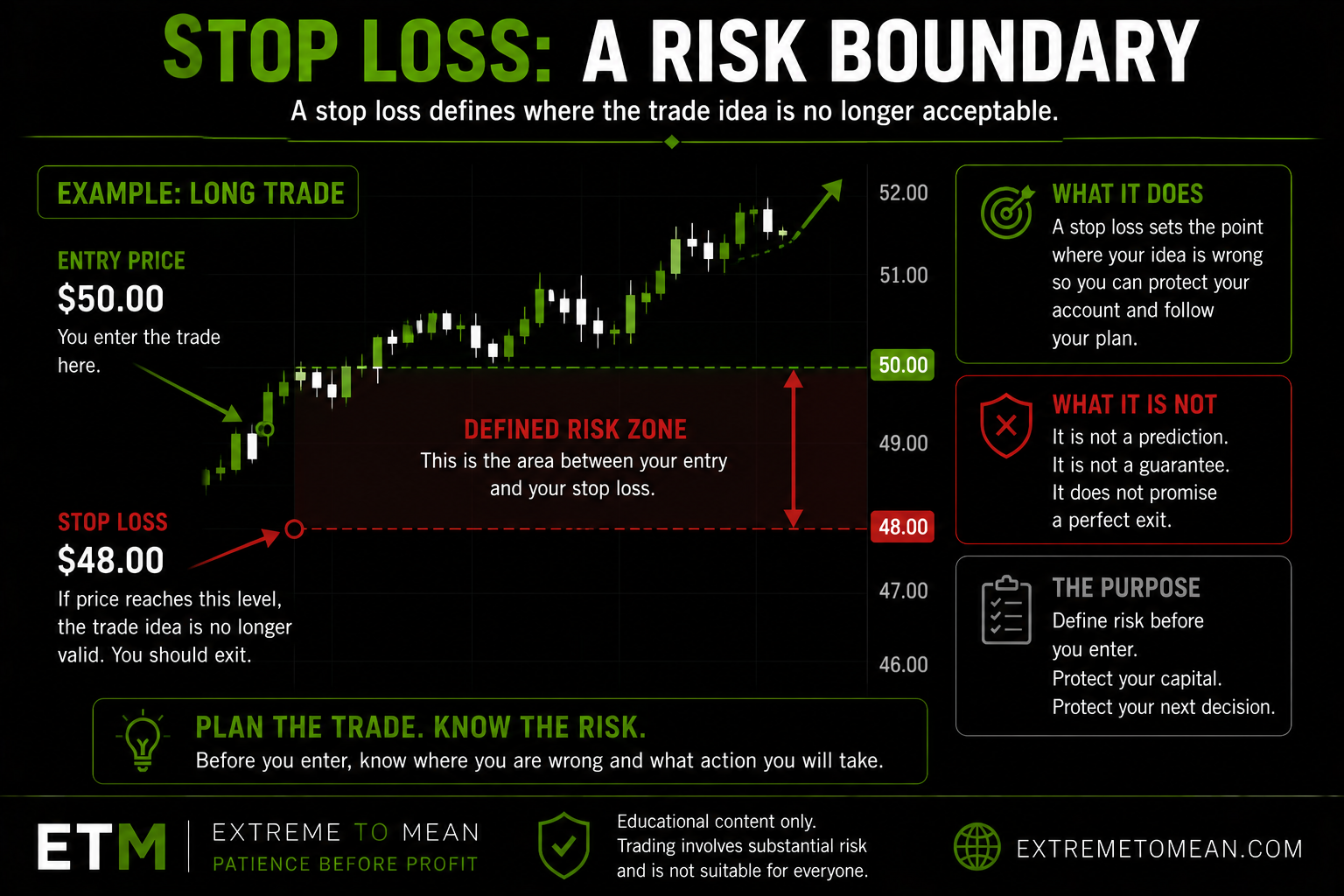
A stop loss is commonly used as an exit plan for a trade that moves against the trader. For a long position, the stop is often placed below the entry or beneath a level the trader believes should hold. If price reaches that area, the trader is acknowledging that the original bullish idea is no longer behaving as planned.
For a short position, the stop is often placed above the entry or above a level the trader believes price should not reclaim. If the market reaches that area, the bearish idea may no longer be valid. The direction changes, but the purpose of the stop remains the same.
The exact level depends on the setup, market, timeframe, and risk plan. This lesson is not intended to teach one universal stop-placement strategy. The first principle is simpler: the trader should identify a meaningful point where the trade is no longer acceptable before entering.
Without a stop or defined exit plan, a trader may remain in a losing position because there is no clear point at which the original idea has failed. That uncertainty can lead to hoping, freezing, averaging down without a plan, or turning a short-term trade into a much larger problem.
A stop loss is not there to make the trade work. It is there to define when the trader should stop treating the trade as valid. That connects directly to the lesson explaining why the trade is not ready until the risk is clear.
A Stop Loss Can Be an Order or a Planned Exit
The phrase stop loss can refer to slightly different things depending on how the trader uses it. Sometimes it is an actual order placed with the broker. A trader who buys at $50, for example, might place a sell stop at $48 so that an exit instruction is triggered if price reaches that level.
In other cases, the stop begins as a planned exit rather than an order already resting in the system. The trader identifies the level where they intend to leave if price moves against the position, then monitors the trade and exits manually if that condition occurs. Some trading styles use this approach, but it requires discipline because a planned stop that is repeatedly ignored is not meaningful risk management.
The stop level and the stop order are therefore related, but they are not identical. The level identifies the price area where the trade should no longer remain acceptable. The order tells the broker or platform what action to take if the trigger condition is reached.
That distinction matters because several things can still go wrong. The trader can choose a poor stop level, use an order type they do not understand, move the stop emotionally, or refuse to follow the original plan. The tool is only effective when it is part of a clear decision process.
The earlier lesson on market orders, limit orders, and stop orders provides the necessary execution foundation. A stop is not merely a line drawn on a chart; when placed as an order, it is an instruction with specific behavior and tradeoffs.
A Stop Loss Does Not Guarantee a Perfect Fill
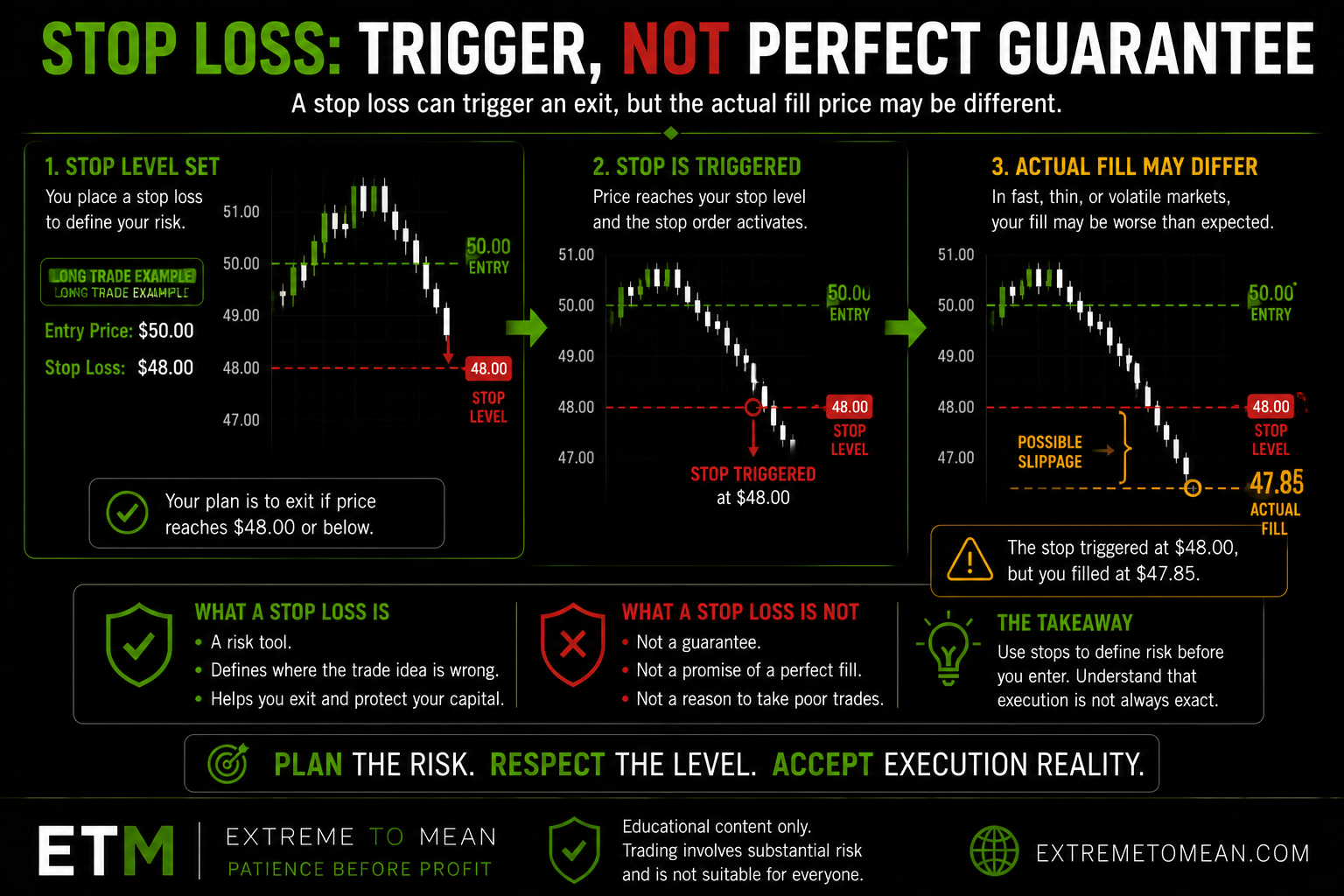
One of the most important beginner lessons is that a stop price and an execution price are not always the same. A stop loss can identify the trigger level, but it cannot guarantee that the position will exit at that exact price. The final fill still depends on the market conditions present when the order becomes active.
Imagine a trader buys at $50 and places a sell stop at $48. If price gradually trades down to $48 in an active, liquid market, the exit may occur close to the stop level. If price drops rapidly because of unexpected news, a gap, or thin liquidity, the order may trigger at $48 but fill lower.
That difference is part of execution reality. A basic stop-market order becomes active when the stop price is reached and then seeks the best available price. If available buyers are below the trigger level, the resulting fill may be worse than the trader expected.
This is where the lesson explaining what slippage is becomes important. Slippage is the difference between the expected execution price and the price actually received. A stop loss can experience slippage because it still needs available liquidity after it is triggered.
This limitation does not make stop losses useless. A stop can define the risk plan, trigger an exit, and prevent a trader from continuing without any downside boundary. What it cannot do is force the market to provide a perfect fill under every condition.
Why Beginners Avoid Stops
Beginners often resist using stops for understandable reasons. A stop makes the possibility of loss visible and forces the trader to acknowledge where the trade might fail. That can feel uncomfortable when the trader wants to believe strongly in the setup.
A stop can also make the trader feel as though they are accepting defeat too early. Being exited and then watching price reverse can be frustrating, which may lead the trader to believe the stop caused the problem. The natural reaction is to give the next trade more room or avoid defining the exit altogether.
Avoiding the stop, however, does not remove the risk. It removes the plan.
A trader without a defined exit may feel more comfortable before entering, but they are usually less prepared once price moves against them. Every unfavorable move becomes a new emotional decision: whether to wait, add without turning the trade into unplanned averaging down, move the line, widen the risk, or hope for a reversal.
Those questions become harder because they are being answered after the position has already created pressure. A cleaner process identifies the risk boundary before the trade is placed. If the trader cannot accept the potential loss at the appropriate stop area, the position size, location, or entire trade may need to be reconsidered.
This is where Patience Before Profit becomes practical. Discipline is not limited to waiting for an entry. It also means taking the time to define and accept the downside before seeking the reward.
A Stop Loss Is Not a Substitute for a Bad Trade
A stop loss does not transform a poor trade into a good one. A trader may take a random entry and justify it by saying, “It is fine because I have a stop,” but the presence of an exit order does not improve the original analysis. It may limit how long the trader remains wrong, yet it does not create a qualified setup.
The stop is one part of the trade structure. It cannot repair weak location, unclear market context, an oversized position, or an emotional entry. Those problems exist before the stop order is ever placed.
Suppose a trader chases price after a move is already extended. Placing a stop beneath the entry does not automatically make the decision clean. A very tight stop may sit inside normal market movement and trigger quickly, while a very wide stop may create more dollar risk than the account can reasonably accept.
The stop therefore has to fit the trade idea. The trader should understand the entry, the invalidation point, the product being traded, the distance between entry and stop, and the amount of size attached to that distance. The final result depends on all of those elements as well as the execution received.
If the structurally appropriate stop creates too much risk, the answer is not necessarily to move the stop closer. The cleaner response may be to reduce the position size or reject the trade. The setup should determine the stop, while the acceptable account risk should help determine the size.
A better trader does not say, “I can take this because I have a stop.” They ask, “Does this stop make sense for the trade idea, and is the resulting risk acceptable before I enter?”
A Simple Stop Loss Filter
Before placing a trade, the trader should be able to explain the stop in plain language. The purpose is not to make the plan unnecessarily complicated, but to ensure that the risk boundary, order behavior, and account impact are understood before the position becomes emotional.
A useful stop-loss filter includes the following questions:
- Where is the trade idea wrong? The stop should connect to the point where the original reasoning is no longer valid.
- Is the stop based on the setup or merely on fear? A random dollar amount or visually comfortable distance may not reflect the market structure.
- Will the stop be an actual order or a planned manual exit? The trader should understand how the exit will be carried out.
- What order behavior should I expect? A triggered stop may become a market order and seek the best available execution.
- Could slippage affect the result? Fast movement, gaps, and limited liquidity can cause the fill to differ from the trigger price.
- Does the position size fit the stop distance? A structurally valid stop can still create excessive account risk when too much size is used.
- Am I willing to accept the planned loss before entering? The risk should be emotionally and financially acceptable before the trade begins.
- Am I likely to move or ignore the stop once the trade is live? A plan that will not be followed does not provide meaningful control.
- Does the trade still qualify after the full risk is calculated? The setup may no longer deserve capital once the account impact becomes visible.
These questions do not make trading safe. Their purpose is to make the downside clearer before the trader acts. Defined risk can be evaluated, while undefined risk is usually discovered only after the position has become difficult to manage.
The better question is not, “Where can I place the stop so I do not lose?” It is, “Where is the trade idea no longer valid, and can I accept the risk if price reaches that point?” That is the difference between using a stop as a process tool and treating it like a wish.
For newer readers, the best next step is to start with the beginner trading path before moving deeper into position sizing, setup quality, and trade management.
Final Thought
A stop loss is a risk tool, not a guarantee. It can define where a trade should be exited if the idea fails, and it can be used as either an actual order or a planned exit. Most importantly, it prevents the trader from entering without any defined response to an unfavorable move.
A stop loss cannot guarantee a perfect fill, eliminate slippage, repair poor location, or turn an unclear setup into a strong decision. It is only one part of a complete trade plan, and it works best when the entry, invalidation level, position size, and execution method all support one another.
The better trader does not use a stop as decoration. They use it to answer one of the most important questions in trading: “Where am I wrong, and what happens if price gets there?” That is how risk planning becomes part of a cleaner trading process.
The next step is learning how the stop fits into a complete trade plan.
For the full sequence connecting invalidation, stop placement, and position size, see how risk-first trading puts those pieces together.
Educational content only. Trading involves substantial risk and is not suitable for everyone.