
A trader might say an NQ stop is 20 points away and feel as though the risk has been defined. It has not, because 20 points describes distance on the chart, not the financial exposure in the account. To understand the trade, you still need the contract, its point value, and the number of contracts.
That distinction belongs near the center of the Basics curriculum. ES, NQ, MES, and MNQ can all move the same number of points while producing very different dollar results. The distance on the chart and the risk in the account are not the same measurement.
The Four Values to Know First
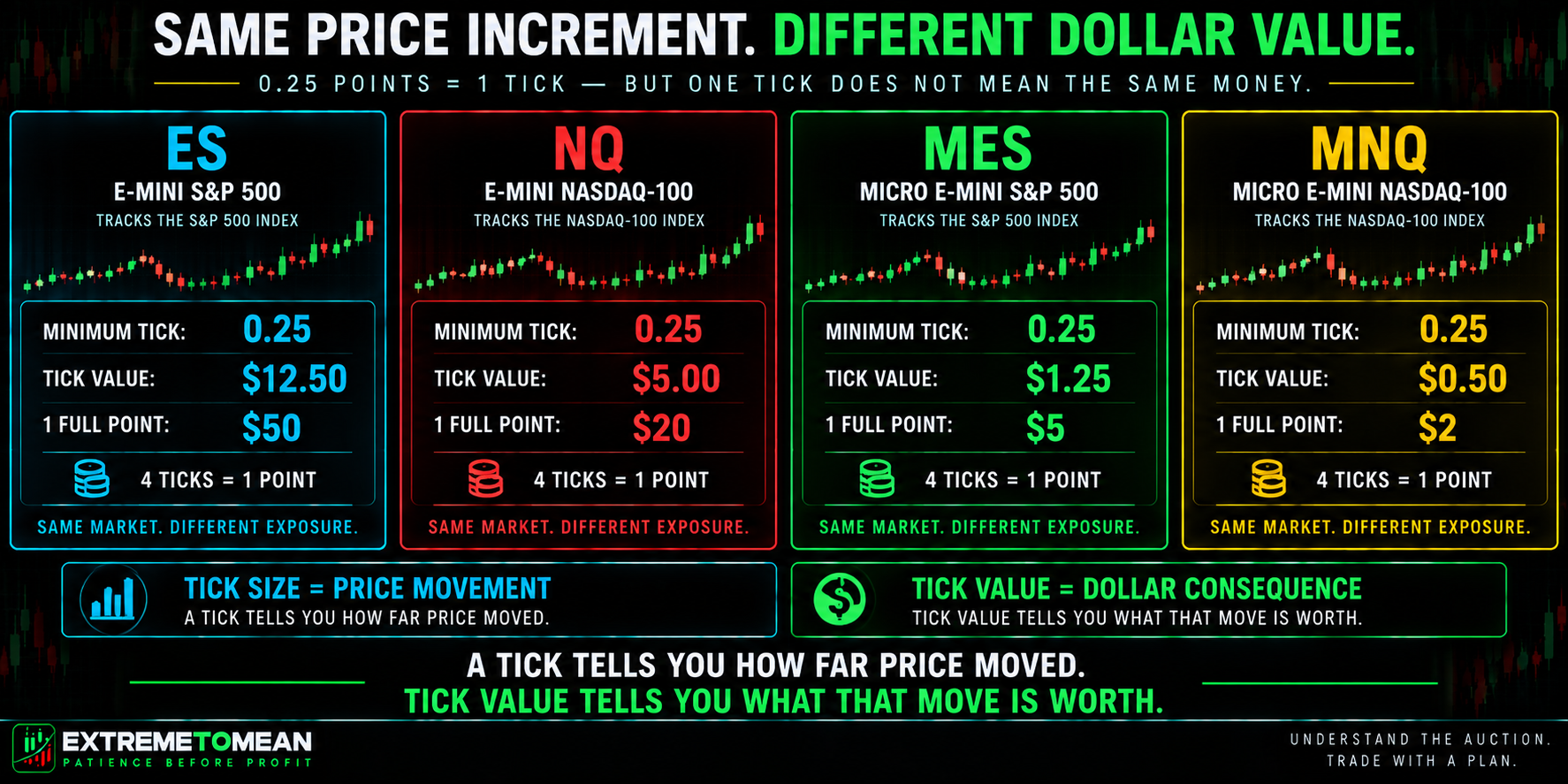
For all four contracts covered here, the minimum price movement is 0.25 index points, so four ticks equal one full point. What changes is the multiplier and therefore the dollar value of each tick and point. Once those relationships are understood, most of the math is simple multiplication.
| Contract | Market | Minimum Tick | Tick Value | 1 Full Point |
|---|---|---|---|---|
| ES | E-mini S&P 500 | 0.25 | $12.50 | $50 |
| NQ | E-mini Nasdaq-100 | 0.25 | $5.00 | $20 |
| MES | Micro E-mini S&P 500 | 0.25 | $1.25 | $5 |
| MNQ | Micro E-mini Nasdaq-100 | 0.25 | $0.50 | $2 |
Memorizing the table is useful, but understanding it is better. A tick tells you the smallest permitted price movement, while tick value tells you what that movement is worth for one contract. The broader lesson on ticks, points, and contract value covers the vocabulary; here we are applying it specifically to ES, NQ, MES, and MNQ.
A Tick and a Point Are Different Measurements
A tick is the minimum price increment in which a contract normally trades. If ES moves from 6000.00 to 6000.25, that is one tick; a move from 6000.00 to 6001.00 is four ticks, or one full point. For these contracts, the conversion is simple: points × 4 = ticks, while ticks × 0.25 = points.
That means 25 ticks and 25 points are not the same thing. Twenty-five ticks equal 6.25 points, while 25 points equal 100 ticks. On one NQ contract, 25 ticks represent $125 of gross contract movement, while 25 points represent $500 before costs and execution differences.
The better question is not, “Did price move a lot of ticks?” Ask, “How far did price move, and what is that distance worth in this specific contract?” That keeps price measurement separate from dollar exposure.
The Contract Multiplier Turns Price Into Dollars
The contract multiplier is the bridge between a move on the chart and a move in the account. One full point is worth $50 in ES, $20 in NQ, $5 in MES, and $2 in MNQ. Multiply the point movement by that value and then by the number of contracts to get the gross contract P&L.
Price movement in points × dollar value per point × number of contracts = gross dollar P&L
The same calculation can be done in ticks. ES is $12.50 per tick, NQ is $5, MES is $1.25, and MNQ is $0.50. The formula is number of ticks × tick value × number of contracts = gross dollar P&L.
A five-point ES move shows why both methods work. Five points multiplied by $50 equals $250 for one ES, while 20 ticks multiplied by $12.50 also equals $250. Ticks and points are simply two ways to describe the same price movement.
The Same Move Can Mean Very Different Dollars
A ten-point move makes the differences easy to see. One ES moving ten points represents $500 of gross contract movement, one NQ represents $200, one MES represents $50, and one MNQ represents $20. The chart distance is identical, but the dollar exposure is not.
| Contract | 10-Point Move | Gross Movement for 1 Contract |
|---|---|---|
| ES | 10 × $50 | $500 |
| NQ | 10 × $20 | $200 |
| MES | 10 × $5 | $50 |
| MNQ | 10 × $2 | $20 |
Those numbers do not mean ES is automatically riskier than NQ. Trade risk also depends on the stop distance, volatility, contract quantity, and strategy. Point value is one component of the risk decision, not the whole decision.
A 10-Point Stop Does Not Mean the Same Risk
Suppose market structure says a trade is wrong ten points from entry. With one ES, that planned contract movement is $500; with one NQ it is $200; with one MES it is $50; and with one MNQ it is $20. The invalidation distance stayed exactly the same while the contract changed what that distance meant financially.
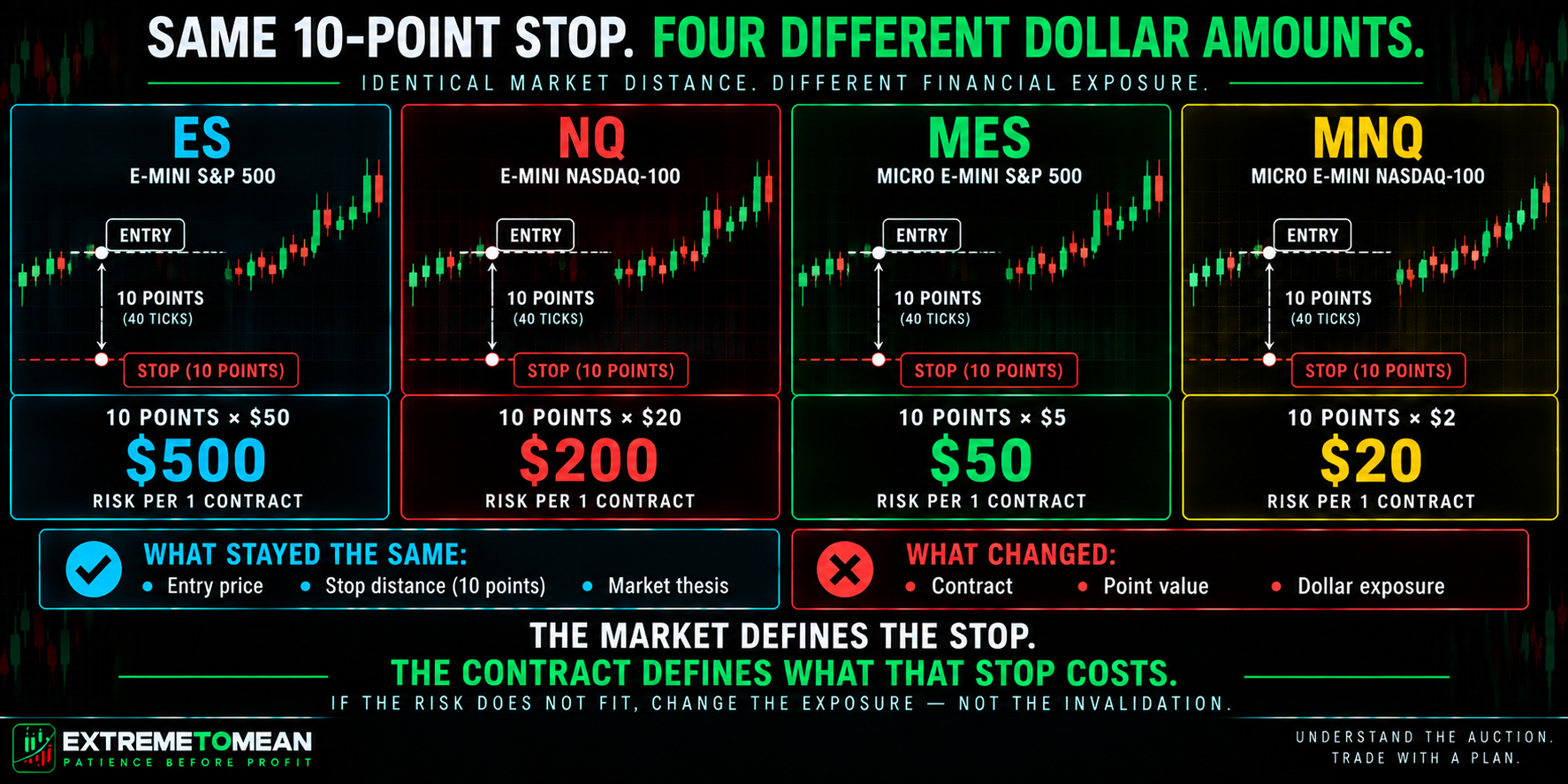
This is why position size should not begin with “I always trade one NQ” or “I always trade five Micros.” The market determines where the trade becomes invalid, and the contract converts that distance into money. Position size comes after those facts are known, as explained more fully in futures position sizing.
Quantity Multiplies Everything
Tick value and point value are quoted per contract, so quantity has to be included in every real calculation. One MNQ is $2 per point, five MNQ are $10 per point, and ten MNQ are $20 per point—the same gross point exposure as one NQ, although costs and execution characteristics may differ. The word “Micro” describes each contract, not the total size of the position.
The same relationship exists between MES and ES: ten MES produce $50 per point of gross exposure, matching one ES multiplier. More contracts do not make a trade more qualified, and a stronger-looking setup does not change what each tick is worth. Market confidence does not alter contract mathematics.
Margin, Tick Value, and Trade Risk Are Different
Margin answers whether the account is permitted to hold the position under applicable requirements. Tick value tells you what the smallest price movement is worth, while planned trade risk requires both a stop distance and a contract quantity. A 10-point stop in one NQ represents $200 of planned contract movement, while the same stop in two NQ represents $400.
A stop order is not a guarantee that the realized loss will equal the clean calculation. Fast movement, thin liquidity, and slippage can produce a fill beyond the intended stop, while commissions and fees affect the final net result. The arithmetic defines planned exposure, not a guaranteed maximum realized loss.
Define Invalidation Before Solving for Dollars
The weakest sequence starts with a desired dollar loss and works backward until the stop fits it. A trader might decide they only want to lose $100 and squeeze an NQ stop into five points even though five points has no structural meaning. The dollar limit matters, but it should control exposure rather than rewrite the trade.
The cleaner sequence is to determine where the trade is wrong, measure the distance, convert that distance into dollars for one contract, and then adjust size. If the exposure is too large, use fewer contracts, use an appropriate Micro, or pass. The trade is not ready until the risk is clear, and clear risk begins with market-based invalidation.
A better question is: “What does the correct invalidation cost in this contract, and what quantity lets that trade fit my risk plan?” Dollar risk should determine how much of the trade you take, not where the market is allowed to prove you wrong. That is the difference between sizing the trade and distorting it.
A Practical Tick-to-Risk Workflow
The calculation should be completed before the entry is moving quickly. A trader should already know the contract’s tick size, tick value, point value, and how quantity changes exposure. That makes the math part of preparation rather than something improvised under pressure.
- Identify the contract: ES, NQ, MES, or MNQ.
- Define invalidation: Where does the market prove the thesis wrong?
- Measure the distance: Calculate entry to stop in points or ticks.
- Convert the distance: Apply the contract’s point value or tick value.
- Apply quantity: Multiply the one-contract amount by the intended contracts.
- Compare with the risk budget: Does the exposure fit the account and plan?
- Adjust exposure if necessary: Reduce quantity, use the appropriate Micro, or pass.
- Allow for real-world costs: Remember commissions, fees, and possible slippage.
The sequence is Setup → Invalidation → Distance → Contract Value → Quantity → Dollar Risk → Decision. Quantity comes late in the process rather than first. The trader evaluates the setup, defines the risk, and then decides how much exposure—if any—the opportunity deserves.
Final Thought
Ticks and points tell you how far futures prices move. Tick values and multipliers tell you what that movement means financially, while quantity determines how large the exposure becomes. Once those pieces are connected, a “10-point stop” becomes a specific planned dollar amount that can be compared with the account’s risk limits.
The goal is not to memorize four numbers and trade mechanically. Know where the market proves the idea wrong, translate that distance into dollars, and adjust the contract or quantity instead of distorting the setup. For the broader process connecting qualification, invalidation, and risk, continue with the Extreme to Mean system.
Educational content only. Trading involves substantial risk and is not suitable for everyone.