
An account may have enough margin for several contracts while the planned stop makes even one too much risk. Inside The Setup, contract count should come near the end of the planning process, after the trade itself has been defined. Position size is an output, not the starting assumption.
Use Setup → Invalidation → Stop Distance → Contract Value → Dollar Risk Per Contract → Risk Budget → Contract Count. Each step answers a different part of the risk problem before size is chosen. The market decides how much room the trade needs; your risk plan decides how much of that trade you can afford.
Position Size Is Not the Same as Buying Power
Futures margin answers whether the account has enough collateral to hold a position. It does not define acceptable stop-loss risk, and even one allowed contract can be too large. Margin answers “Can the account hold it?” Risk sizing answers “Can the account survive it?”
That is also why “I only trade one contract” is not a complete risk rule. Contract economics and stop distance both matter. One contract is a quantity—not a measure of risk.
You Cannot Size the Trade Until You Know Where It Is Wrong
Position sizing begins with invalidation, not preferred size. If a long entry is planned at 6,500 and the setup becomes invalid below 6,492, the eight-point distance is part of the trade's logic before size is chosen. The lesson on where the trade is wrong explains why that boundary should come from structure rather than account arithmetic.
Suppose a trader always uses two ES contracts. A four-point stop risks $400 across the position, while a 14-point stop risks $1,400 across the same two contracts. Same size does not mean same risk when stop distance changes.
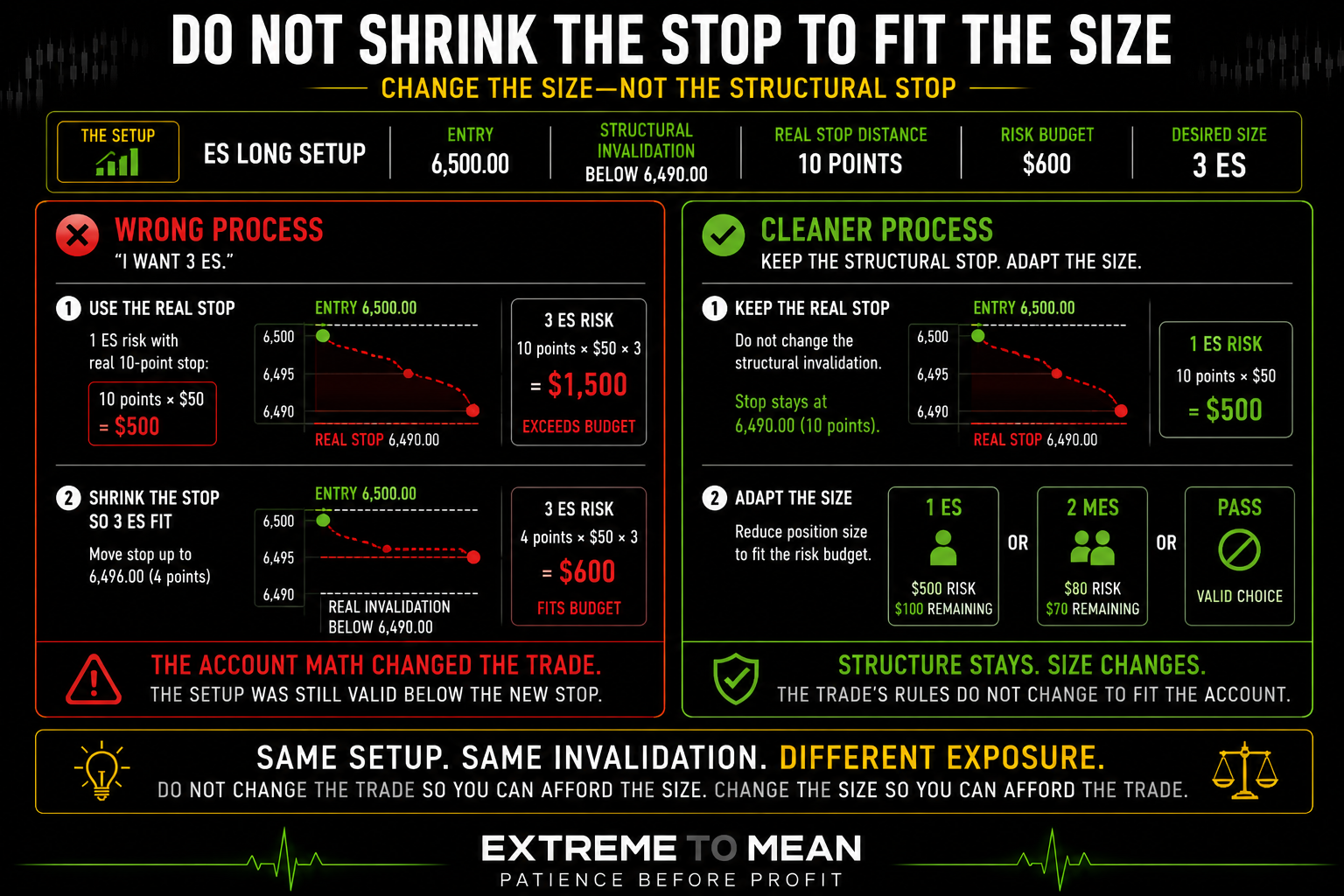
The wrong solution is to choose the desired contract count first and then pull the stop closer until the numbers fit. If the setup remains valid beyond that tighter stop, the trader has changed the trade to preserve the size. Contract count should be the result of the risk calculation—not an input into it.
Convert the Stop Distance Into Dollar Risk
For equity-index futures, first convert the stop into dollar risk for one contract. In points, use Dollar Risk Per Contract = Stop Distance in Points × Dollar Value Per Point; in ticks, use Dollar Risk Per Contract = Ticks to Stop × Dollar Value Per Tick. For ES, one point is worth $50 and a 0.25-point tick is worth $12.50, so an eight-point or 32-tick stop represents $400 of planned price risk before commissions, fees, and execution effects.
For a contract-specific walk-through of ES, NQ, MES, and MNQ tick and point values, see ES, NQ, MES & MNQ Tick Values Explained.
MES expresses the same S&P 500 idea at one-tenth the ES multiplier. An eight-point stop is $40 per MES, while a hypothetical 30-point NQ stop is $600 per NQ or $60 per MNQ. A smaller contract lets you resize the risk without rewriting the setup.
The Futures Position-Sizing Formula
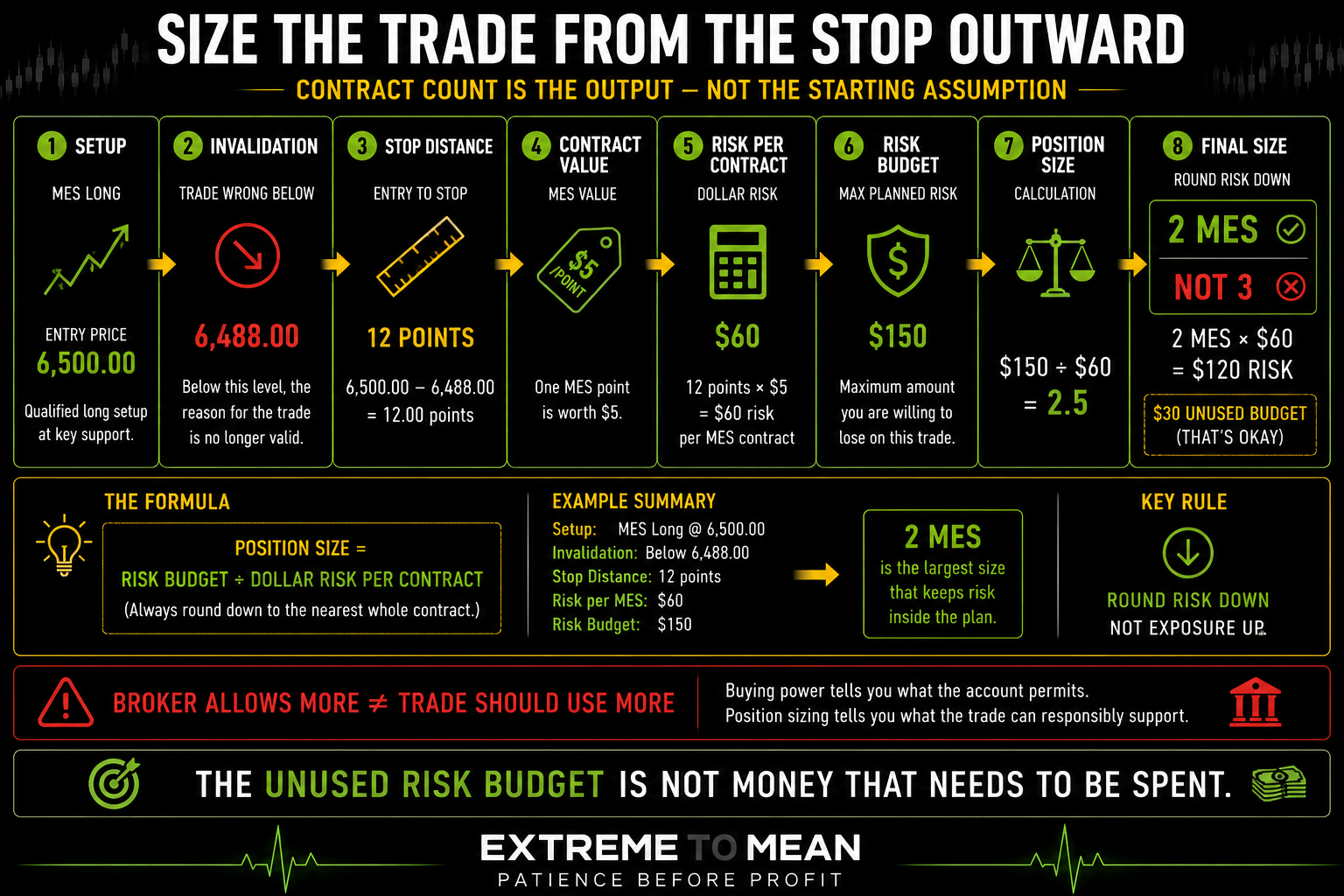
Once one-contract risk is known, compare it with the maximum planned loss using Position Size = Risk Budget ÷ Dollar Risk Per Contract. This turns the trade's structural risk into a whole-contract decision. Consider a $150 risk budget and a MES trade with a 12-point stop.
One MES risks 12 × $5 = $60, so $150 ÷ $60 = 2.5 contracts; because futures trade in whole contracts, the largest size inside the budget is 2 MES, or $120 of planned price risk. When the math lands between contracts, round risk down—not exposure up. The unused $30 is not a problem to solve.
Three MES would create $180 of planned price risk and exceed the stated maximum. There is no requirement to consume every dollar the trader was willing to risk. The unused risk budget is not money that needs to be spent.
Sometimes the Formula Says E-mini, Micro, or Zero
Micros are useful when one E-mini is already too large for the planned stop. If a 25-point NQ stop represents $500 per NQ but the risk budget is $250, one NQ does not fit; the same stop is $50 per MNQ, so five MNQ can express the idea within the stated budget. The setup remains the same while the contract size changes.
The practical differences among MES, MNQ, MYM, and M2K are covered in this Micro futures guide.
The calculation can also produce a number below one even for a Micro. If a 100-point MNQ stop represents $200 but the maximum planned risk is $75, one MNQ is already too large. Zero is a valid position size.
Micros improve sizing precision, but per-contract costs may rise as quantity increases. That matters when many smaller contracts replace one larger contract. Smaller contracts improve flexibility; they do not make risk disappear.
This is one reason the trade is not ready until the risk is clear. A sensible setup can still fail the risk test because the smallest position is too large. Passing is part of position sizing, not a failure to participate.
A Risk Budget Is a Limit, Not a Target
A risk budget is the maximum planned account loss the trader is willing to accept if the trade reaches its intended stop. Some traders use fixed dollars and others use a percentage of equity, but no percentage such as 1% is a universal law. The method has to fit the strategy, account, and broader risk framework.
Daily limits, losing streaks, correlated positions, trading frequency, and prop drawdown rules can all make sensible risk smaller than a simple account percentage suggests. A nominal prop-account number can be especially misleading when the actual loss room is much smaller. In a prop account, size against the risk room—not the marketing number.
Volatility Should Change Size Through the Real Stop
A consistent risk budget can require an inconsistent number of contracts. If a MES setup needs a four-point stop, each contract risks $20 and a $100 budget can support five; if another valid setup needs a ten-point stop, each MES risks $50 and the same budget supports only two. Wider valid stop → more dollar risk per contract → smaller position.
Volatility tools can explain changing structural room, but sizing still uses the planned stop. ATR should not automatically become a universal stop formula unless that exact rule belongs to a tested strategy. The real stop remains the bridge between market structure and contract count.
Suppose a trader wants three ES with a ten-point structural stop, creating $1,500 of planned price risk, but the risk budget is $600. Moving the stop to four points merely to preserve three contracts reverses the process because the new stop no longer reflects invalidation. Do not change the trade so you can afford the size; change the size so you can afford the trade.
Planned Risk Is Still an Estimate
The calculation assumes an orderly exit near the stop, but execution can be worse. Slippage, fast markets, scheduled releases, and thin conditions can increase realized loss, so some traders reserve room for estimated execution costs inside the risk budget. Planned stop risk is a planning estimate—not a guaranteed maximum loss.
Risk also needs to be viewed across the account. A $300 ES risk and a separate $300 NQ risk may pass individually, yet simultaneous positions can create overlapping equity-index exposure because the markets are often correlated. Two different tickers can still create one concentrated risk.
Oversizing Changes the Strategy Experience
Position sizing looks mathematical until size changes behavior. A trader may accept a loss amount on paper and then find that live P&L causes premature exits, stop movement, refusal to take the planned loss, or constant attention to dollars instead of structure. If changing the contract count changes your ability to follow the rules, size is changing the strategy.
Position sizing does not improve location, confirmation, target quality, or win probability. It changes the financial magnitude of the outcome. As what an edge actually is explains, exposure cannot create expectancy that was not already present.
A Practical Futures Position-Sizing Framework
Use Setup → Invalidation → Distance → Contract → Dollars → Risk Budget → Size → Survival. The framework keeps market logic ahead of account arithmetic and makes contract count the output rather than an income goal. It also gives the trader a repeatable sequence to review after the trade.
- Setup: Is there actually a qualified trade?
- Invalidation: Where is the trade wrong?
- Distance: How far is entry from that invalidation?
- Contract: What is this futures contract worth per point or tick?
- Dollars: What does one contract risk at the planned stop?
- Risk Budget: What is the maximum planned loss this trade may carry?
- Size: How many whole contracts fit without exceeding that maximum?
- Survival: Would the size remain tolerable through a normal losing sequence and still let you follow the strategy?
The better question is not “How many contracts can my account trade?” Ask, “Can I take this setup at its natural risk without forcing the market to fit my account?” If the answer is no, the correct output may be a Micro, fewer contracts, or zero.
Size the trade from the stop outward—not from the buying power downward. The setup defines invalidation, the contract defines dollar value, the risk plan defines the budget, and the math defines the allowable size. Leverage should remain subordinate to the trade rather than redesigning it.
Final Thought
Position sizing is where a trading idea becomes account exposure. Define where the setup is wrong, measure the stop distance, convert that distance into dollar risk for one contract, and only then decide how many whole contracts fit. Skipping that order turns contract count into a guess.
The calculation may call for a Micro, smaller size, unused risk budget, or no position. Those are legitimate outputs because the goal is not to spend every available dollar of risk. A valid setup with invalid size is still an invalid trading decision.
The market defines the stop, the contract defines the dollar value, the risk plan defines the budget, and the math defines the size. Keeping those jobs separate helps prevent a manageable setup from becoming an emotional trade. That relationship between patience, risk, and process continues in The Patience Principle.
In a prop environment, conservative size can protect both drawdown room and decision quality while the trader learns the account. Why small position size is a prop trader's first advantage explains that trade-off.
Educational content only. Trading involves substantial risk and is not suitable for everyone.