
Traders do not gain or lose abstract “points” in their accounts. The account balance changes in dollars, which means every price move must eventually be translated into a financial result. A five-point move may look identical on two charts while producing very different exposure depending on the instrument, contract size, and number of contracts being traded.
This distinction is especially important in futures because every contract has its own minimum tick size, tick value, multiplier, and dollar value per point. Two contracts can track the same underlying market and display nearly identical price movement while affecting the account very differently.
For a concrete comparison of those relationships across the major equity-index contracts, see ES, NQ, MES & MNQ Tick Values Explained.
Before studying these relationships, it helps to understand how entry price, exit price, and price difference create profit or loss. The next step is learning how that price difference is converted into an actual dollar amount before capital is placed at risk.
A Point Measures Price Movement
A point is a unit used to describe how far a market has moved. If a futures contract rises from 5,200 to 5,205, it has moved five points. If it falls from 5,205 to 5,202, the movement is three points.
The basic calculation is:
Exit price − entry price = point movement
A long position entered at 5,200 and exited at 5,205 gained five points because 5,205 minus 5,200 equals five. A short position entered at 5,205 and exited at 5,200 also moved five points in the trader’s favor because the market declined after the short entry.
Points describe the distance between prices, but they do not provide the complete financial result. The trader must also know how much one point is worth for the specific instrument being traded. That value is not universal across stocks, futures, commodities, or even different contracts tied to the same market.
This is why saying, “I made ten points,” does not explain the actual result. The instrument, contract type, quantity, and dollar value per point all matter. Without those details, the point total has no consistent financial meaning.
A Tick Is the Smallest Allowed Price Movement
A tick is the smallest price increment in which a market or contract is permitted to move. The exchange defines this minimum price fluctuation, and it can differ significantly between instruments. Some contracts move in increments of 0.25 points, while others may use 0.10, 0.01, 0.50, one full point, or another quotation method. That single-authority model is a useful contrast to Bitcoin, whose issuance rules are enforced by independent validating nodes rather than one exchange, as explained in who enforces the 21 million Bitcoin limit.
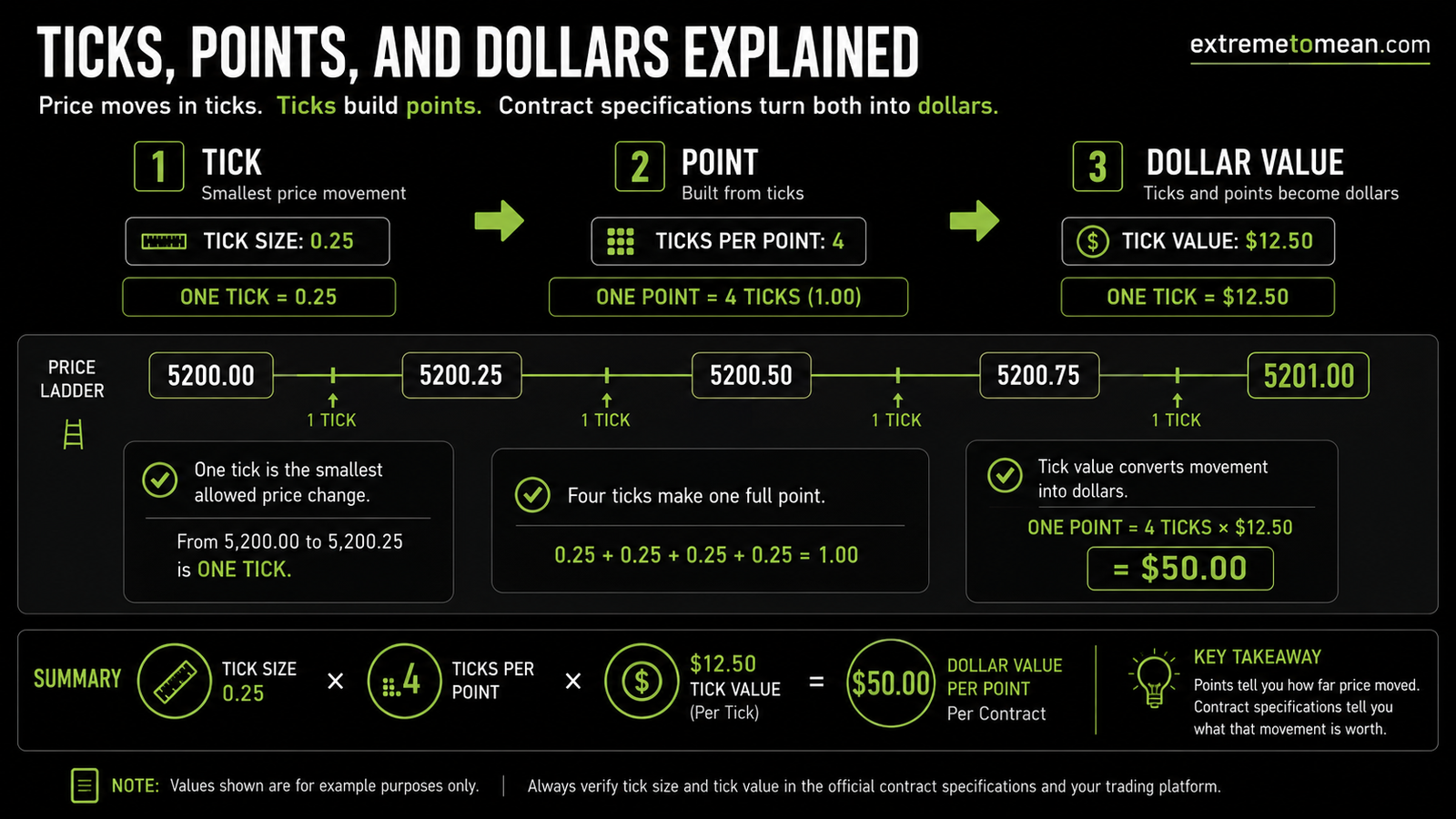
Suppose a contract has a tick size of 0.25 points. Its price can move from 5,200.00 to 5,200.25, then to 5,200.50, 5,200.75, and 5,201.00. Each quarter-point change is one tick, so four ticks equal one full point.
The relationship is:
One point ÷ tick size = ticks per point
For a contract with a 0.25 tick size, one divided by 0.25 equals four ticks per point. If that contract moves three points, it has moved twelve ticks because three points multiplied by four ticks per point equals twelve.
This distinction matters because brokers, platforms, and risk tools may display movement in either ticks or points. A trader who confuses the two can misunderstand a stop distance or underestimate the amount being risked. With quarter-point ticks, a three-tick stop equals only 0.75 points, while a three-point stop equals twelve ticks.
The exchange also assigns a dollar value to each tick. That tick value is what begins connecting the movement shown on the chart to the movement that appears in the trading account.
Tick Value and Point Value Are Not the Same
Tick value is the dollar amount gained or lost when one contract moves by one tick. Point value is the dollar amount gained or lost when one contract moves by one full point. They describe related parts of the same contract, but they are not interchangeable.
The relationship is:
Tick value × ticks per point = dollar value per point
Consider the E-mini S&P 500 futures contract, commonly identified as ES. Its minimum price movement is 0.25 index points, and each tick is worth $12.50 per contract. Because four ticks make one full point, each ES point is worth $50 per contract.
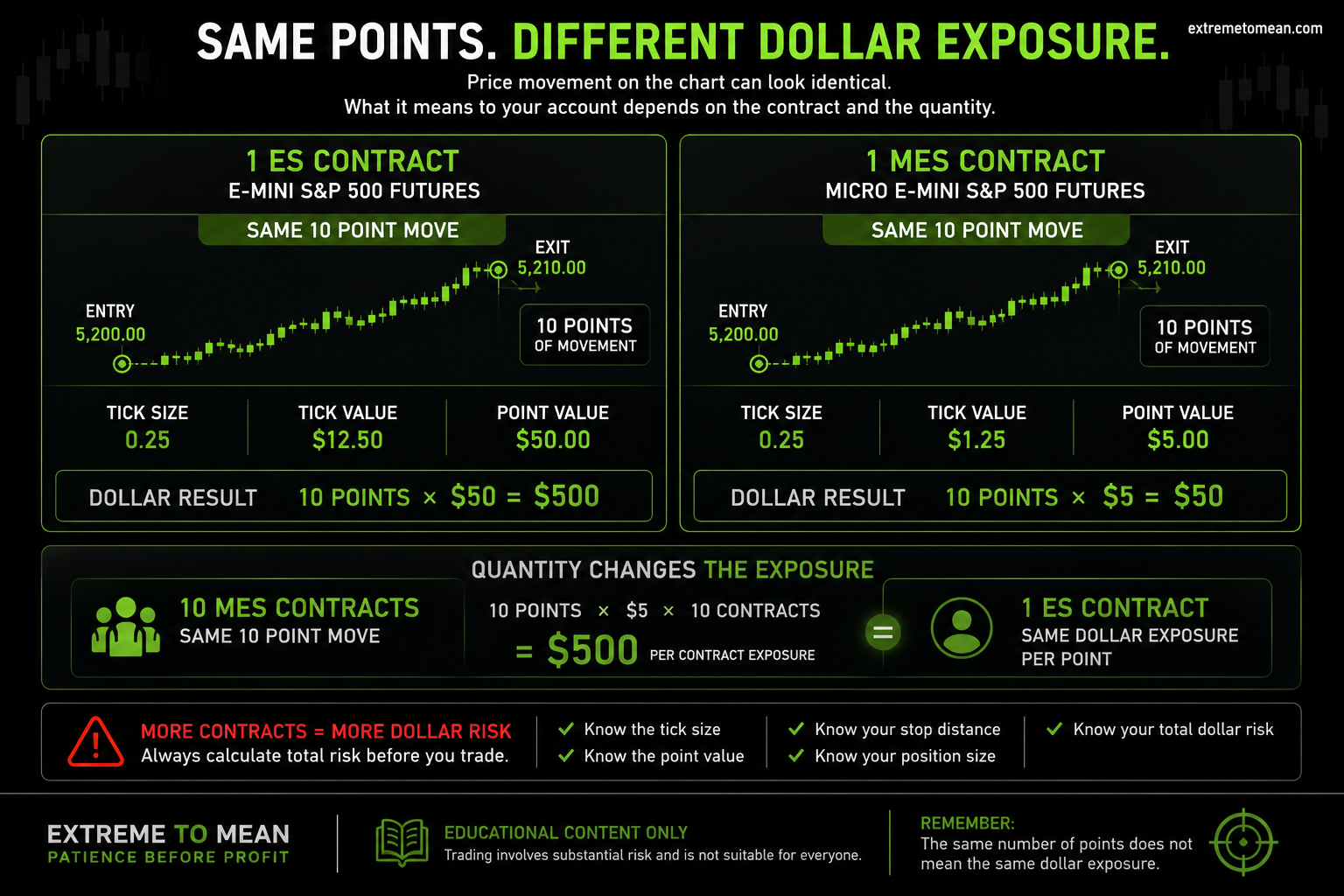
The Micro E-mini S&P 500 contract, MES, tracks the same underlying index but uses a smaller multiplier. It also moves in 0.25-point ticks, but each tick is worth $1.25 and each full point is worth $5 per contract.
| Contract | Tick size | Tick value | Point value |
|---|---|---|---|
| ES | 0.25 points | $12.50 | $50 |
| MES | 0.25 points | $1.25 | $5 |
A ten-point move in one ES contract represents $500 because ten points multiplied by $50 per point equals $500. The same ten-point move in one MES contract represents $50 because ten points multiplied by $5 per point equals $50.
The chart movement is identical, but the dollar exposure is not. This is one reason beginners should understand what a futures contract represents before choosing a market based only on how its chart appears.
Contract Value Can Mean Two Different Things
The phrase contract value is sometimes used loosely, which can create confusion. In everyday conversation, a trader may use it to describe the dollar value of one tick or point, such as saying that ES is worth $50 per point. In formal futures terminology, however, contract value often refers to the contract’s notional value.
Notional value represents the total market exposure controlled by one futures contract. For an equity-index future, the general relationship is:
Futures price × contract multiplier = notional contract value
If MES were trading at 5,200 and its multiplier were $5, the notional value would be $26,000. That does not mean the trader pays $26,000 to open one contract. Futures positions are generally opened using margin, which is not the same as total exposure or planned trade risk, and the amount posted as margin does not define the maximum possible loss.
Several related terms therefore need to remain separate:
- Notional contract value: The total market exposure represented by the contract.
- Point value: The dollar amount represented by one full point of movement.
- Tick value: The dollar amount represented by the smallest permitted price movement.
- Margin requirement: The capital that must be available to open or maintain the position under the broker’s or exchange’s rules.
Confusing margin with risk is particularly dangerous. Margin determines whether the account is permitted to hold the position, but it does not identify a sensible stop, maximum acceptable loss, or appropriate position size. Permission to control the contract is not the same as a plan for managing its exposure.
The Same Move Can Create Very Different Exposure
Traders often compare markets by the number of points they tend to move, but that comparison can be misleading. A twenty-point move may represent modest exposure in one contract and a much larger account change in another. Standard, mini, and micro contracts may follow almost identical charts while carrying very different dollar values per point.
Contract quantity changes the calculation again. If MES moves ten points, one contract changes by $50 because ten points multiplied by $5 per point equals $50. Four contracts turn the same move into $200, while ten MES contracts turn it into $500.
At ten MES contracts, the total dollar exposure per point equals one ES contract:
10 MES contracts × $5 per point = $50 per point
This is why a micro contract does not automatically make a trade low risk. The smaller contract provides greater flexibility, but the trader can remove that advantage by trading too many contracts. Total exposure matters more than the word “micro” in the contract name.
The better comparison is therefore not simply ES versus MES. It is the total dollar exposure after the contract type, point value, and number of contracts have all been considered.
Why Traders Misjudge Dollar Risk
The mistake often begins with the chart. A trader sees a nearby invalidation level and decides that the stop is “only three points away.” Three points may look small visually, especially in a fast-moving market, but visual distance does not determine the financial exposure.
With one ES contract, a three-point stop represents $150 of price risk because three points multiplied by $50 per point equals $150. With one MES contract, the same stop represents $15. With eight MES contracts, it represents $120.
Those figures describe only the planned price movement. The final result may also be affected by commissions, exchange fees, bid-ask spread, and slippage, which are explained in the real cost of a trade. A complete plan should therefore recognize that actual loss can differ from the clean price-risk calculation.
The mistake feels reasonable because traders naturally see the entry, stop, and target as visual locations first. A valid plan, however, must translate each of those locations into dollars before the order is placed. Until that translation is complete, the trader does not know what the setup means for the account.
A stop should not be moved closer simply because the correct structural stop creates more exposure than the trader wants. If the proper invalidation level costs too much, the cleaner choices are to reduce the number of contracts or pass on the trade. The setup must earn risk; it should not be distorted to fit an unsuitable position size.
Calculate the Exposure Before Entering
Before placing a futures trade, the trader should know the contract specifications and the full relationship between the entry, stop, and position size. A practical pre-trade calculation should confirm:
- The contract symbol and specifications: Identify the exact contract, minimum tick size, tick value, and dollar value per point.
- The entry and invalidation levels: Determine the distance between the planned entry and the level where the trade idea becomes wrong.
- The number of contracts: Position quantity must be included because exposure increases with every additional contract.
- The estimated dollar risk: Translate the full stop distance and contract quantity into an account amount.
- Whether the exposure is acceptable: The final dollar amount must fit the account and the quality of the setup.
The calculation can be performed in points:
Stop distance in points × dollar value per point × number of contracts = price risk
It can also be performed in ticks:
Stop distance in ticks × tick value × number of contracts = price risk
Both methods should produce the same answer. Suppose a contract has a 0.25 tick size and a $1.25 tick value, and the proposed stop is 2.5 points away. Dividing 2.5 by 0.25 converts the distance into ten ticks.
For three contracts, the tick-based calculation is:
10 ticks × $1.25 × 3 contracts = $37.50
The point-based calculation confirms the same result:
2.5 points × $5 per point × 3 contracts = $37.50
This math does not determine whether the setup is good. It cannot turn a weak location into a strong opportunity, make poor market conditions supportive, or guarantee an exact stop fill. Its purpose is to show what the planned market movement would mean financially before the trader commits capital.
The better question is not simply, “How many points could this trade make?” It is:
How many dollars are exposed if the trade reaches its invalidation level, and is that amount appropriate for this account and this setup?
That question shifts attention away from possible reward and toward decision quality.
Use Contract Specifications, Not Memory
Tick size, tick value, contract multiplier, settlement rules, and trading hours are defined in the contract specifications. Traders should not assume that every futures product works like an equity-index contract. Commodity, currency, interest-rate, and volatility futures may use different contract units, tick structures, or quotation conventions.
Before trading an unfamiliar contract, review the official exchange specifications and confirm the values inside the trading platform. This preparation should happen before the market becomes fast and before an order is waiting to be placed. Trying to remember an unfamiliar tick value while managing a live position introduces unnecessary uncertainty.
Contract specifications can also change, and different expirations or product versions may have distinct rules. The trader should rely on the current official information rather than on memory, a social-media post, or an example from another instrument. Preparation protects the decision before execution pressure begins.
Newer traders can continue through The Basics curriculum. Those building their full learning sequence can also start with the beginner trading path before moving into more advanced futures execution and risk planning.
Final Thought
Points describe how far price moved, while ticks describe the smallest permitted steps that created that movement. The contract specifications determine what each of those movements means in dollars. Contract choice, stop distance, and quantity must therefore be evaluated together.
Two contracts can display the same chart and produce very different financial exposure. A micro contract can still become oversized when too many contracts are used, and a visually small stop can represent meaningful account risk when the point value is high.
Before entering, translate the trade into dollars. Know the tick size, tick value, point value, number of contracts, and the amount the invalidation level would cost. Those numbers will not predict whether the trade wins or loses, but they will help ensure the trader understands the decision before capital is committed.
For a concrete metals example, see Micro Gold futures contract size, tick value, and risk.
Educational content only. Trading involves substantial risk and is not suitable for everyone.