
Traders often learn markets through strategy names. Breakout, pullback, reversal, mean reversion, and other labels can make price action look like a collection of unrelated patterns, even though many of those setups are built from the same underlying behaviors. Price persists, pressure strengthens or weakens, movement becomes extended, and volatility shifts between compression and expansion. Learning those behaviors gives the trader a framework that can travel from one setup to another and a clearer way to read The Market.
The four-part framework used here takes intellectual inspiration from principles associated with trader Linda Bradford Raschke, while applying them through the Extreme to Mean emphasis on context and evaluation. They are best treated as tendencies and diagnostic questions rather than universal laws. Trend can reverse, momentum can fail, exhaustion can resolve through time instead of price, and contraction can continue longer than expected. The value comes from recognizing what the market is doing now, not assuming one behavior guarantees the next.
Principle One: Trend Tends to Persist Until the Evidence Changes
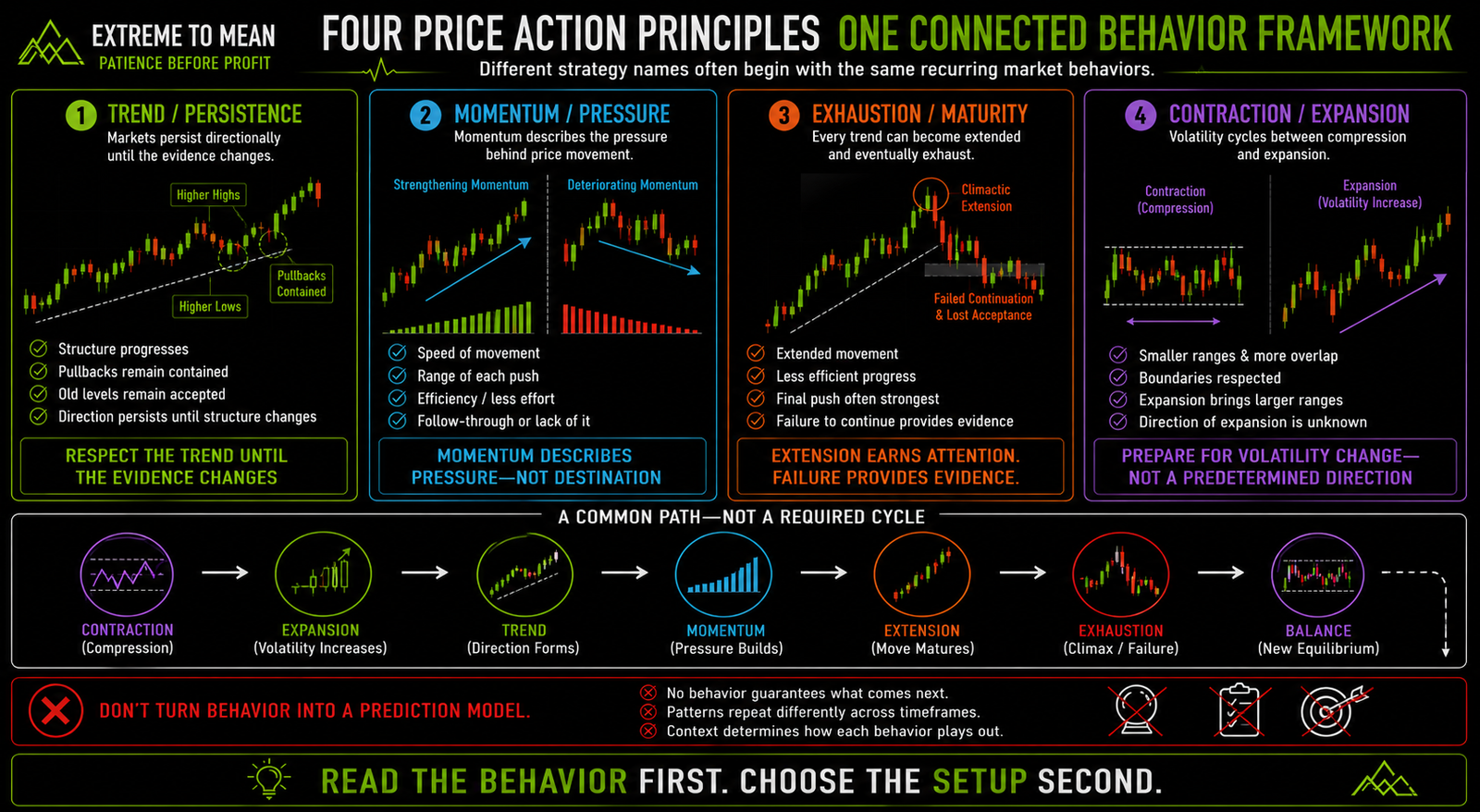
A trend is more than a run of candles moving in one direction. Directional persistence becomes more meaningful when price keeps making structural progress, pullbacks remain contained, broken areas stay accepted, and countertrend attempts fail to reclaim important structure. The practical assumption should not be that every trend must continue, but that an intact directional environment deserves respect until the market shows evidence that its character is changing. Fighting persistence simply because price looks high or low turns discomfort into a trading thesis.
A reversal requires something in the existing directional structure to deteriorate, while continuation only requires the current structure to remain functional. Thinking in terms of the three market states helps because the trader can distinguish intact directional behavior from transition or rotation. The better question is not "How far has this gone?" but "What has actually changed?" That question keeps the trader focused on evidence instead of distance.
Principle Two: Momentum Describes Pressure
Momentum describes how forcefully price is moving, not whether the next candle must continue in the same direction. Strong momentum often appears through faster progress, larger ranges, shallower interruptions, and repeated success when price pushes forward. When that pressure begins weakening, price may still make new highs or lows even though each attempt accomplishes less. That deterioration can become useful context before a larger structural change is obvious.
The danger is turning momentum into a prediction tool. An oscillator divergence, slower candle, or one weak push does not automatically mean reversal because trends can continue while momentum varies. A cleaner process compares pressure with structure: is weakening momentum producing failed breakouts, deeper retracements, or lost acceptance, or is the market merely pausing? This is why context comes before the candle, even when the candle appears to show obvious strength or weakness.
Principle Three: Trends Can End Through Exhaustion
Directional moves do not continue with equal efficiency forever. As a trend matures, price may become increasingly extended, ranges can expand sharply, and a final aggressive push can become difficult to sustain. Traders often describe this as climax or exhaustion. The important idea is that the strongest-looking part of a move can sometimes occur when the current directional process is becoming less stable.
Exhaustion still needs confirmation because extension alone does not prove the trend has ended. A strong market can remain extended, consolidate, and continue, while an apparent climax can produce only a temporary pullback. The reversal case becomes more credible when extreme movement is followed by failed acceptance, structural change, and inability to resume the prior direction. The distinction in Reversion Is Not Reversal matters because an exhausted move can revert without producing a durable reversal.
Principle Four: Range Contracts and Expands
Periods of contraction tend to feature smaller ranges, more overlap, tighter boundaries, and less directional progress, while expansion brings larger ranges and more decisive movement away from prior balance. The transition matters because a setup designed for rotation can struggle when range suddenly expands, while a breakout idea can become less attractive after much of the expansion has already occurred. Range behavior tells the trader how active the current price-discovery process has become. It does not tell the trader which direction must win.
Contraction can break higher, break lower, produce a false start, or remain compressed longer than expected. Expansion can also continue, stall, or create a new balance rather than extending indefinitely. The useful observation is that volatility changes state and that the trader should update expectations as the market shifts between compression and movement. Preparation for expansion is different from prediction of direction.
The Four Principles Work Together
These behaviors often connect in a recognizable sequence, but they should not be forced into a rigid cycle. Contraction can give way to expansion; expansion can establish a trend; momentum can carry that trend farther; extension can reduce efficiency; exhaustion may lead to balance; and balance can contract again. The sequence is useful because it shows how apparently different setups can emerge from connected market behavior. It becomes harmful when the trader assumes every contraction must expand immediately or every exhausted trend must reverse.
The same market can display several principles at once. A strong directional move can be trending, carrying high momentum, and expanding in range simultaneously, while a mature move can still trend even as momentum deteriorates. The trader therefore needs to describe the combination rather than search for one perfect label. Behavior asks what price is doing now; the broader market environment explains the context in which those behaviors are occurring.
Why Strategy Names Can Hide the Same Behavior
A comparison of trend, breakout, pullback, and mean-reversion strategies shows why the labels can look unrelated even when several depend on the same underlying behavior. A reversal setup and a mean-reversion setup may both appear after extension, but one requires structural change while the other may only require temporary movement back toward balance. Range-expansion ideas rely on volatility leaving compression, while rotational ideas usually fit better before expansion takes control. Recognizing the underlying behavior makes it easier to understand why the same named setup can perform differently across environments.
This is where market conditions change the quality of a setup. The chart pattern is only one layer of the decision; the behavior surrounding it determines whether the setup is aligned with what the market is currently doing. A pullback during healthy trend persistence is different from the same pullback after momentum has deteriorated and price is slipping into balance. The trader improves clarity by asking which behavior is active before asking which strategy name applies.
A Cleaner Behavior-First Process
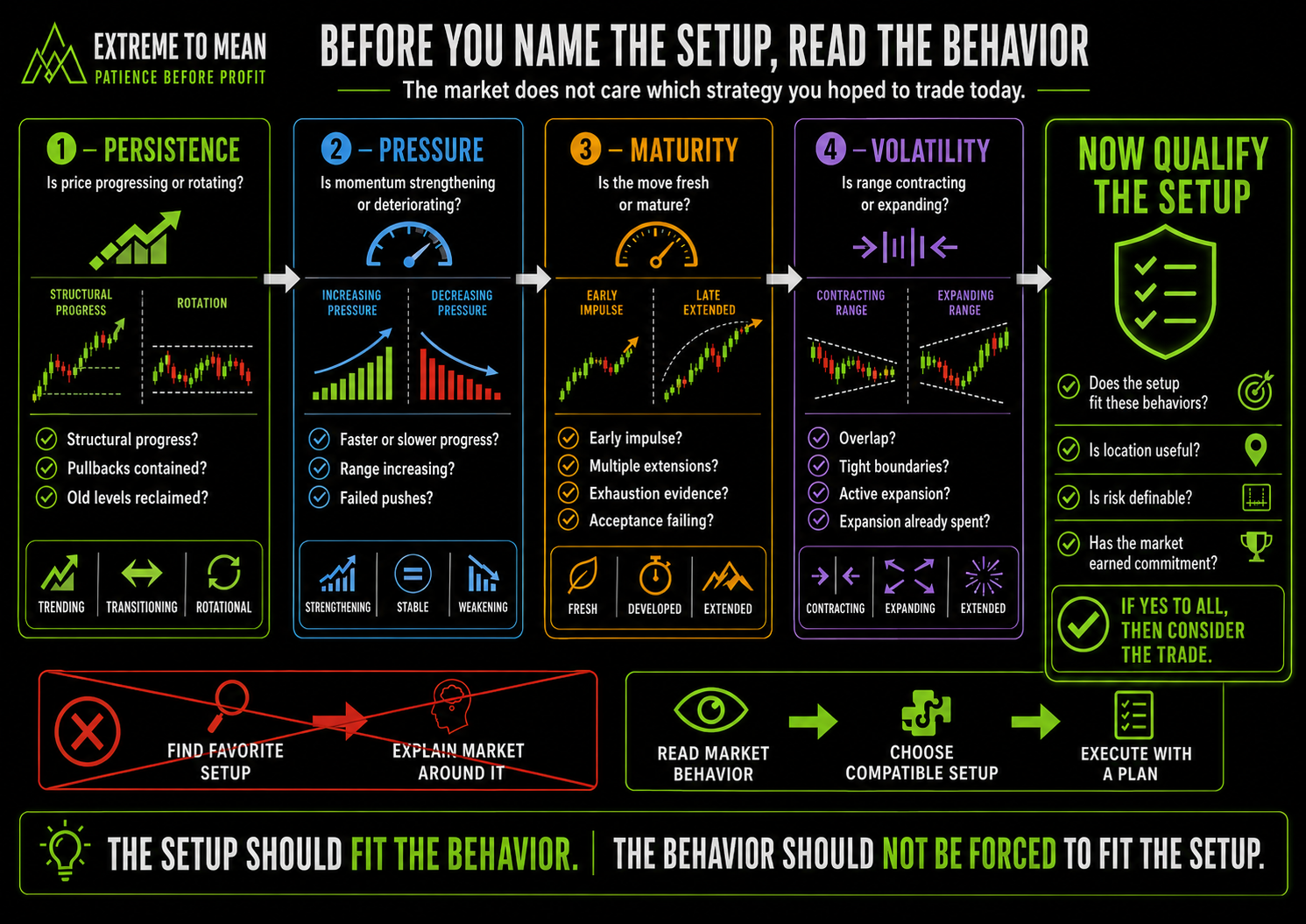
Strategy-first thinking feels efficient because it gives the trader something concrete to search for. If the plan says "trade breakouts," every range boundary becomes interesting; if the plan says "fade extremes," every large move begins to look exhausted. The cleaner alternative is to map behavior first: is price persisting or rotating, is momentum strengthening or weakening, is the move fresh or mature, and is range contracting or expanding? Those observations provide the context in which a setup should be judged.
That map has to remain flexible. A trend that was healthy an hour ago can begin losing momentum, an exhausted move can rebuild balance instead of reversing, and a tight range can expand in either direction. Updating the map before entry is not changing the story; it is responding to new evidence. The trader's job is to evaluate what the market is doing now rather than force the strategy they hoped to trade.
Better Questions Before Choosing a Strategy
A useful framework should reduce the assumptions required before a trade. Instead of asking only whether a named setup is present, ask which recurring behaviors are supporting or contradicting it. The questions do not have to produce a forecast; they need to clarify what kind of pressure, maturity, and volatility the setup is sitting inside. If the answers conflict, the trade may simply not be well qualified yet.
- Is price making sustained directional progress or mostly rotating?
- Are pullbacks contained, or are they reclaiming important structure?
- Is momentum strengthening, stable, or deteriorating?
- Is the current move fresh, mature, or showing signs of exhaustion?
- Is range contracting, expanding, or already extended?
- Does the setup I am considering align with those behaviors?
- What evidence would tell me the current behavior has changed?
- Am I trading what price is doing, or forcing a strategy I wanted to use?
These questions also improve review. A trader can record not just "breakout trade" or "reversal trade," but whether trend persistence, momentum, exhaustion, and range behavior supported the decision at the time. That makes it easier to separate a poor outcome from a poorly matched process and to identify recurring mistakes. The benefit is a more consistent framework for evaluation, not a promise that reading behavior correctly will produce a particular result.
Final Thought
Trend, momentum, exhaustion, and range expansion provide a compact way to organize many of the behaviors traders see every day. They explain why price can persist, accelerate, lose efficiency, compress, and move again without requiring a separate theory for every named strategy. The principles can overlap, change across timeframes, and conflict during transitions. Their purpose is to improve the trader's description of the market, not eliminate uncertainty.
Learn the behavior before reaching for the setup. Trend deserves respect while persistence remains intact, momentum should be read as pressure rather than prediction, exhaustion needs structural evidence, and contraction tells you to prepare for change without pretending to know its direction. For a deeper framework on reading these behaviors inside broader market structure, Decode the Market is the natural next step. Many strategies look different on the surface, but disciplined evaluation begins with a small number of recurring market behaviors underneath them.
Educational content only. Trading involves substantial risk and is not suitable for everyone.