
Inside The Setup, strategy selection should begin before entry hunting. A trader determined to find a breakout can turn every resistance test into one, while a trader determined to fade can call every strong trend “too extended.” The cleaner process identifies the market behavior first, then asks which strategy family is designed to exploit it.
Traders often reverse that order because a candle, indicator, or level catches their attention first. They see VWAP, RSI, a moving-average cross, or a breakout line and call the tool their strategy. An entry tells you when you acted; a strategy explains why the opportunity should exist in the first place.
Strategy, Setup, Signal, and Timeframe Are Different
A strategy is the broad behavior being exploited, a setup is a repeatable circumstance that makes that strategy interesting, and a trigger or entry is the evidence used to act. Trade management begins after entry, while timeframe describes how long the trader intends to participate. Mixing those ideas makes it easy to turn one signal into a trade thesis it was never meant to provide.
Indicators belong one level lower. VWAP can support reversion, trend context, or location, while CVD, RSI, or a candlestick can support several different strategies depending on the question. The tool is not the edge—the market behavior the tool helps you identify is what matters.
The Four Main Strategy Families
These four families organize different market hypotheses, and they can overlap as conditions evolve. A breakout can start a trend, a pullback can become an entry structure inside that trend, and a failed expansion can later contribute to a reversion idea. Trading strategies are different ways of organizing market behavior—not boxes the market promises to remain inside.
| Strategy | What It Tries to Exploit | Best-Suited General Condition | Core Question |
|---|---|---|---|
| Trend | Persistence of directional movement | Established directional market | Is direction continuing? |
| Breakout | Expansion beyond a meaningful boundary | Compression/balance resolving into expansion | Is price being accepted outside the prior area? |
| Pullback | Temporary retracement inside a larger directional move | Established trend with controlled retracement | Is the trend resuming after better location? |
| Mean Reversion | Return toward balance after meaningful extension | Extended, rotational, or stabilizing market | Has the extreme begun losing continuation? |
Pullback deserves one nuance because it often describes an entry approach inside a broader trend thesis. The trend trader wants to participate with direction, while the pullback trader often waits for that direction to retrace toward a better location first. Trend describes the direction you want to participate in; pullback often describes how you wait for a better place to participate.
Trend and Breakout Strategies Look for Continuation
Trend trading is built around persistence. The trader assumes established directional behavior may continue long enough to create another opportunity, not that every move continues forever. The deeper trend-trading foundation explains why direction still needs structure, room, location, and invalidation.
A trend strategy can look broken when the market supplies rotation instead of persistence, while breakout trading fails when a boundary is crossed without real acceptance. The Opening Range Breakout lesson applies that principle to one specific setup: the break gets attention; acceptance earns confidence. A good continuation idea can still become a poor trade if the trader chases after useful location and room are gone.
A wick beyond resistance is therefore not automatically a successful breakout, just as strong directional movement is not automatic permission to chase a trend. Both approaches still need location, available room, and a clear failure point. A valid market read does not make every later entry valid.
Pullback and Mean Reversion Trade Different Retracements
A pullback trader usually agrees with the larger directional move but refuses to chase it. Price retraces toward structure or another meaningful area, and the trader asks whether the original direction remains intact and is beginning to resume. The trend-pullback strategy develops that distinction without treating every dip or rally as an opportunity.
Mean reversion starts from a different thesis: price has moved meaningfully away from a defined reference or balance and may begin moving back toward it. Strong trends and genuine repricing can remain extreme, so distance alone is not enough; the broader mean-reversion foundation explains why the reference, deviation, volatility, and market state all matter. Mean reversion trades distance plus changing behavior—not distance alone.
The two can look similar because both involve price moving against a recent direction, but they expect different outcomes. A pullback trades the end of the retracement in expectation that the larger direction resumes, while mean reversion trades the retracement itself toward balance. A pullback may never come, and accepting that missed move is part of refusing to chase.
One Session Can Offer More Than One Strategy
Imagine ES compresses, breaks higher, retests the old boundary, develops sustained directional structure, and later becomes unusually extended. A breakout trader may focus on the initial expansion, a pullback trader on the retest, a trend trader on later persistence, and a mean-reversion trader only after the extension begins losing continuation. The strategy can change as the market changes.
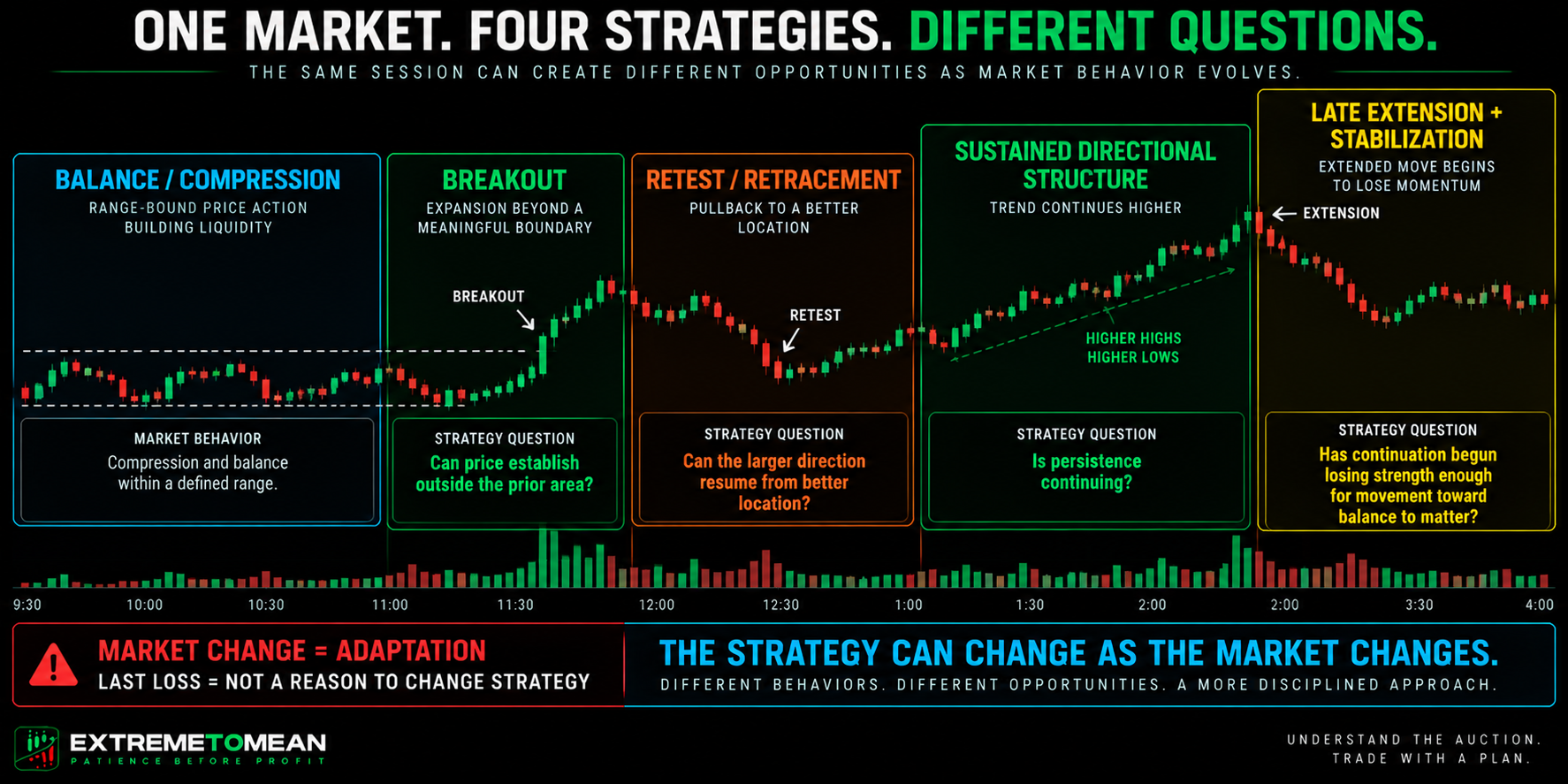
That flexibility should not become strategy hopping. Losing a breakout and immediately relabeling the same market as a mean-reversion short, then switching again after another loss, is reaction rather than adaptation. Changing strategy because the condition changed is adaptation; changing strategy because the last trade lost is strategy hopping.
Market Condition Comes Before Strategy Selection
The market should narrow the strategy choices before the trader searches for an entry. A broader market-state framework can distinguish trend, rotation, and transition, but the practical point is simple: identify what the market is doing before deciding what you want to trade. The market does not owe your favorite strategy a suitable environment every day.
| Market Condition | Strategy Families That May Become Relevant | Main Risk |
|---|---|---|
| Persistent directional structure | Trend / Pullback | Chasing or entering late |
| Compression near meaningful boundary | Breakout | False break / rejection |
| Trend with orderly retracement | Pullback | Mistaking reversal for pullback |
| Meaningful extension from balance | Mean reversion | Fading continued repricing |
| Overlapping unclear chop | Often none | Overtrading noise |
This is not an entry matrix. A trend may exist without a usable pullback, compression may never resolve cleanly, and an extreme may remain extended without qualifying a reversion. A strategy-comparison framework is useful partly because it can tell you that none of the available strategies fit.
There Is No Universal Best Strategy
Questions about the best beginner strategy, highest win rate, or most profitable strategy cannot be answered by the category name. Results depend on the instrument, timeframe, entry, stop, target, market regime, costs, slippage, and exact rules. Strategy names are categories; edges live in specific rules.
A day trading strategy for beginners therefore needs to be clearly defined, testable, appropriately sized, and reviewable rather than simply popular. One trader may understand pullbacks more naturally, while another may be better able to define a reversion process. The relevant question is whether the trader can explain what makes the setup valid and what would prove it wrong.
Understanding all four families also does not mean trading all four. Specialization can reduce the number of opportunities available while making it clearer when a trade actually belongs in the plan. The goal is not to become prepared to trade everything; it is to recognize when your trade is actually present.
Every Strategy Still Needs Risk and Specific Rules
Every strategy needs invalidation. Trend must define when persistence has failed, breakout when acceptance has failed, pullback when the retracement has become structural failure, and mean reversion when extension is continuing rather than unwinding. A strategy is incomplete if it can explain the entry but not what would prove the idea wrong.
Targets should come from the behavior being captured rather than the ratio a trader wants a calculator to display, while position size depends on stop distance, contract value, account risk, and volatility. Backtesting should evaluate specific rules using an adequate sample, costs, expectancy, average wins and losses, drawdown, and regime dependence rather than judging a category from a few recent trades. You are not testing “breakout trading”; you are testing your particular breakout rules.
A Practical ETM Strategy-Selection Framework
Use Condition → Behavior → Strategy → Location → Setup → Invalidation → Size → Target → Decision. This keeps the market upstream of the strategy and the strategy upstream of the entry. Choose the strategy from the market condition, then make the setup earn the trade.
- Condition: What market environment exists?
- Behavior: What are you trying to exploit—persistence, expansion, resumption, or return toward balance?
- Strategy: Which family is designed for that behavior?
- Location: Where does the opportunity make sense?
- Setup: Has a specific repeatable circumstance qualified?
- Invalidation: What proves the thesis wrong?
- Size: How much of that risk fits the account?
- Target: What realistic outcome does the strategy seek?
- Decision: Trade, wait, or pass.
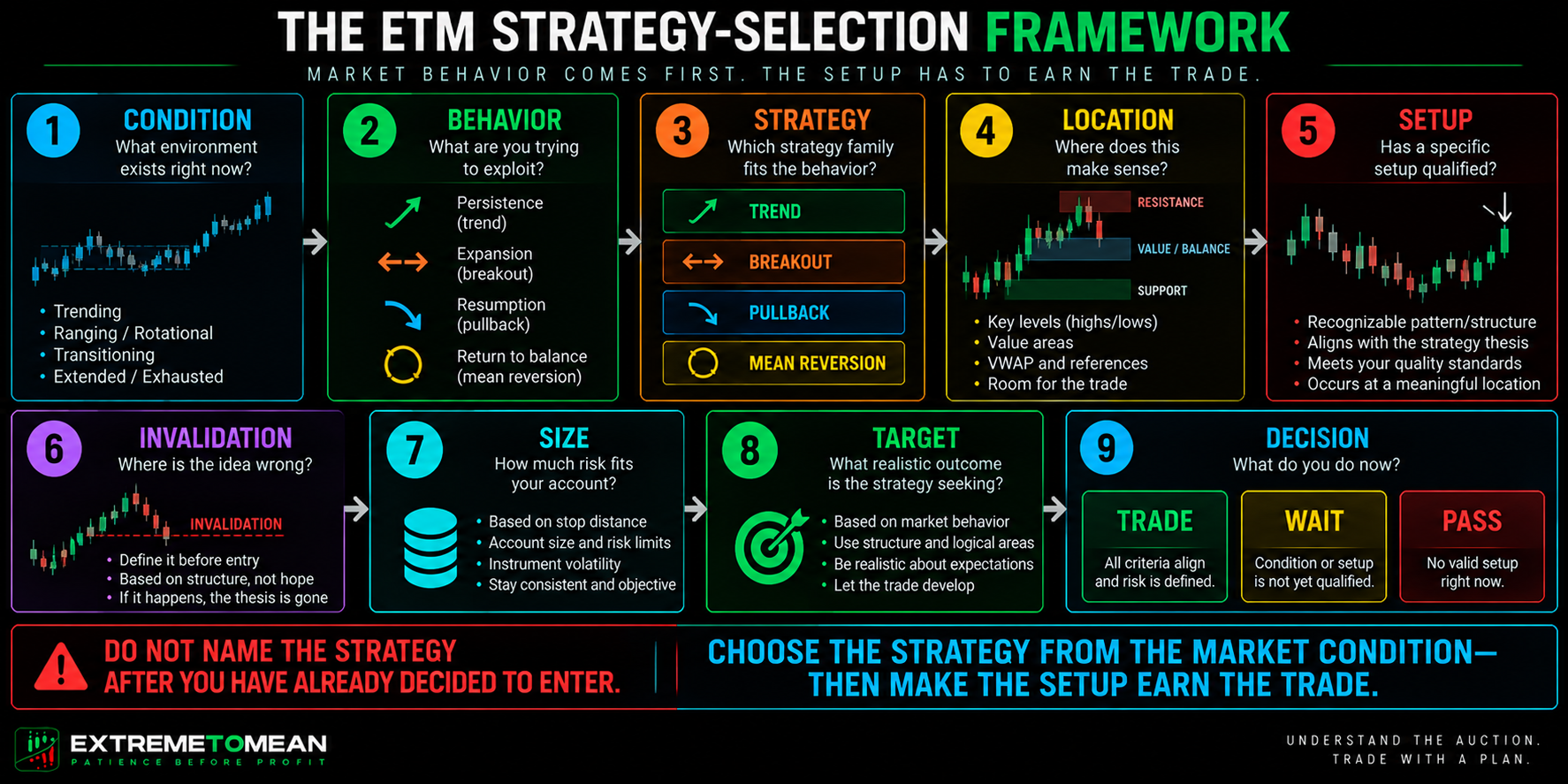
The better question is not “Which strategy do I feel like trading today?” Ask, “What is the market actually doing, which behavior am I trying to exploit, and has a specific setup earned risk inside that condition?” If no strategy fits, the framework has still done its job.
Common Day-Trading Strategy Mistakes
Common errors usually come from confusing categories or forcing a preferred trade onto the market. Most begin with the trade the trader wants rather than the condition the market is actually offering. The most common versions include:
- Calling an indicator, candlestick, or entry signal a strategy.
- Trend trading a balanced market or chasing because direction looks obvious.
- Buying every break above resistance without evaluating acceptance or remaining room.
- Calling every retracement a pullback when no established trend exists.
- Fading every extreme or treating mean reversion as automatic top/bottom picking.
- Strategy hopping after losses or assuming every session must contain a tradable strategy.
- Skipping invalidation, forcing targets from desired reward-to-risk, or using the same size across different stops.
- Judging a strategy from a few trades while ignoring costs, sample size, and market regime.
Final Thought
The goal is not to identify a universally best day trading strategy. Trend looks for persistence, breakout looks for expansion and acceptance, pullback waits to rejoin direction from better location, and mean reversion looks for meaningful extension that may unwind toward balance. Each approach begins with a different assumption, so market condition has to come first.
A trader can understand all four and still specialize in only one or two clearly defined setups. Start with the market you have, choose the strategy family that fits its behavior, make the setup prove itself through location and risk, and remain willing to pass when nothing qualifies. That context-first process is part of the broader discipline developed throughout Decode the Market.
Educational content only. Trading involves substantial risk and is not suitable for everyone.