
Why Futures Contracts Have to Roll
Inside The Basics, unlike a stock ticker that can represent the same listed company for years, an individual futures contract is tied to a specific expiration. ESU6 represents one E-mini S&P 500 expiration, while ESZ6 represents a later one, and both can exist at the same time. Eventually the September contract ends even though the ES product family continues.
That finite lifespan is why rollover exists. Traders who want exposure beyond the current expiration need a later contract, while flat day traders still need to know when the center of activity has shifted. A contract can remain technically tradable after it stops being the contract your process should be centered on.
This follows naturally from learning how futures contract symbols work. Reading ESU6 identifies the contract; rollover explains why ESU6 and ESZ6 can coexist and why the active symbol changes. During rollover, “ES” is not enough information—ask which ES contract.
Expiration, Rollover, Contract Switch, and Settlement
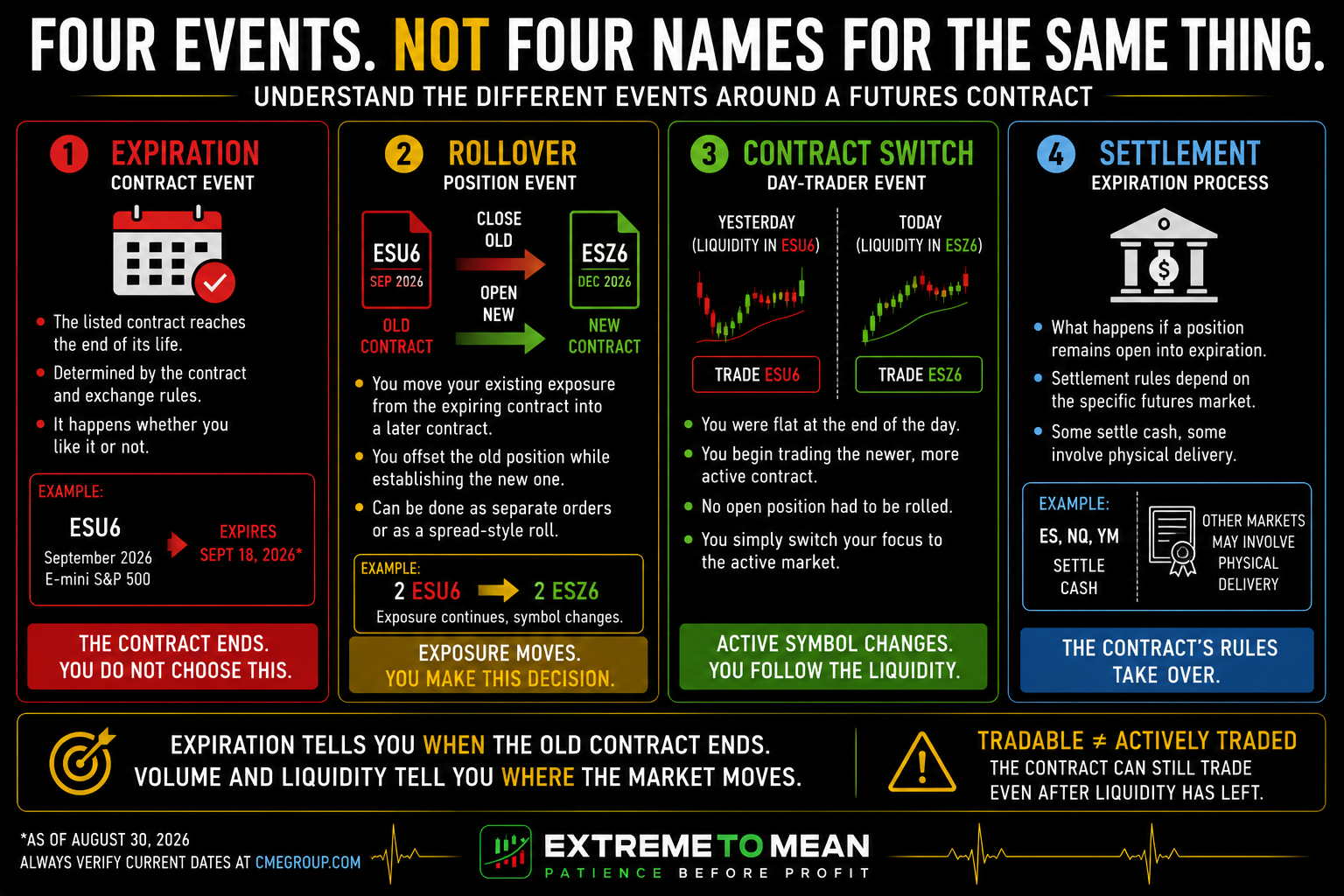
Expiration is the exchange-defined end of the listed contract's life. Rollover is a trader action that offsets exposure in the current contract and establishes exposure in a later expiration. CME describes rolling forward in that same general way: offset the current position while establishing one in a more distant contract month. (cmegroup.com)
A contract switch is slightly different for a day trader. Someone who finished yesterday flat may simply stop trading September and begin using December once the newer expiration becomes the active market. A flat day trader may switch contracts without ever carrying a position through a roll.
Settlement is what happens if a position remains open into expiration under that product's rules. Depending on the futures market, settlement may be cash-based or involve physical delivery, so traders need to know the specifications of what they trade. For the major U.S. equity-index futures discussed here, the contracts are cash settled rather than delivering a basket of hundreds of stocks. The contract expires automatically; the trader decides whether and when to roll. (cmegroup.com)
| Concept | What It Means | Who or What Determines It |
|---|---|---|
| Expiration | The listed contract reaches the end of its life | Contract / exchange rules |
| Rollover | Existing exposure is moved from the old contract to a later one | Trader |
| Contract switch | A flat trader begins using the newer active expiration | Trader + market liquidity |
| Settlement | The final process if held through expiration | Contract specifications |
The Quarterly Cycle Gives You the Calendar
The core U.S. equity-index futures commonly discussed at Extreme to Mean generally use the March, June, September, and December cycle: H → M → U → Z. That creates a predictable rollover calendar, but it does not mean every futures market uses the same schedule. Other futures products can have different listing and expiration structures. (cmegroup.com)
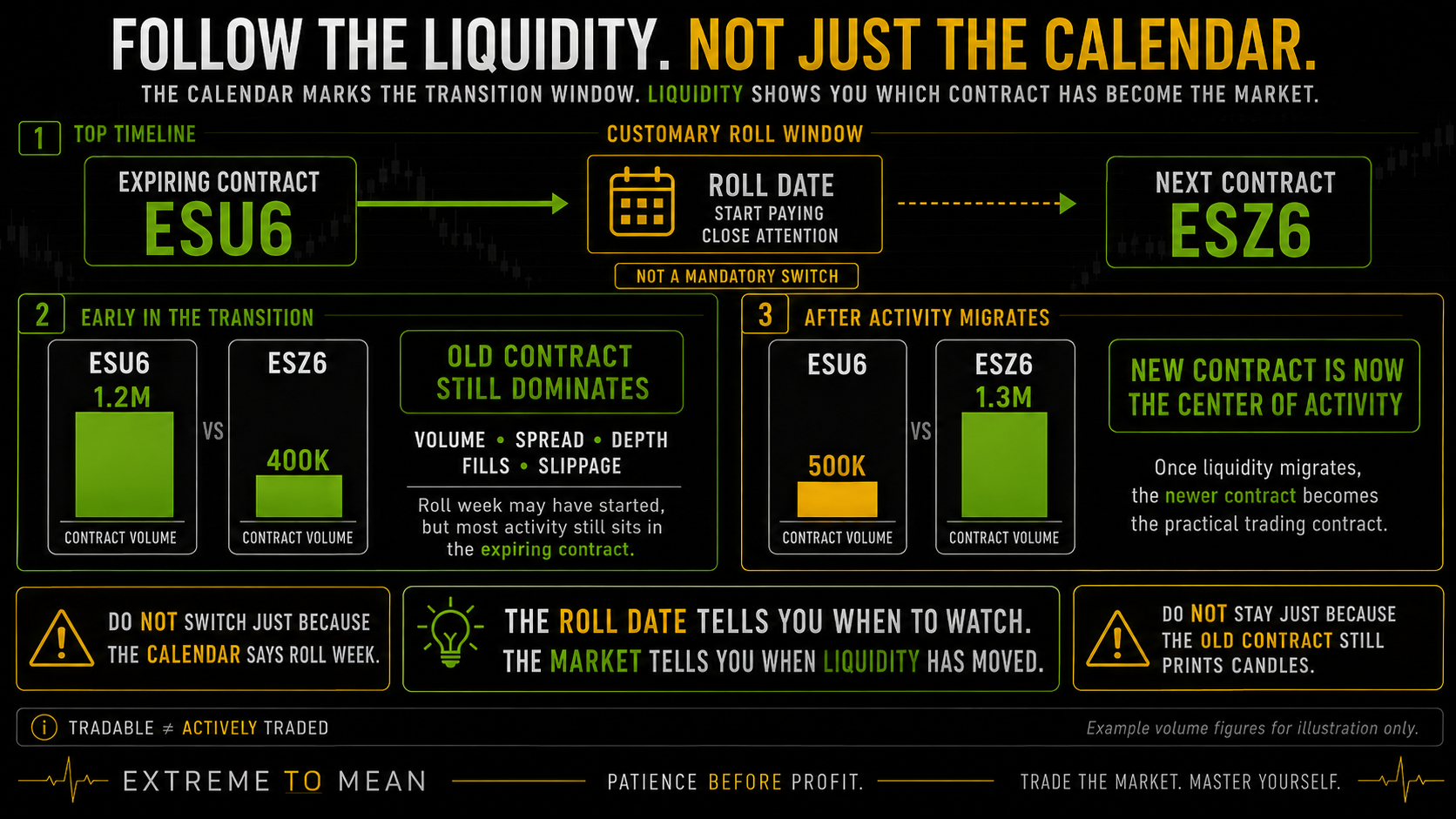
CME's equity-index roll calendar currently defines the customary U.S. equity-index roll date as the Monday before the third Friday of the quarterly expiration month, while also stating that participants may roll whenever they choose. For September 2026, CME lists September 14 as the customary roll date and September 18 as expiration. The date is a reference point, not a command to switch at one exact moment. (cmegroup.com)
Follow the Liquidity, Not Just the Calendar
CME's futures education tells traders to watch volume in both the expiring contract and the next contract as rollover develops. As volume decreases in the old expiration and increases in the new one, trading activity shifts toward the later contract. The calendar tells you expiration is coming; volume tells you where traders are actually moving. (cmegroup.com)
Imagine a hypothetical week where September ES trades 1.2 million contracts while December trades 400,000. Most activity still sits in September, so switching simply because roll week has started may be premature. Later, if September falls to 500,000 while December rises to 1.3 million, the center of participation has clearly shifted.
This is why futures trading hours and changing liquidity still matter during rollover. Compare old and new contracts during the hours you actually trade, including volume, spread, depth, and execution quality. The roll date tells you when to start paying attention; the market tells you when liquidity has actually moved.
Both Contracts Can Trade—and Their Prices Can Differ
During rollover, the old and new expirations are separate exchange-listed contracts. September ES and December ES can both trade normally at the same moment, so two traders can show different “ES” prices without either feed being wrong. Before troubleshooting the platform, compare the complete symbols.
Different expiration prices are normal because equity-index futures pricing reflects factors such as time to expiration, financing, and expected dividends. CME's fair-value material incorporates interest rates, dividends, and days to expiration into the relationship between futures and the cash index. Different expirations are different contracts, not duplicate copies of the same instrument. (cmegroup.com)
The new contract trading above or below the old one is not automatically bullish or bearish. The spread reflects pricing across different dates and can itself be traded, but that is separate from directional analysis. The roll spread is not the same thing as directional conviction.
“Front month” often means the nearest expiration, while “lead” or “active” month may refer to the contract where liquidity has concentrated. CME says the second-nearest expiration is customarily treated as the new lead month after its equity-index roll date as the expiring contract becomes less liquid. When terminology is unclear, ask whether the speaker means nearest expiration or most active contract. (cmegroup.com)
Rolling a Position Is More Than Changing the Ticker
Suppose a trader is long two September ES contracts and wants to maintain S&P 500 futures exposure beyond that expiration. Conceptually, the trader can sell two September contracts and buy two December contracts, closing the old exposure and opening the new one. CME describes a roll as offsetting the current position and establishing the forward-month position, either separately or through a spread-style transaction. (cmegroup.com)
A day trader who ends every session flat may never perform that position roll. The practical task may simply be changing the contract in the chart, watchlist, order ticket, and related tools once liquidity has migrated. The broader process in How to Trade Futures still applies: know the exact instrument before sending the order.
Continuous Charts Can Hide the Contract Change
A continuous futures chart stitches data from successive individual contracts into one longer history. That is useful for technical analysis and research because the trader does not have to open each quarterly chart separately. A continuous chart stitches history together; it does not create a futures contract that never expires.
Suppose the expiring contract is near 6,500 while the next contract is near 6,530 when the series switches. A raw continuous chart can show a 30-point jump even if there was no 30-point market event at that moment. A rollover gap can be a contract-pricing gap rather than a market-event gap.
Back-adjusted data reduces those discontinuities by modifying historical prices around contract transitions. The chart may look cleaner, but an adjusted historical level may no longer equal the literal price traded by the individual contract. A cleaner chart can come at the cost of changing historical price levels.
What Happens at Expiration
If an open position is neither offset nor rolled before expiration, it proceeds through the contract's settlement process. CME notes that settlement may be physical or cash depending on the market, while the major U.S. equity-index futures discussed here are cash-settled products. So ES expiration does not result in 500 stocks showing up at your house. (cmegroup.com)
That does not make expiration something a day trader should casually ignore. Active liquidity will generally have migrated before the old contract reaches its final settlement process, so the practical trading decision usually happens earlier. Expiration tells you when the old contract ends; it does not tell you how long it remains the best contract to day trade.
A Practical Futures-Rollover Framework
Use Expiration → Roll Window → Volume → Liquidity → Contract → Verify. The sequence starts with the calendar but refuses to let the calendar make the entire decision. Follow the liquidity, not just the calendar.
- Expiration: When does the current listed contract terminate?
- Roll Window: When should I begin monitoring the next expiration closely?
- Volume: Where is trading activity actually concentrating?
- Liquidity: Which contract currently offers the execution environment my process expects?
- Contract: Which specific expiration should I now analyze and trade?
- Verify: Before the order, are the product, month, year, and quantity correct?
The better question is not “Is today the official rollover day?” Ask, “Which expiration is now functioning as the active market for the way I trade?” Then verify the full symbol instead of trusting whichever saved ticker the platform happened to open.
Final Thought
Rollover becomes simpler once expiration and trading activity are separated. The exchange determines when the individual contract ends, while traders decide when to move exposure or switch the contract they use. A customary roll date tells you when the transition deserves attention; it does not replace observation of the market.
The beginner mistake is staying loyal to a familiar ticker because it still moves or switching early because the calendar says roll week has arrived. Both decisions ignore the same information: where volume and liquidity are actually concentrating. Do not trade the calendar instead of the market—but do not ignore the calendar until the market has already left you behind.
Before every quarterly transition, know the expiration, watch the old and new contracts together, and verify the symbol before execution. Understand whether your chart is specific or continuous before trusting historical levels. That turns rollover into normal futures preparation, and newer traders can continue building that foundation through Start Here.
Educational content only. Trading involves substantial risk and is not suitable for everyone.