
Start With the Root Symbol
The root symbol tells you the product family. ES identifies E-mini S&P 500 futures, NQ identifies E-mini Nasdaq-100 futures, and YM identifies E-mini Dow futures. If the underlying instrument itself is still unfamiliar, the foundational lesson on what a futures contract is should come before worrying about the expiration letters.
For the equity-index futures most often discussed at Extreme to Mean, the main roots are straightforward:
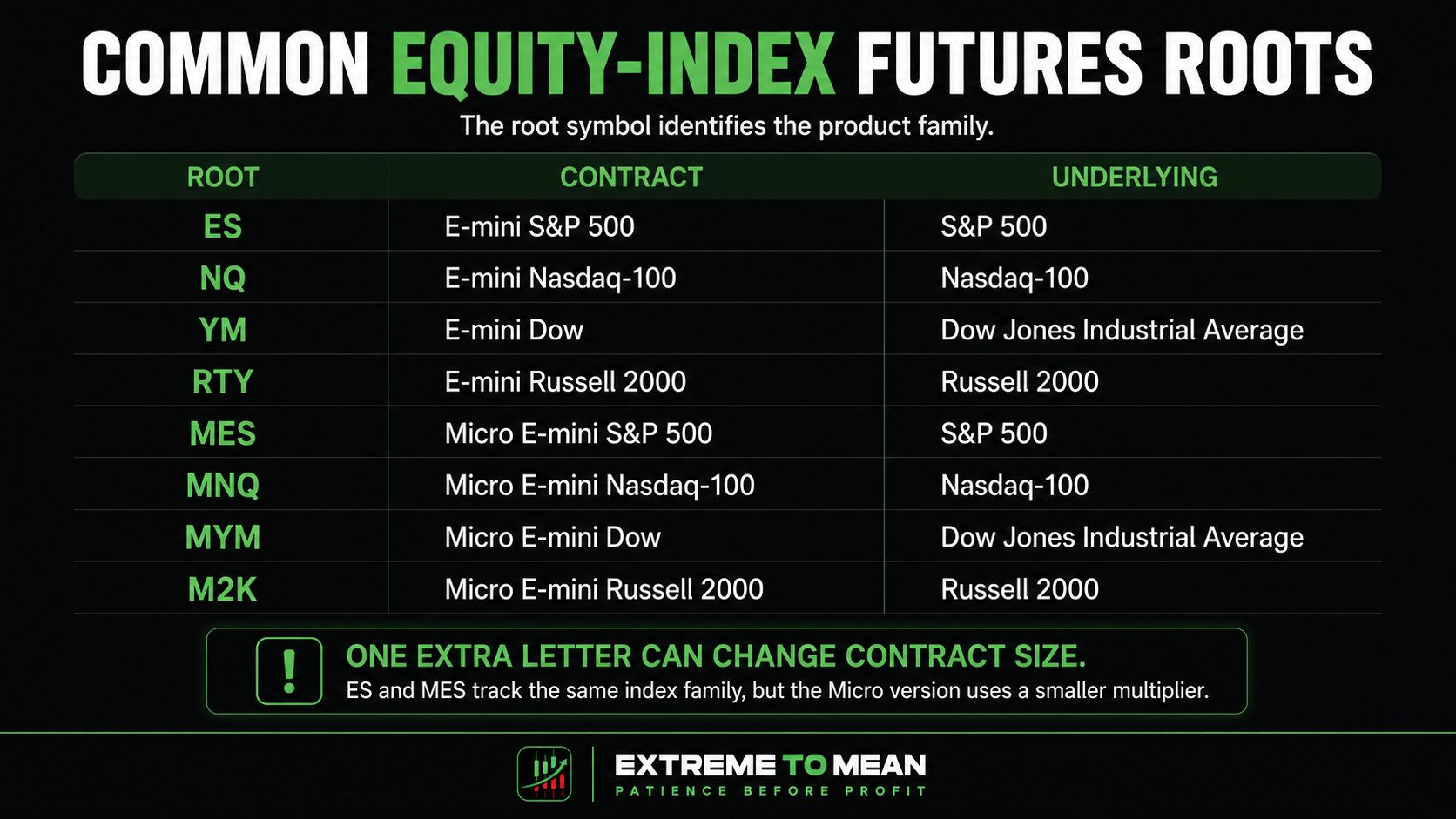
The Micro roots are especially important because one extra letter can represent a very different contract size. ES and MES belong to the same S&P 500 exposure family, while NQ and MNQ belong to the same Nasdaq-100 family, but the Micro versions use smaller multipliers. The root therefore identifies more than the index; it identifies the particular futures product built around that index.
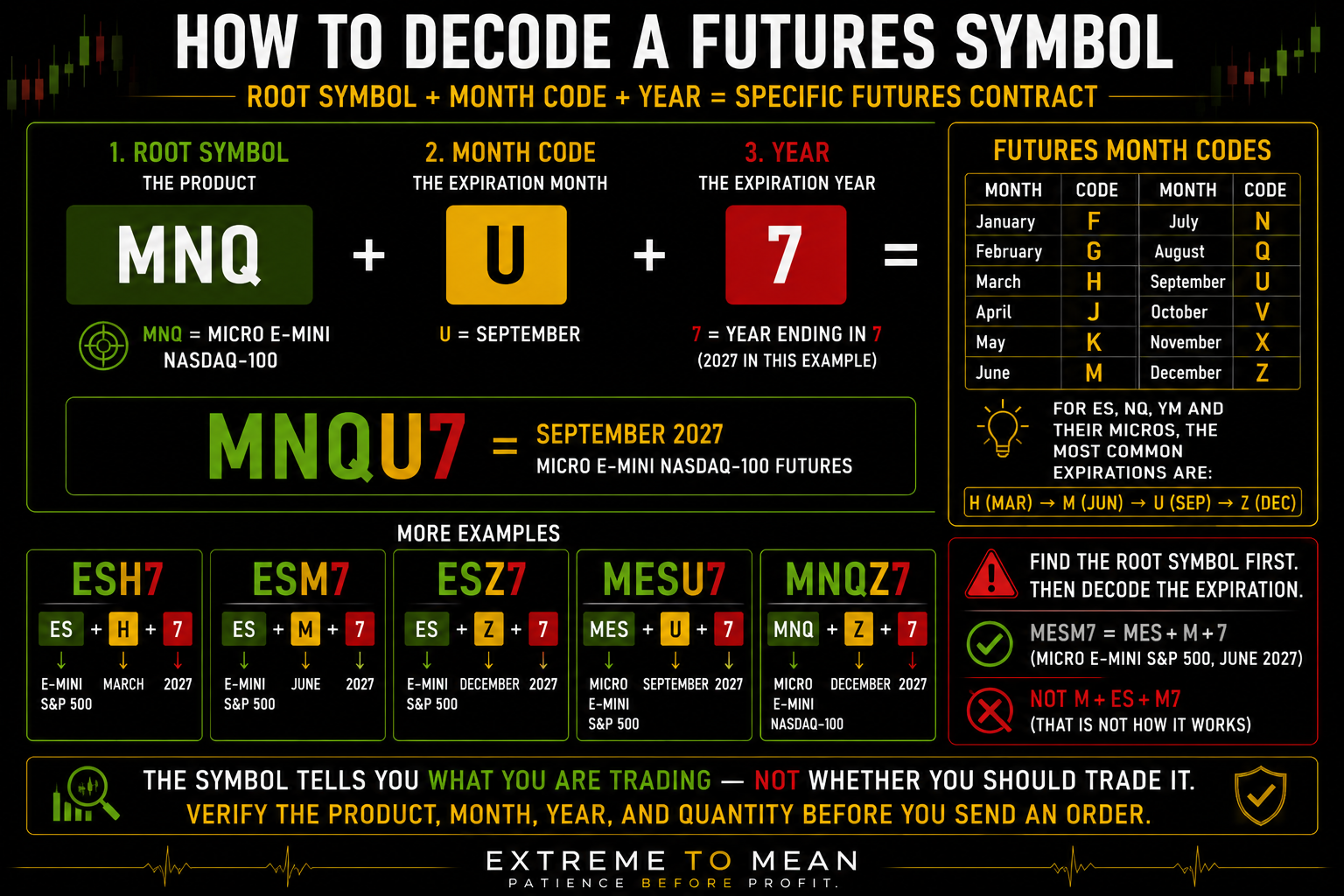
The M in MES does not mean March, margin, or “month.” MES is the complete root for the Micro E-mini S&P 500 contract, just as MNQ is the complete root for Micro E-mini Nasdaq-100. Find the root symbol first; then decode the expiration.
Futures Month Codes Are Their Own Language
After the root comes the expiration month. Futures use a standardized letter system, and the letters are not intuitive abbreviations of the month names. March is H, June is M, September is U, and December is Z, which is why beginners often need a reference table until the codes become familiar.
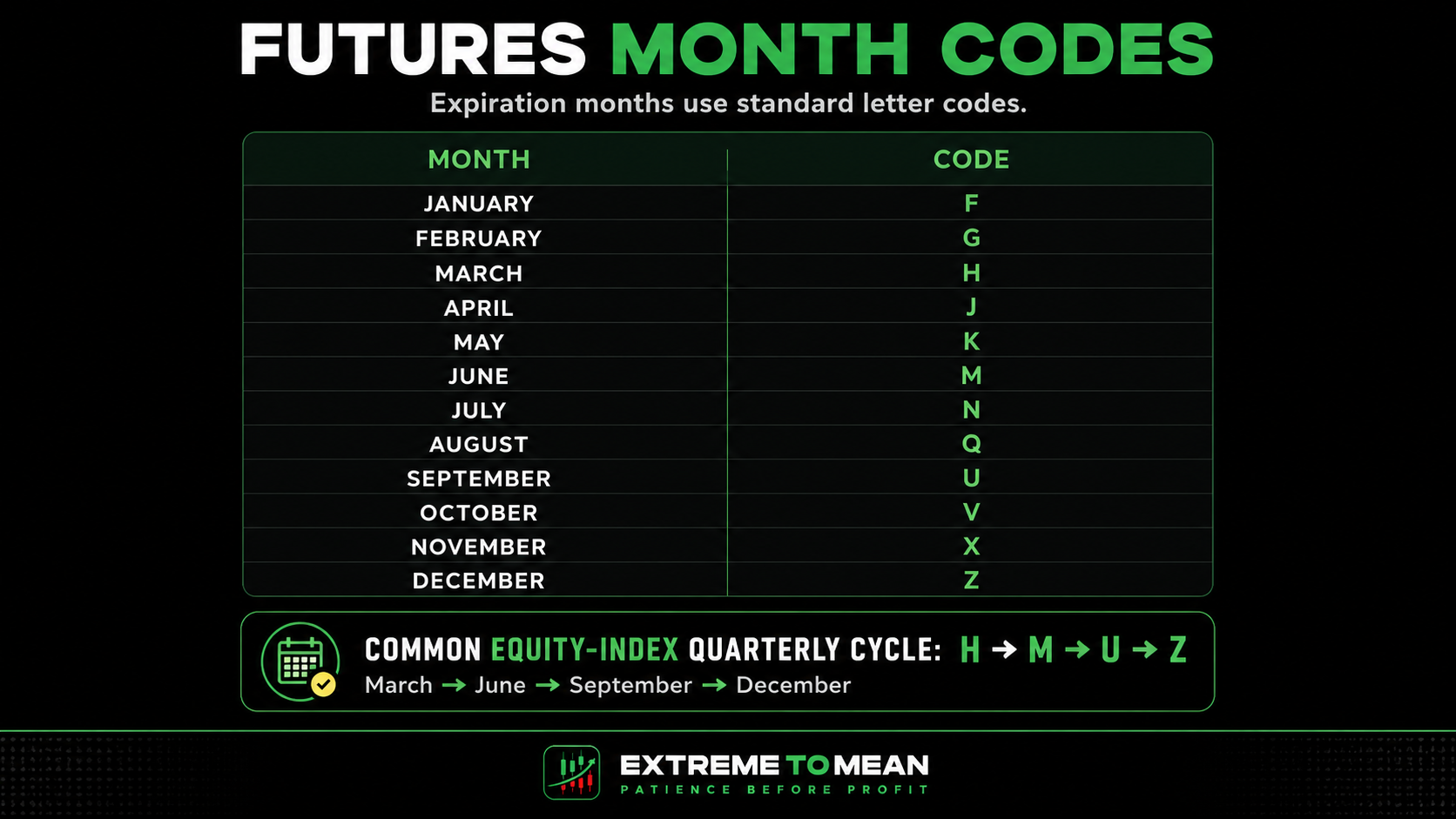
For ES, NQ, YM, and the primary Micro equity-index contracts, traders commonly encounter the quarterly H → M → U → Z sequence. That corresponds to March, June, September, and December. Other futures products can use different available expiration schedules, so do not assume every contract in every market follows only the quarterly cycle.
This is also why MESM7 has to be separated correctly. The symbol is MES | M | 7, where MES is the Micro E-mini S&P 500 root and the second M is the June month code. Reading it as M + ES + M7 would confuse the product code with the expiration code.
Add the Year to Identify the Specific Contract
Once the root and month are understood, the year completes the identity. In a common abbreviated convention, ESH7 can be read as ES | H | 7: E-mini S&P 500, March, year ending in 7. In a 2027 contract context, that means the March 2027 E-mini S&P 500 futures contract.
The same logic works across the family:
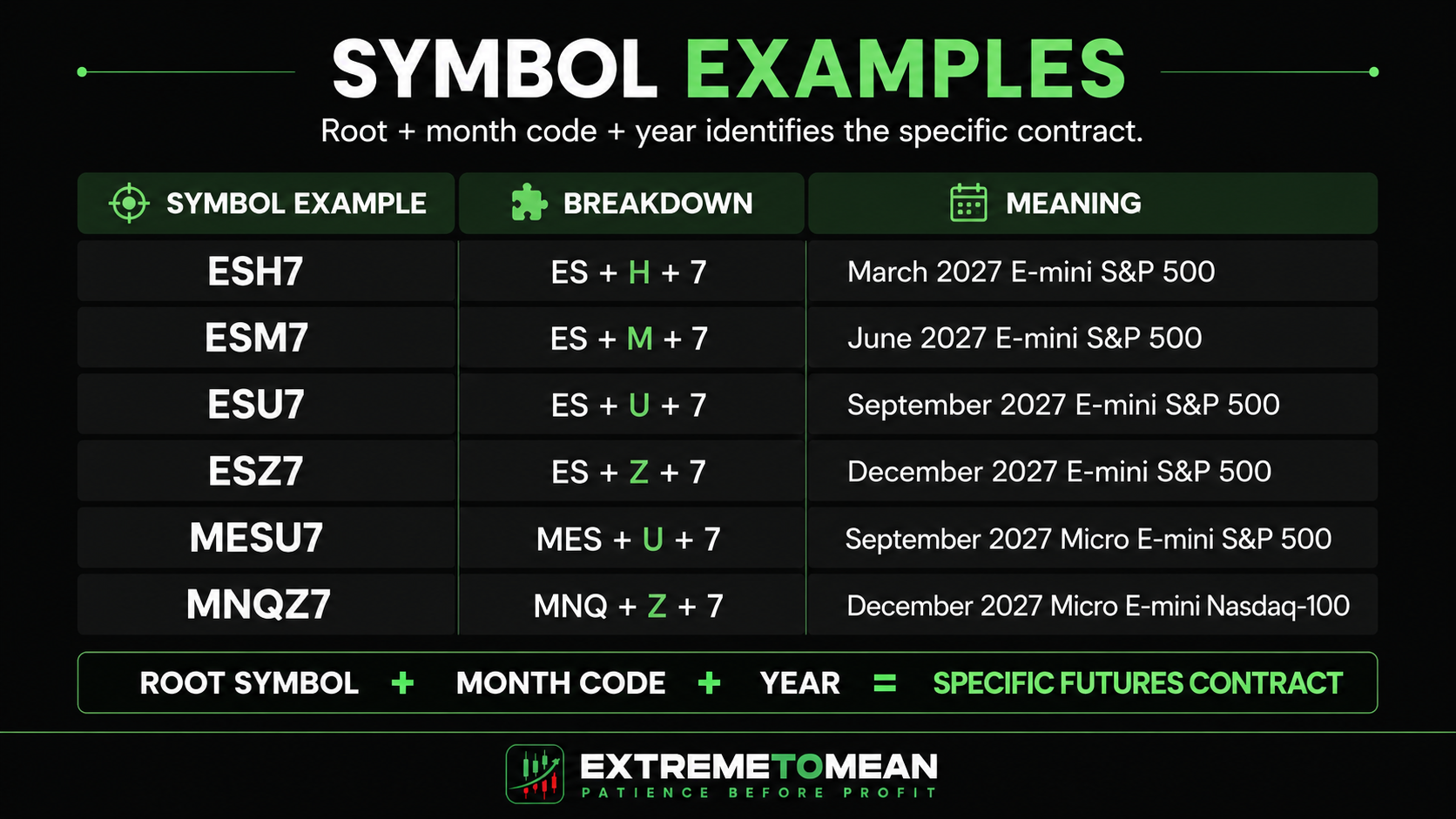
The year formatting is where platform conventions begin to matter. One system may use a single year digit, while another may show two digits or another vendor-specific format. Learn the contract identity rather than assuming the exact characters used by one platform are universal.
Platform Symbols Can Look Different
A trader may see one notation on an exchange reference page, another on a charting platform, and another in a broker's order-entry window. That does not automatically mean they represent different markets. Data vendors and trading platforms can use different display conventions for the same underlying product and expiration.
This matters because beginners naturally memorize the characters they see on one screen. If they later change platforms, the contract can appear unfamiliar even though the underlying product and expiration have not changed. Learn what the symbol means, not just how one piece of software prints it.
The distinction is similar to the broader contract-selection issue explained in Best Futures for Day Trading. ES versus MES or NQ versus MNQ is a real product-size difference; a platform formatting difference may simply be notation. The trader needs to know which type of difference they are looking at before acting.
“ES” and “ESU6” Do Not Mean the Same Thing
When a trader says, “I trade ES,” they usually mean the E-mini S&P 500 product family. An actual exchange-listed futures order, however, ultimately references a specific expiration such as a September or December contract. ES identifies the family; ESU6 identifies one specific contract under that display convention.
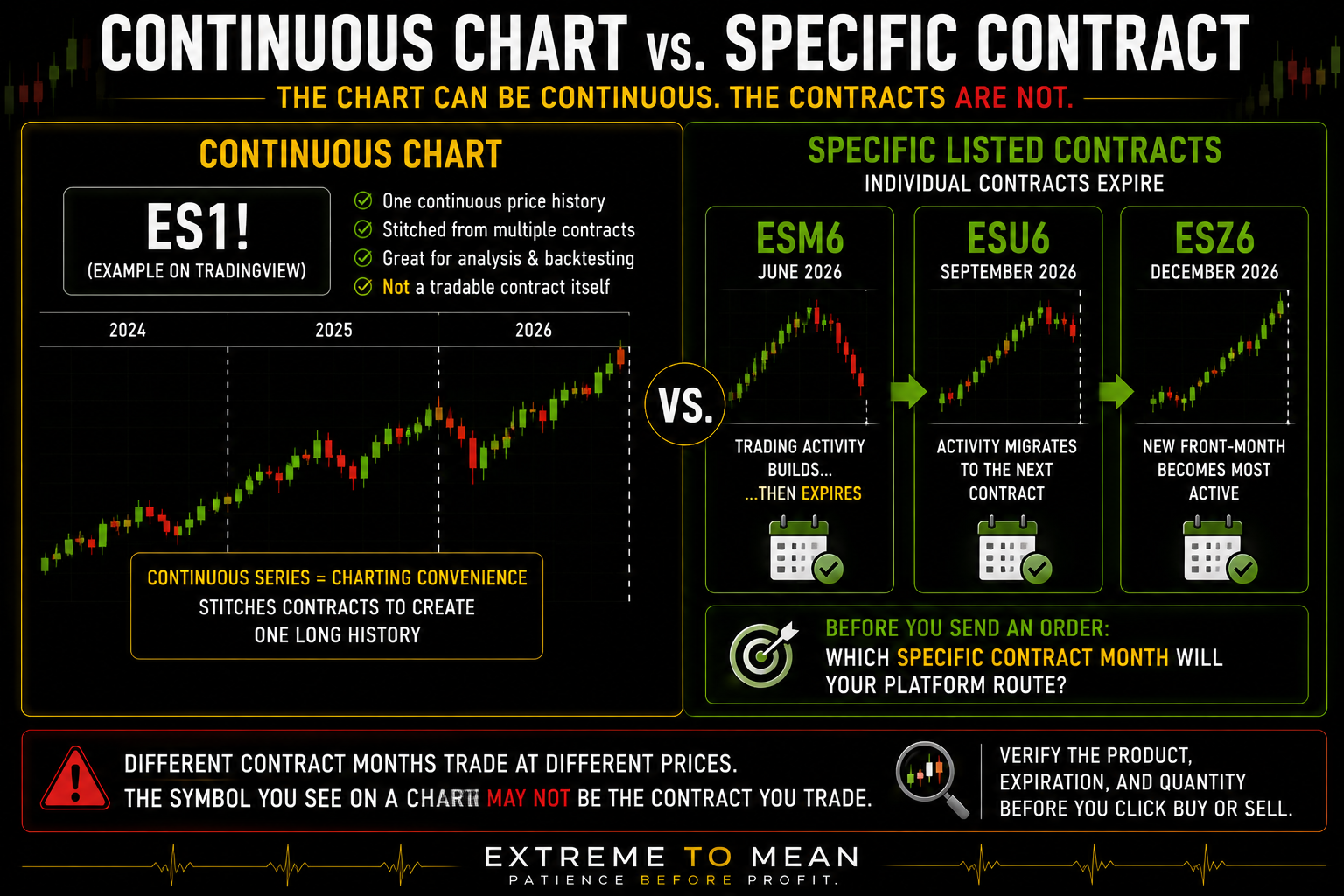
Several expirations can exist at the same time. One ES contract may be approaching expiration while another represents the next quarter, and the two contracts can trade at slightly different prices because they are separate instruments tied to different settlement dates. Seeing different prices therefore does not automatically mean one chart or data feed is wrong.
The same distinction applies to volume and liquidity. As an expiration approaches, trading activity can migrate toward a later contract, so the nearest calendar date and the contract with the most active participation are not always identical at every moment. The detailed decision about when to switch belongs in the futures rollover lesson; here, the important point is simply that multiple valid contract symbols can exist simultaneously.
Continuous Futures Charts Solve a Different Problem
Charting platforms often provide a continuous futures series that stitches historical data from successive expirations into one longer chart. That is useful for studying history because the trader does not have to manually open a different contract every few months. It is a data and charting convenience rather than proof that an individual futures contract never expires.
A symbol such as ES1! on one platform may represent a continuous or front-contract construction rather than one specific exchange-listed expiration. Another platform may use completely different notation for the same purpose. A continuous chart solves a chart-history problem; it does not remove futures expiration.
The practical question appears when an order is sent. In many environments, the order ultimately needs to route to a specific listed contract even if the trader is viewing a continuous chart, while some platforms may handle that mapping inside the interface. Before clicking Buy or Sell, verify which actual contract month the platform intends to trade.
One Symbol Error Can Change the Trade
Suppose a trader intends to trade Micro Nasdaq futures but selects NQ instead of MNQ. Both reference the Nasdaq-100 family, but they are not the same contract size, so the mistake can materially change the dollar exposure. Knowing the index is not enough; know the exact contract.
A second mistake can happen around expiration. One trader may be watching ESU6 while another has already moved to ESZ6, and their prices, levels, and volume may no longer line up perfectly. If the first trader assumes the data is broken instead of checking the expiration, the real problem is contract identity.
The same discipline applies to contract math. The ticker tells you which instrument you selected, but it does not tell you whether the position size or risk is appropriate. The lesson on ticks, points, and contract value remains necessary because identifying MNQ correctly is only the first step toward understanding what its movement means in dollars.
The Symbol Does Not Tell You Whether to Trade
A correctly decoded symbol tells you the product and expiration. It does not tell you whether the market is bullish, whether a setup is valid, how volatile conditions are, where a stop belongs, or how many contracts your account should trade. Symbol equals identity, not decision.
Micro and E-mini labels also should not be treated as skill levels. A Micro contract is not automatically safe for a beginner, and an E-mini is not automatically reserved for an advanced trader. Contract selection still depends on the strategy, volatility, account, stop distance, and acceptable risk.
Margin belongs to that separate decision as well. Knowing that you selected the correct contract does not tell you what size the account can prudently support, because margin and trade risk are different calculations. The order-entry screen may accept the contract perfectly even when the risk decision behind it is poor.
A Practical Futures-Symbol Framework
Use Root → Month → Year → Platform → Liquidity → Verify. The sequence starts by identifying what the contract is and ends by checking that the order will actually go to the product and expiration you intended. Decode first. Trade second.
- Root: What product am I trading—ES, MES, NQ, MNQ, YM, MYM, or something else?
- Month: Which expiration month does the letter represent?
- Year: Which expiration year does the number represent in this context?
- Platform: How does this particular software display the contract?
- Liquidity: Is this the expiration where active trading is currently concentrated?
- Verify: Are the product, expiration, and quantity correct before I submit the order?
The better question is not simply, “What does this ticker stand for?” Ask, “Am I about to send an order to the exact product, size, expiration, and quantity I intend to trade?” One letter can change the month, while a few letters can change the size of the contract.
Futures markets can also trade across long sessions, which makes verification especially important when contracts or liquidity conditions are changing outside the cash-market day. The lesson on futures trading hours provides the broader session context. Symbol knowledge identifies the instrument; session context helps explain the environment in which that instrument is currently trading.
Final Thought
Futures symbols become much easier once the layers are separated. The root tells you what product you are trading, the month code identifies the expiration month, and the year identifies the expiration year. Platform formatting may vary, but the underlying contract identity does not.
The biggest beginner mistake is treating the symbol as decoration around the chart. A trader can click an NQ contract while intending MNQ, select an old expiration after activity has shifted, or mistake a continuous-chart notation for the specific listed contract being routed. Software can execute a contract you do not understand perfectly efficiently.
Before every futures order, decode and verify the product, month, year, and quantity. The symbol tells you what you are trading—not whether you should trade it—and that distinction belongs to the larger decision process new traders can continue building through Start Here.
For a broader reference across micro index, metals, energy, FX, and crypto contracts, see this Micro Futures Symbols beginner reference.
Educational content only. Trading involves substantial risk and is not suitable for everyone.