
U.S. equity-index futures such as ES, MES, NQ, MNQ, YM, MYM, RTY, and M2K can trade for most of the day during the trading week. Volume, liquidity, spreads, volatility, catalysts, and participation can still change dramatically from one period to another. Inside The Basics, trading hours should therefore be understood as market context rather than permission to stay active whenever the platform is available.
Futures Do Not Open at 9:30 a.m.
The 9:30 a.m. Eastern Time bell is not the futures open. By then, index futures may already have traded for many hours in response to overseas markets, economic releases, rates, currencies, and other information. 9:30 a.m. is the U.S. cash-equity open—and that distinction matters.
NYSE currently lists its core stock-market session as 9:30 a.m. to 4:00 p.m. ET. At 9:30, the underlying U.S. equities open, opening auctions resolve, and a large new layer of participation enters the market. Futures are not beginning their day; the participation environment is changing.
That is why 9:31 can look very different from 9:15 even though the same futures contract was open at both times. The cash open can bring more volume and liquidity, but it can also bring faster movement, reversals, and emotional chasing. The guide to the best time to trade futures compares those session tendencies without treating the clock as a signal. More participation can arrive together with more speed and more risk.
So When Do Index Futures Actually Trade?
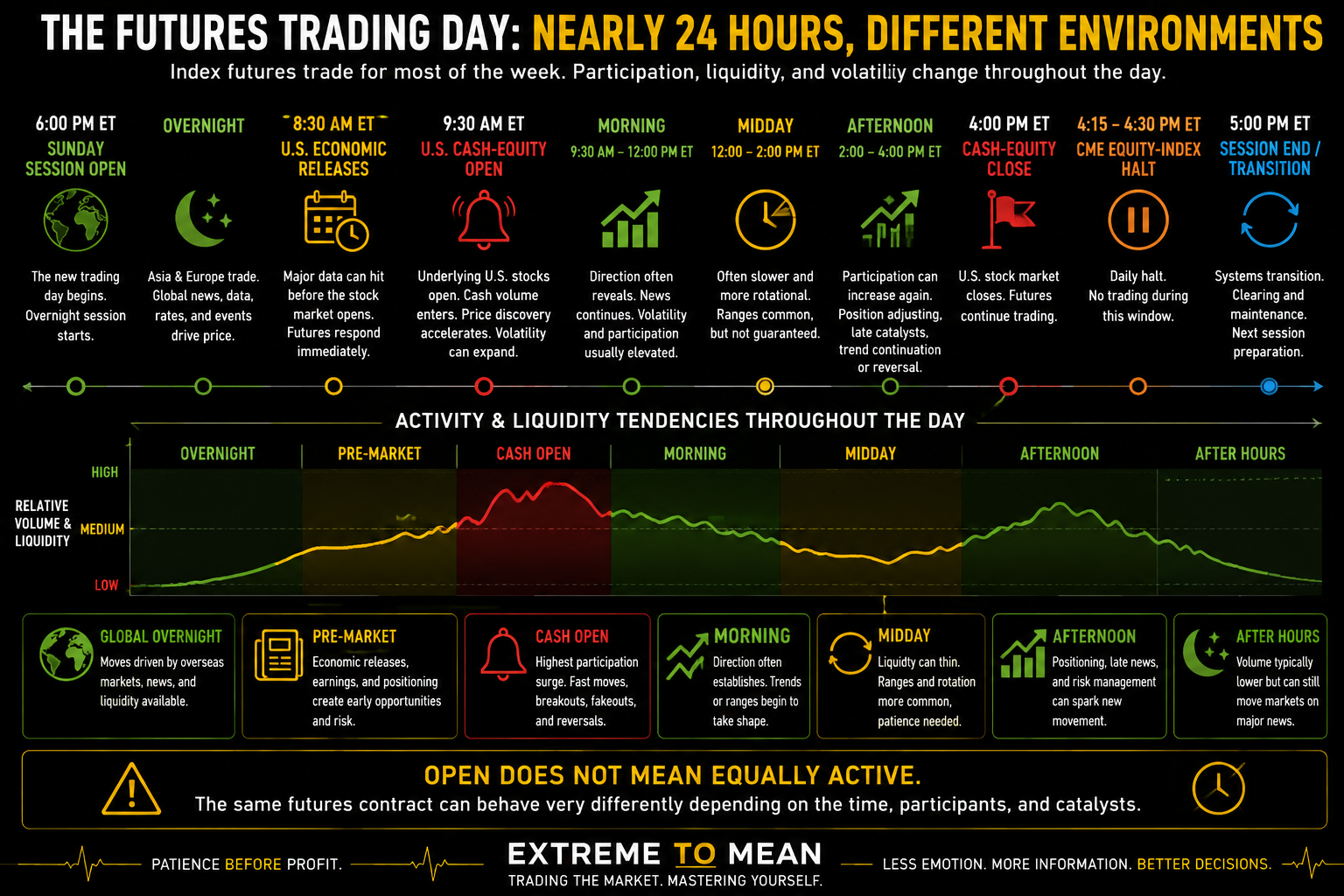
The core U.S. equity-index futures complex trades nearly around the clock during the trading week. Current CME material for the Micro E-mini equity-index suite lists Sunday 6:00 p.m. through Friday 5:00 p.m. ET, with a daily 4:15–4:30 p.m. ET trading halt; CME materials for related equity-index products also identify the 5:00–6:00 p.m. period as the daily session transition or maintenance window. Product rules, holidays, expiration schedules, and special sessions can change details, so always verify the current CME product page.
This is why saying futures trade “24/7” is inaccurate. Most major U.S. equity-index futures are better described as trading nearly 24 hours a day during the trading week, subject to exchange halts, the daily session transition, holidays, and product-specific rules. A Sunday evening trade also belongs to the Monday futures session, so the trading day begins before the calendar morning many stock traders think of as “the open.”
Overnight Trading Is Real Trading
Overnight futures can move substantially as Asian and European markets trade and new economic, geopolitical, currency, and bond information arrives. Liquidity can be thinner at some overnight times, but that does not make overnight movement irrelevant. A smaller amount of aggressive activity may also move price more when available liquidity is lighter.
By 9:30, futures may already have established an overnight high, overnight low, range, trend, or failed move. Those references can matter when U.S. participation enters because the cash session is interacting with a market that has already been auctioning for hours. The market arrives at 9:30 with a history.
U.S. Pre-Market Can Move Before Stocks Open
As the U.S. morning approaches, participation can build before the cash market opens. Major economic releases such as CPI, employment data, jobless claims, GDP, or retail sales can hit while the underlying stock market is still closed, and futures can respond immediately. The Market Calendar is therefore part of understanding trading hours rather than a separate concern.
An 8:30 a.m. report can produce high volume and fast movement before 9:30. That activity does not automatically create a good trade because liquidity and execution can change rapidly while price reprices. A market can be extremely active and still be difficult to trade cleanly.
Why Liquidity Changes Throughout the Day
Liquidity is dynamic because active participants, global-session overlap, scheduled news, cash-market activity, volatility, holidays, and uncertainty all change. The lesson on what volume and liquidity mean matters here because volume and liquidity are related without being identical. High volume tells you that a lot traded; it does not automatically tell you that execution was easy.
During thinner or unusually volatile periods, spreads can widen, available size can shrink, and price can move through levels rapidly. Those conditions can make actual fills differ from what the trader expected, which is why slippage matters when comparing one trading period with another. Open does not mean equally liquid, and high volume does not mean low difficulty.
Morning, Midday, and Afternoon Create Tendencies
After the opening burst, the morning often begins revealing whether the session is becoming directional, rotational, volatile, or balanced. Participation may stabilize as the opening auction is absorbed, but there is no rule that the morning must trend or provide a clean setup. The market still has to earn participation.
Midday can often bring slower pace, narrower movement, and more rotation. That tendency is context rather than a prohibition because an FOMC decision, breaking headline, or strong trend can completely change midday behavior. Time of day creates tendencies, not guarantees.
Participation can increase again later as traders adjust positions, manage risk, and prepare for the cash close. The 4:00 p.m. ET stock-market close is another participation event, not the permanent end of futures trading. Futures can continue after cash equities have closed.
Session Templates, Holidays, and Clock Changes Matter
Platforms may use session templates labeled RTH, ETH, regular hours, or electronic hours, and those labels do not always represent identical timestamps. For ETM readers, the clearest benchmark is the U.S. cash-equity session of 9:30 a.m. to 4:00 p.m. ET while remembering that futures trade outside it. Session settings can also change candle construction, VWAP resets, and session-based highs and lows.
Holiday schedules can include early closes, delayed opens, or other modified hours, so the exchange calendar should override a remembered routine. International traders should also remember that their local conversion can shift around daylight-saving changes. Use current CME exchange information when a normal session may not apply.
Nearly 24 Hours of Access Can Create Too Much Temptation
Futures accessibility creates a behavioral problem: during the trading week, the market is almost always available. That can encourage boredom trades, unfamiliar overnight trading, and constant searching for action simply because something is moving. More available trading hours do not create more high-quality opportunities.
That is why The Market Comes First matters even in an article about time. The deeper question is, “Just because I can trade right now, does the market actually deserve a trade right now?” Futures can be open while the opportunity is closed.
A Simple Futures-Hours Framework
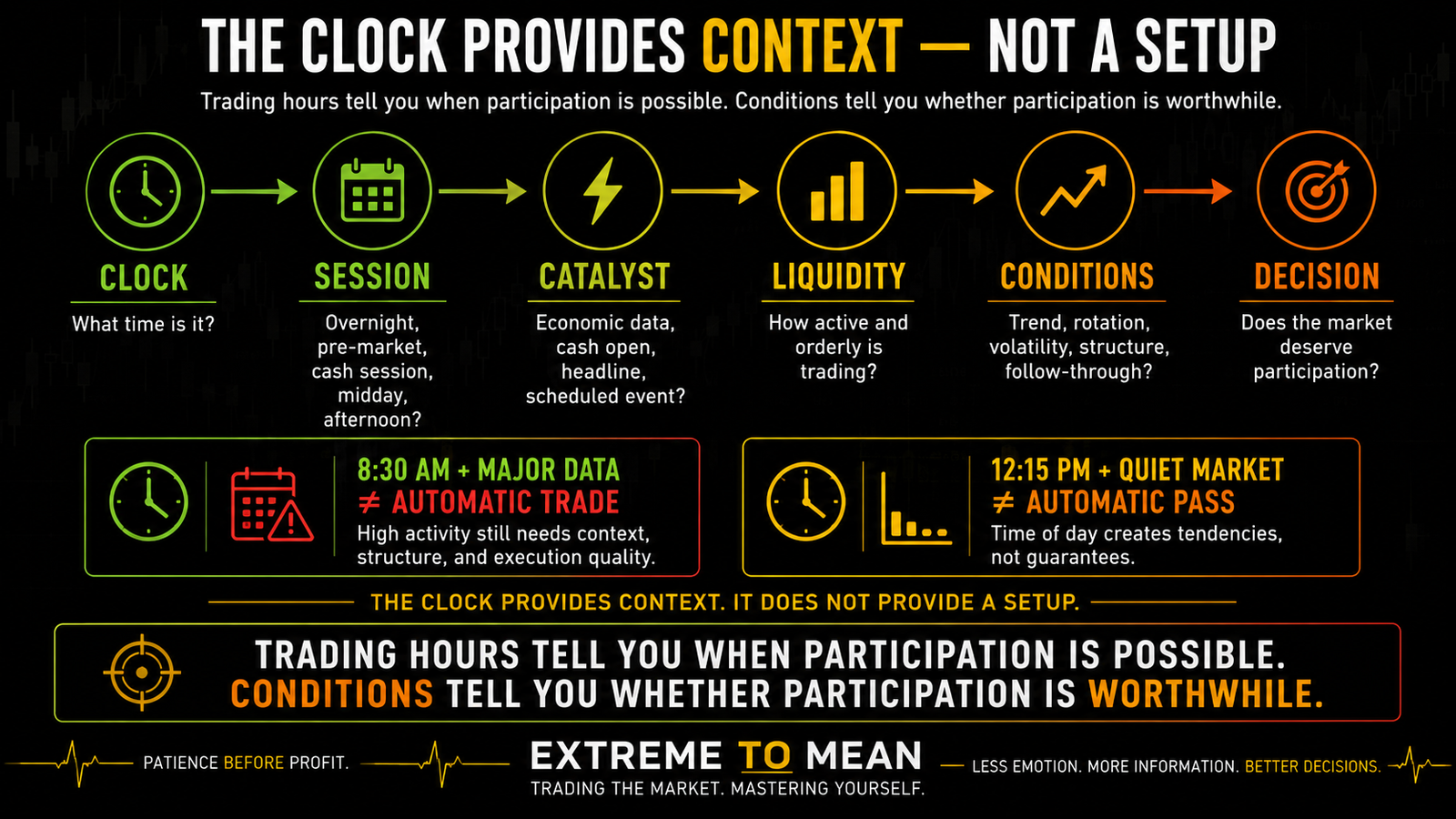
Use Clock → Session → Catalyst → Liquidity → Conditions → Decision. The clock is the first piece of context, not the final reason to trade. Each step asks whether the market environment supports the next decision.
- Clock: What time is it in Eastern Time?
- Session: Which part of the global futures day are we in?
- Catalyst: Is economic data, news, the cash open, or another event changing participation?
- Liquidity: How active and orderly is the market right now?
- Conditions: Is price trending, rotating, volatile, balanced, or behaving erratically?
- Decision: Does the market actually deserve participation?
The clock provides context. It does not provide a setup. Knowing the schedule matters only when it improves the read of liquidity, volatility, execution, and opportunity. The goal is to understand why the same contract can behave differently from one part of the trading day to another.
Final Thought
Index futures give traders broad access to the market. ES, NQ, YM, and their Micro counterparts can respond to information overnight, before the stock market opens, throughout the cash session, and after the cash close. That access is useful because price discovery does not wait for 9:30.
The important distinction is that market quality is not evenly distributed across those hours. Overnight liquidity, pre-market releases, the cash open, midday rotation, the afternoon, and the session transition can each create different conditions. Trading hours tell you when participation is possible; market conditions tell you whether participation is worthwhile.
Before taking a trade simply because futures are open, ask what session you are in, what catalyst may be affecting participation, what liquidity and execution look like, and whether the conditions support the decision. If you are still building that market language, continue through the beginner trading path before turning the clock into another reason to stay active.
Educational content only. Trading involves substantial risk and is not suitable for everyone.