
Start With the Contract Behind the Chart
A futures contract is a standardized exchange-traded agreement tied to an underlying market. Unlike buying a share of stock, the trader is taking exposure through a contract with its own multiplier, minimum tick, expiration, settlement rules, trading hours, and margin requirements. CME’s introductory futures curriculum treats contract specifications, trading codes, expiration, settlement, tick movement, notional value, and margin as foundational knowledge for exactly this reason. (cmegroup.com)
Before trading ES, MES, NQ, MNQ, YM, or another futures market, know what the symbol represents and how its contract works. A beginner should be able to identify the underlying index, contract size, tick value, point value, current contract month, and expiration structure before sending an order. Before you trade the chart, know the contract behind the chart.
Choosing the market and choosing the contract size are related but separate decisions. ES and MES both provide S&P 500 exposure, while NQ and MNQ provide Nasdaq-100 exposure, but the Micro contracts use smaller multipliers and therefore create smaller dollar movement per contract. Smaller size can improve flexibility, but it does not make the underlying decision automatically better or the position automatically low risk.
Open the Right Account and Understand the Trading Setup
Individual futures traders generally access the market through a futures brokerage relationship rather than sending orders directly to an exchange. In the U.S. regulatory structure, a Futures Commission Merchant can accept customer orders and customer funds, while an Introducing Broker can solicit or accept futures orders but does not itself hold customer funds. The beginner does not need to become a regulation expert, but the account relationship matters. (cftc.gov)
The broker and the trading platform are also not necessarily the same thing. The broker or carrying firm is part of the account and execution infrastructure, while the platform is the software used to view markets, submit orders, manage positions, modify stops and targets, and monitor P&L. Your broker is part of the account infrastructure; your platform is how you interact with that infrastructure.
Real-time market data is another part of that setup. Futures platforms may require exchange data subscriptions or specific real-time permissions, and costs vary by provider. Before depositing money, the CFTC recommends checking a futures firm or professional’s registration and disciplinary history through NFA BASIC and reviewing the required disclosures and risks. (cftc.gov)
Margin Tells You What You Can Open—Not What You Can Afford
Futures margin is different from borrowing money to buy stock on margin. CME describes futures margin as money that must be deposited and maintained with the broker to support the position; it is not a down payment on the underlying asset. Requirements can also change, and brokers may impose their own requirements above exchange minimums. (cmegroup.com)
That creates leverage because the contract’s notional exposure can be much larger than the cash posted as margin. Leverage magnifies gains and losses, which is why the CFTC tells prospective futures traders to understand their contractual obligations, financial resources, and ability to sustain losses beyond the initial amount committed. (cftc.gov)
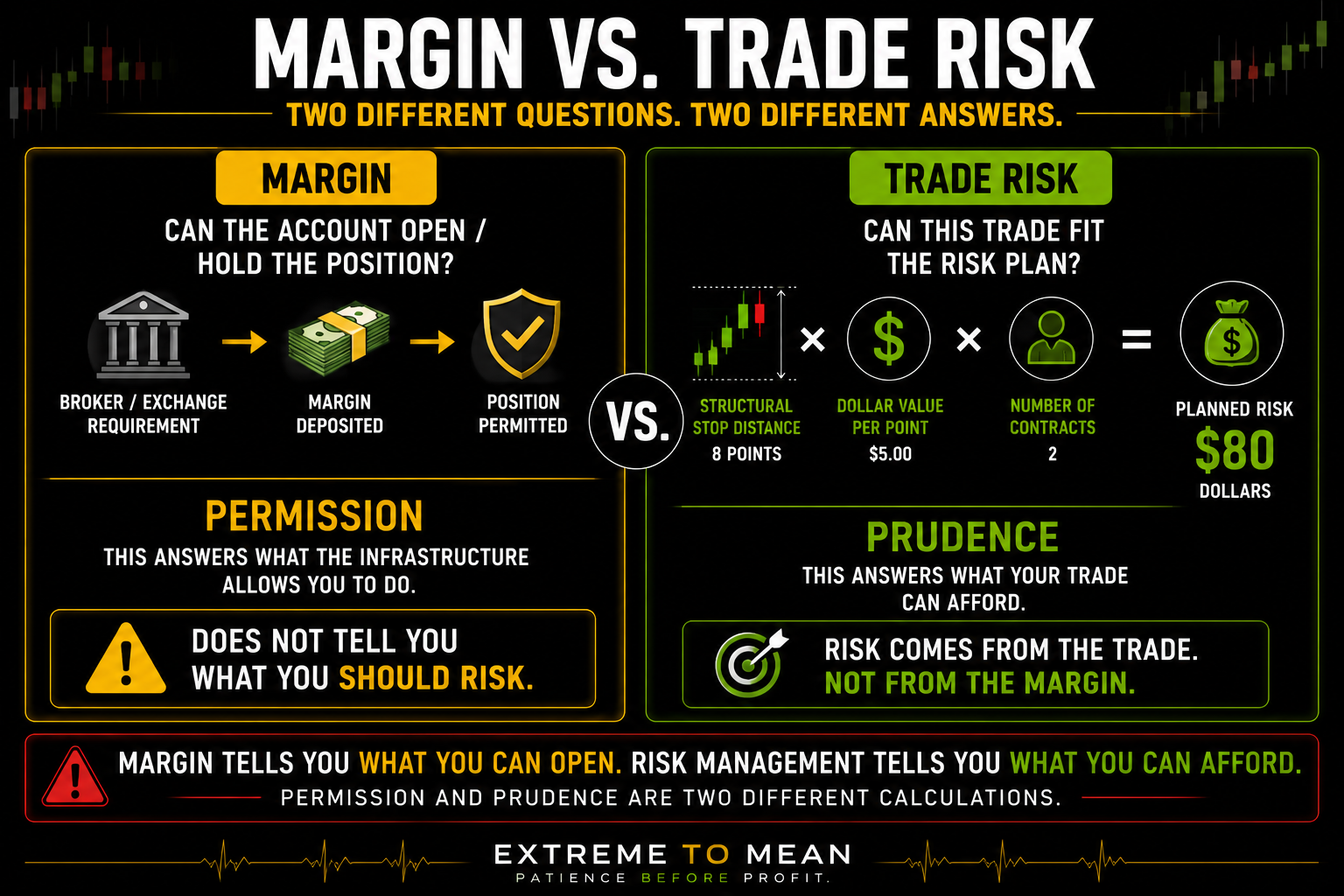
The crucial distinction is simple: margin tells you what you can open; risk management tells you what you can afford. A platform allowing one or five contracts does not mean either size is appropriate for a particular trade. Permission and prudence are two different calculations.
Convert Price Movement Into Dollars Before You Trade
Price distance means very little to the account until it is converted into dollars. Suppose a hypothetical contract moves in 0.25-point ticks, each tick is worth $1.25, and four ticks equal one point. One point is therefore worth $5 per contract, so a 10-point move equals $50 per contract before commissions, fees, and execution effects.
With two contracts, that same 10-point move represents $100 of gross P&L. The general relationship is Price Movement × Dollar Value × Number of Contracts = Gross P&L. A trader who says, “It is only a 10-point stop,” has not finished the risk calculation until the point value and quantity are included.
This calculation should happen before the trade rather than after entry. If the structurally appropriate stop creates too much dollar risk in an E-mini contract, the cleaner choices may include a smaller Micro contract, fewer contracts, or no trade. Do not distort market structure simply to make the position affordable.
Know When the Market Trades and How Orders Work
Major U.S. equity-index futures trade through much of the weekday rather than simply opening with the stock market at 9:30 a.m. Eastern Time. The important beginner lesson is that an open market is not an identical market at every hour; overnight, pre-market, cash-session, and late-day conditions can differ substantially in liquidity and behavior. The dedicated lesson on futures trading hours goes deeper into that changing environment.
The trader also needs to understand the basic order types before using them. CME identifies market, limit, and stop orders among the common futures order types, with each solving a different execution problem: market orders prioritize execution, limit orders constrain acceptable price, and stop orders activate after a specified trigger condition is reached. (cmegroup.com)
None of those order types removes execution risk. Bids, offers, available liquidity, and prices can change rapidly, so a stop does not guarantee the exact exit price imagined on the chart and a limit target is not guaranteed to fill simply because price came close. Modern software makes orders easy to submit; it does not make their consequences disappear.
Define the Trade Before Sending the Order
Before entry, the trader should know why the trade exists, where the idea becomes wrong, where the protective stop belongs, how much that distance means in dollars, how many contracts fit the predefined risk, and where a realistic target lies. The cleaner sequence is Setup → Invalidation → Stop Distance → Contract Value → Position Size → Entry. Starting with maximum available contracts and calculating risk afterward reverses the process.
Suppose a trade requires a 15-point structural stop. If one E-mini makes that stop too expensive, reducing the stop to five points simply to force the position into the account changes the trade’s logic. The contract size should adapt to the trade rather than forcing the market structure to adapt to the account.
This is also where mechanics begin turning into actual trading judgment. The Market Comes First because the ability to place an order does not create a reason to place one. Execution turns an idea into a trade; it does not turn a random idea into an edge.
Walk Through One Hypothetical Futures Trade
Imagine a trader has already identified a purely hypothetical S&P 500 futures long with an entry at 6,500 and structural invalidation at 6,492. The stop distance is eight points, so the trader first converts those eight points into dollar risk using the chosen contract’s point value. Only then can the trader decide whether an E-mini, a Micro, multiple Micros, or no position fits the predetermined risk.
Next, the trader selects the planned order type, enters the position, and places the protective stop at the predefined invalidation rather than improvising it after seeing P&L. Many platforms support bracket-style logic that can attach a protective stop and target to an entry, allowing the risk structure to exist before emotion enters the trade. The platform-specific buttons differ, but the concept is the same: risk controls can be planned before entry.
After entry, management should follow the trade plan rather than the flashing profit-and-loss display. When the position closes, actual fills, commissions, fees, and any execution differences should be included in the review. The purpose of the walkthrough is not “buy at 6,500”; it is to show how contract math, risk, orders, management, and review connect into one process.
Expiration, Simulation, and Account Type Still Matter
Futures contracts expire, so traders need to understand that a specific contract month is being traded and that attention eventually migrates to a newer contract as rollover approaches. A charting platform may also display a continuous symbol stitched from multiple contracts for analysis, but that does not necessarily mean the continuous symbol itself is the specific exchange-listed contract being executed. Beginners do not need to master rollover on day one, but they do need to know that expiration and contract selection exist.
Simulation can be useful for learning order entry, quantity, stop modification, target placement, platform navigation, and basic P&L mechanics without immediately adding real financial pressure. It does not perfectly reproduce hesitation, fear, greed, attachment to open profit, or other live-trading pressures. Simulation can teach the mechanics without proving the psychology.
A beginner may also encounter a personal brokerage account or a futures funding / prop-firm route. Those are materially different account environments because a prop program adds its own evaluation, drawdown, sizing, and payout rules on top of the underlying futures mechanics. Readers considering that path can review how futures prop-firm challenges work separately rather than treating the two account models as interchangeable.
How Much Money Do You Need to Trade Futures?
There is no useful universal account minimum because at least three different numbers are involved. A broker may have one minimum to open or maintain an account, a futures position may require a separate margin amount, and the trader’s strategy may require substantially more sensible risk capital to support normal stop distances, position sizing, drawdowns, and financial circumstances. The minimum amount required to place a futures trade is not automatically enough capital to trade futures responsibly.
Buying power should not determine position size. If a platform says the account is permitted to open five contracts, that answers what the infrastructure allows, not what the setup justifies. Risk should still come from the invalidation distance, contract value, number of contracts, and the amount the trader has decided can be lost on the idea.
Costs matter as well. Commissions, exchange and clearing fees, regulatory charges, market data, platform costs, spread, and slippage can all affect actual results, and these vary too much by provider to justify one permanent universal figure. Low capital required to control a leveraged position does not mean low risk in that position.
A Practical Beginner Futures Framework
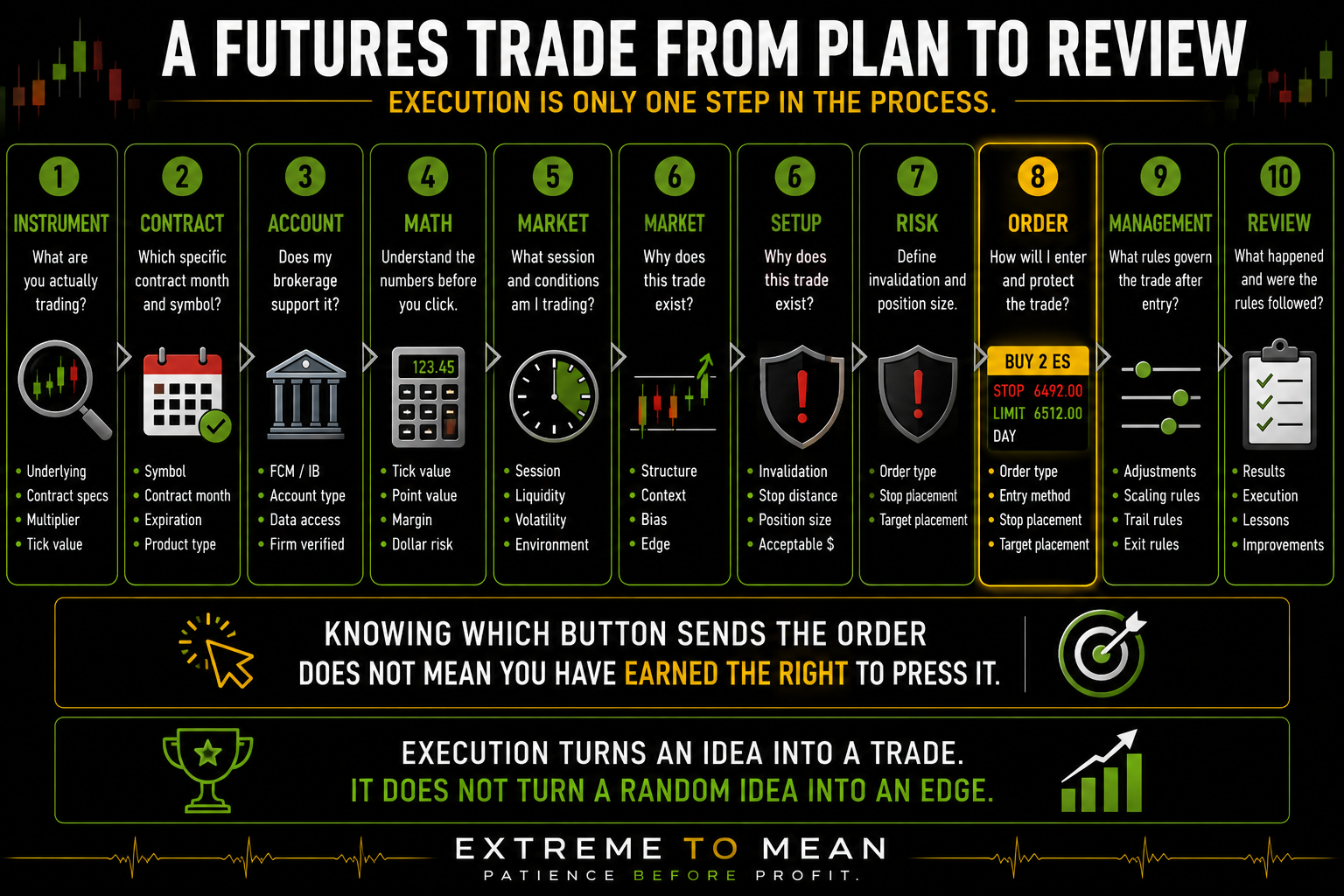
Use Instrument → Contract → Account → Math → Market → Setup → Risk → Order → Management → Review. A futures trade begins before the order is sent and continues after the position is closed. The purpose of the framework is to make each mechanical decision explicit before execution becomes easy enough to feel automatic.
- Instrument: What am I actually trading?
- Contract: Which specific futures contract and contract month?
- Account: Does my brokerage or account legitimately support it?
- Math: What are the tick, point, multiplier, and dollar exposure?
- Market: What session and conditions am I trading?
- Setup: Why does this trade exist?
- Risk: Where is it wrong, and what is the actual dollar risk?
- Order: How will I enter and protect the position?
- Management: What predefined rules govern the trade afterward?
- Review: Did I execute the process correctly?
The better question is not “Do I know how to buy and sell futures yet?” Ask, “Do I understand the instrument well enough that its mechanics are no longer creating unnecessary risk—and do I have an actual reason for this trade to exist?” Knowing how to place the trade means understanding the mechanics; knowing when the trade deserves to be placed is the harder skill.
Final Thought
Futures trading software can make buying, selling, flattening, attaching a stop, and changing quantity feel straightforward very quickly. That convenience can create the illusion that the trader has learned futures when they have really learned only the interface. The platform can make trading easy long before the trader is ready for trading to be easy.
A responsible beginner needs to understand the contract, multiplier, tick value, margin, leverage, session, order mechanics, expiration, dollar risk, and account structure before real money is exposed. Those skills do not create a trading edge, but they remove mechanical confusion that should never have been part of the trade in the first place.
From there, the challenge becomes market judgment: context, location, structure, qualification, and the ability to wait. That is why understanding what an edge actually is belongs after learning the mechanics, and newer readers can continue building the full foundation through Start Here.
Educational content only. Trading involves substantial risk and is not suitable for everyone.