
If you are long one ES contract and nervous about what might happen overnight, shorting a few MES contracts can reduce your S&P 500 exposure. The more important question is whether that hedge solves a defined risk problem—or simply makes a trade you no longer trust harder to manage.
A hedge changes the risk. It does not make risk disappear.
A hedge is an offsetting position designed to reduce an existing exposure. If we are long, opposite short exposure can reduce our sensitivity to a decline; if we are short, opposite long exposure can reduce our sensitivity to a rally. But HEDGE ≠ FREE PROTECTION because the offset can reduce favorable movement too, while adding another position, execution, cost, and exit decision.
This belongs in The Basics because hedging is easy to misunderstand before we know what the contracts represent. Hedgers use futures to manage or offset price risk rather than simply adding speculative exposure. For a retail trader already in a futures position, the cleaner question is: what exact risk are we reducing, and why does the original position need to remain open?
Why Micros Make Partial Hedging Possible
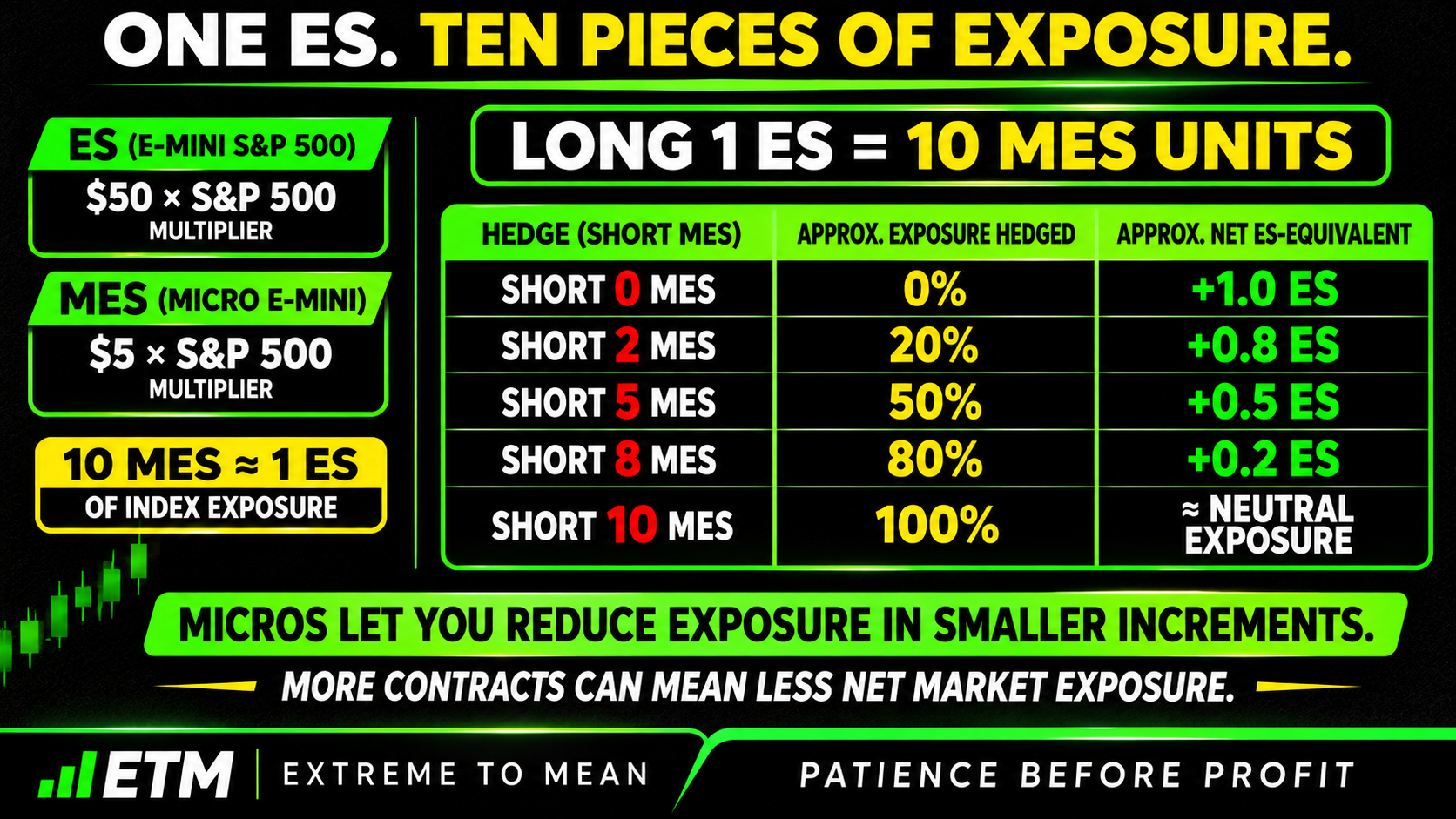
One ES contract uses a $50 S&P 500 multiplier, while one MES uses $5, so MES is one-tenth the size of ES. Ten MES therefore provide approximately one ES-equivalent exposure. That relationship lets Micros turn an all-or-nothing E-mini adjustment into smaller pieces.
If we are long one ES and want to hedge about 30%, the simple same-index calculation is 1 ES × 10 × 30% = 3 MES. Shorting three MES against the long ES leaves us approximately +0.7 ES-equivalent of directional exposure before transaction costs and execution differences. The original bullish position remains, but its sensitivity to the index is smaller.
| Position | Approx. Exposure Hedged | Approx. Net ES-Equivalent |
|---|---|---|
| Long 1 ES | 0% | +1.0 ES |
| Long 1 ES + Short 2 MES | 20% | +0.8 ES |
| Long 1 ES + Short 5 MES | 50% | +0.5 ES |
| Long 1 ES + Short 8 MES | 80% | +0.2 ES |
| Long 1 ES + Short 10 MES | 100% | ~0 ES |
The distinction is NET EXPOSURE ≠ GROSS CONTRACT COUNT. Long one ES and short five MES means six open contracts, yet the directional exposure is only about half an ES. More open contracts can mean less net market exposure while creating more operational complexity.
A Hedge Cuts Both the Pain and the Participation
Suppose we are long one ES and short five MES, leaving roughly +0.5 ES-equivalent exposure. If S&P futures fall 20 points, the long ES loses about $1,000, while the five short MES gain about $500, for an approximate combined directional loss of $500 before costs. Without the hedge, the same decline would have produced about a $1,000 directional loss.
Now reverse the move. If the market rises 20 points, the ES gains about $1,000, while the five short MES lose about $500, leaving approximately +$500 before costs. A hedge that protects us when we are wrong also gives back part of the gain when we are right.
A full same-index hedge makes that trade-off even clearer. Long one ES plus short ten MES is approximately directionally neutral, although fills, spreads, fees, and separate order books mean the account will not necessarily remain perfectly unchanged. PARTIAL HEDGE ≠ ZERO RISK.
Hedge, Stop, Reduce, and Exit Are Different Decisions
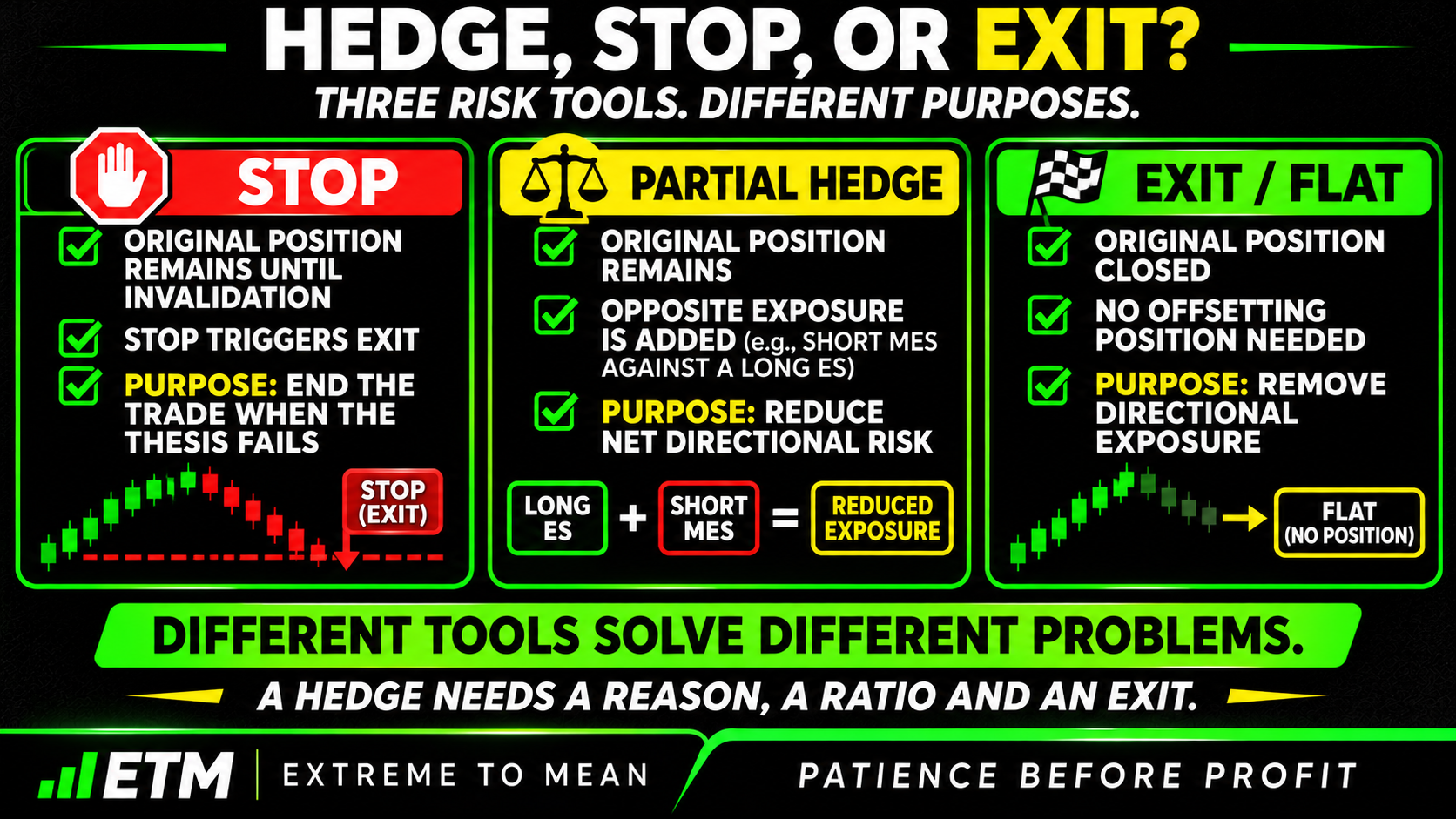
A stop loss and a hedge solve different problems. A stop is intended to exit when an invalidation condition is reached, while a hedge keeps the original position open and adds opposite exposure. HEDGE ≠ STOP LOSS, and the existing lesson on what a stop loss actually does is the cleaner reference for defining invalidation.
Flattening is different again. Close the ES and there is no remaining position; keep the ES and short ten MES and we still have eleven contracts whose directional exposure largely offsets. FULL DIRECTIONAL HEDGE ≠ OPERATIONALLY FLAT. A perfect hedge can become a complicated way to be approximately flat.
That is why the skeptical ETM question matters: if we no longer want the full risk, why are we hedging instead of reducing or closing it? If the thesis is invalid, adding opposite Micros does not repair it; a hedge should manage defined exposure, not postpone a decision we refuse to make.
The Strongest Retail Use Case Is Precision
If we own two ES and want half the exposure, we can sell one ES. If we own one ES and want to remain only 40% as long, we cannot sell 0.6 of an E-mini contract; shorting six MES leaves approximately +0.4 ES-equivalent exposure. That is where Micro granularity becomes genuinely useful.
A partial hedge is best understood as exposure reduction, not magical protection. The same logic complements futures position sizing: the E-mini gives us coarse units, while Micros can fine-tune an existing position without changing the underlying market thesis. Micros can turn coarse position sizing into finer exposure control.
For a simple long-ES/short-MES hedge, Net ES-equivalent = Long ES − (Short MES ÷ 10). One ES minus seven MES leaves roughly +0.3 ES-equivalent. If we cannot calculate our net exposure after the hedge, we are guessing.
Same-Index Hedging Is Cleaner Than Cross-Hedging
Long ES hedged with short MES is a direct same-index relationship because both reference the S&P 500 and the Micro is designed at one-tenth the E-mini multiplier. Long ES hedged with short MNQ is different: the S&P 500 and Nasdaq-100 can be correlated, but their constituents, sector weights, and relative performance differ. SAME-INDEX HEDGE ≠ CROSS-INDEX HEDGE.
Using the same underlying and contract month is the cleanest comparison. Even ES and MES have separate order books, spreads, and fills, so matching multipliers do not guarantee matching executions. The ES, NQ, MES and MNQ tick-value lesson is useful when translating those differences into dollars.
Overnight Hedging Needs a Plan Before Fear Arrives
A trader may want to keep a long ES position but reduce directional sensitivity across an overnight session or defined event. Long one ES plus short four MES leaves roughly +0.6 ES-equivalent exposure, so a planned partial hedge can reduce—but not eliminate—the market risk. “Overnight” is a time period—not a justification for a hedge.
The cleaner version has a reason for retaining the original position, a predefined hedge ratio, and a condition for removing the hedge. The weak version is, “I do not want to take the loss, so I will hedge it until it comes back.” Once that happens, one difficult trade has become two positions and another timing problem.
Timing matters because a late hedge can become a second speculative trade. If we short MES only after ES has already fallen sharply and the market rebounds, the original position may recover while the new hedge loses. A hedge is much cleaner when the rule exists before fear arrives.
Costs, Margin, and Operational Risk Still Matter
Every hedge needs two plans: when it goes on and when it comes off. Remove it too early and the original exposure returns; remove it too late and the hedge can offset the recovery we wanted. A hedge without a removal condition is not a risk plan. It is a suspended decision.
Costs matter too. A full one-ES hedge using ten MES creates many additional contract executions, with commissions, exchange/clearing fees, and spread costs depending on the broker. Precision has a transaction-cost budget.
Margin should not be assumed from net economic exposure. Exchange clearing may recognize offsets between corresponding Micro and E-mini positions, but broker risk systems, account type, and intraday versus overnight requirements can produce different retail treatment. Net economic exposure and broker margin requirement are not necessarily the same calculation.
Operational risk can rise as market risk falls. Close the ES but forget the short MES and the hedge becomes an outright short position. When the original exposure disappears, the hedge becomes the position.
The Retail Hedge Checklist
Before adding opposite Micro exposure, ask:
- What exact risk am I trying to reduce?
- Is the original trade still valid?
- Why does the original position need to remain open?
- What percentage of exposure do I want to offset?
- What is the correct Micro hedge ratio?
- Am I using the same underlying and contract month?
- What net exposure remains after the hedge?
- What will entering and removing the hedge cost?
- How will my broker treat the margin?
- What exact condition removes the hedge?
- What happens if I close the original position first?
- Would simply reducing or closing the original trade be cleaner?
The strongest final question is number twelve because hedging should solve a specific risk problem, not generic discomfort. The ETM free tools can help organize exposure and risk calculations, but the trader still has to decide whether the extra structure is justified. A hedge needs a reason, a ratio and an exit.
The ETM Exposure → Purpose → Ratio → Cost → Exit Framework
Use EXPOSURE → PURPOSE → RATIO → COST → EXIT. EXPOSURE asks what risk exists now; PURPOSE asks why the original position should remain; RATIO determines how much exposure should be offset. COST includes transactions, margin treatment, and operational complexity, while EXIT defines when the hedge comes off.
Then choose among HEDGE / REDUCE / EXIT. A hedge is appropriate only when we can explain why the original trade remains valid, why the offset is needed, how much exposure remains afterward, and what removes the hedge. REDUCED NET EXPOSURE ≠ ELIMINATED RISK.
Final Thought
Micro futures give retail traders something E-mini contracts alone cannot: finer control over an existing position. Because MES is one-tenth the size of ES, opposite MES contracts can reduce S&P 500 exposure in roughly 10% increments, allowing us to move from one whole E-mini to a more precise net exposure.
That precision comes with trade-offs. The hedge reduces favorable participation along with adverse movement, adds costs and execution decisions, and may not receive the margin treatment we assume. A full hedge can become economically similar to being flat while remaining operationally more complicated.
Most importantly, hedging does not make a broken thesis valid again. If the original reason for the trade is gone, exiting may be cleaner than building an opposite position around a trade we no longer believe in. Use Micros when we genuinely need finer exposure control, calculate the ratio, understand the remaining net risk, and decide before fear arrives when the hedge comes off.
A hedge changes the risk. It does not make risk disappear. A hedge needs a reason, a ratio and an exit.
Educational content only. Trading involves substantial risk and is not suitable for everyone.