
Knowing whether trading is working requires more than today’s P&L. A serious evaluation should consider edge, execution, risk, net results, trajectory, and cost together. The sharper question is: If hope, frustration, sunk cost, and today’s P&L disappeared from the decision, what would the evidence say about the trajectory?
That question belongs inside The Trader because continuing, rebuilding, pausing, or stopping are decision-quality problems. The goal is not to prove that a trader can endure indefinitely. It is to decide whether the next dollar, trade, and hour are justified by evidence.
“Is Trading Working?” Is Harder Than “Am I Profitable?”
Profit matters, but one profitable period does not prove the process is viable. One unusually large trade can overwhelm several weak decisions. A profitable period can hide a process that is not working.
Losses are incomplete evidence too. A positive-expectancy strategy can experience losing streaks, flat periods, and drawdowns. The job is to distinguish outcome from trajectory rather than letting the latest result decide the future of the project.
Define What “Working” Means at the Current Stage
The definition of progress can change with the stage; the requirement for evidence cannot. In research, progress may mean clearer rules, better data, rejected weak ideas, and more realistic testing. Judging that stage only by monthly income would confuse research with a mature operation.
During execution development, evidence should increasingly appear in behavior. Rule violations should become less frequent, sizing more consistent, and the gap between intended and actual execution smaller. Learning counts as progress only when something measurable is being learned.
At the viability stage, however, “I am still learning” cannot remain an unlimited exemption from results. If the goal is sustainable trading, the process eventually needs evidence of positive net expectancy under realistic conditions. An unprofitable development phase can be legitimate; indefinite absence of evidence cannot be called viability.
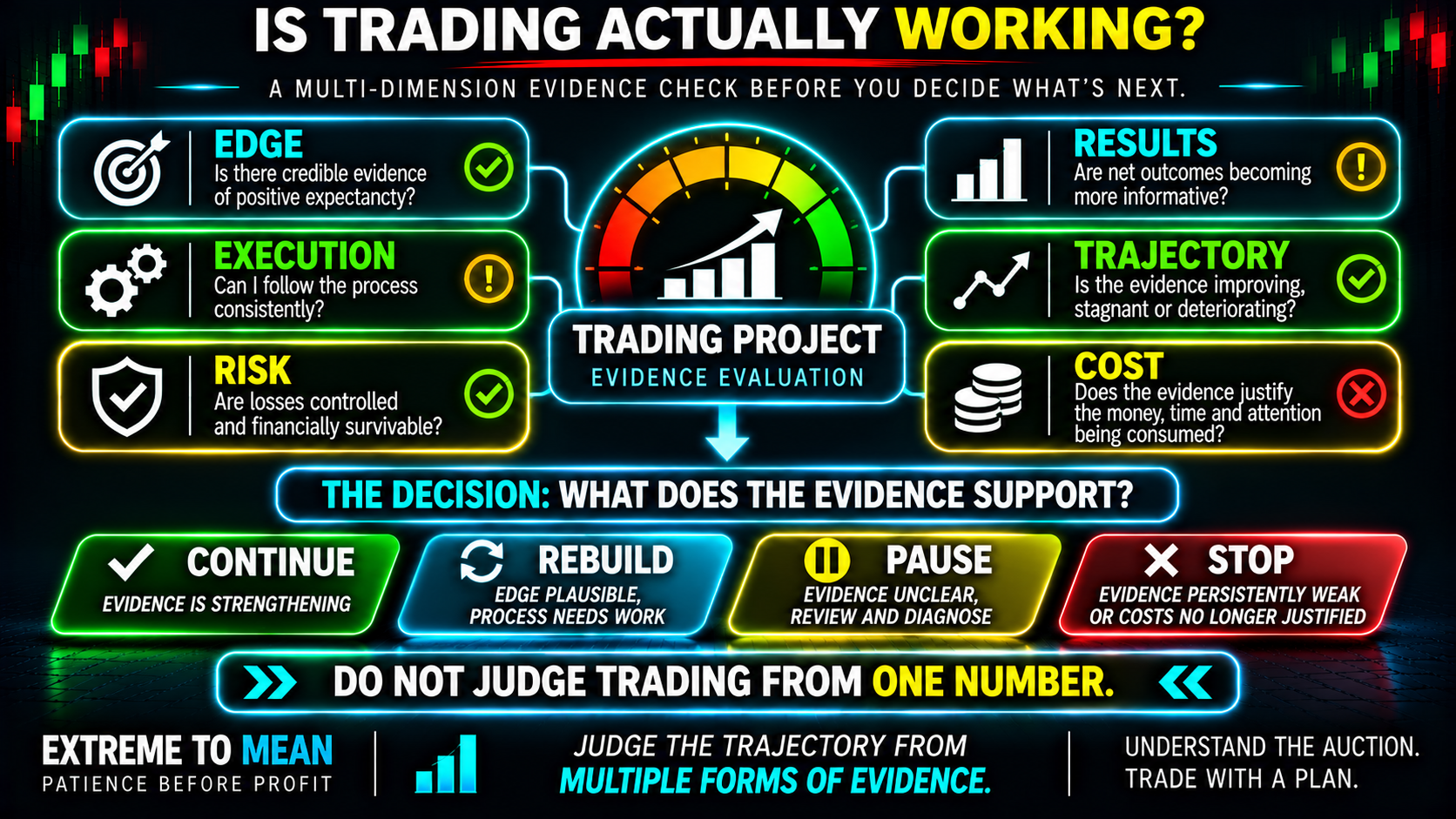
Criterion 1: Is There Evidence of an Edge?
Time spent trading is not evidence of edge. The trader should be able to define the setup, qualifying conditions, invalidation, risk, and expected behavior across a sample. Ideally that case is supported by backtesting, forward testing, live records, or some combination.
The lesson on what an edge actually is matters because persistence cannot substitute for a strategy that has never demonstrated positive expectancy. An edge does not guarantee the next trade or month. It gives the trader something testable instead of a collection of impressions.
Sample size matters, but calendar time alone is weak. Six months could contain twenty relevant setups or five hundred, which are very different evidence sets. Time in the market is not the same thing as evidence collected from the market.
Criterion 2: Can You Actually Execute It?
A strategy can look credible on paper while live execution remains unusable. Entries may be chased, winners cut early, stops widened, valid trades skipped, or revenge trades added. When strategy evidence and trader evidence diverge, the live process is not functioning as the model assumes.
Execution should improve in measurable ways. Track rule adherence, premature exits, oversized positions, unplanned trades, and missed qualified setups. Progress should eventually appear in behavior before it appears reliably in income.
This is why protecting the next decision matters more than explaining away the previous one. Repeatedly allowing one outcome to distort the next decision is evidence about execution quality. Identify whether the failure is in the strategy, the trader’s execution, or both.
Criterion 3: Is Risk Controlled and Financially Survivable?
A trader may be profitable while routinely taking catastrophic risk. That is weak evidence of viability because favorable outcomes can conceal a structure that depends on avoiding one destructive loss. Profitability without survivability can be temporary success inside a failing process.
Losses should be predefined, position size controlled, and ordinary drawdown survivable without requiring the next trade to repair the account. If survival depends on the next trade working, the process is not working. Risk deserves its own evaluation regardless of current P&L.
There is also an outside financial boundary. Current CFTC and NFA guidance says speculative futures trading should use only risk capital—money that can be lost without jeopardizing living expenses, emergency needs, retirement savings, or financial security. Potential future edge does not turn essential money into risk capital.
Criterion 4: Are Net Results Becoming More Informative?
The question is not merely whether P&L went up. As the sample grows, expectancy, average winner and loser, drawdown, costs, and the difference between rule-following and rule-breaking trades should become easier to evaluate. More trades are useful only if they produce better evidence.
Costs belong inside that evaluation. Commissions, fees, spread, slippage, and relevant platform expenses can separate an attractive gross result from an economically viable strategy. If the edge disappears after realistic costs, the economics matter more than the gross chart.
Criterion 5: Is the Trajectory Improving?
Imagine two traders who are both unprofitable. Trader A has moved from poor records and an inconsistent strategy toward one defined setup, stronger rule adherence, smaller mistakes, and near-breakeven net expectancy. Trader B now uses more strategies, more size, larger losses, and still cannot produce usable records.
Their current P&L may look similar, but their evidence is moving in opposite directions. Current position matters; direction of travel matters too. Improvement should be measurable through cleaner execution, stronger expectancy estimates, controlled drawdown, or fewer costly mistakes.
A review date can help, but it should trigger evaluation rather than demand success by a deadline. “At this review point I will examine the sample, expectancy, behavior, drawdown, and costs” is useful. “If I am not profitable in twelve months, I must quit” invents a universal timeline the evidence cannot support.
Criterion 6: What Is Trading Costing Outside the Account?
Trading has a P&L outside the trading account too. It consumes time, attention, sleep, family time, career development, and other opportunities. A viable strategy does not automatically make trading the best use of a person’s time.
Past effort is not a reason by itself to keep spending more. Years already invested may explain why stopping feels expensive, but they cannot make the next year valuable. The next period should be justified by future evidence rather than sunk cost.
If trading is materially disrupting sleep, relationships, work, financial security, or controlled decision-making, that impact belongs in the evaluation. This framework does not diagnose mental-health conditions or tell a reader what career decision to make. It simply refuses to exclude real-life costs from the evidence.
Continue, Rebuild, Pause or Stop?
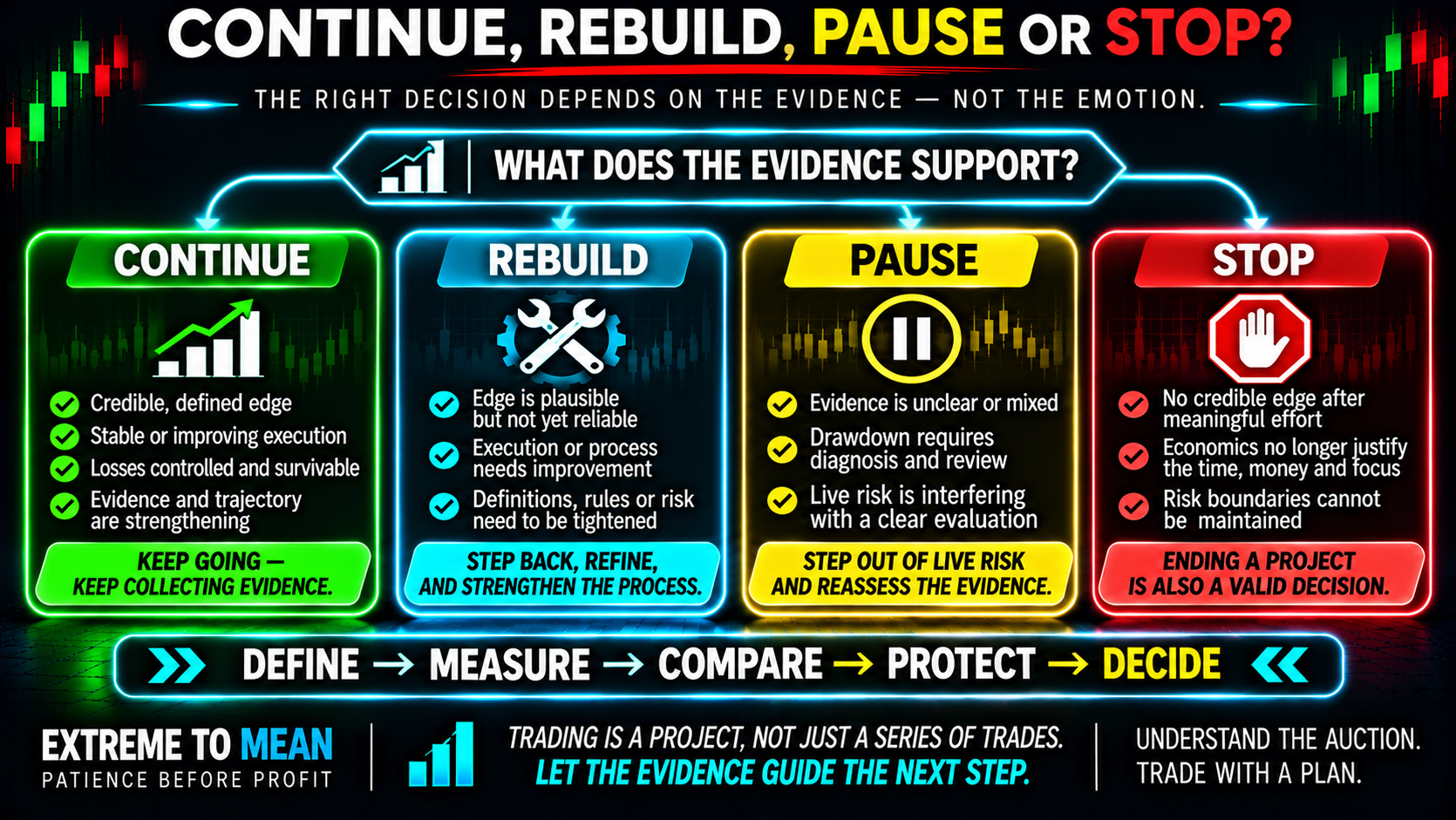
A serious review should produce more than “keep going” or “quit.” Continue fits evidence showing a credible edge, stable or improving execution, controlled risk, a growing meaningful sample, and a healthier trajectory. Continue means keep gathering evidence—not automatically increase risk.
Rebuild fits a plausible edge with a process that is not yet viable. The response may involve reducing size, simplifying the method, returning temporarily to simulation, tightening definitions, or collecting cleaner data. Sometimes trading does not need to end; it needs to become smaller and more measurable.
Pause fits unclear evidence, drawdown requiring diagnosis, deteriorated execution, or live risk interfering with the review itself. Pausing can mean temporarily stopping live exposure while records are reviewed or the strategy is retested. Pause is not indecision; it is a decision to stop paying for information that may be gathered more safely another way.
Stop should be evidence-based too. Persistent lack of credible edge, poor economics after realistic costs, repeated inability to remain inside risk rules, use of non-risk capital, or unjustifiable opportunity costs can change the decision. Ending one strategy or live-trading project is not the same thing as proving that trading itself is impossible.
The Trading Trajectory Check
Before deciding what comes next, ask:
- Can I define the edge clearly?
- Do I have enough clean data to evaluate it?
- Is expectancy positive after realistic costs, or becoming more informative?
- Can I execute the rules consistently?
- Is risk controlled and financially survivable?
- Is the account funded only with genuine risk capital?
- Are mistakes becoming less frequent or less costly?
- Is the sample becoming cleaner and more representative?
- What is trading costing outside the account?
- If I had not already invested this much time and money, would today’s evidence convince me to begin this project?
A trading plan made before the session defines trade-level rules, and the same principle should exist at the project level. The best time to decide how trading will be judged is before trading needs to defend itself. Predefine the review cadence, risk boundaries, evidence needed to continue, and reasons to pause.
The ETM Define → Measure → Compare → Protect → Decide Framework
Use DEFINE → MEASURE → COMPARE → PROTECT → DECIDE. Define what “working” means for the current stage, measure edge, expectancy, execution, drawdown, costs, and behavior, then compare the trajectory with prior reviews. Protect financial security and decision quality while evidence develops.
Then decide among CONTINUE / REBUILD / PAUSE / STOP. The ETM free tools can support journaling and review, but the framework matters more than any worksheet. The decision should follow the evidence—not rescue the emotion.
Final Thought
Knowing whether trading is working requires more than today’s P&L or the time already invested. A profitable month can hide reckless risk, while a losing month can occur inside a valid edge. PROFITABLE ≠ VIABLE, LOSING ≠ FAILING, and TIME INVESTED ≠ EVIDENCE.
The better question is whether the evidence is becoming stronger. Can the edge be defined, does it survive realistic costs, can it be executed without repeated rule violations, is risk controlled with genuine risk capital, and is the trajectory improving enough to justify what the pursuit consumes?
If the answers are strengthening, continuing may be reasonable. If the edge is plausible but the process is weak, rebuild; if evidence is unclear or live risk is interfering with diagnosis, pause; and if economics remain persistently poor or financial boundaries cannot be maintained, stopping can also be legitimate. The goal is to require enough evidence that continuing deserves the next dollar, the next trade, and the next hour.
Educational content only. Trading involves substantial risk and is not suitable for everyone.