
First Define “Consistently Profitable”
Before asking how long profitability takes, define profitability. A trader can be profitable today, this month, over a lifetime, before costs, after costs, or only because one unusually large winner overwhelms an otherwise weak record. Those are different standards.
For a repeatable process, gross profit is not enough. Commissions, exchange fees, spread, slippage, and other execution friction eventually have to be absorbed by the edge. Gross profitability can describe an idea; net profitability is what the trader actually gets to keep.
Consistency also does not mean winning every day, week, or month. A better conceptual standard is a sufficiently large body of evidence showing positive net expectancy and repeatable execution despite normal variation, losing streaks, and drawdown. This is why what an edge actually is matters before any timeline discussion.
A four-week winning streak may be useful evidence, but suppose only twelve trades occurred, one winner produced most of the profit, and the market strongly favored the strategy. The correct label may be PROMISING, not “consistently profitable.” A profitable period is an observation; consistent profitability requires a body of observations.
The Three Clocks of Trading Development
There are really three clocks. The calendar clock measures months and years, the opportunity clock measures how many valid setups the strategy encountered, and the evidence clock measures how much clean information accumulated about the strategy and the trader's execution. The evidence clock matters most.
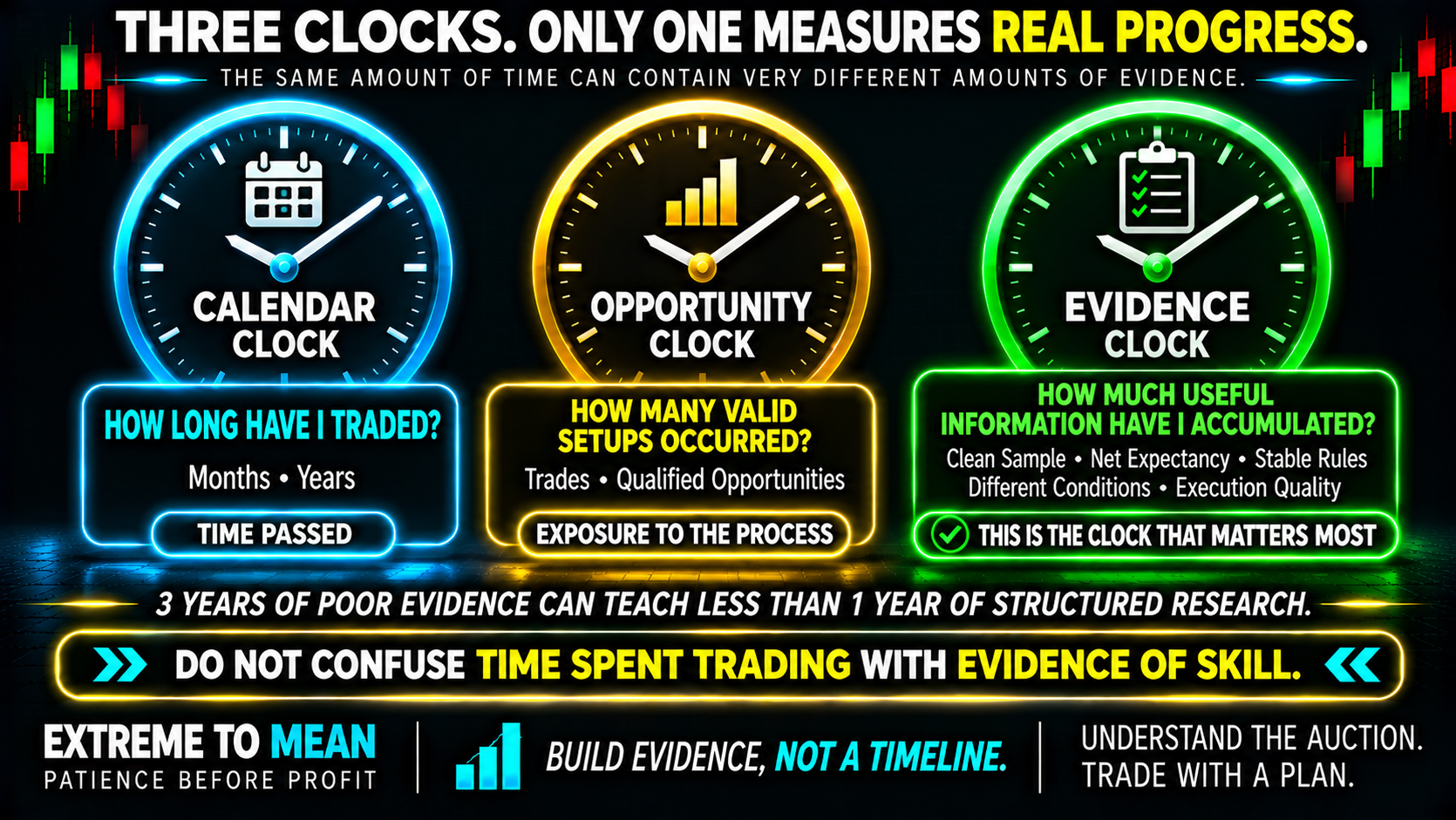
Suppose Strategy A produces three qualified trades per month while Strategy B produces sixty. After six months, one may have roughly eighteen relevant observations and the other roughly 360; “six months of experience” therefore means very different things. Equal calendar time can contain radically different amounts of evidence.
More trades do not automatically make the evidence stronger either. Five hundred trades concentrated in one unusually favorable regime may tell us less about robustness than a smaller sample spanning trend, range, higher volatility, quieter conditions, and normal drawdown. The amount of evidence matters, and the diversity of the evidence matters too.
What the Research Actually Says About Learning
Research can challenge the belief that staying in the market longer automatically creates skill, but it cannot supply a universal graduation date. A study of new Brazilian mini-Ibovespa futures day traders who persisted for at least 300 trading days found that the vast majority lost net money and reported no evidence that performance improved simply because those persistent traders kept day trading. The useful lesson is not a percentage to apply to every modern futures trader; it is that persistence is not the same thing as learning.
Large-sample research on Taiwanese day traders reaches a related conclusion from a different market. Most traders exited relatively quickly, poor performers were more likely to quit, yet many experienced losing traders continued, while a small group of experienced traders with prior profits showed predictably positive future net performance. That does not tell a new trader that “two years” is the required timeline.
Research on thousands of aspiring professional futures floor traders offers another caution. Surviving traders changed their risk-taking behavior with experience, but researchers did not find a simple improvement in risk-adjusted performance. That setting differs from today's retail market, but the broader point survives: experience and improvement are not synonyms.
These studies describe specific populations under specific conditions. They cannot tell one trader, “You will succeed in year three,” “you should quit after year two,” or “your current losses are tuition that will eventually pay off.” Research can describe learning and performance; it cannot give every aspiring trader a graduation date.
Why Success Stories Are Weak Clocks
Online discussions make it tempting to average personal stories. One trader says profitability arrived after six months, another after three years, and another after five, so the number in the middle begins to sound like a benchmark. Methodologically, that is the wrong conclusion.
The people answering “How long did it take?” are disproportionately those who still trade, identify as successful, and choose to participate; people who quit or remained unprofitable are less visible. Personal success stories are useful experiences, but they are weak clocks.
Memory also changes the finish line. “It took me two years” could mean a first green month, positive lifetime P&L, reliable expectancy, or living income. The clock cannot be standardized when the finish line is not standardized.
Profit Can Arrive Before Proof—and Improvement Before Profit
A new trader can produce +8R in the first month. That may reflect skill, favorable variance, or a supportive regime. Profit can arrive before proof, so early profitability should be investigated rather than immediately promoted into permanent evidence of skill.
The reverse can happen too. A trader may still be slightly negative while strategy hopping has stopped, losses are controlled, rule violations have fallen, costs are included, and expectancy is moving toward breakeven over a cleaner sample. That can represent genuine improvement even though it is not yet profitability.
This distinction matters when deciding whether trading is actually working. Getting better and being profitable are related milestones, not identical ones, so progress should appear in the evidence rather than being inferred from the calendar.
What Should Actually Improve Over Time?
A productive development period should leave measurable fingerprints. The strategy should become clearer, the rules more stable, costs better understood, position sizing more consistent, rule violations less frequent, and the sample more representative. Repetition by itself is not enough.
A trader who repeats the same execution mistake 1,000 times has accumulated experience, but not necessarily learning. Repetition creates experience; feedback turns experience into learning. Review, measurement, modification, and retesting are what make additional time informative.
Strategy hopping can keep resetting parts of the experiment. Six months on Strategy A, three on B, and four on C may truthfully equal thirteen months of trading, but each process may still have little clean evidence. The calendar advanced while the experiment kept restarting.
Profitability Is an Evidence Ladder
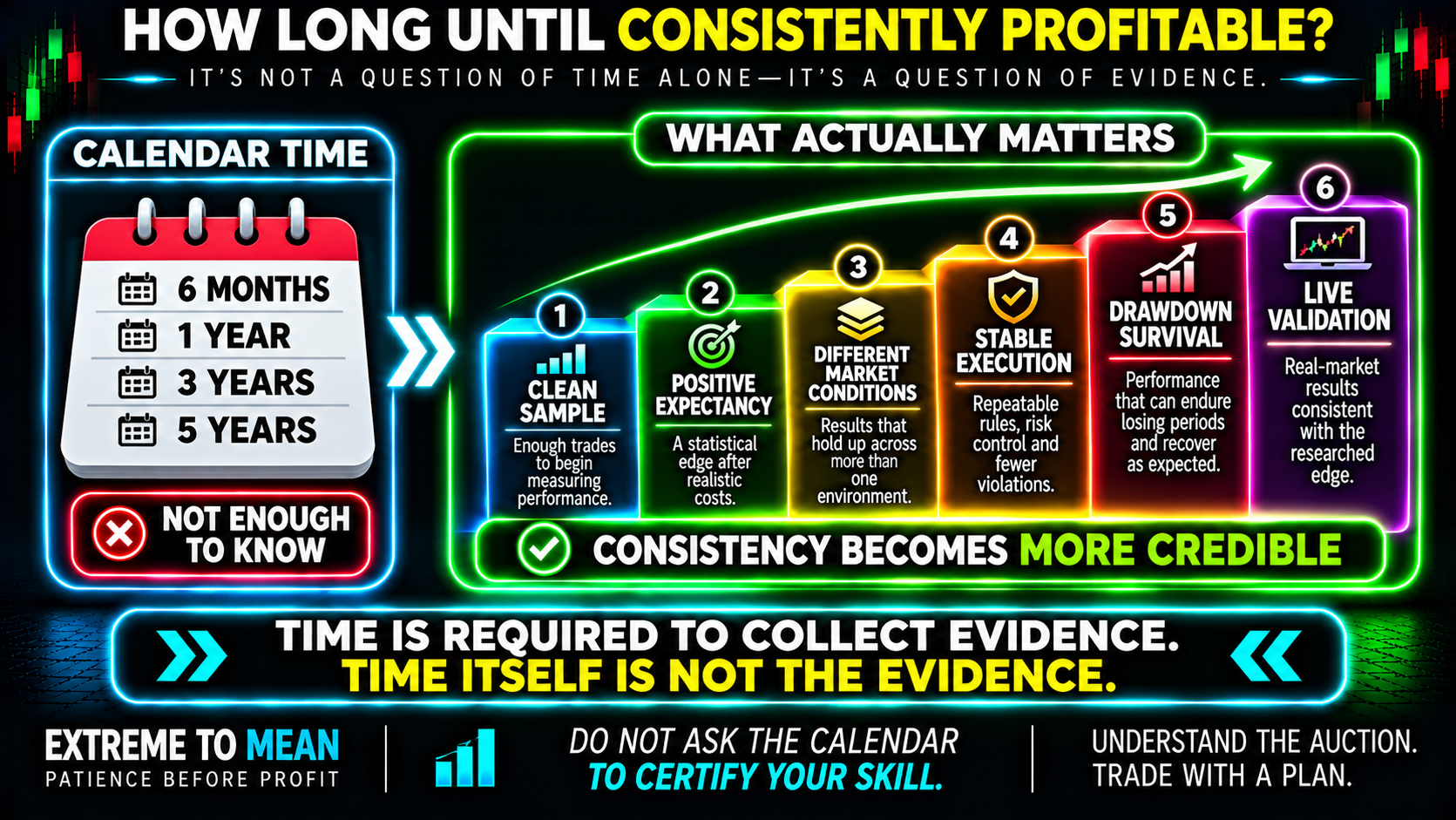
“Officially profitable” is rarely one moment. A first green period is interesting, positive lifetime net P&L is stronger, positive expectancy over a meaningful sample is stronger again, and performance that survives different conditions and drawdown is more credible still. Live results consistent with the researched edge add another layer.
Use PROFIT → REPEAT → SAMPLE → SURVIVE → VERIFY. Can the process produce positive net results, can that behavior repeat beyond one streak, is the sample meaningful, can performance survive costs and changing conditions, and do live results remain compatible with the claimed edge? Consistency is something the evidence earns gradually.
The same logic appears in whether a strategy is ready to go live. Simulation profitability and live profitability are related evidence, not interchangeable achievements, because actual fills, financial pressure, and execution errors add information a backtest cannot fully provide.
The Consistent-Profitability Check
Before describing a record as consistently profitable, ask:
- Am I profitable after realistic costs rather than only before them?
- How many comparable trades support the result?
- Is profit concentrated in one short streak or a few exceptional trades?
- Has the process encountered more than one market environment?
- Is expectancy positive across a meaningful sample?
- Are the rules and size stable enough that the sample represents one process?
- Can I execute the process without frequently overriding it?
- Has the process survived ordinary drawdown without being abandoned or distorted?
- Does live performance remain reasonably consistent with research and simulation?
- If I removed my best recent streak, would I still describe the record as evidence of an edge?
The checklist does not create a universal threshold. It replaces a weak question: “How many years have I done this?” The better question is: What evidence would make the claim credible?
Set Deadlines for Review, Not Deadlines for Success
A trader can define review dates, journal metrics, research questions, and behavioral standards in advance. Those deadlines specify when evidence is examined. “I must be profitable by month twelve” pretends to know what the market and learning process must deliver.
The opposite mistake is just as dangerous. Hearing that trading can take years should not become permission to accept years of uncontrolled losses as mandatory tuition. A long learning process does not require a large financial learning bill.
Losses can accompany learning, but losses do not prove learning is occurring. A loss becomes useful tuition only when it produces information that improves the process; otherwise it is simply a loss. Continuing longer is useful only when the additional time produces better evidence.
Final Thought
There is no credible universal answer to how many months or years it takes to become a consistently profitable trader. Research can tell us that durable profitability was uncommon in the populations studied and that accumulating experience did not automatically turn losing traders into winners. It cannot tell a new trader that success should arrive in year two, year three, or any other calendar milestone.
The better standard is evidence. Are results positive after realistic costs, is expectancy positive over a meaningful and sufficiently diverse sample, are the rules stable enough that the observations represent the same process, has performance survived normal drawdown and different conditions, and can the strategy be executed consistently in live markets?
TIME ≠ EVIDENCE, EXPERIENCE ≠ IMPROVEMENT, PROFIT ≠ PROVEN EDGE, GREEN STREAK ≠ CONSISTENCY, PERSISTENCE ≠ PROGRESS, and PERSONAL SUCCESS STORY ≠ POPULATION TIMELINE. Do not ask the calendar to certify your skill. Use the calendar to collect evidence—and require that evidence to become stronger before calling the result consistent.
Educational content only. Trading involves substantial risk and is not suitable for everyone.