
Inside the Setup curriculum, the Cheatsheet is a practical pause between noticing an extreme and deciding whether it has earned risk.
Why Seeing an Extreme Creates Urgency
Mean reversion has an emotional trap built into the idea itself. The more stretched price appears, the more obvious the opportunity can feel, and that visual extreme creates pressure to act before the move back toward the mean begins. The trader moves quickly from “price is stretched” to “price must revert” to “I should enter now.”
That progression feels reasonable because waiting appears expensive. If the market really is about to snap back, every extra candle can seem like lost opportunity, and the trader may believe that faster action produces a better entry. The problem is that an extreme is evidence of distance, not proof that the market has finished extending or that a qualified trade already exists.
This is why not every extreme is a trade. Price can become unusually extended and continue moving, remain extended longer than expected, or reach an extreme in an environment where the apparent distance is actually normal. The extreme should earn attention, but attention and risk are two different decisions.
The RTM Cheatsheet Is a Pause, Not a Signal
The first job of the RTM Cheatsheet is not to generate another trading signal. Its first job is simpler and more valuable: interrupt the path from “something interesting happened” to “click the order button.” That pause creates enough space for the trader to evaluate rather than react.
A useful process tool creates friction at the exact moment urgency wants to remove it. Instead of asking only whether price looks stretched, the trader has to consider location, distance, volatility, confirmation, risk, and target before deciding what comes next. Those questions do not guarantee a good trade, but they make it harder for the extreme itself to make the decision.
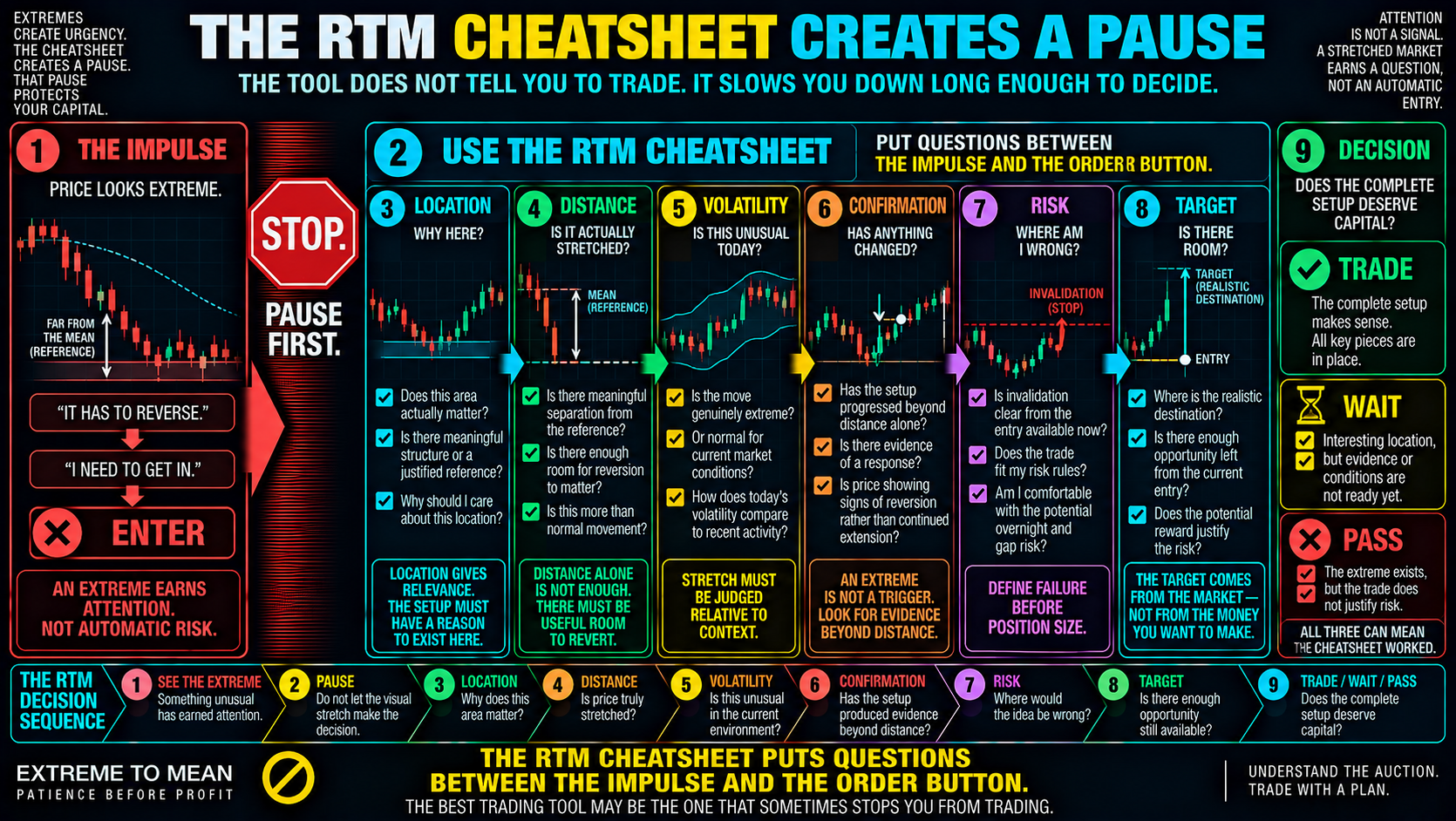
That is the important distinction. The Cheatsheet should not tell the trader what to trade, and completing it should not become automatic permission to act. It puts questions between the impulse and the order button.
Location and Distance: Is This Really an Extreme?
The first filter is location because “price is down a lot” is not a location. A trader should have a reason the area deserves attention, whether that reason is prior structure, an established reference, an important extreme, or another location defined by the process. Without that context, the trader may simply be reacting to the size of the move.
That is why location is the first filter. A dramatic move in the middle of nowhere can look tempting while offering little structural reason to expect the area to matter. The better question is not merely, “How far did price move?” but, “Why should I care about where price is now?”
Distance comes next because mean reversion requires meaningful separation between price and the reference the trader expects price to revert toward. If there is very little room to revert, the visual appearance of extension may be more exciting than the actual opportunity. A reversion thesis needs enough separation for the return toward balance to matter from the entry that is actually available.
Volatility Changes What “Stretched” Means
Distance cannot be judged in isolation because markets do not move the same amount every day. A twenty-point move may look dramatic during a quiet session and completely ordinary during a high-volatility session. The number itself does not tell the trader whether the move is genuinely unusual.
This is where current conditions matter. As market conditions change the quality of a setup, volatility changes the meaning of the distance between price and its reference. The Cheatsheet should slow the trader down long enough to ask whether the apparent stretch is unusual for this environment rather than unusual compared with what the trader remembers from a quieter day.
That does not require one universal volatility number, indicator level, or threshold. Different strategies can define extension differently, and the purpose here is not to turn the Cheatsheet into a mechanical formula. The principle is simply that stretch must be judged relative to context.
Confirmation: Has Anything Changed Besides Distance?
A market can become extreme without immediately beginning to revert. Price may still be accelerating in the same direction, making new extremes, or showing no meaningful change in behavior at all. Distance tells the trader where price is relative to the reference; it does not automatically tell the trader that the move has finished.
Confirmation therefore asks a different question: has anything happened besides price becoming stretched? The specific evidence will depend on the trader’s strategy, and the Cheatsheet should not prescribe one universal candle, indicator, or proprietary trigger. Its role is to stop the trader from treating extreme and entry as synonyms.
This distinction is especially important because waiting for evidence can feel like sacrificing price. Sometimes the trader will indeed receive a less favorable entry after additional evidence appears, and sometimes the move will happen too quickly to leave a clean opportunity. That is acceptable because the objective is not to capture every snapback; it is to take risk only when the available trade still makes sense.
Risk and Target Force the Exciting Idea to Survive Boring Math
Once a trader becomes excited about a possible reversion, risk can easily become an afterthought. The trader knows where they want price to go but has not decided where the idea is genuinely wrong from the entry available now. “I will know when it looks bad” is not a defensible invalidation plan.
That is why the trade is not ready until the risk is clear. The Cheatsheet forces the trader to confront invalidation before emotional attachment to the position makes that conversation harder. A trade can look visually compelling and still deserve no capital if the current entry leaves vague or unattractive risk.
The target matters for the same reason. A trader should evaluate the realistic destination from the price available now, not admire how far price traveled before the entry became available. If most of the useful reversion has already happened, or the realistic destination leaves too little remaining opportunity relative to the risk, the correct answer may be to let the trade go.
A Fast Drop Shows Why the Pause Matters
Imagine price falls sharply and appears obviously stretched from a meaningful reference. The immediate reaction is, “This has gone too far; I need to catch the bounce.” Instead of entering, the trader pauses and works through the conceptual filters.
Location asks whether price has actually reached an area that matters, while distance asks whether there is meaningful separation from the reference. Volatility asks whether that distance is unusual under current conditions, confirmation asks whether behavior has changed, risk asks where the idea would be wrong from the available entry, and target asks whether enough realistic opportunity remains. The same dramatic chart now has to survive six different questions instead of one emotional reaction.
In one version, the answers line up well enough that the setup deserves further consideration. In another, price is stretched but volatility is unusually high, no meaningful response has appeared, invalidation is poor, or too little room remains to the target. The Cheatsheet worked in both cases because success is not measured by whether it produced a trade.
“Wait” and “Pass” Mean the Cheatsheet Worked
Trading tools are often judged by how many opportunities they appear to uncover. That creates the wrong incentive for a decision filter because the filter starts feeling useful only when it gives the trader permission to participate. A good filter should be just as comfortable removing a trade as approving further consideration.
Sometimes the answer should be not here because the location lacks meaning. Sometimes it should be not yet because the setup has not progressed beyond the extreme, and sometimes it should be not this one because the risk or remaining opportunity is poor. Those outcomes are not failures of the Cheatsheet; they are evidence that it prevented urgency from becoming the decision process.
This is where patience becomes practical rather than philosophical. The pause is not inactivity; it is the time required to determine whether the market has actually created the trade the trader thinks they see. The best trading tool may occasionally be the one that helps you decide not to trade.
The RTM Decision Sequence
The Cheatsheet can be understood as a simple progression from observation toward commitment. Each stage asks the trader to earn the next one rather than jumping directly from extreme to entry. The tool is useful because it makes that sequence repeatable when live price movement is trying to speed the trader up.
- See the extreme — Something unusual or interesting has earned attention.
- Pause — Do not let the visual stretch make the trade decision.
- Location — Why does this area matter?
- Distance — Is price truly stretched from a meaningful reference?
- Volatility — Is that distance unusual in the current environment?
- Confirmation — Has the setup produced evidence beyond the extreme itself?
- Risk — Where would the idea be wrong from the entry available now?
- Target — Where is the realistic destination, and is enough opportunity still available?
- Trade / wait / pass — Does the complete setup deserve risk?
The condensed framework is See the Extreme → Pause → Location → Distance → Volatility → Confirmation → Risk → Target → Trade / Wait / Pass. It is deliberately not a formula that says enough green boxes equal a trade. Its purpose is to make the trader slow down long enough for observation, context, and risk to compete with urgency.
The better question is: “Does this setup deserve risk—or do I simply feel urgency because price looks extreme?” That question gets to the psychological heart of the tool because it separates the opportunity the market has actually created from the opportunity the trader is afraid of missing.
Final Thought
The RTM Cheatsheet should not make mean-reversion trading mechanical. It should not predict reversals, identify perfect entries, eliminate losses, or replace the judgment required to interpret a live market. Its value is much simpler: it creates a repeatable pause before capital is committed.
Location tells you why the area matters. Distance tells you whether a meaningful stretch exists, volatility tells you how unusual that stretch really is, confirmation asks whether the setup has progressed, risk tells you where the idea fails, and target tells you whether enough opportunity remains. Together, those questions force the exciting idea to survive a more boring—but much more useful—evaluation.
An extreme earns attention, not automatic risk. The RTM Cheatsheet is useful because it keeps questions between the impulse and the order button, which is exactly the role a practical tool should play inside the broader Extreme to Mean free tools: not giving you the answer, but keeping you from answering too quickly.
Educational content only. Trading involves substantial risk and is not suitable for everyone.