
Prop trading adds a layer that ordinary market preparation does not have. You are not only deciding whether a setup makes sense; you are also deciding whether the exact account is allowed and prepared to take that risk today. That is why a prop trader should not discover the account while trading the market.
This fits directly inside the broader Trader curriculum: preparation is not about predicting the next move. It is about reducing decisions you have to invent while price is moving. The better question is not, “What can I trade today?” but, “What must be true before this account should take a trade?”
A Prop Trader Has Two Environments to Prepare For
Most traders naturally look at the market first. They open ES or NQ, notice an overnight move, see price approaching a level, and immediately start thinking about direction. That feels reasonable because the chart is where the trade will eventually happen, but for a prop trader the chart is only half of the environment.
The other half is the account itself. Different account types, sizes, stages, or providers may come with different operating boundaries even when the trader uses the same strategy. If you need the foundation, what a prop firm is and how the model works explains that structure; this lesson begins after you already have the account.
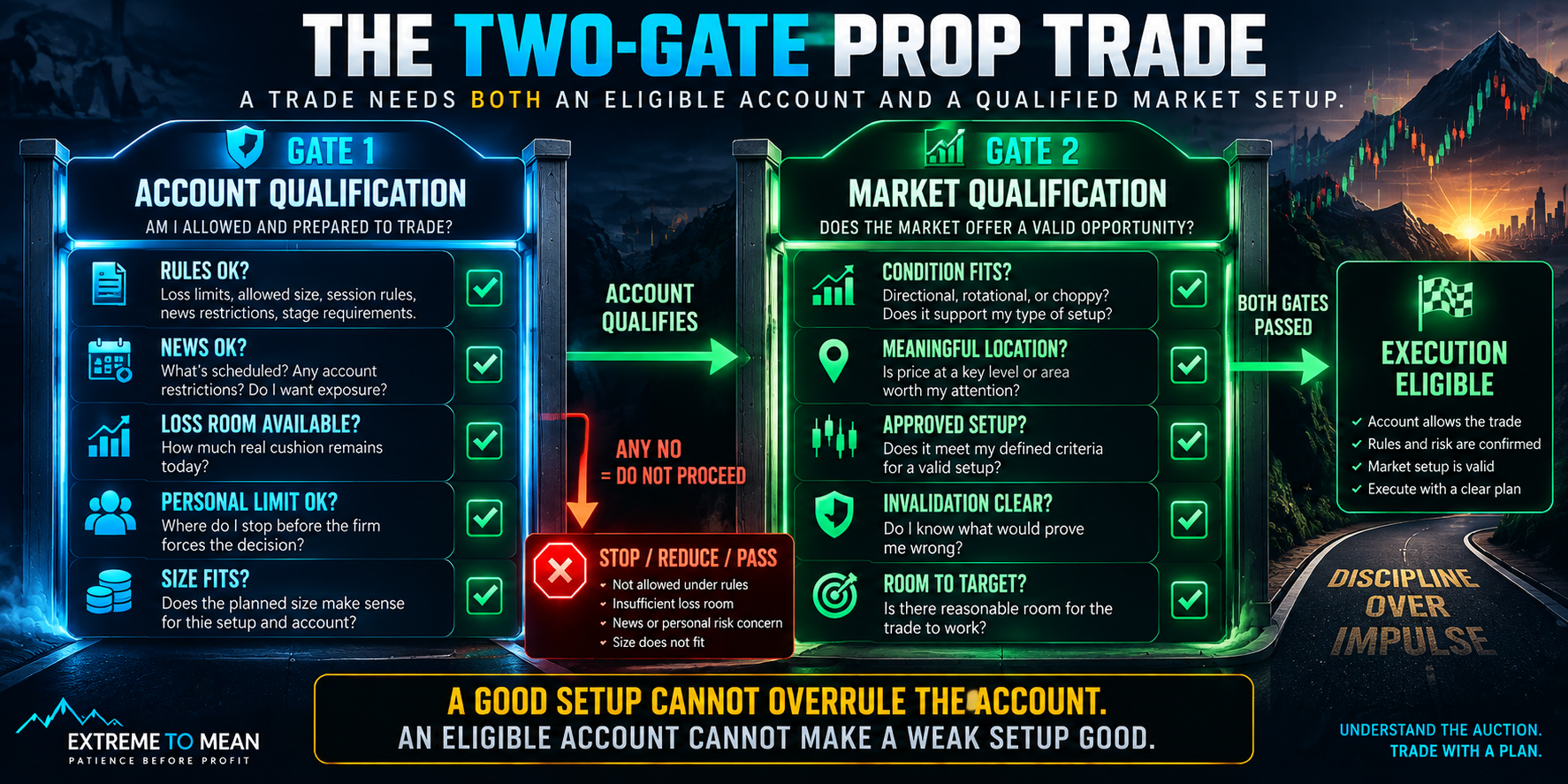
A clean routine therefore has two gates. First, determine whether the account can responsibly participate under today’s rules and risk conditions. Second, determine whether the market has actually produced an opportunity worth using that account on.
Start With the Account, Not the Chart
Before studying the overnight move, confirm the exact account you intend to trade. Traders who manage multiple accounts, stages, sizes, or providers can easily operate from memory instead of verifying what applies today. The point is not bureaucracy; it is removing avoidable uncertainty before the session gets interesting.
Then identify the account’s real loss room before thinking about what you want to make. A profit target can create urgency because it focuses attention on what is missing, while the remaining cushion tells you what the account can actually absorb. The account number should never manufacture an opportunity just because you are close to a target or payout threshold.
This is also the right time to define your own stopping point inside the firm’s outer boundary. The maximum consequence a provider will tolerate is not automatically the amount you should be willing to lose in a normal session. Decide what would make you stop before the first loss turns that decision into an emotional negotiation.
Know the Rules That Can Change Today’s Decisions
Review the current official rules for your exact provider, account type, and stage. Know whichever boundaries can affect today’s decisions: allowed size, relevant loss limits, flat-time requirements, news restrictions, consistency conditions, or other stage-specific rules. Rules can differ and change, so “I remember how this works” is weaker than “I confirmed what applies today.”
A market setup can be valid and still be unusable because the account does not qualify for the trade under its current rules. That is why a trading plan made before the open matters even more in a funded-account environment. The plan has to respect both the market and the operating container around it.
Do not turn this step into a rule-comparison hobby. The goal is not to study every provider on the internet; it is to know the rules that govern the account you are actually trading. Once those boundaries are clear, move on.
Check News and Define Your Personal Risk Boundary
Before deciding what normal market behavior should look like, check the economic calendar for scheduled events during your session. Major releases can change volatility, liquidity, slippage, and execution, so know what is coming and when. Also confirm whether your exact account has restrictions around those events.
Permission and preference are two different questions. A firm may permit trading around a release while your own plan says the conditions are too fast or too uncertain for you. Firm permission is not trader obligation.
Now connect that information to your personal risk boundary. If a major release is approaching, the account cushion is thinner than usual, or the day contains conditions you do not handle well, your normal operating range may need to be smaller or you may decide not to participate. A routine is doing its job when it gives you legitimate reasons to wait or pass.
Set Position-Size Expectations Before Excitement Arrives
Position size should be considered before the clean-looking setup appears. Once price reaches a level you have been waiting for and begins moving quickly, increasing size can suddenly feel justified because the opportunity looks better. That is precisely when you do not want to invent your risk logic.
You do not need a universal contract count or percentage. The important sequence is that size comes from the trade’s invalidation, the contract’s value, the risk you are willing to accept, and the room available in the account. If those pieces do not fit together, the correct answer may be reduce size or pass.
If the account can only support a position that no longer makes sense for the setup, the market does not owe you a workaround. The trade is not ready merely because the chart looks attractive; risk still has to be clear before the trade is ready. Clarity beats enthusiasm.
Then Map the Market: Condition, Levels, and Scenarios
Only after the account side is organized should you move fully into market preparation. Ask what happened overnight, what condition the market is in, where the meaningful levels are, and where price sits in relation to those areas. A key level is a place to pay attention, not a command to enter.
The same setup can behave differently in a directional market, a rotational range, or messy chop. That is why market conditions change the quality of a setup, even when the visual pattern looks familiar. Identify the environment first so you are not asking a setup to do a job the current market is poorly suited to support.
Scenario planning should stay conditional. Instead of deciding, “I am definitely buying NQ today,” say, “If price reaches this area, the condition still supports the idea, and my setup qualifies, I am interested.” That narrows your choices without pretending uncertainty has disappeared.
Define the Setups You Are Actually Willing to Trade
Before the open, decide which setups are eligible for your attention and what must happen before one qualifies. This is not the same as predicting which setup will appear. It is deciding what evidence you are willing to act on so the open does not become an improvised hunt for reasons to participate.
Imagine a trader who sees NQ approaching a meaningful area and immediately becomes interested in a long. The old process is Chart → Setup → Order, because movement creates urgency and the trader starts solving every other question afterward. The better process confirms the account, rules, loss room, news, personal stop, and size range first, then judges market condition, location, and setup.
Suppose a major release is scheduled for 10:00 a.m., the market is directional but extended, and the planned opportunity is a pullback continuation only if structure remains intact near meaningful support. The open comes, but price never reaches the planned area. The trader takes no trade, and the routine still worked because its purpose was to define what would qualify, not manufacture participation.
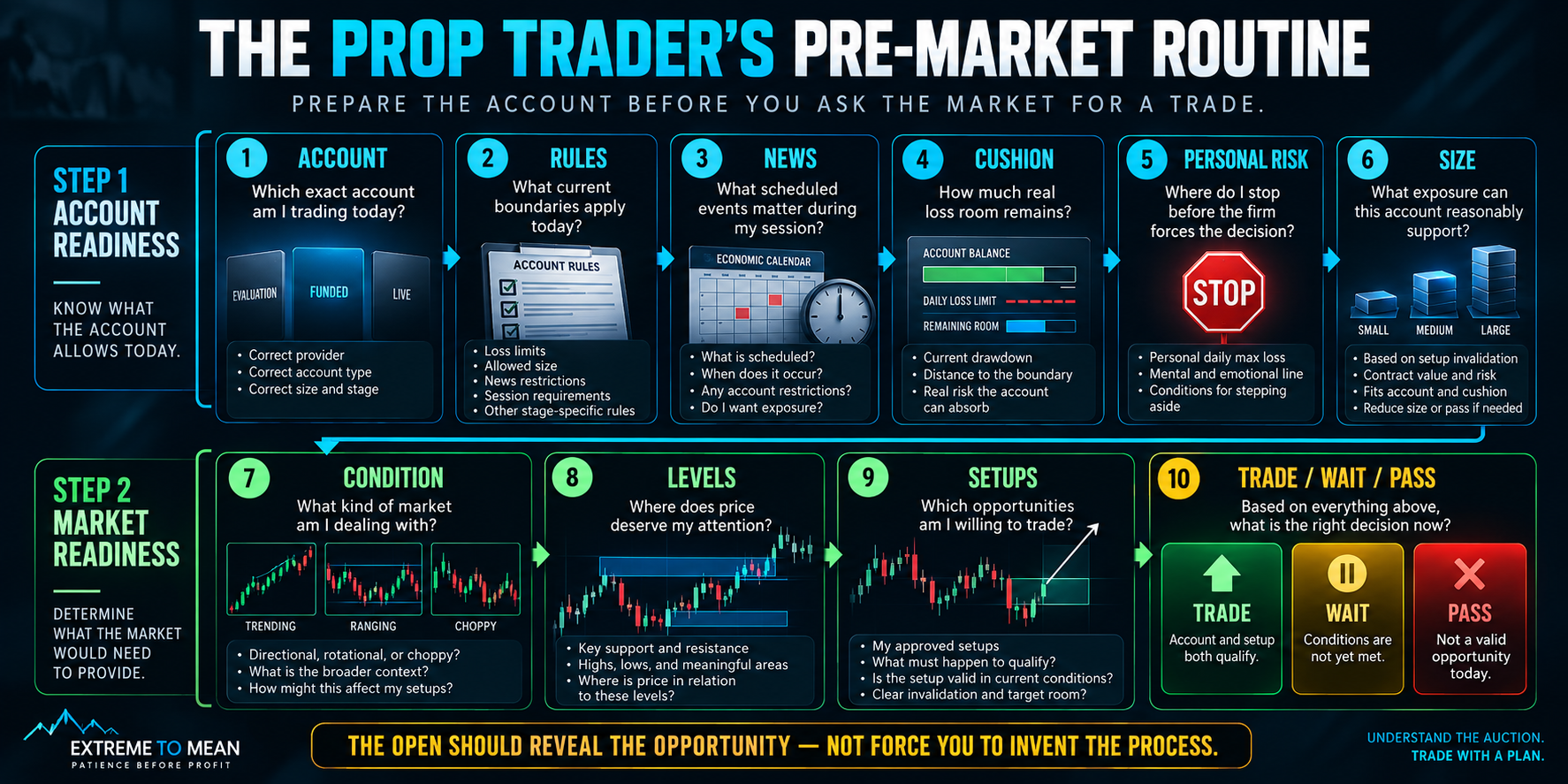
The ETM Prop Pre-Market Routine
The routine can be reduced to one sequence. It should be short enough to use consistently. The order is the point:
- ACCOUNT — Which exact account am I trading?
- RULES — What current boundaries apply today?
- NEWS — What scheduled events matter during my session?
- CUSHION — How much real loss room remains?
- PERSONAL STOP — Where do I stop before the firm forces the decision?
- SIZE — What exposure can this account reasonably support?
- CONDITION — What kind of market am I dealing with?
- LEVELS — Where does price deserve my attention?
- SETUPS — Which opportunities am I willing to trade?
- DECISION — Trade, reduce, wait, or pass.
You can also think of the routine as three questions. Can the account trade under today’s boundaries? Should I trade under today’s risk conditions, and has the market actually produced one of my qualified setups?
The sequence matters because each step removes a live decision from the most emotional part of the session. Account limits should not be discovered after entry, size should not be negotiated because a candle looks exciting, and scenarios should not be rewritten because you feel pressure to use the account. A routine organizes decisions; it does not guarantee discipline, passing, payouts, or a profitable day.
If your answers remain unclear by the time the market opens, that uncertainty is information. The next step is not to force the account into action; it is to resolve the missing piece or stand aside. For traders who repeatedly reach the open without knowing what they can afford to lose, the deeper issue may be unclear risk rather than a lack of setups.
Final Thought
A prop trader prepares two environments before the market opens. First, understand what the exact account permits, what room remains, what events matter, where your personal stop sits, and what size the account can reasonably support. Then turn to the market and decide what condition exists, which locations matter, and what setup would actually qualify.
The open should reveal whether an opportunity develops, not force you to invent the entire process in real time. Some mornings it will lead to a trade; others to a smaller position, a delay, or no trade. A successful routine makes each of those outcomes acceptable before price starts testing your patience.
Educational content only. Trading involves substantial risk and is not suitable for everyone.