
Recessions rarely announce themselves through one clean number. The more useful warning comes when weakness begins spreading across consumers, employment, earnings, credit, liquidity, and financial markets.
Calling a recession in real time is harder than it looks afterward. Traders can point to unemployment, GDP, the yield curve, credit spreads, consumer debt, or volatility and find examples where each measure appeared important before a downturn. The mistake is turning one useful indicator into a universal trigger. A stronger process looks for deterioration spreading across several independent parts of the economy.
That approach also fits the way recessions are ultimately identified. The NBER Business Cycle Dating Committee defines a recession as a significant decline in economic activity spread across the economy and considers depth, diffusion, and duration rather than relying on one mechanical GDP rule. Its analysis includes measures such as payroll employment, real personal income, consumption, industrial production, and sales. For traders studying The Market, the lesson is straightforward: broad deterioration matters more than one frightening statistic. (nber.org)
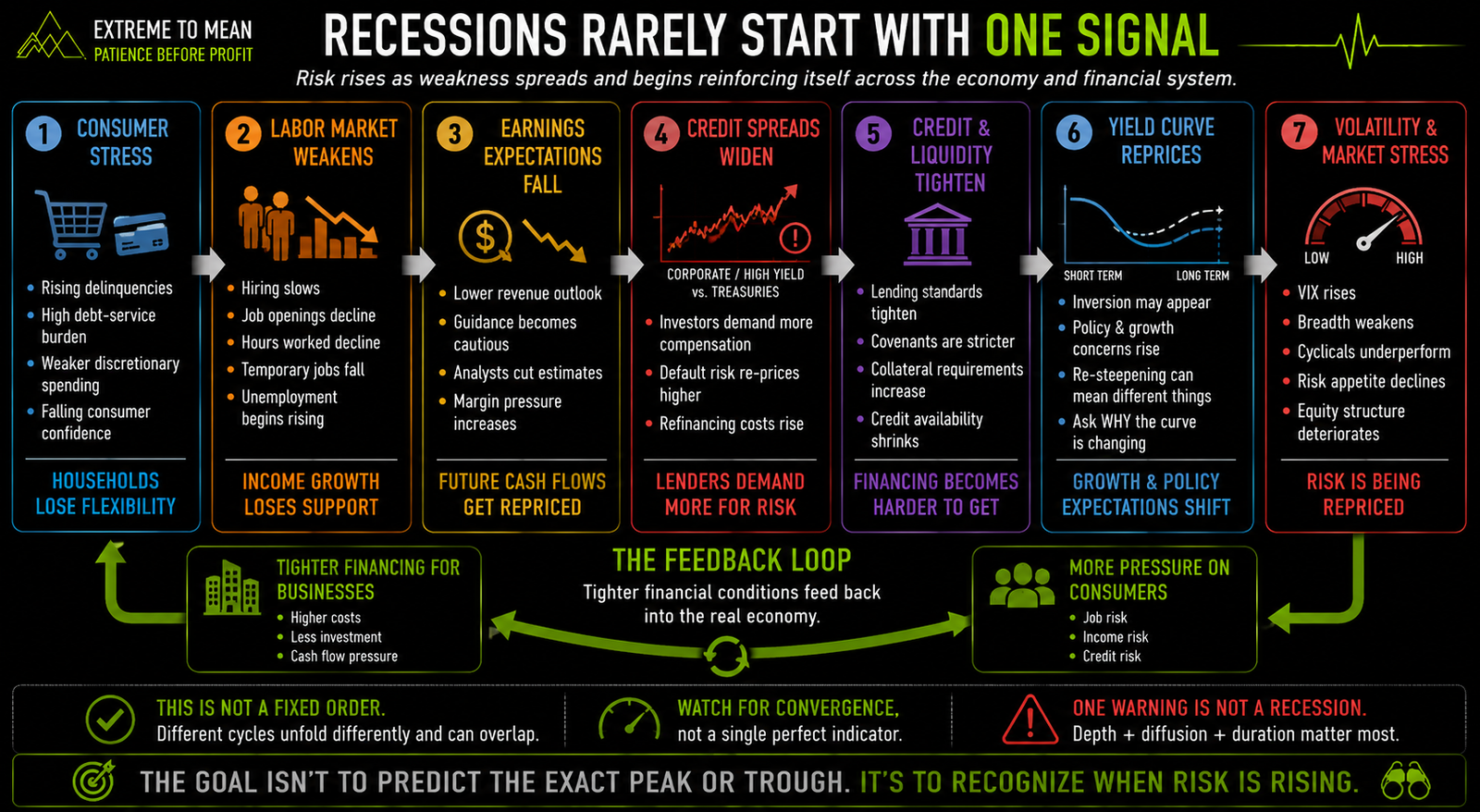
A Recession Is Usually a Process, Not a Switch
Economic deterioration does not move through a fixed seven-step checklist every time. Consumer stress may appear before employment weakens in one cycle, while credit conditions or business investment deteriorate earlier in another. External shocks can also compress what normally develops over many months into a much shorter period. The value of a recession framework is therefore in recognizing convergence, not demanding that every indicator arrive in the same order.
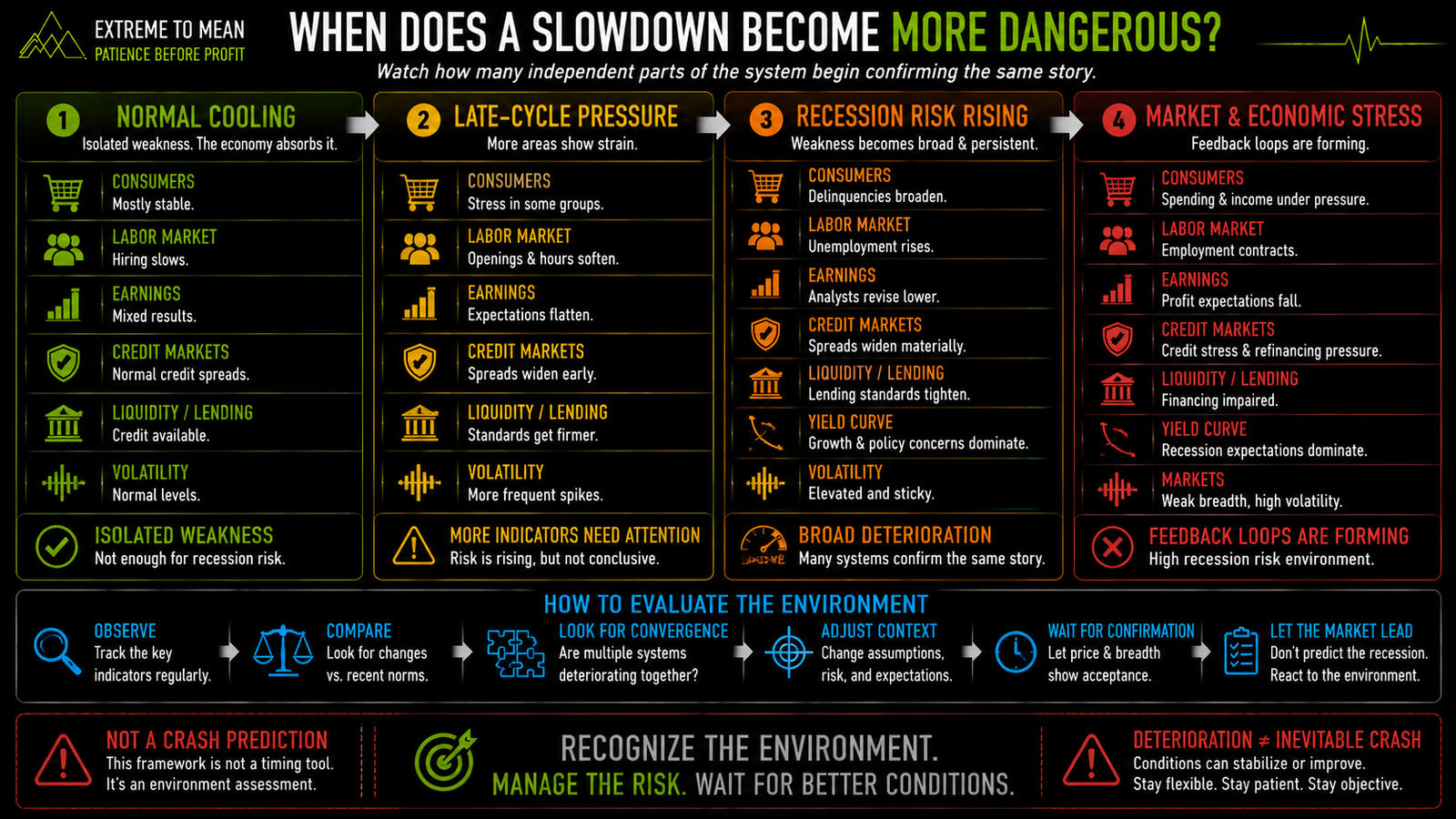
This distinction keeps the trader from confusing slowdown with recession. Economies routinely experience softer manufacturing, slower hiring, cautious consumers, or weaker earnings without entering a broad contraction. The concern increases when those problems begin reinforcing one another instead of remaining isolated. The three market states offer a useful analogy: the important change is not one weak reading but evidence that the broader environment itself is transitioning.
Consumer Stress Can Appear Before the Headline Economy Breaks
Consumer spending represents a major part of U.S. economic activity, so household pressure deserves attention when evaluating deterioration. Useful signs include rising delinquencies, greater dependence on revolving credit, weakening discretionary spending, deteriorating consumer confidence, and increasing difficulty servicing debt. The New York Fed’s Household Debt and Credit framework tracks mortgages, credit cards, auto loans, student loans, and transitions into delinquency precisely because household balance sheets provide information about consumer credit conditions. (newyorkfed.org)
No single increase in delinquency means recession. Stress can remain concentrated among particular borrower groups while aggregate employment and income remain healthy, and temporary changes in loan programs can distort individual categories. The cleaner question is whether financial pressure is spreading while income growth, hiring, and spending are also weakening. Consumer trouble becomes more important when other parts of the economy start confirming it.
Employment Weakness Changes the Character of the Slowdown
The labor market can remain resilient surprisingly late in an economic cycle because companies usually do not want to dismiss trained workers at the first sign of weaker demand. Early deterioration may instead appear through slower hiring, fewer openings, reduced hours, less temporary employment, or smaller payroll gains. As weakness deepens, unemployment can begin rising more persistently. That progression matters because lost income can feed directly back into weaker household spending and higher credit stress.
Employment is important enough that the NBER includes both payroll and household measures when evaluating business-cycle turning points. Yet unemployment is not a perfect timing tool: the NBER notes that the unemployment rate can start rising before an economic peak and can continue rising after a recession has already reached its trough. (nber.org) The trader should therefore use labor deterioration as confirmation of a changing environment rather than as a single “recession on” signal.
Earnings Expectations Can Weaken Before the Official Label
Stock prices reflect expectations about future corporate cash flows, not simply current economic statistics. As demand slows, companies may guide cautiously, analysts may reduce future earnings estimates, and margins may come under pressure from weaker revenue, financing costs, or operating leverage. The Federal Reserve’s financial-stability framework explicitly evaluates equity valuations relative to analysts’ expected earnings over the next 12 months, illustrating how forward earnings assumptions are embedded in market valuation. (federalreserve.gov)
For traders, falling earnings expectations can matter well before recession dating is complete. Equities may respond when investors conclude that future profits are deteriorating, even though backward-looking economic data still appears acceptable. That is why context comes before the candle at the macro level too. A weakening earnings backdrop changes what an otherwise ordinary technical setup is occurring inside.
Credit Spreads Show What Lenders Demand for Risk
Credit markets provide another view because corporate borrowers must compensate investors for taking default and liquidity risk. The spread between corporate-bond yields and comparable Treasury yields can widen when investors demand more compensation for holding weaker credits. Federal Reserve historical data show particularly large spread increases during episodes such as 2008–09 and 2020, with other notable increases around earlier periods of stress. (federalreserve.gov)
Wider spreads do not automatically identify a recession, but sustained widening across lower-quality credit can indicate that financial markets are becoming less comfortable with corporate risk. That matters because higher borrowing costs can make refinancing, investment, acquisitions, inventory financing, and other business decisions more expensive. Credit stress becomes more concerning when it appears alongside weaker earnings and employment. At that point, the financial system may be reinforcing the economic slowdown rather than merely reflecting it.
Tightening Liquidity Can Turn Weakness Into a Feedback Loop
Credit spreads describe market pricing, while lending standards provide another view of how available financing is becoming. The Federal Reserve’s Senior Loan Officer Opinion Survey asks banks whether standards are tightening or easing for business and household loans and why those policies are changing. Banks can respond to a more uncertain economic outlook, deteriorating borrower credit quality, reduced risk tolerance, or concerns about collateral and liquidity. (federalreserve.gov)
Tighter credit can become economically important because businesses and consumers do not all have equal access to capital markets. A company facing weaker sales may also encounter more restrictive loan terms just when additional flexibility would be useful, while households facing financial stress may find credit harder or more expensive to obtain. That interaction can amplify an existing slowdown. Liquidity becomes especially important when several forms of financing tighten simultaneously rather than one lending category weakening in isolation.
The Yield Curve Is a Warning Tool, Not a Countdown Clock
The yield curve receives enormous attention because differences between short- and long-term Treasury rates contain information about expected policy and economic conditions. The New York Fed maintains a recession-probability model based on the spread between the 10-year and 3-month Treasury rates, using that term spread to estimate recession probability twelve months ahead. Importantly, the New York Fed explicitly states that those probabilities are not official forecasts of the Federal Reserve System. (newyorkfed.org)
An inverted curve can therefore be useful evidence without providing a precise recession date. The curve can remain inverted for an extended period, and later steepening can occur for very different reasons: long rates may rise, short rates may fall as markets price policy easing, or both can move together. Traders should ask why the curve is changing rather than treating inversion or dis-inversion as a self-contained signal. The yield curve becomes more useful when labor, credit, earnings, and consumer evidence are moving in the same direction.
Rising Volatility Shows the Market Is Charging More for Uncertainty
Volatility often changes as investors become less certain about earnings, policy, credit, or economic outcomes. The VIX Index is designed to measure the S&P 500 options market’s expectation of volatility over roughly the next 30 days, making it a forward-looking measure of expected movement rather than a direct recession indicator. (cboe.com) Rising VIX can therefore show that market participants are demanding more protection or pricing a wider distribution of possible outcomes.
A volatility spike can happen for many reasons that have nothing to do with recession, including geopolitical events, policy surprises, and short-lived market dislocations. The stronger evidence comes when elevated volatility persists while credit spreads widen, market breadth weakens, earnings expectations deteriorate, and economically sensitive areas struggle. In that environment, volatility is one piece of a larger risk repricing. The objective is not to call a crash from VIX; it is to recognize when uncertainty is no longer isolated.
Markets Can Move Before the Recession Is Official
One of the most important distinctions for traders is that recession dating and market pricing operate on different clocks. The NBER waits for sufficient evidence to determine economic peaks and troughs, while financial markets continuously price expectations about growth, earnings, policy, credit, and risk. That means equities and futures can weaken before an official recession announcement—or rally before the economic data has clearly recovered. The declaration itself is not the trading trigger. (nber.org)
This is where economic context changes practical decision-making. An ES or NQ pullback inside a healthy expansion does not carry the same surrounding risks as a similar pattern occurring while earnings expectations are falling, credit is deteriorating, unemployment is rising, and volatility is expanding. Market conditions change the quality of a setup because the same technical structure can exist inside very different risk environments. Context does not predict the outcome, but it tells the trader what kind of environment is demanding a decision.
A Cleaner Recession-Risk Process
Start by separating slowdown evidence from systemic confirmation. One soft consumer reading or one weak payroll report earns attention, but recession risk becomes more significant when consumer stress, employment, earnings, credit, liquidity, and financial-market behavior begin deteriorating together. The sequence does not have to be perfect. What matters is whether weakness is becoming deeper and more widely distributed.
Then watch the interaction among the indicators rather than building a checklist in which every box must turn red. Are weaker consumers contributing to weaker company revenue? Are weaker earnings expectations occurring alongside wider credit spreads? Are banks becoming more cautious while unemployment rises and volatility remains elevated? The cleaner process looks for feedback loops that make the slowdown harder for healthy areas of the economy to offset.
Better Questions When Recession Risk Is Rising
A useful recession framework should reduce the temptation to predict dramatic outcomes from one chart. The purpose is to identify whether the environment is moving from normal economic variation toward broad deterioration that deserves greater caution. It should also allow the conclusion that several warning signs are present without claiming that a recession or market crash is inevitable. The better question is, “How much of the economy and financial system is now confirming the same deterioration?”
- Is consumer stress isolated or becoming broader?
- Is hiring merely slowing, or is employment beginning to contract?
- Are unemployment and reduced hours confirming weaker labor demand?
- Are companies and analysts lowering earnings expectations?
- Are corporate credit spreads widening materially?
- Are banks tightening lending standards or loan terms?
- Is financing becoming harder for businesses and households?
- What is the yield curve changing because markets expect?
- Is volatility temporarily elevated or persistently repricing risk?
- Is market breadth deteriorating alongside the headline indexes?
- Are cyclical and economically sensitive areas weakening?
- Are multiple independent indicators now reinforcing one another?
- Am I identifying a changing environment, or trying to predict a crash?
These questions create a more useful trading review because they separate economic diagnosis from market prediction. A recession-risk environment may justify more caution, tighter qualification, greater respect for volatility, or simply fewer assumptions about what a familiar setup should do. It does not automatically create a short trade. The broader Macro Playbook provides a natural place to organize these signals alongside inflation, rates, the dollar, employment, and financial conditions.
Final Thought
You usually do not know that an economy is entering recession because one indicator suddenly flashes red. The more important transition occurs when weakness spreads: households become more stressed, employment deteriorates, earnings expectations soften, credit becomes more expensive, lending gets tighter, the yield curve reflects growing policy and growth concerns, and volatility shows that financial markets are repricing uncertainty. Those signals can arrive in different orders and with different intensity. Their convergence matters more than any single one.
For traders, the objective is not to predict the next recession before everyone else or turn an economic warning into an automatic bearish position. It is to recognize when the environment has changed enough that assumptions built during healthier conditions deserve to be questioned. Market comes first, and economic context is one part of understanding that market. The trader’s job is to evaluate whether deterioration is becoming broad and self-reinforcing—not react to the word “recession.”
Educational content only. Trading involves substantial risk and is not suitable for everyone.