
Many traders decide when to stop by looking only at profit and loss. A losing session creates pressure to recover, while a winning session can create confidence that encourages another trade. Both reactions allow the current result to determine how long participation continues. A cleaner process defines several reasons the session may need to end before those emotions appear.
The lessons in The Trader category emphasize that the trader’s job is to evaluate rather than react. That responsibility includes evaluating whether the trader should still be participating at all. A setup may remain visible while attention, patience, emotional control, or market fit has deteriorated. Continuing should require permission from the plan, not merely the ability to place another order.
Stopping Is Part of the Plan
A trading plan is incomplete when it explains how to enter but not when to stop participating. Entry rules define when a setup may earn risk, while stopping rules define when the session no longer supports responsible exposure. Both decisions should be prepared before the market creates urgency. A trader should not have to invent the ending of the session while frustrated, excited, or fatigued.
Stopping rules also prevent the session from becoming open-ended. Without a defined finish, every new candle can appear to offer another chance, and every missed move can restart the search for action. The trader remains exposed to decision pressure long after the intended work should have ended. A clear boundary protects the rest of the day from becoming an extension of one unresolved trading result.
Profit and Loss Is Only One Signal
Profit and loss matters because exposure must remain inside the account and strategy limits. It does not provide a complete measure of whether the trader is still making disciplined decisions. A trader can be profitable while entering too frequently, ignoring confirmation, or increasing size without permission. A trader can also be losing while following the plan correctly and remaining capable of evaluating the next qualified setup.
This is why stopping cannot be based only on whether the session is red or green. The relevant question is whether the decision process remains stable enough to justify another trade. Financial results should be reviewed alongside rule adherence, emotional state, attention, and market conditions. The combination provides a clearer picture than the account balance alone.
Limits and Rule Breaks Are Stop Signals
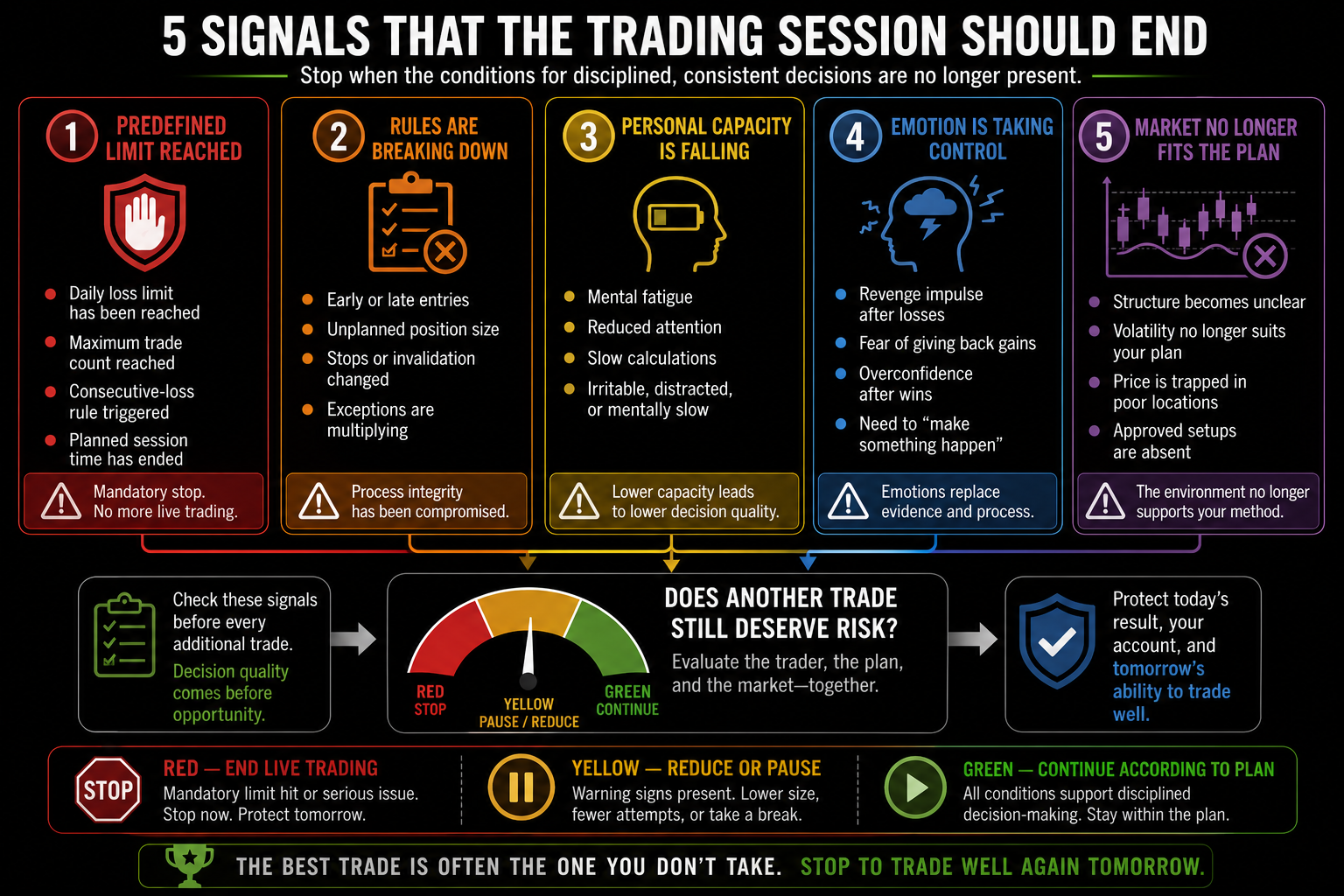
The lesson that daily loss limits are decision limits establishes one nonnegotiable reason to stop. Once the written loss, trade-count, or consecutive-loss boundary is reached, live participation ends. The rule does not predict that the next trade will fail. It states that the accepted financial and decision pressure for the session has already been used.
A serious rule break can create another stop condition even when the daily loss limit remains untouched. Entering before confirmation, using unplanned size, moving an invalidation point, or taking a setup outside the approved method shows that the process has already changed. One isolated deviation may call for an immediate pause and review. Repeated or deliberate deviations indicate that the session should end before they become the new operating standard.
The trader should pay attention to the explanation used after a broken rule. Statements such as “this one was different,” “I knew it would move,” or “I only needed one more attempt” may sound reasonable under pressure. They often show that the trader is adjusting the story to preserve participation. When exceptions begin multiplying, the plan is no longer controlling the session.
Stopping after a rule break is not punishment. It creates distance between one poor decision and the temptation to repair it through another trade. The trader can review what triggered the deviation without adding fresh financial pressure. That interruption protects the next decision from inheriting the urgency of the previous one.
Fatigue and Stress Change Capacity
The trader’s personal condition can become a stopping factor even when the session began normally. The article on how sleep, stress, and fatigue affect trading decisions explains how reduced attention, slower judgment, and emotional sensitivity can interfere with execution. Mental capacity can also decline during the session as concentration is used and frustration accumulates. A trader who was ready at the open may not remain equally prepared several hours later.
Warning signs include rereading the same information, forgetting rules, making slow calculations, feeling unusually irritated, or struggling to follow multiple timeframes. The trader may begin reacting to individual candles because maintaining the larger context has become difficult. These changes do not mean the trader has lost all ability to understand the market. They mean the current capacity may no longer match the demands of live risk.
Winning Can Also Lower Decision Quality
A profitable session can create its own stopping problem. Several successful trades may increase confidence, reduce caution, and create the belief that the trader is especially aligned with the market. Size may increase, standards may loosen, or a low-quality trade may be treated as acceptable because the session has room to absorb it. The trader begins risking the quality of the day rather than protecting it.
Overconfidence is difficult to recognize because it feels different from frustration. The trader may feel calm, capable, and justified while still making decisions the original plan did not allow. A winning result can hide those deviations because there is no immediate financial pain drawing attention to them. Rule adherence must therefore be reviewed independently from whether the session is profitable.
The Market Can Stop Fitting the Plan
Sometimes the reason to stop comes from the market rather than the trader. The session may become slow, erratic, excessively volatile, or trapped in an area where the strategy has no clear advantage. A directional environment can turn rotational, while a clean range can break into unstable movement after unexpected information. The plan may no longer match the conditions currently being offered.
Continuing in the wrong environment encourages the trader to lower the standard for what counts as a setup. Movement is interpreted as opportunity, weak locations receive more attention, and risk becomes harder to define. The trader may still recognize familiar patterns, but recognition does not mean the trade is qualified. When the market no longer supports the method, stopping protects the plan from being forced onto unsuitable conditions.
Pause, Reduce, or Stop
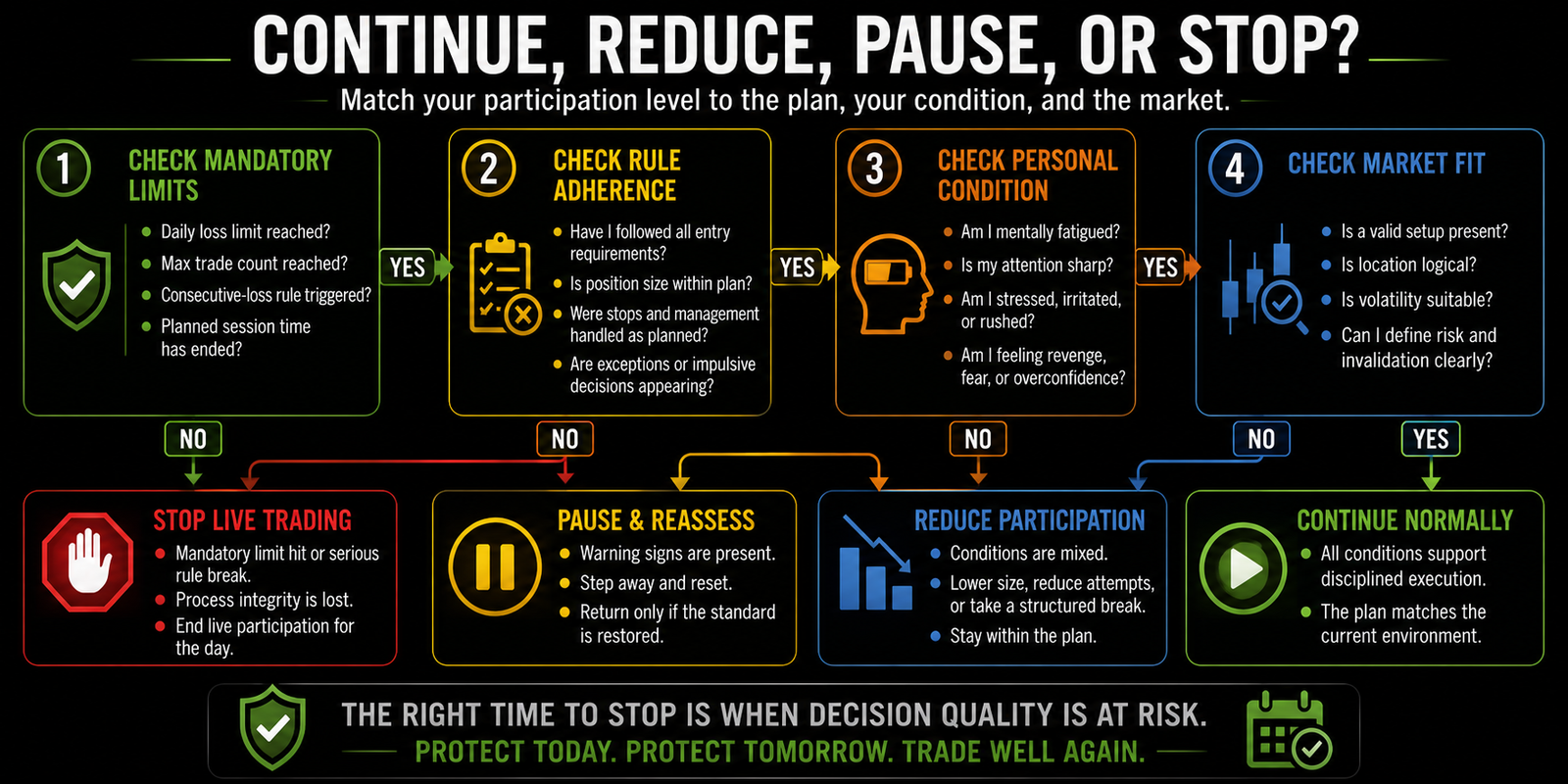
Not every warning sign requires the same response. A brief loss of focus may justify a planned break, while increased volatility may require reduced size or fewer attempts. A triggered daily limit, repeated rule breaks, strong revenge impulses, or an inability to define risk should end live trading. The response should match the severity and persistence of the problem.
A pause should have a defined purpose and ending condition. The trader may step away, review the plan, reassess market state, and determine whether attention and emotional control have returned. The pause should not become a short delay before taking the same impulsive trade. Participation resumes only when the original qualification and risk standards can be applied again.
A Better Question Before Continuing
The question “Is there another trade available?” focuses attention on the chart while ignoring the condition of the decision-maker. A better question is, “Am I still capable of evaluating the next trade by the same standard I used at the start of the session?” That comparison reveals whether the market evidence or the session’s emotional history is controlling the decision. It also allows stopping to become a professional conclusion rather than a reluctant surrender.
Before continuing, the trader can review a short stop-trading filter. The questions should be answered honestly before another order is prepared. A single severe trigger or several smaller warnings may be enough to end participation:
- Has a daily loss, trade-count, or consecutive-loss limit been reached?
- Have I broken an entry, sizing, management, or invalidation rule?
- Am I trying to recover a loss or protect an unrealized gain emotionally?
- Has confidence after winning caused me to lower the setup standard?
- Am I tired, distracted, irritated, rushed, or mentally slow?
- Does the current market state still fit the setups in my plan?
- Can I define the next trade’s location, confirmation, invalidation, and size clearly?
- Would I take this exact trade if the session were still flat?
The filter should lead to a defined participation decision rather than another promise to be careful. The available choices may include normal participation, reduced size, one final qualified attempt within the plan, observation only, or ending live trading. Once a mandatory stop condition has been triggered, the decision is no longer open for negotiation. The remaining work is to execute the shutdown process.
Build a Shutdown Routine
Stopping becomes easier when the trader knows exactly what happens next. The routine may include canceling working orders, disabling live-order entry, closing the execution platform, capturing charts, and recording the reason the session ended. These actions remove immediate access to another trade while preserving information for review. A vague intention to stop is weaker than a physical process that makes continued participation difficult.
The routine should also create separation between the session and the later review. Immediate notes can record facts, but deeper evaluation is often cleaner after urgency and frustration have settled. The article on protecting your next decision reinforces why distance matters after emotional or financial pressure. The objective is to prepare for the next session without requiring today’s result to be repaired first.
Traders who repeatedly extend sessions beyond their limits should examine the broader process behind trading too much. The issue may involve an undefined schedule, constant platform access, unrealistic expectations, or no meaningful activity after trading ends. The correction should make stopping easier through structure rather than depend on willpower alone. A planned end-of-session routine gives the trader somewhere constructive to go when live participation ends.
Review the Stop Separately From What Happened Next
The decision to stop should be reviewed according to the information available at that moment. Price may later offer a clean move, reverse sharply, or make the skipped trade appear obvious in hindsight. None of those outcomes automatically makes the stop incorrect. The boundary was based on decision quality, accepted exposure, personal condition, or market fit rather than knowledge of the next candle.
Review should record why the session ended and whether the stopping rule was followed promptly. Repeated patterns may show that fatigue appears after a certain amount of screen time, rule breaks follow missed entries, or overconfidence rises after consecutive wins. Those observations can improve future limits and shutdown procedures. The goal is not to eliminate every difficult session but to recognize earlier when continuing no longer supports the plan.
Final Thought
Knowing when to stop trading requires more than watching the account balance. Daily limits, rule adherence, emotional state, fatigue, overconfidence, and market conditions all affect whether the next decision still deserves risk. A trader can be winning and need to stop, or losing and remain inside a disciplined process. The decision depends on the quality and permission of continued participation.
Stopping for the day does not predict what the market will do next. It recognizes that the trader’s responsibility is limited to the decisions the plan can support. Ending exposure can protect the account, the rest of the day, and tomorrow’s ability to return with a clear process. The market will provide another session, but the trader does not need to force this one to continue.
Educational content only. Trading involves substantial risk and is not suitable for everyone.