
Many traders prepare the chart but never evaluate the person who will trade it. They mark levels, review news, define setups, and calculate risk while assuming their decision-making ability will be the same every day. The rules may be unchanged, but the trader applying them may be less attentive, more impulsive, or more emotionally sensitive than usual.
The lessons in The Trader category focus on the person responsible for applying the process. Personal condition should not become an excuse for every poor decision, but it is still a legitimate part of preparation. The same market can be interpreted differently when the trader is rested, distracted, stressed, or mentally depleted. The trader is one of the conditions that must be assessed.
The Trader Is Part of the Environment
Trading environment is often described only in terms of volatility, liquidity, account rules, or platform limits. Those factors matter, but the trader also brings an internal environment to the session. Sleep quality, personal stress, physical fatigue, and mental load can affect how clearly information is processed. That condition can influence whether a valid plan is applied consistently.
This does not mean a trader must feel perfect before participating. Normal tiredness and distraction are part of life, and no checklist can remove them completely. The goal is to recognize when personal condition has changed enough to interfere with the established process.
Why Poor Condition Is Easy to Ignore
Poor readiness can be difficult to identify because the trader may still feel capable of opening the platform and reading the chart. Familiar routines create confidence, while skipping the session can feel undisciplined. The trader may believe that effort and determination can overcome any temporary weakness.
The weaker choice often appears as a small compromise rather than an obvious breakdown. A tired trader enters slightly early, a stressed trader checks the position too often, or a distracted trader forgets one part of the setup criteria. Each mistake can look isolated even when the same condition is affecting them all. By the time the pattern becomes obvious, several decisions may already have drifted away from the plan.
Poor Sleep Reduces Attention
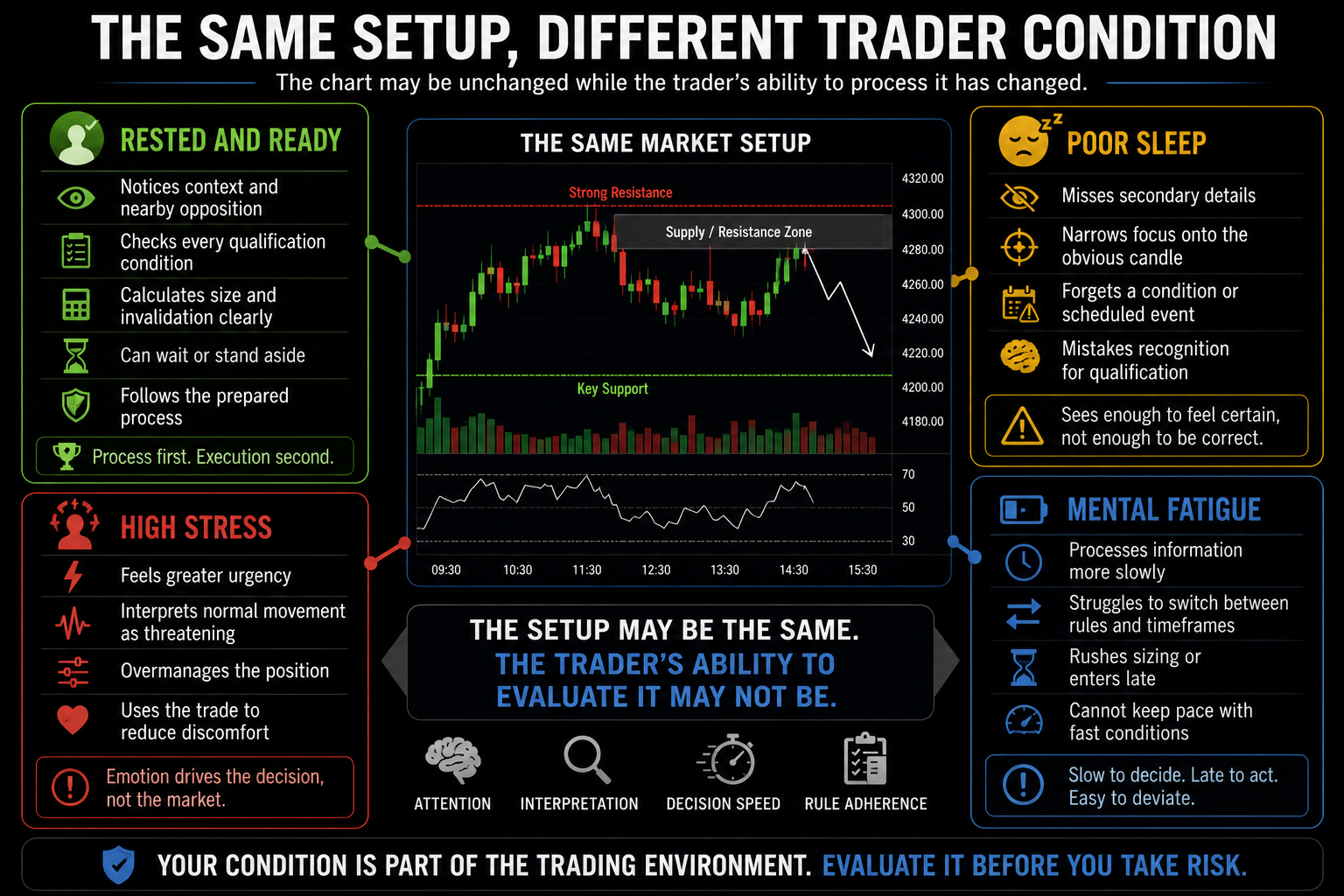
Poor-quality sleep can make sustained attention harder to maintain. The trader may miss a scheduled event, overlook nearby opposition, read the wrong timeframe, or fail to notice that volatility has changed. Small omissions are enough to weaken a process that depends on several conditions being evaluated together.
Reduced attention can also narrow focus onto the most emotionally persuasive information. A fast candle may receive more weight than the larger structure, while a familiar pattern may be recognized without checking location or risk. The trader sees enough to feel certain but not enough to complete the evaluation. In that state, setup recognition can be mistaken for trade qualification.
Stress Changes How Information Feels
Stress can make ordinary uncertainty feel more threatening. A normal pullback may feel like immediate failure, a missed entry may feel intolerable, and a small loss may carry emotional weight unrelated to the trade. The trader may then close early, move a stop, chase another entry, or monitor every tick mainly to reduce discomfort. The decision becomes a form of emotional relief rather than a response to market evidence.
Stress can also make trading feel like a place where action will provide an immediate answer when other parts of life feel unresolved. The trader may not consciously be using the market as a distraction. The emotional purpose of the trade may still have changed before the order was placed.
Fatigue Slows Judgment
Fatigue is not always the same as sleepiness. A trader may be physically awake but mentally depleted after demanding work, family responsibilities, travel, illness, or prolonged concentration. Decisions that normally feel straightforward may take longer, while switching between timeframes, rules, and risk calculations becomes harder.
Slower judgment is especially problematic in fast conditions because the market continues moving while the trader is still organizing the decision. The pressure to catch up can lead to late entries, rushed sizing, or ignored invalidation. The opportunity may be moving faster than the trader can evaluate it. Standing aside may be cleaner than forcing a process that cannot keep pace.
Personal Condition Can Change Risk
A trade is not defined only by the chart and stop distance. Its real risk also includes the likelihood that the trader will follow the entry, management, and exit rules as written. The mathematical exposure may be unchanged while poor personal condition increases the behavioral risk.
This is where protecting your next decision becomes practical. A fatigued or stressed trader may reduce size, limit attempts, use simulation, or decide not to trade. Those boundaries do not guarantee a mistake-free session, but they can better match exposure to current capacity.
When Personal Condition Becomes a No-Trade Factor
A no-trade decision should not require the trader to prove complete incapacity. The relevant question is whether the current condition makes the planned process unreliable enough that participation no longer deserves risk. The issue is not whether the trader can place an order, but whether the order can be managed according to plan. Repeated difficulty concentrating, unusually strong emotional reactions, forgotten rules, delayed calculations, or an urgent need to trade should be taken seriously.
The lesson that doing nothing is still a trading decision applies here without turning patience into passivity. The trader can still prepare levels, observe behavior, journal the session, or practice in simulation. A no-trade day can remain active and educational while protecting the next session.
Build Readiness Into the Trading Plan
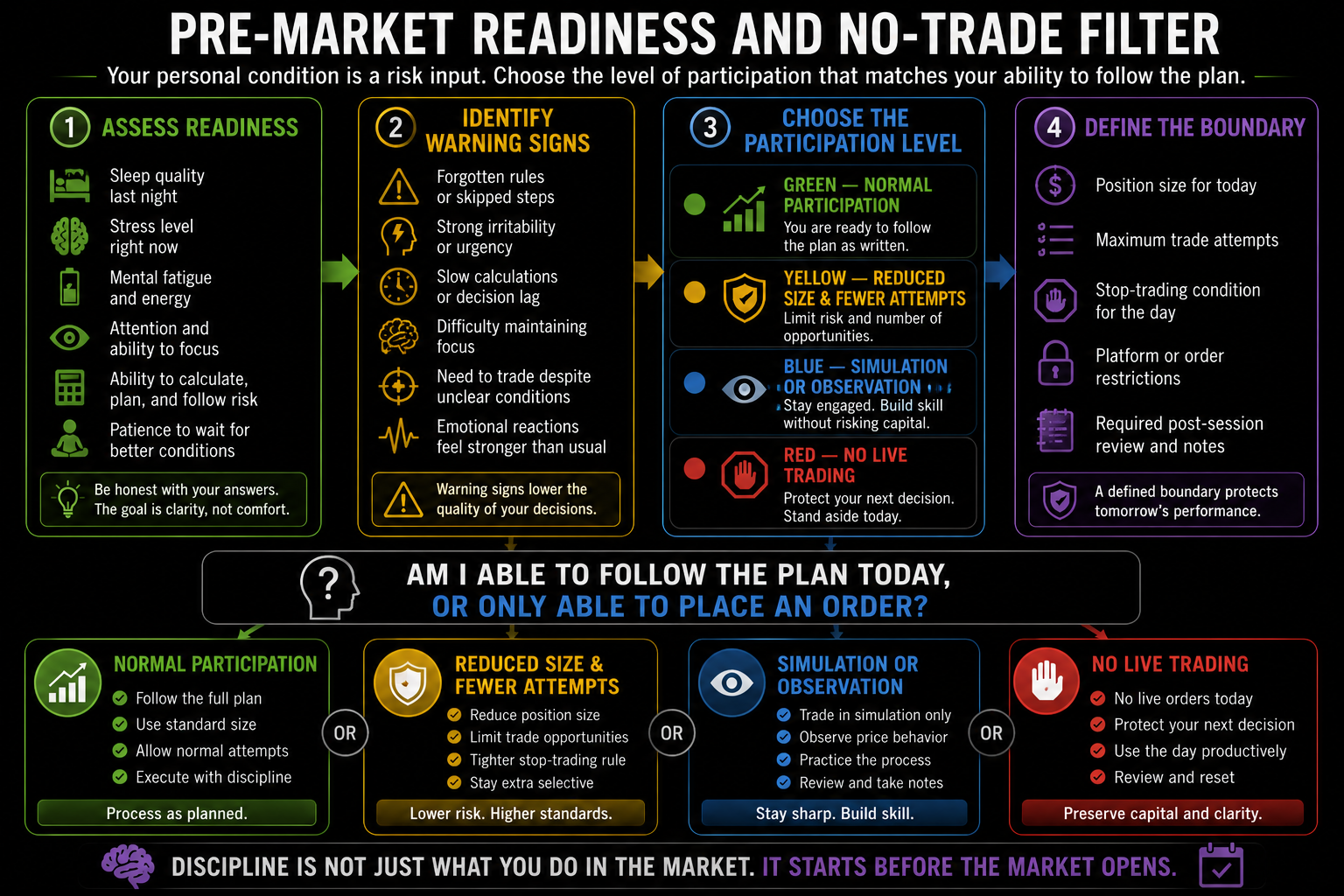
Personal readiness should be included in the plan rather than judged only after a mistake occurs. A trading plan made before the open can define when normal participation, reduced participation, simulation, or a stand-aside decision is appropriate. The rule should tell the trader what changes when readiness is lower. “Trade carefully when tired” is vague, while a specific size reduction or stopping rule can be reviewed later.
The plan should also distinguish temporary emotion from a broader condition affecting the entire session. Frustration after one valid loss may call for a reset, while sustained fatigue or personal stress may justify changing the day’s participation. The practical goal is to choose exposure that matches the current ability to follow the process.
A Better Question Before the Open
The question “Can I force myself to trade today?” frames participation as a test of toughness. A better question is, “Am I in a condition to follow my plan with the attention, patience, and judgment it requires?” That question asks whether the trader can perform the actual work of evaluating and managing risk.
A brief readiness filter can convert a general feeling into a defined choice. It should be completed before market movement creates urgency. Each answer should point toward a specific participation level:
- Did I sleep well enough to maintain attention?
- Is personal stress likely to compete with the market for my focus?
- Am I unusually impatient, irritable, or emotionally sensitive?
- Can I calculate size, invalidation, and daily limits without rushing?
- Am I prepared to wait, or do I feel a strong need to make something happen?
- Should today be normal size, reduced size, simulation, observation, or no trade?
The answers should lead to action rather than a vague promise to be careful. Reduced participation should be defined through size, trade count, and stopping conditions. Observation should also remove easy access to an impulsive live order when possible.
Traders can use the planning resources in the free trading tools to turn this filter into a repeatable pre-market check. A written record makes it easier to compare personal condition with later execution. Over time, patterns may become visible that memory alone would miss.
Review Condition Separately From Outcome
Trade review should record personal condition separately from whether the trade won or lost. A favorable trade taken while exhausted may still contain early entry, poor sizing, or weak management. A losing trade taken under good conditions may still reflect clean execution.
The review can also compare how fatigue, stress, and sleep affect specific behaviors. The trader may discover that poor sleep leads to missed context, while stress leads to overmanagement or excessive trade frequency. Those patterns can support more precise rules than a general instruction to be disciplined.
Final Thought
Sleep, stress, and fatigue do not determine every trading result, but they can change the quality of decisions made before and after entry. Reduced attention can hide context, stress can magnify uncertainty, and fatigue can slow the judgment required by fast conditions. The chart is only one side of the decision. Personal readiness belongs inside the risk process.
The disciplined response is not to demand perfect energy or avoid every difficult day. It is to recognize when current capacity no longer matches the demands of the market and strategy. Normal participation, reduced exposure, simulation, observation, and no trade are all valid choices when defined in advance. The same objective standard is useful when a trader is trying to rebuild trading confidence after a losing streak, since fatigue and accumulated losses can distort judgment in similar ways.
Educational content only. Trading involves substantial risk and is not suitable for everyone.