
Many traders treat a daily loss limit as a number designed only to protect the account. That is part of its purpose, but the boundary also protects the quality of the decisions that follow. After enough damage, frustration, urgency, and the desire to recover can begin replacing the process. The limit exists because the trader may no longer be evaluating the market in the same condition that existed at the start of the session.
The lessons in The Trader category focus on the person applying the method because the plan cannot enforce itself. A trader may understand the setup, know the risk, and begin the day with clear intentions. Several losses can still change how evidence feels and how urgently the trader wants the next opportunity. The daily limit turns that behavioral risk into a boundary that can be respected before judgment deteriorates further.
The Limit Protects More Than the Account
A daily loss limit defines the maximum amount of financial damage the trader is willing to accept during one session. That number should reflect the account, strategy, normal trade risk, and the number of attempts the plan allows. For a trader working inside a prop-firm evaluation account, it also has to satisfy the firm's own daily loss or drawdown rules, not just the trader's personal comfort level. It prevents one difficult day from expanding into a loss that was never part of the intended process. It also creates a point where continued participation must be questioned rather than assumed.
The deeper purpose is to recognize that losses do not affect only account balance. They can alter confidence, attention, patience, and the willingness to follow the next rule exactly. The trader may become more defensive after a loss or more aggressive while trying to recover it. A daily boundary protects against both reactions by ending the session before emotional pressure becomes the main decision-maker.
Damage Changes the Decision Environment
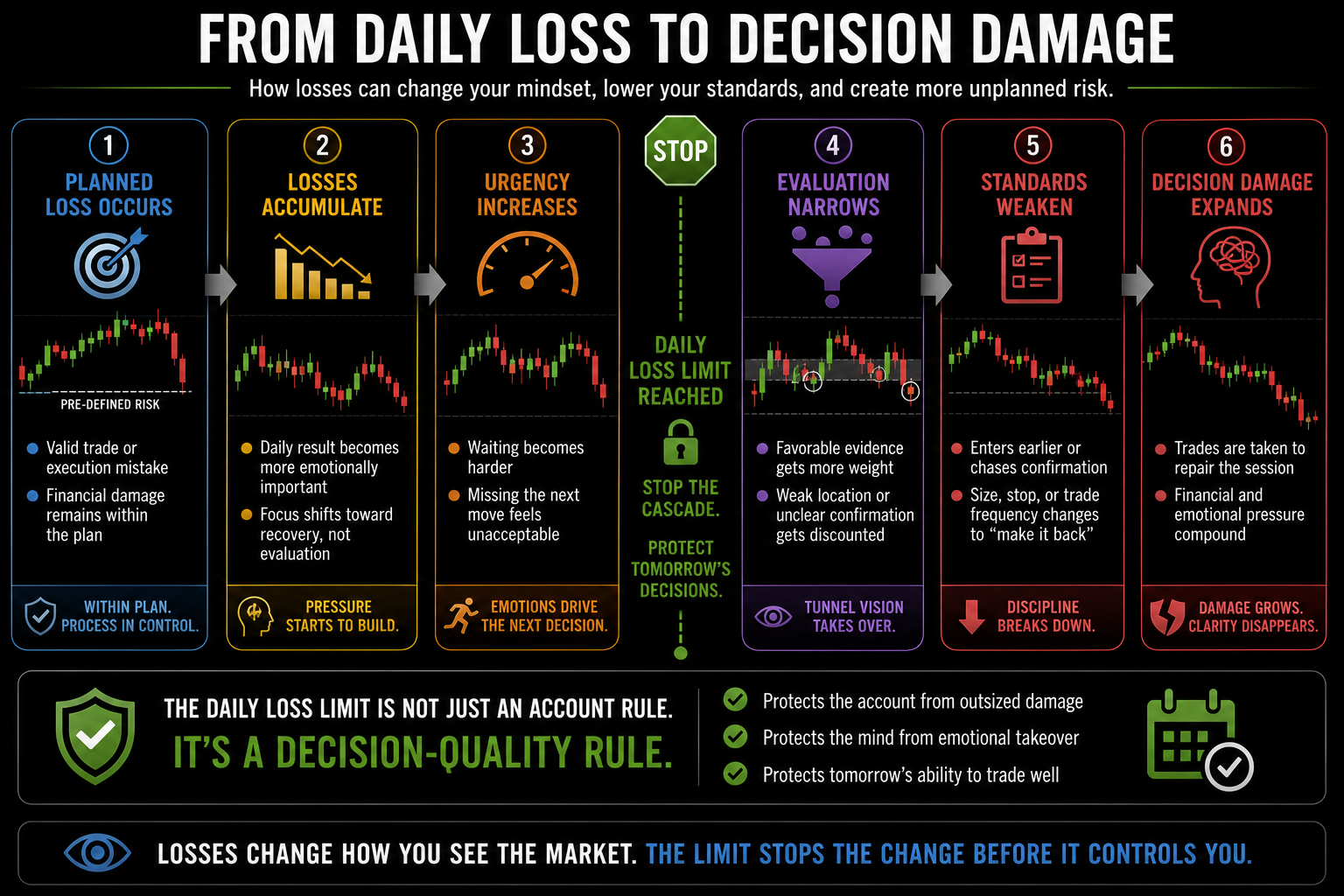
The first loss of the day may be handled with patience because the trader is still close to the original plan. After several losses, the same setup can feel different even when the chart has not changed. A normal pause may look like another missed opportunity, while a weak signal may feel like the chance to repair the session. The market is being evaluated through the accumulated pressure of what has already happened.
This is why protecting your next decision matters more than defending the current day. One poor decision can create urgency, and urgency can make the next decision easier to justify and harder to evaluate. As the loss grows, the trader may stop asking whether the setup earns risk and start asking whether it can recover the damage. The financial loss then becomes a decision-quality problem.
Why One More Trade Feels Reasonable
The trade that breaks the daily limit often feels more reasonable than it looks afterward. The trader may believe the next setup is cleaner, the market is finally moving, or one controlled attempt can restore confidence. Stopping at the limit can feel like accepting defeat at the exact moment the opportunity appears to improve. That emotional timing makes the boundary hardest to respect when it is most needed.
The desire for one more trade is also supported by selective evidence. The trader notices the reasons the setup could work while discounting weak location, unclear risk, or the fact that the trade would not have been taken earlier in the session. The planned standard has not necessarily changed, but the need for a favorable result has. A boundary prevents that need from becoming permission.
Losses Can Distort Risk and Setup Quality
A trader near the daily limit may change position size without admitting that the plan has changed. Size may be increased to recover more quickly or reduced so that an additional trade can be described as harmless. Stops may be widened to avoid another immediate loss, or tightened so aggressively that the setup no longer has room to behave normally. Each adjustment can sound practical while still being driven by the accumulated result.
Setup quality can be distorted in the same way. A familiar pattern may be treated as complete even though confirmation is missing, or a middle-of-range entry may be accepted because waiting feels unbearable. The trader begins grading the setup according to what the session needs rather than what the market shows. A daily limit interrupts that shift before lower standards create a larger sample of unplanned trades.
Revenge trading is commonly described as anger directed at the market, but it can appear in quieter forms. The trader may take trades more frequently, monitor every small move, or keep searching for a setup after the planned work is finished. The behavior is driven by the need to change the result before the session ends. It does not always feel emotional because the trader may still be using technical language to justify each entry.
The Limit Must Be Set Before Emotion Appears
A daily loss limit should be defined before the session, not negotiated after the trader is already under pressure. The amount, trade-count boundary, and any consecutive-loss rule should be written clearly enough to trigger a specific action. A trading plan made before the open gives that rule authority before live results begin changing the story. The purpose is to remove the decision from the moment when the trader is least likely to judge it calmly.
The limit should also match the normal structure of the strategy. A method that allows two planned attempts should not have a loss boundary that assumes six improvised trades. The number should be realistic enough to protect the account without being treated as a target that must be fully used. Reaching the maximum is a stop condition, not permission to keep trading until every dollar of the limit is lost.
Reaching the Limit Means the Session Has Changed
When the daily limit is reached, the market may still offer a valid setup. That does not mean the trader remains in a valid condition to take it. The session now includes financial damage, emotional pressure, and evidence that the original plan has not produced an acceptable result. Those facts become part of the trading environment even if the chart looks attractive.
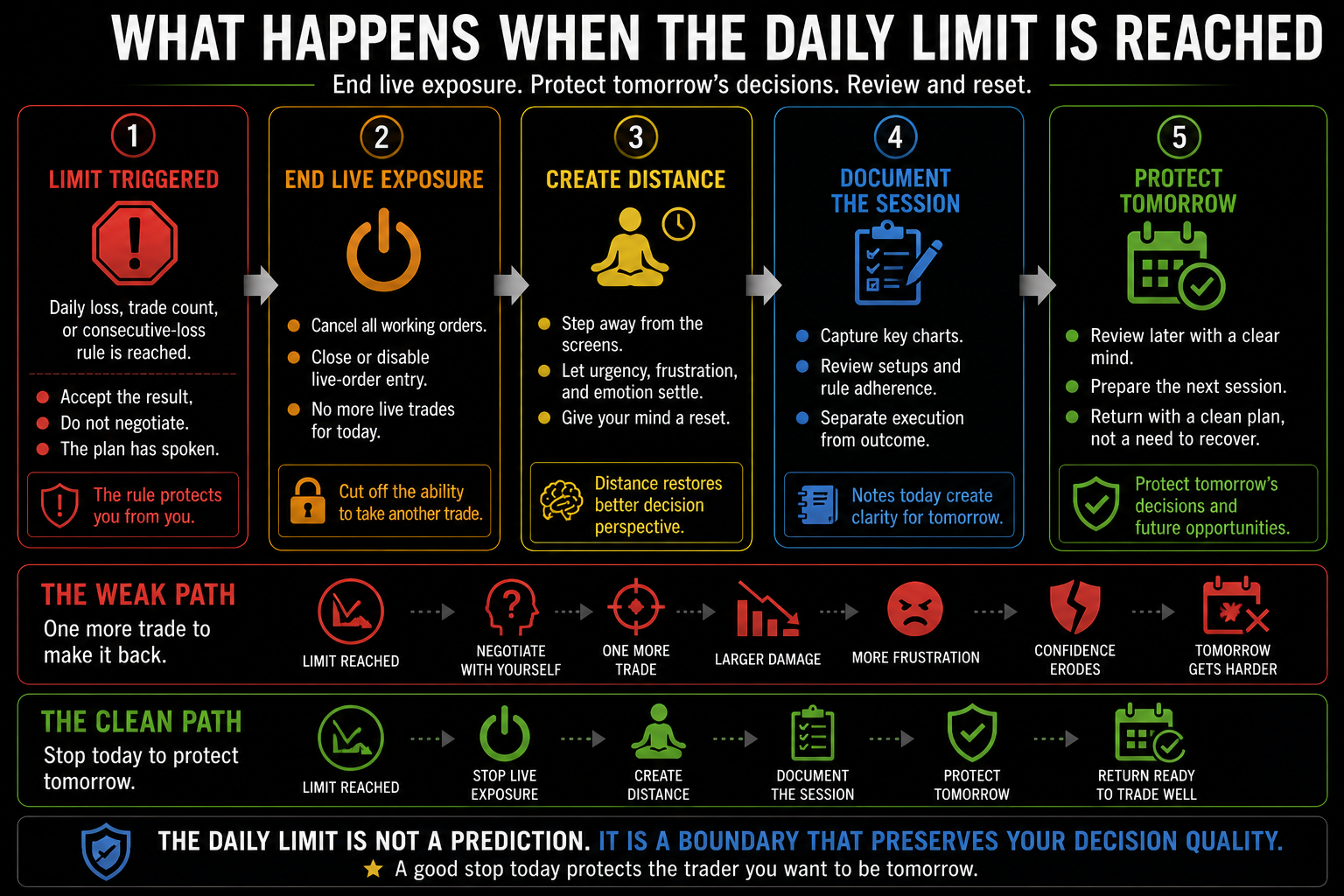
The limit therefore marks a change in permission rather than a prediction about the next trade. It does not claim that the next setup will fail or that the trader is incapable of making a correct observation. It states that the day has reached the maximum exposure and decision pressure accepted in advance. The trader can continue observing without continuing to place risk.
Stopping Protects Tomorrow
Stopping at the limit preserves more than the remaining account balance. It protects the trader from carrying a larger loss, stronger frustration, and damaged confidence into the next session. An extra trade can turn a manageable day into an event that requires several days of emotional and financial recovery. The boundary keeps one difficult session from taking control of tomorrow’s preparation, especially when a manageable loss starts to feel disproportionately large.
The idea that doing nothing is still a trading decision applies after the limit is reached. The trader can capture screenshots, record mistakes, observe the rest of the session, and prepare for review without placing another order. Standing aside is active risk management when the original permission to trade has expired. The work continues, but the exposure ends.
A Better Question Before the Next Trade
The question “Can this next trade make the money back?” turns the setup into a recovery tool. A better question is, “Would I take this exact trade if the session were still flat?” That comparison exposes whether the market evidence is truly strong or the previous result is creating urgency. It also helps the trader identify when a familiar setup is being graded under a different standard.
Before taking another trade after a difficult sequence, the trader should review a short decision filter. The questions should be answered before the next order is prepared, not after the trade begins moving. Their purpose is to reveal whether the original standard is still controlling the decision:
- Am I still inside the written daily loss and trade-count limits?
- Would I accept this location and confirmation at the beginning of the session?
- Is position size based on the plan or on the amount I want to recover?
- Has frustration changed how quickly I am willing to enter?
- Is the invalidation still logical and affordable?
- Am I evaluating the setup, or asking the trade to repair the day?
- Has the stop-trading condition already been triggered?
The filter should not become a way to negotiate with a limit that has already been reached. Once the boundary is triggered, the answer is already defined. The questions are most useful before that point because they reveal when decision quality is beginning to deteriorate. Early recognition may allow the trader to stop before the maximum damage is reached.
Traders who repeatedly continue beyond the planned boundary should examine the broader process behind trading too much. The issue may involve platform access, vague stopping rules, oversized expectations, or a routine that keeps the trader engaged after the planned session is complete. The correction should make the stop easier to execute rather than depend on stronger willpower in the worst moment. A defined shutdown process can be more reliable than another promise to be disciplined.
Review the Stop Separately From the Outcome
Post-session review should grade whether the daily boundary was respected, not whether the market later offered a winning trade. Price may reverse after the trader stops, and that does not make the stop incorrect. The limit was designed around accepted exposure and decision quality, not hindsight about the next move. A disciplined stop can remain a good decision even when continued trading would have produced a favorable result.
Final Thought
A daily loss limit is an account boundary, but it is also a decision boundary. It recognizes that financial damage can change how the trader sees opportunity, evaluates risk, and responds to uncertainty. The rule ends participation before recovery pressure becomes the purpose of the next trade. That protection matters even when another setup appears immediately afterward.
The limit does not guarantee a better next day or prevent every emotional response. It creates a clear point where today’s damage stops expanding and tomorrow’s decision-making remains worth protecting. Respecting the boundary is not giving up on the session. It is choosing not to let one session take more than the plan was designed to give. That same discipline, applied per trade rather than per session, is what makes risk-first trading sustainable.
Educational content only. Trading involves substantial risk and is not suitable for everyone.