
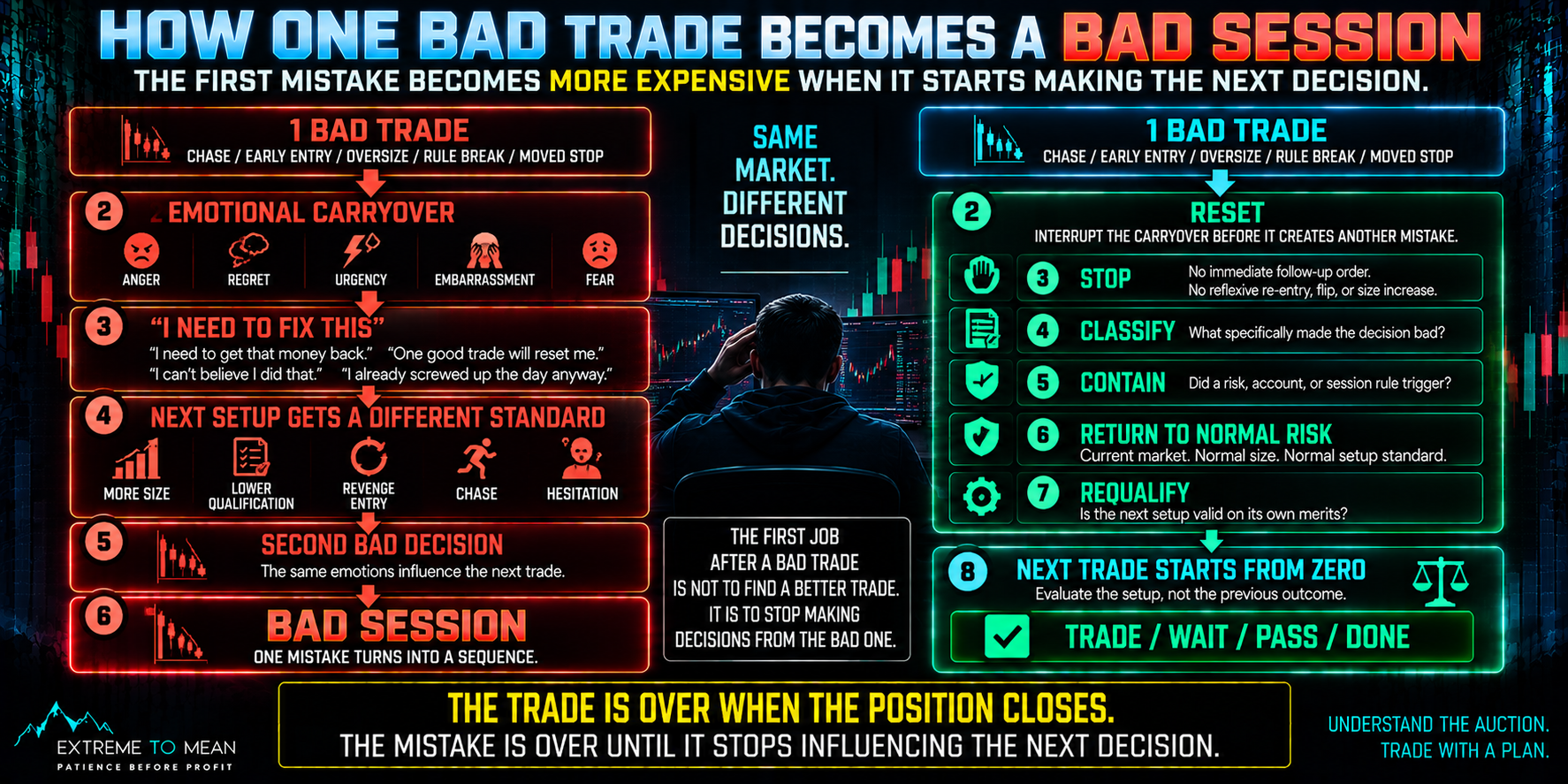
A bad trade can keep trading after the position is closed. The financial result may be finished, but anger, urgency, embarrassment, fear, or the need to recover can still influence what happens next. If the next setup is judged through those emotions, the first mistake is still affecting risk.
The trade is over when the position closes. The mistake is not over until it stops influencing the next decision.
A reset is not about forgetting what happened, forcing yourself to feel good, or immediately winning the money back. Its purpose is to restore enough separation between the last decision and the next one that the next setup can be judged on its own merits. That is why this lesson belongs inside the broader Trader curriculum: the reset is ultimately about decision quality, not emotional perfection.
First: Was It a Bad Trade or Just a Losing Trade?
A clean loss and a bad trade are not the same thing. A clean loss can come from a setup that qualified, used appropriate risk, followed the plan, respected the stop, and simply did not work. That outcome may require little more than recording the result and returning to the process.
A bad trade is different because something in the decision fell below the trader's normal standard. The setup may not have qualified, the entry may have been chased, size may have been too large, the stop may have been moved emotionally, or the trade may have been taken to recover money. Do not turn every loss into a psychological emergency; reset the behavior that actually needs resetting.
The distinction works in the other direction too. A trader can chase, double normal size, ignore the planned stop, and still be rescued by the market for a profit. Financially the trade won, but the process was poor, and the need for a reset comes from the quality of the decision—not the color of the P&L.
A profitable mistake can sometimes be more dangerous than a losing one because the bad behavior received a reward. If the trader interprets the profit as proof that the rule was unnecessary, the next violation becomes easier to justify. A reset should therefore respond to the decision that was made, not merely to whether the account turned green or red.
Why the Next Trade Becomes Dangerous
One poor decision often creates pressure to repair itself. The sequence can become BAD DECISION → EMOTIONAL REACTION → NEED TO REPAIR → LOWERED STANDARD → SECOND BAD DECISION, even though the first position is already gone. Recovery, validation, embarrassment, frustration, and fear can all become hidden inputs in the next trade.
That carryover does not always make the trader more aggressive. One person may revenge trade, increase size, or chase another entry, while another becomes so cautious that a perfectly valid setup is skipped or managed fearfully. The goal of the reset is not merely to suppress aggression; it is to restore normal decision-making.
This is an immediate application of protecting your next decision. A mistake becomes more expensive when it starts choosing the next entry, size, stop, or willingness to pass. The first job after a bad trade is not to find a better trade; it is to stop making decisions from the bad one.
Do Not Make Breakeven the New Setup
Suppose a bad trade costs $200. The mind can instantly create a new objective: make $200 back, and suddenly every new setup is being evaluated partly by whether it can restore the account to breakeven. That new objective can change trade selection, urgency, size, holding behavior, and how much risk feels acceptable.
But breakeven is an account number; it is not a market setup. The next trade does not know what the previous trade cost you, and price does not become more qualified because your account is below its earlier high-water mark. When recovery becomes the objective, the trader begins asking the market to solve an accounting problem.
The same issue appears after a profitable rule-break. If a fast breakout was chased against the plan and happens to produce +$250, the next trade should not inherit larger size or looser rules because the violation worked. A profitable mistake can be more dangerous than a losing mistake because the market just paid you to repeat it.
Name the Mistake Without Turning It Into an Identity
A useful reset begins with classification. “I suck,” “that was stupid,” or “I traded terribly” may express frustration, but none identifies what needs to change before another order is placed. The trader needs diagnostic precision rather than a judgment about personal worth.
Name the behavior specifically: EARLY ENTRY, CHASE, OVERSIZE, RULE BREAK, REVENGE ENTRY, MOVED STOP, TRADED WITHOUT SETUP, IGNORED EVENT RULE, or TRADED WHILE TOO EMOTIONAL. Better still, connect the behavior to the reason: “I entered before qualification because I was afraid the move would leave without me.” Name the behavior without turning the behavior into an identity.
Then separate two questions. Market question: has anything meaningful changed in the market? Trader question: has anything meaningful changed in me? A bad trade can make the trader unready, the market untradable, both, or neither, and those states should be checked independently.
The market may still be offering normal opportunities while the trader is angry, rushed, desperate, or frightened. The reverse can also occur: the trader may feel composed while the market has become event-driven, disorderly, or outside the strategy's normal conditions. A reset works better when these two problems are not blended together.
Know When the Reset Means Done for the Day
Before trying to become ready again, contain the financial damage. If the trade triggered a daily risk limit, account rule, predefined stopping condition, or other session-ending rule, the answer is not “calm down and try again.” The answer is DONE.
A reset cannot override a rule that already ended the session. This is where a trading plan made before the open matters because the stopping conditions should exist before frustration begins negotiating with them. A reset restores the process; it does not create an exception to the process.
The opposite guardrail matters too. One rule-breaking trade does not universally require stopping for the entire day, and inventing a punishment afterward can be another emotional reaction. If actual risk limits, behavioral limits, and account rules remain intact and the trader can genuinely return to normal qualification, another trade may be appropriate.
The goal is not to punish the mistake; it is to prevent the mistake from reproducing itself. That can mean stopping for the day, waiting for readiness, or eventually taking another trade. The correct outcome comes from the existing rules and current state, not from shame about what happened.
How to Tell Whether You're Ready to Trade Again
Readiness should not mean feeling completely calm. Traders can still feel irritation, regret, or disappointment and remain capable of following a normal process. The useful standard is whether the trader can execute without asking the next trade to repair the previous outcome.
The strongest diagnostic is: Would I take this exact trade if the previous trade had never happened? If the answer is yes and the setup, risk, and market conditions independently qualify, that is a good sign. If the answer becomes “I need more size because I need it back,” “I normally would not take this,” or “I need this one to win,” the reset is not finished.
Risk should also return to its predefined standard. One common distortion is expansion—“I'll size up and recover it”—while the opposite distortion is collapse, such as trading abnormally small, using an unnaturally tight stop, or taking profit immediately because another loss feels intolerable. A reset is not complete if the last trade is still choosing the size of the next one.
This is also why the trade is not ready until the risk is clear. The next trade should not inherit an improvised stop, altered size, or changed risk tolerance simply because the previous outcome hurt. Normal standards need to become normal again before another position can be treated as independent.
The NQ Reset: Same Market, Different Decision
Imagine a trader has been waiting for an NQ pullback long, but price begins moving higher before the planned setup completes. The thought appears: “It's leaving,” so the trader chases, price immediately pulls back, and the trade stops out for a $150 loss. The trader knows immediately that this was not a clean planned loss.
The temptation is powerful because the original pullback may now finally be developing. Trader A re-enters immediately, uses slightly larger size, and tells themselves, “The setup is even better now.” Maybe the market opportunity really did improve, but the decision is now contaminated by frustration, the $150 deficit, the desire to prove the original idea, and urgency to recover.
Price stops Trader A again, turning the sequence into a $400 loss. The important point is not that the second setup could never have been valid; it is that Trader A never separated the second decision from the first one. One bad trade became a bad sequence.
Trader B closes the first position and says, “Bad entry. The idea may still be valid, but that trade is over.” They stop immediate order entry, classify the mistake as an early FOMO-driven entry, confirm that risk limits still allow trading, and require the full setup to qualify independently before considering another order. The key question becomes: Would I take this new setup if the first trade had never happened?
If the answer is yes, Trader B may trade. If the answer is no, they wait or pass, even if the market eventually rallies without them. The market can offer a valid trade immediately after a bad one; the challenge is making sure it is actually the market offering it—not the previous loss demanding it.
The ETM Post-Trade Reset
Use this sequence:
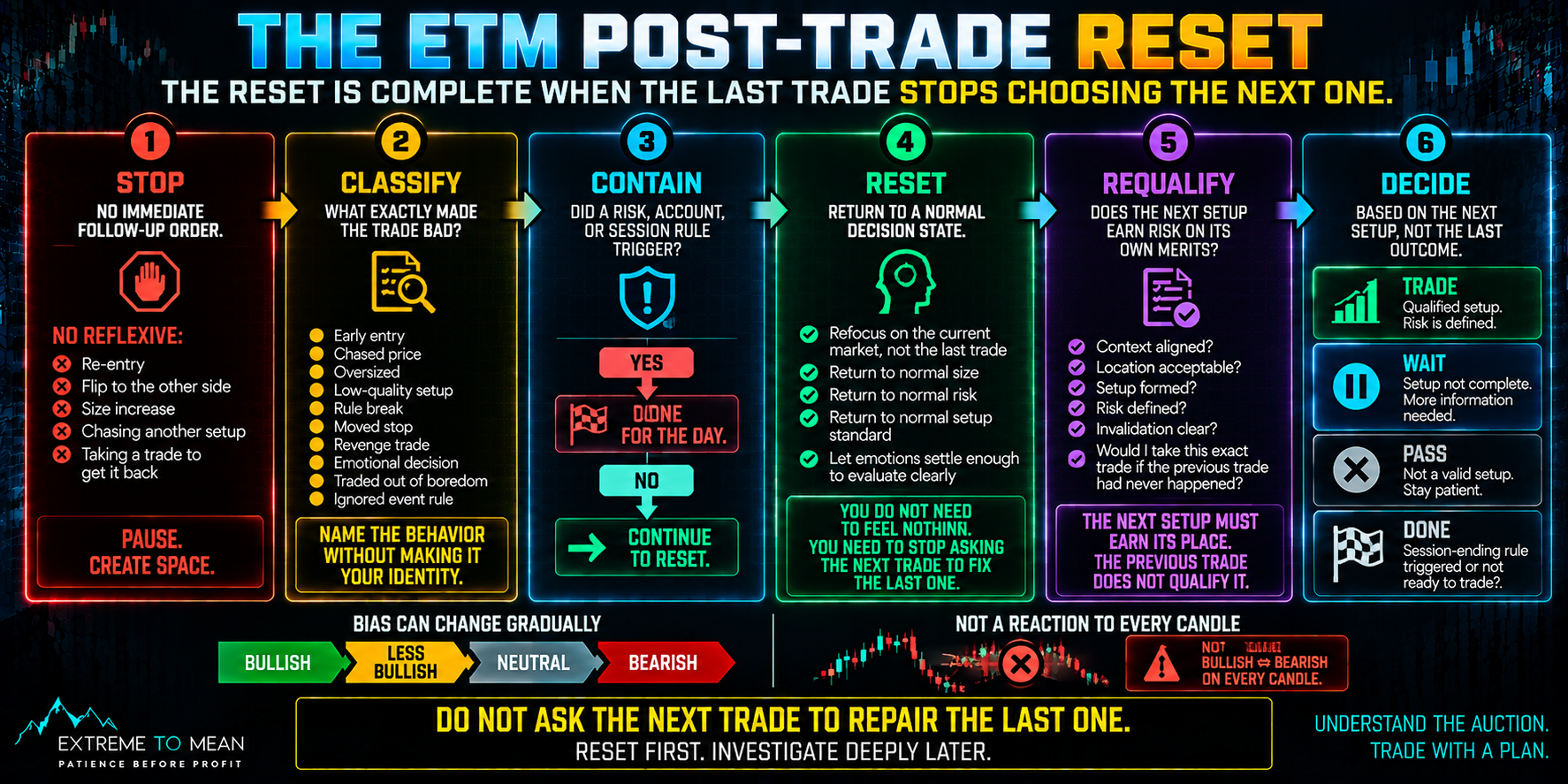
- STOP — Prevent immediate follow-up action. No reflexive re-entry, opposite-side trade, or spontaneous size increase.
- CLASSIFY — What specifically made the decision bad?
- CONTAIN — Did the trade trigger a daily risk limit, behavioral stop, account rule, or session-ending condition? If yes: DONE.
- RESET — Return attention to the actual account state, normal risk, current market, and enough emotional separation to evaluate again.
- REQUALIFY — Ask: Would I take this exact next trade if the previous trade had never happened?
Then choose:
TRADE / WAIT / PASS / DONE
The reset does not require emotional emptiness. It requires enough separation that the old trade is no longer deciding the setup standard, risk, or need to participate. You do not need to feel nothing; you need to stop asking the next trade to fix the last one.
A compact reset card can make this practical in real time. It does not need to solve the entire trade or your entire trading psychology. It only needs enough information to protect the next decision:
- WHAT HAPPENED? One sentence.
- WHAT RULE OR STANDARD FAILED? Be specific.
- WHAT AM I FEELING? Anger, urgency, fear, embarrassment, or need to recover?
- AM I STILL ELIGIBLE TO TRADE? Check the actual rules.
- WHAT MUST HAPPEN BEFORE I TAKE ANOTHER TRADE? Define observable readiness.
- WOULD I TAKE THE NEXT SETUP IF THIS TRADE NEVER HAPPENED?
The pause itself is not magic. There is no universal five-minute or ten-minute reset that guarantees better decisions, and simply waiting longer does not automatically restore good judgment. A pause is useful when it has a job: classify, contain, restore the process, and requalify.
Reset First, Review Deeply Later
The immediate reset is not the same job as a full post-trade review. Right after a mistake, the trader needs enough diagnosis to prevent repetition, but they do not necessarily need a long journal session, statistical analysis, or a redesign of the strategy. Reset first. Investigate deeply later.
A one-line review can be enough during the session: What did I do? Why did I do it? What must not happen next? For example: “Entered before qualification. Afraid the move would leave. No new entry unless the full setup qualifies.” The immediate note should protect the next decision—not solve the trader's entire psychology.
Deeper review still matters because recurring errors may eventually require better rules, preparation, or training. But trying to solve everything while emotional carryover is still active can create new rules in reaction to one event. Reset means containment now; review means learning later.
If the mistake creates an urge to keep firing orders simply to recover or repair the session, trading too much may become the next problem. The reset should interrupt that transmission before volume of decisions replaces quality of decisions. You can take responsibility for a bad trade without letting it run the rest of the session.
Final Thought
A bad trade becomes most expensive when it changes the trade that comes after it. Once the position is closed, stop adding decisions long enough to identify what actually went wrong, check whether your risk rules have already ended the session, and separate the current market from the frustration, fear, or urgency left by the previous decision.
You do not have to feel perfectly calm before trading again. You do have to be able to return to your normal setup standard, normal risk, and normal willingness to pass. The trade is over when the position closes. The mistake is over when it stops influencing the next decision.
Before the next order, ask one question: Would I take this exact trade if the previous trade had never happened? If the answer is no, the reset is not finished. If the answer is yes, let the current market—not the previous trade—decide whether the next action is TRADE / WAIT / PASS / DONE.
Educational content only. Trading involves substantial risk and is not suitable for everyone.