
“Lying to yourself” does not usually mean deliberately falsifying your journal. More often, the story gets cleaned up without you noticing: a weak winner gains reasons that were never part of the entry, while a clean loser develops flaws that only became visible afterward. The goal of review is not to accuse yourself of dishonesty; it is to protect the evidence from hindsight.
That distinction belongs naturally inside the broader Trader curriculum. A completed chart contains more information than the trader had when risk was actually taken, so reviewing the trade fairly requires rebuilding the smaller information set that existed then. Otherwise the outcome gets to testify about a decision it already knows the ending to.
The Chart Looks Different After You Know the Ending
Imagine an NQ trade where your plan calls for a pullback into meaningful support, a qualified setup, defined invalidation, and predetermined risk. The pullback arrives, the setup qualifies, you enter, price briefly holds, and then the defined stop is hit. Twenty minutes later, NQ reverses sharply and rallies far beyond your original entry.
Now hindsight starts talking. “My stop was obviously too tight,” “I should have known that was a sweep,” and “If I had just held, the trade would have worked” all become tempting explanations. The problem is that the later reversal did not exist when the stop decision had to be made.
This is why clear risk before the trade matters so much during review. If invalidation was genuinely defined beforehand and the market reached it, the later reversal does not automatically turn the original stop into a mistake. Future candles cannot retroactively change the information available before they existed.
Separate What You Knew Then From What You Know Now
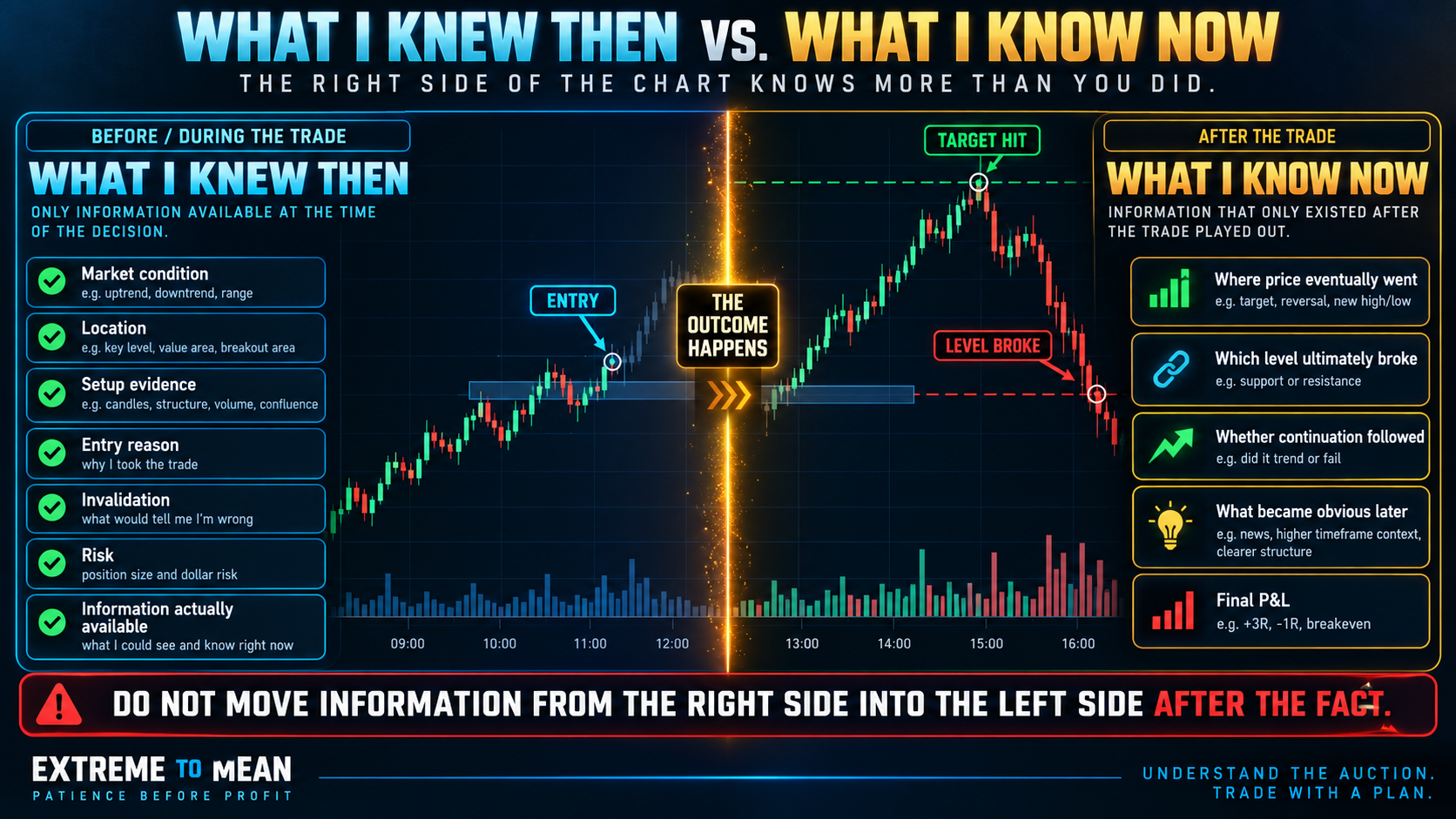
A useful review can be divided into two mental columns. The first contains KNOWN THEN: market condition, location, setup evidence, reason for entry, invalidation, intended risk, intended management, and what you actually believed when the decision was made. The second contains KNOWN NOW: where price eventually went, which level ultimately failed, whether continuation developed, whether the breakout became a fakeout, and the final P&L.
That separation sounds simple, but it prevents one of the easiest review errors. Once you know support eventually failed, it is easy to remember the support as weaker than it looked beforehand; once the trade rallies beautifully, it is easy to remember yourself as more confident than you really were. The ending pulls memory toward itself.
A better review asks, “What evidence was genuinely available when I had to decide?” If the later chart reveals an important clue, record it as something learned afterward rather than pretending it was part of the original thesis. Do not let future candles testify about what you should have known before they existed.
Reconstruct the Original Trade Before Judging It
The first review question should not be, “Why did this trade lose?” That question begins with the outcome and immediately encourages you to search backward for a cause. Start instead with, “What was the actual trade I took?”
Reconstruct it in the same order the decision unfolded. What market condition did you believe existed, where was price, what setup did you think had qualified, why did you enter, where was invalidation, how much risk did you intend to take, and how did you expect to manage the position? Only after that reconstruction should you compare the actual result.
This is where a trading plan made before the open becomes valuable evidence rather than merely preparation. A written scenario, checklist, screenshot, alert, or note gives the review something outside your later memory to compare against. It does not prove the decision was good, but it helps establish what the decision actually was.
Do Not Let a Win Excuse a Broken Rule
Winning trades deserve the same scrutiny as losing ones because profit offers an easy defense: “But it worked.” A trader can chase after missing the planned entry, use more risk than intended, ignore invalidation, skip required confirmation, or take a setup outside the strategy and still finish with a profitable trade. The market can reward a decision that the trader should not want to repeat.
Return to the NQ example and change one detail. Instead of respecting the planned invalidation, suppose the trader holds through the break, violates the stop rule, and then gets rescued by the later reversal. The final P&L may be positive, but the honest review remains: the trade made money after the trader abandoned the process.
A useful filter is, “If this exact decision had lost, would I still defend it?” If your explanation only sounds reasonable because you can see green P&L, you may be defending the outcome rather than the decision. Protecting your next decision sometimes requires admitting that a winner rewarded behavior you should not carry forward.
Do Not Let a Loss Invent Problems That Were Not There
The opposite error happens after a loss. Because something went wrong financially, the trader assumes there must have been a process flaw somewhere and begins searching the chart until one appears. A normal losing outcome turns into a forensic hunt for a mistake that may not exist.
That can produce unnecessary changes. A trader moves the stop farther away because the last one was hit, removes a setup because one example failed, or invents a new filter because the losing chart makes that filter look obvious in hindsight. The process becomes unstable because every loss demands an explanation beyond uncertainty.
Sometimes the honest conclusion is much less dramatic: clean trade, planned loss, no immediate change. That does not mean losses are ignored or that repeated results do not matter; it means one outcome should not manufacture a lesson the evidence does not support. If a pattern develops across repeated observations, then the process itself may deserve review.
Explanation Is Useful; Excuse-Making Is Not
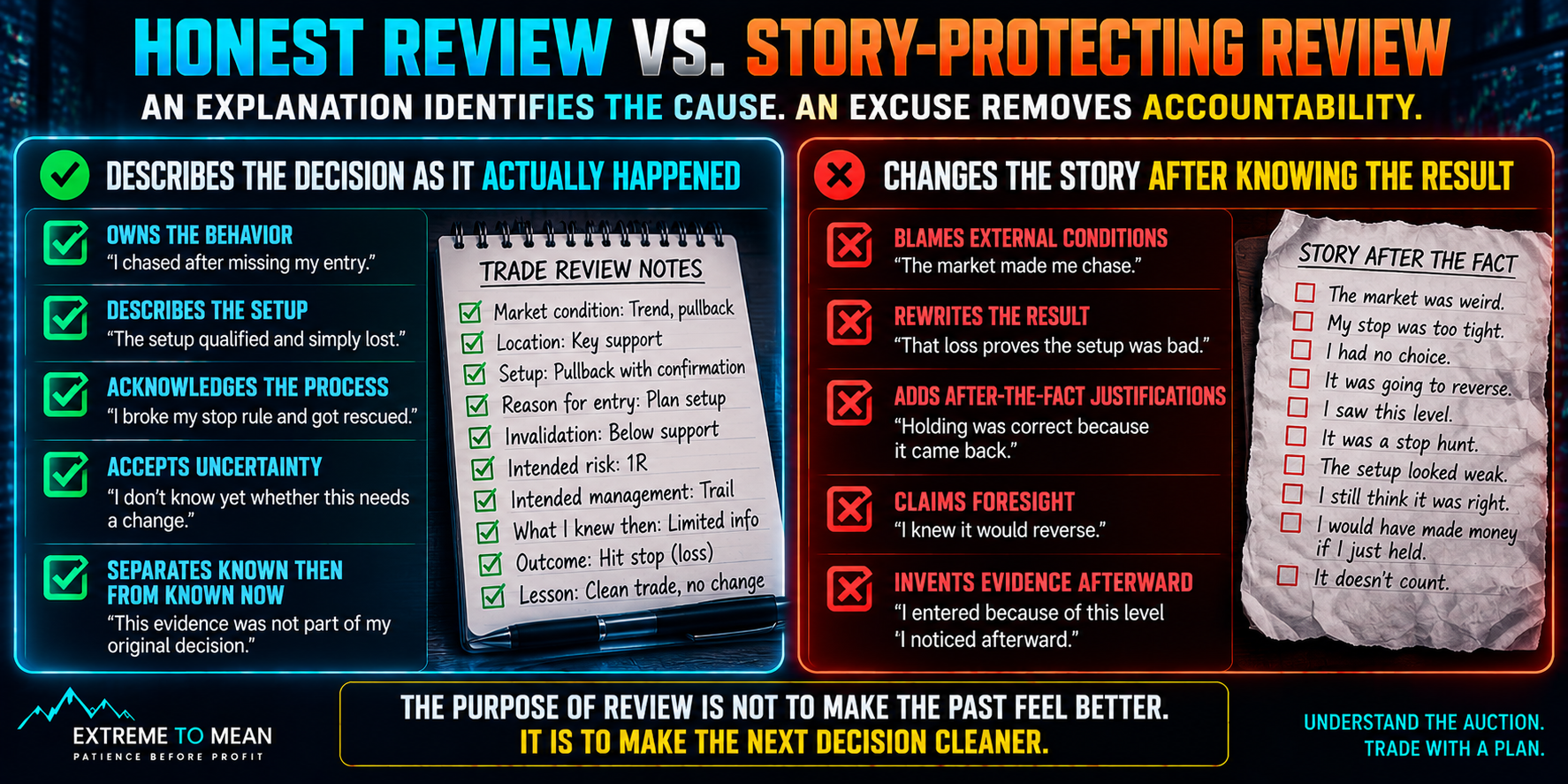
An explanation and an excuse can sound similar because both describe why something happened. The difference is accountability. “After missing the first move, I felt urgency and lowered my entry standard” explains the decision while still identifying the trader’s part in it.
An excuse moves responsibility somewhere else. “The market was weird,” “It moved too fast,” “I had no choice,” or “That stop hunt was not normal” may describe genuine difficulty, but none of them automatically explains why a known rule was broken. External conditions matter, yet the review still has to return to “What part of this decision was mine?”
This is especially important when the problem was chasing the trade. A fast market can explain why chasing felt tempting without turning the chase into a required response. Honest review can acknowledge the environment and still identify the choice.
Do Not Invent Evidence After the Fact
Suppose a trader takes a somewhat impulsive long that eventually wins. During review, the trader scrolls backward and notices a support level, improving breadth, moving-average alignment, an earlier reaction, and several other pieces of evidence that make the entry look sophisticated. The journal then says, “Entered because support held and momentum improved.”
But what if none of those observations actually caused the entry? If the trader entered because price started moving and only discovered the supporting evidence later, that evidence cannot retroactively become the entry reason. The chart may contain the information, but the original decision did not.
This is one of the easiest ways to turn a weak decision into a convincing story. Evidence discovered afterward can become useful for future research, but it should be labeled honestly as noticed after the trade. Review loses value when it upgrades hindsight into intention.
Use Evidence From Before the Outcome Whenever Possible
Memory is useful, but it is not the only evidence available. Whenever possible, compare the completed trade with material created before or during the decision: the written plan, screenshot, checklist, alert, scenario note, or journal entry. Those records create an anchor outside the story you tell after the result.
They still do not make the review perfectly objective. A pre-trade note can describe a poor plan, a screenshot can miss important context, and written confidence can still be wrong. Their value is narrower: they help establish what you actually thought and intended before the outcome became known.
That makes a strong review question possible: “Would I describe this trade the same way if the P&L were reversed?” If a winner suddenly becomes “high conviction” while the identical losing decision would have been called “questionable,” outcome may be controlling the explanation. The goal is to make the description stable enough that profit and loss do not rewrite the facts.
The ETM Honest Trade Review
Use this sequence:
- RECONSTRUCT — What was the trade as it actually existed?
- VERIFY — What did my plan require?
- SEPARATE — What was known then versus learned later?
- JUDGE — Did the decision and execution meet the process?
- LEARN — What, if anything, should change?
A more detailed version is PLAN → EVIDENCE → DECISION → EXECUTION → OUTCOME → LESSON. The critical rule is simple: do not jump directly from OUTCOME → LESSON, because that shortcut gives hindsight and P&L too much control over the review. Reconstruct the decision first, then decide what the outcome actually teaches.
Useful questions include: What was my actual reason for entering? Did that reason exist before the result? What information was available at the time, what became obvious later, did I change the plan while the trade was active, and am I explaining a rule break or defending it?
The strongest question may be: “If I hid the outcome, what would I say about this decision?” Sometimes the answer will be that the trade was clean and simply lost; sometimes it will be that a rule was broken and the trader got lucky. Sometimes the most honest answer is, “I do not have enough evidence to change anything yet.”
Final Thought
A trade review is not where you create the most convincing explanation for what the market eventually did. It is where you reconstruct what you knew, what you decided, whether you followed the process, and what the evidence actually justifies changing. Tell the truth about the decision first and let the lesson come second.
Do not let the ending rewrite what you knew at the beginning. The right side of the chart will always know more than the trader who had to make the decision on the left side. A cleaner review respects that difference so the next decision can be built from evidence rather than a better-sounding story.
Educational content only. Trading involves substantial risk and is not suitable for everyone.