
The useful question is not whether taking partial profits is good or bad. The trader needs to know what job the partial is supposed to perform, what remains afterward, and what future participation was surrendered. Inside The Setup, scaling should be planned rather than improvised because open profit feels uncomfortable.
What Scaling Out Actually Means
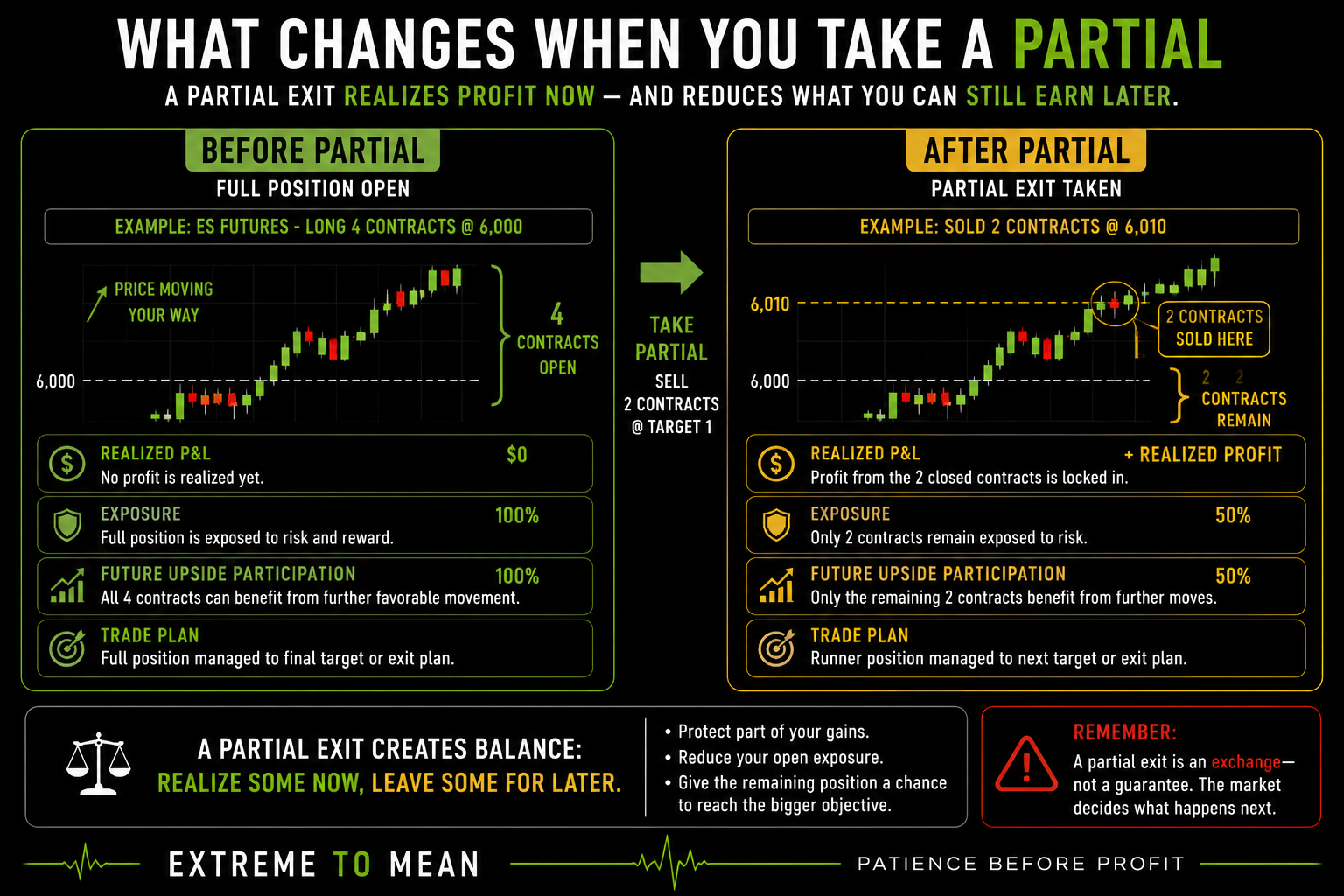
Scaling out means closing only part of an open position while leaving the rest open. A trader long four futures contracts might sell two at a first objective and continue managing the remaining two under a separate plan. The original position now has multiple exits instead of one full-position exit.
The portion closed is commonly called a partial, while the contracts left open are often called the runner. A runner is the remaining position intended for a later exit; it is not automatically profitable, protected, or “free.” CME describes futures exits as offsetting an open position with an opposite transaction in the same contract. (cmegroup.com)
A Partial Changes More Than Realized Profit
A partial changes three things immediately: realized P&L, remaining exposure, and future upside participation. Once contracts are closed, their result is realized; because fewer contracts remain, less size is exposed to the next price move. At the same time, less size remains available to benefit if price continues favorably.
That last change is the one traders often underweight. A partial does not merely “lock in profit”; it also sells part of the position’s future participation. That can be sensible when the trade reaches a planned objective or uncertainty increases, but it is still an exchange rather than a free improvement.
Why Traders Scale Out—and Why the Reason Matters
A partial can have several legitimate jobs. It may realize part of the move at an opposing level, reduce exposure, separate a nearer objective from a larger one, or respond to new information without fully invalidating the trade. The key word is planned.
The weaker version begins when open P&L itself becomes the reason to act. A normal pullback feels more threatening, the original target suddenly seems farther away, and taking something off provides emotional relief even though the market has not reached a structural reason to reduce size. Fidelity’s current exit-strategy material emphasizes planning exits before entry and recognizes multiple ways to structure an exit rather than one universal method. (fidelity.com)
The better question is: Did the market reach a reason to reduce the position, or did the unrealized gain simply become large enough to make me uncomfortable? A planned partial and fear-based early profit taking can look identical on the order ticket, but the decision process is different.
A Four-Contract ES Example
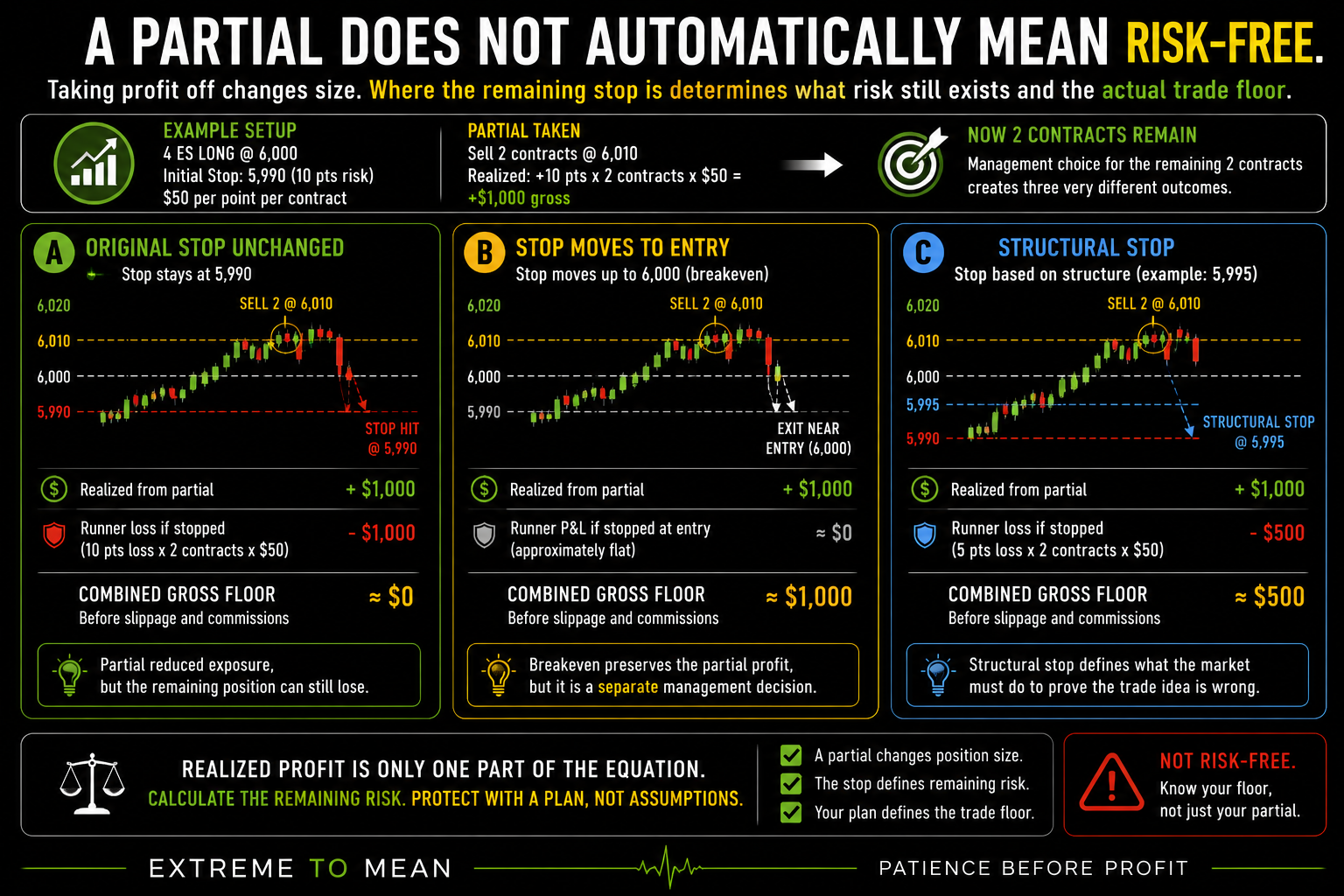
Suppose a trader buys four ES contracts at 6,000 with an initial stop at 5,990. Using the article’s $50-per-point ES assumption, 10 points of risk equals $500 per contract and $2,000 across all four contracts. This is why entry, stop, and target belong in the plan before the trade, rather than being reconstructed after price starts moving.
Price reaches 6,010 and the trader sells two contracts. Those two contracts realize 10 points each, or $1,000 gross, while two contracts remain open. The position now has less exposure, but only half of the original size can participate in any further favorable move.
A Partial Does Not Automatically Make the Runner Risk-Free
If the stop on the remaining two contracts stays at 5,990, those contracts still have $1,000 of gross downside to the stop. If they are stopped there, the +$1,000 partial and -$1,000 runner loss produce an approximately flat gross combined result before costs. The partial reduced exposure, but it did not make the remaining position risk-free.
If the stop instead moves to the 6,000 entry price and the remaining contracts exit near entry, the gross trade result would remain about +$1,000 before slippage and fees. That still does not make breakeven the automatically correct stop, because moving the stop is a second management decision that can change how much normal rotation the runner can survive. The trade is not ready until the remaining risk is clear.
A structural stop creates a third possibility. The gross floor is then the realized partial P&L plus whatever the remaining contracts would gain or lose if that actual stop were hit. CME’s futures education similarly treats exit parameters as part of the broader trade and risk plan rather than something to improvise after entry. (cmegroup.com)
Scaling Out Can Kill a Good Winner
Consider another four-contract example in which price ultimately moves 30 points in the intended direction. If all four contracts reached +30 points, the gross result would be 4 × 30 × $50, or $6,000. If three contracts were removed at only +5 points and one contract reached +30, the gross result would instead be $750 + $1,500 = $2,250.
The example does not prove the full-position exit was better, because price could have reversed after five points. It simply shows the cost of giving up size early. A trader can be directionally right and still leave only a token runner for the best part of the move.
A Partial Should Have a Job
The location of a partial should follow the trade logic rather than a universal formula such as “always take half at 1R.” Previous highs or lows, opposing structure, a range boundary, or another planned objective can all justify evaluating a reduction. The amount removed should follow the trader’s tested management plan.
This is where risk-first trading still matters after entry. Ask what the partial is protecting, why this level is appropriate, and whether the remaining size is large enough to accomplish the runner’s intended job. If those answers are unclear, the partial may be emotional interference dressed up as sophisticated management.
A full fixed exit and a scaled exit solve the problem differently. A fixed exit is simpler and keeps the entire position participating until one objective, while scaling realizes some P&L and reduces open exposure but also lowers future payoff and adds management decisions. Neither structure is universally superior.
Scaling Out and Moving the Stop Are Separate Decisions
Taking a partial changes position size. Moving the stop changes the exit location and risk of the remaining position. The common sequence “take a partial, then move the rest to breakeven” combines two separate choices that should each have their own justification.
The runner also needs an exit plan. A fixed second target, structural trailing rule, continuation condition, time-based exit, or final session exit can all be reasonable if they belong to the strategy. “Let it run” is not a complete management rule.
Scaling Out Changes the Distribution of Results
Scaling should be tested as part of the strategy rather than assumed to improve expectancy. It can change average winning trades, exposure during reversals, the number of exit transactions, transaction costs, and how strongly large favorable moves affect the overall sample. Al Brooks defines scaling out as exiting part of a position while leaving the rest for a later exit and explicitly notes that a mathematical basis for scaling does not make it automatically the wisest use of capital. (onlinelibrary.wiley.com)
Maximum Favorable Excursion, or MFE, asks how far the trade moved in the trader’s favor before it was over. Review where the first partial occurred, how much size was removed, how far price traveled, and how much the runner captured. Over a meaningful sample, that can show whether partials serve the setup or repeatedly remove most size too early.
Weighted exit price adds another useful comparison. If four contracts exit with two at +10 points, one at +20, and one at +30, the effective average gain is (2×10 + 1×20 + 1×30) ÷ 4 = 17.5 points before costs. That makes alternate management plans easier to compare.
A Practical Scaling-Out Decision Framework
Use Reason → Level → Size → Remaining Risk → Runner Plan before taking a partial. The framework forces the trader to identify what the action is supposed to accomplish and what will be different after the order fills. If those questions cannot be answered, the trader is improvising.
- Reason: What specific job is the partial supposed to perform?
- Level: Why is this the logical place to reduce size?
- Size: How much is being removed, and why that amount?
- Remaining risk: Where is the stop, and what is the actual gross trade floor if it is hit?
- Runner plan: What target, structural change, or time condition will close the rest?
After the partial, use Plan → Partial → Recalculate → Manage → Review. Recalculate realized P&L, remaining size, stop location, remaining dollar risk, and available upside instead of assuming the trade is protected because some gain was realized. The better question is: What specific job would this partial exit perform, and what am I giving up by reducing my position here?
- Plan: Define the partial’s job before entry.
- Partial: Execute the reduction at the planned level.
- Recalculate: Update realized P&L, remaining size, and remaining dollar risk.
- Manage: Apply the runner’s predefined stop and target plan.
- Review: Compare what happened against what the partial was supposed to accomplish.
A second question protects the runner: If I remove this much size now, will the remaining position still matter if the trade reaches its intended larger target? That does not prescribe a percentage. It makes the tradeoff between current protection and future participation explicit.
Final Thought
Scaling out is neither automatically sophisticated nor automatically harmful. It is a tradeoff: part of the current result becomes realized, open exposure falls, and less size remains available if the move continues. Good management begins by knowing why that exchange belongs in the plan.
The goal is not to protect every dollar of unrealized gain or keep every contract open for the maximum move. It is to make the partial serve a structural purpose while leaving the runner with enough size and a clear plan. That balance also requires patience—allowing the plan rather than emotional relief to determine when action occurs, a broader problem explored in The Patience Principle.
Educational content only. Trading involves substantial risk and is not suitable for everyone.