
A trade can look attractive and still be untradeable. The location may be interesting, the pattern may be familiar, and the potential target may be obvious—but none of that makes the idea ready until the risk is clear.
Risk-first trading reverses the order many traders naturally follow. Instead of beginning with how much a trade might make, it begins with the conditions that would prove the idea wrong. Only then can the trader decide where a stop belongs, how large the position can be, whether the potential destination justifies the exposure, and whether the trade deserves participation at all.
Risk management is not something added after the entry. It is part of deciding whether there is a valid setup in the first place. A signal without defined invalidation is incomplete. A target without a stop is only a preferred outcome. A position size chosen before the stop is known forces the market structure to fit the trader’s comfort instead of allowing the structure to define the trade.
This is why The Setup treats risk as part of qualification rather than damage control. The trader’s job is not to predict perfectly. The job is to define the idea, identify the evidence that would invalidate it, and decide whether the trade can be taken without violating the broader plan.
Risk Must Be Defined Before Entry
Many traders begin with the reward. They see a move that could travel ten points, reach a previous high, return to VWAP, or fill an obvious area on the chart. They imagine the destination first and then search for a stop that makes the trade look acceptable.
That sequence creates a hidden problem: the stop becomes a budgeting tool instead of an invalidation point. It may be placed close because the trader wants a larger position, or pushed farther away because the trader does not want to be wrong. In either case, the stop is being shaped by preference rather than by the trade idea.
A complete setup must answer a more demanding question: What has to remain true for this trade to remain valid? The answer may involve a price area holding, a rejection continuing, a breakout maintaining acceptance, or a specific structure remaining intact. When that required condition fails, the trade thesis has changed.
The deeper lesson in If You Cannot Define the Risk, You Do Not Have a Setup is that invalidation is not paperwork completed after a signal. It is one of the conditions that allows the signal to qualify. When the trader cannot define where the idea is wrong, the setup has not earned risk.
Invalidation Is Different From Discomfort
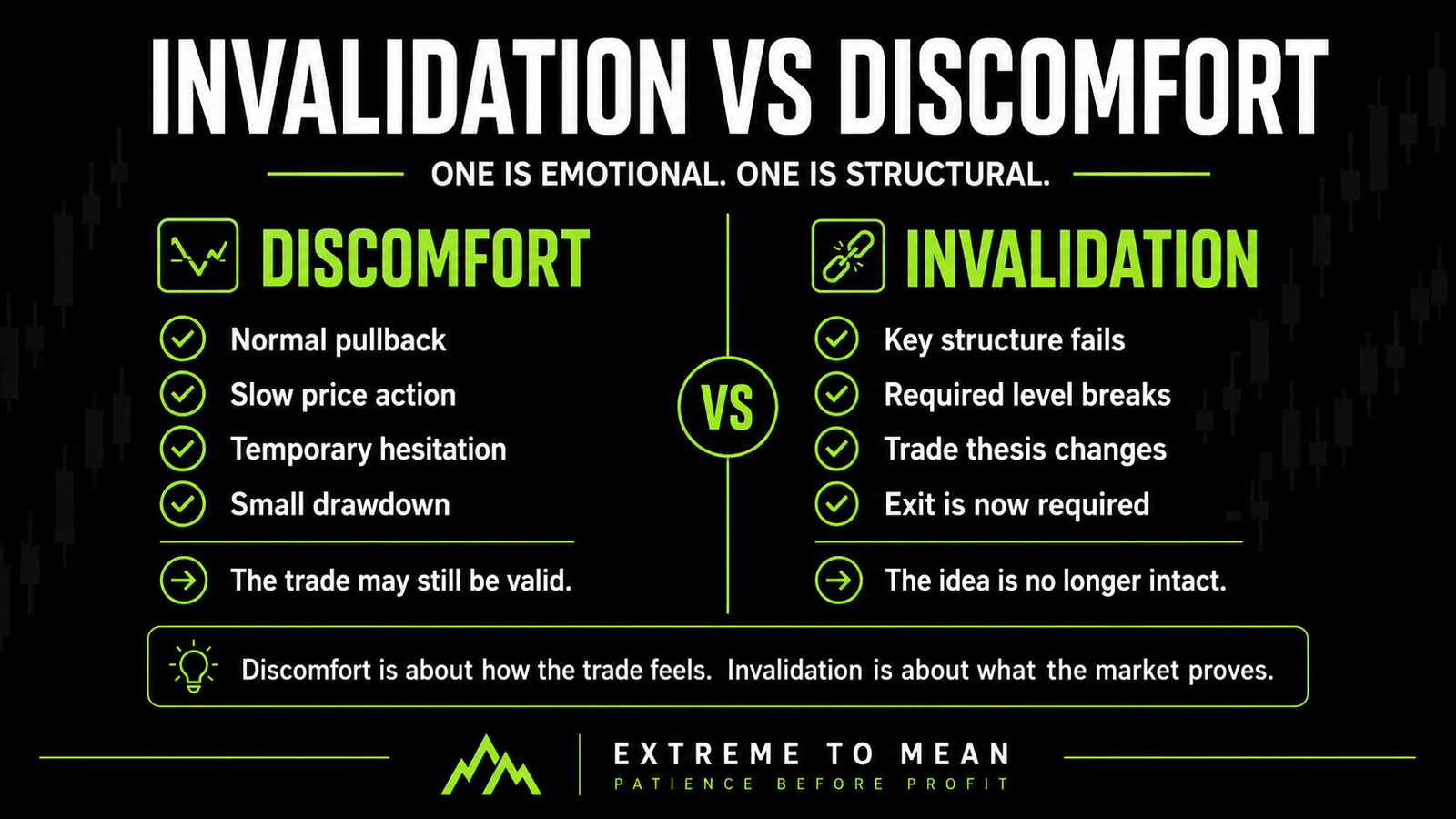
Discomfort is emotional. Invalidation is structural.
A trade can become uncomfortable without becoming wrong. Price may pause, pull back, test an area twice, or move less cleanly than expected while the original structure remains intact. The trader may feel uncertain because the position is fluctuating, but uncertainty alone does not prove the thesis has failed.
The opposite is also possible. A trader may feel calm while the trade is clearly invalidated because the loss is still small, the position is moving slowly, or hope has replaced evaluation. Emotional comfort is not proof that a trade remains valid.
The question Where Is the Trade Wrong? forces the trader to identify evidence rather than feelings. The answer should describe a price area, structural failure, time condition, or market behavior that contradicts the reason for entry. It should be defined before the trade, not invented after the position becomes difficult.
This distinction matters because traders often move a stop to breakeven when discomfort and invalidation are confused. Fear can pull the stop too close, causing normal movement to end an otherwise valid idea. Hope can push the stop too far away, allowing a failed idea to become a larger loss.
The article Why a Trade Without Invalidation Is Just Hope explains how quickly a plan becomes a changing story when the point of failure was never defined.
A Stop Belongs Where the Trade Is Wrong
A stop loss is an order used to exit a position after price reaches a specified level or condition. It is an important risk-control tool, but the order itself does not decide where it belongs. Market structure and the trade thesis must make that decision first.
The stop should sit beyond the area or behavior required for the setup to remain valid. That does not mean every stop must be wide. It means the distance must come from the logic of the trade rather than from an arbitrary dollar amount or the trader’s current anxiety.
This is the central principle behind Stop Placement: Where You’re Wrong, Not Where You’re Scared. A stop that is too close may sit inside normal volatility. A stop that is too far away may allow the position to survive long after the original thesis has failed. The correct question is not, “How much room can I tolerate?” It is, “What market behavior would make this idea no longer valid?”
The mechanics also matter. A stop order does not guarantee the exact planned exit price. Fast markets, gaps, thin liquidity, and slippage can produce a fill beyond the trigger. The beginner explanation in What Is a Stop Loss? covers the difference between the purpose of a stop and the practical limits of the order. Risk planning should account for those limits rather than treating the stop price as a guaranteed outcome.
Position Size Follows the Stop
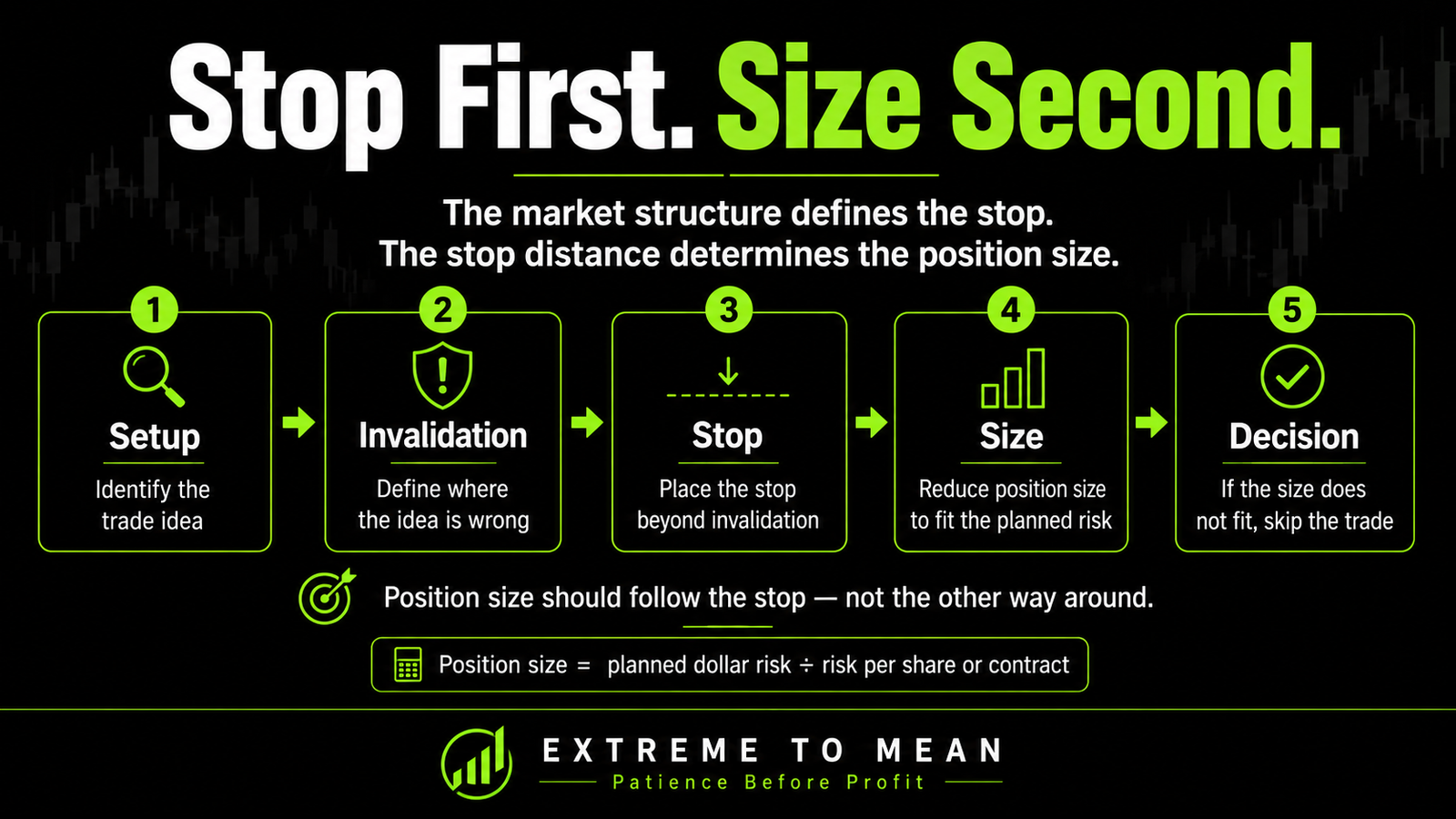
Once invalidation defines the stop distance, the trader can determine whether the position fits the acceptable dollar risk. The futures position-sizing guide applies that sequence to contract count and dollar risk per contract. This order cannot be reversed without distorting the setup.
Suppose a trader decides that the maximum planned loss for one trade is $100. An entry at $50 with structural invalidation at $49.50 creates $0.50 of risk per share before commissions, fees, or slippage. Dividing the planned dollar risk by the risk per share produces a maximum theoretical size of 200 shares:
Position size = acceptable dollar risk ÷ risk per share or contract
This is an educational example, not a recommended dollar amount or account-risk percentage. Real position sizing must reflect the instrument, point or tick value, liquidity, order type, slippage, trading costs, account rules, and the possibility that the actual loss may exceed the estimate.
The important principle is the sequence. The trader does not choose 500 shares and then force the stop close enough to make the math comfortable. The trader identifies invalidation, measures the stop distance, and then reduces the position until the exposure fits the plan. When the minimum tradable size is still too large, the correct size may be zero.
That sequencing is central to How to Think Like a Risk Manager Before Thinking Like a Trader. The risk manager asks what can be lost and whether the exposure is acceptable before becoming interested in what can be gained. Position size is the result of the decision process, not the starting point.
Entry, Stop, and Target Must Describe One Trade
An entry, stop, and target should not be three unrelated numbers. Together, they describe the complete trade thesis.
The entry identifies the conditions under which the trader is willing to participate. The stop identifies where the idea is no longer valid. The target identifies a realistic destination supported by the timeframe and market structure. Each part must make sense relative to the other two.
A distant target cannot rescue a poorly defined stop. A tight stop cannot make a weak location attractive. A favorable reward-to-risk calculation does not prove that the target is realistic or that the invalidation is structurally sound. Ratios are useful only after the underlying prices have earned their place in the plan.
This becomes especially important in mean-reversion trades. A trader may identify an extreme and assume that VWAP or another mean is the destination, but the possible reversion still needs clear invalidation and enough room to develop. The VWAP Mean Reversion Strategy shows why location creates interest rather than automatic permission.
The same point holds on the tools side: a reference like the ones covered in the mean-reversion indicators article can help organize the chart, but it cannot replace a complete risk decision.
Risk Management Is Not Prediction
Risk-first trading does not require certainty about what happens next. It requires clarity about what the trader will do when the market provides different outcomes.
Prediction asks, “Where will price go?” Risk management asks, “What evidence supports this trade, what evidence would reject it, and what will the loss be if the idea fails?” The first question has no dependable answer. The second can be planned before entry.
This change in focus improves decision quality because it reduces the need to defend a forecast. The trader no longer has to prove that the market should reverse, break out, or continue. The trade can be treated as a conditional idea: valid while certain evidence remains present, invalid when that evidence fails.
That philosophy fits what reversion to the mean means at Extreme to Mean. An extreme creates a question, not a promise. The same is true of any setup. A pattern, indicator, or location may earn attention, but only context, structure, and defined risk can determine whether it earns participation.
Daily Loss Limits Protect the Next Decision
Per-trade risk is only one layer of the plan. A trader can take several individually acceptable losses and still reach a point where continuing becomes a decision-quality problem.
A daily loss limit defines the point at which trading stops for the session. It can be based on a dollar amount, a number of planned losses, a rule violation, or another boundary established in the trading plan. Its purpose is not to predict that the next trade will fail. Its purpose is to prevent one difficult session from becoming an uncontrolled sequence of increasingly emotional decisions.
Losses can change behavior. The trader may begin increasing size, taking lower-quality setups, entering too quickly, moving stops, or trading simply to recover. Wins can also reduce discipline by creating overconfidence and a desire to press. A daily boundary protects the process from both conditions.
Why Daily Loss Limits Are Decision Limits develops this idea at the session level. The limit is not only a cap on money lost. It is a preplanned response to the point where fatigue, frustration, urgency, or overconfidence may begin controlling the next decision.
A Simple Risk-First Filter
Before entering, the trader should be able to answer these questions in plain language:
- What is the trade idea? Describe the setup without relying on “it looks good.”
- Where is the idea wrong? Identify the structural, behavioral, price, or time-based invalidation.
- Where does the stop belong? Place it beyond the invalidation, not at an emotionally comfortable distance.
- What is the planned dollar exposure? Include the instrument’s value, expected costs, and possible slippage.
- What position size fits that exposure? Reduce the size after measuring the real stop distance.
- Is the target realistic? The destination should be supported by the timeframe and structure.
- Does this trade fit the daily plan? Consider current losses, decision quality, market conditions, and remaining limits.
When one answer is vague, the trade is not automatically rejected forever. It may need more time, better structure, or a different entry. But the trader should not use uncertainty as permission to improvise with real money.
This is where the diagnostic page Having Unclear Risk remains useful. It helps traders recognize the emotional and behavioral symptoms of vague risk. The pillar here provides the instructional framework: define invalidation, derive the stop, calculate the size, evaluate the destination, and respect the daily boundary.
Why Unclear Risk Means No Valid Setup
Unclear risk creates decisions that should have been made before entry. Every candle becomes a new debate. The trader does not know whether to hold, exit, add, reduce, or move the stop because the conditions for those choices were never defined.
The result is not flexibility. It is unmanaged discretion under pressure.
A risk-first process moves those decisions to a calmer moment. Before the trade, the trader defines what must remain true, what would prove the idea wrong, how much exposure is acceptable, and what action follows invalidation. The outcome remains uncertain, but the response does not have to be.
This is why The Trade Is Not Ready Until the Risk Is Clear is more than a reminder about stop losses. It is a qualification rule. A trade that cannot explain its own failure condition has not earned risk, regardless of how attractive the possible reward appears.
Frequently Asked Questions
What does risk-first trading mean?
Risk-first trading means evaluating invalidation, stop placement, position size, and acceptable loss before focusing on the potential reward. It treats risk definition as part of setup qualification rather than something added after entry.
How do I know whether a trade’s risk is clearly defined?
You should be able to explain what market behavior would prove the idea wrong, where the stop belongs relative to that evidence, how much the position could reasonably lose, and whether that exposure fits your trading plan. When any of those answers is vague, the risk is not fully defined.
What is the difference between invalidation and a stop loss?
Invalidation is the market condition that proves the trade thesis is no longer valid. A stop loss is the order or exit mechanism used to act on that conclusion. The invalidation should determine the stop location—not the other way around.
Where should I place my stop loss?
The stop should generally be placed beyond the price area or market behavior required for the trade to remain valid, while accounting for normal volatility and execution realities. It should not be placed solely where the loss feels comfortable or where a preferred position size requires it to be.
How do I determine position size after defining the stop?
Measure the risk per share, contract, or unit between the intended entry and the planned stop. Then divide the acceptable planned dollar risk by that per-unit risk, adjusting for the instrument, minimum size, fees, slippage, and account restrictions. When the available size still exceeds the plan, the trade may need to be skipped.
What is a daily loss limit?
A daily loss limit is a preplanned boundary that ends trading for the session after a defined amount of financial loss, a set number of losses, a serious rule break, or another deterioration in decision quality. It protects the broader trading process from emotional escalation.
Does defining risk guarantee that a trade will be safe?
No. Every trade carries uncertainty, and actual losses can exceed planned losses because of gaps, slippage, liquidity, technical failures, or other market conditions. Defining risk creates a clearer decision process; it does not remove market risk or guarantee a specific outcome.
Final Takeaway
The possible reward may attract the trader, but the defined risk determines whether the trade deserves participation.
Start with the idea. Identify what must remain true. Define where the idea is wrong. Place the stop from that structure. Calculate the position size from the stop distance. Evaluate whether the target is realistic. Then confirm that the trade fits the daily plan.
The market does not require you to take every attractive setup. When the risk is unclear, patience is not hesitation. It is the decision to wait until the trade becomes complete—or to leave it alone.
Educational content only. Nothing in this article is financial advice, a recommendation to buy or sell any security or futures contract, or a guarantee of any trading outcome. Trading involves substantial risk, and losses may exceed the amount originally planned.