
Most traders are introduced to the market through opportunity. They learn to recognize patterns, identify direction, find entries, and estimate how far price might move if the idea works. That naturally directs attention toward the potential reward while risk is treated as a secondary calculation added after the trader has already become interested in the position.
That order makes objective evaluation difficult because the trader is no longer asking whether the complete trade is acceptable. They are often trying to make the risk fit an opportunity they already want to take. A better process examines the consequences first, then determines whether the possible reward justifies accepting them.
This lesson belongs within the broader trader psychology curriculum because risk management is not only about account math. It is also about protecting the trader from urgency, fear, hope, frustration, and the pressure to recover. Clear risk decisions made before entry reduce the number of important choices that must later be made while profit and loss are moving.
The Trader Sees Opportunity; the Risk Manager Sees Exposure
A trader and a risk manager can look at the same chart and notice different parts of the same decision. The trader may see a familiar setup, a meaningful location, a clean trigger, and an attractive target. Those observations explain why the opportunity deserves attention, but they do not yet establish whether it deserves capital.
The risk manager examines what must be accepted for the trade to be taken. That includes where the idea becomes invalid, how far the planned entry sits from that point, and what position size would convert the distance into an acceptable account risk. The risk manager also asks whether the realistic destination offers enough room to justify that exposure.
Market conditions can make the actual risk greater than the calculation shown on the chart. Volatility, thin liquidity, wider spreads, gaps, scheduled news, and slippage may all affect the entry or exit. A stop defines where the trader intends to leave, but it cannot guarantee that the position will be filled at exactly that price under every condition.
The emotional effect of the loss also deserves consideration. A position may be mathematically affordable while still being large enough to create panic, hesitation, revenge trading, or an immediate need to recover. The purpose of risk management is therefore not to eliminate uncertainty, which trading cannot do, but to understand the exposure well enough to decide deliberately whether it should be accepted.
An opportunity may look technically attractive while requiring a stop that is too wide for the intended size. Another may offer manageable risk but too little realistic room before price reaches opposing structure. A third may be valid under normal conditions but occur during a market environment that makes execution unusually unstable.
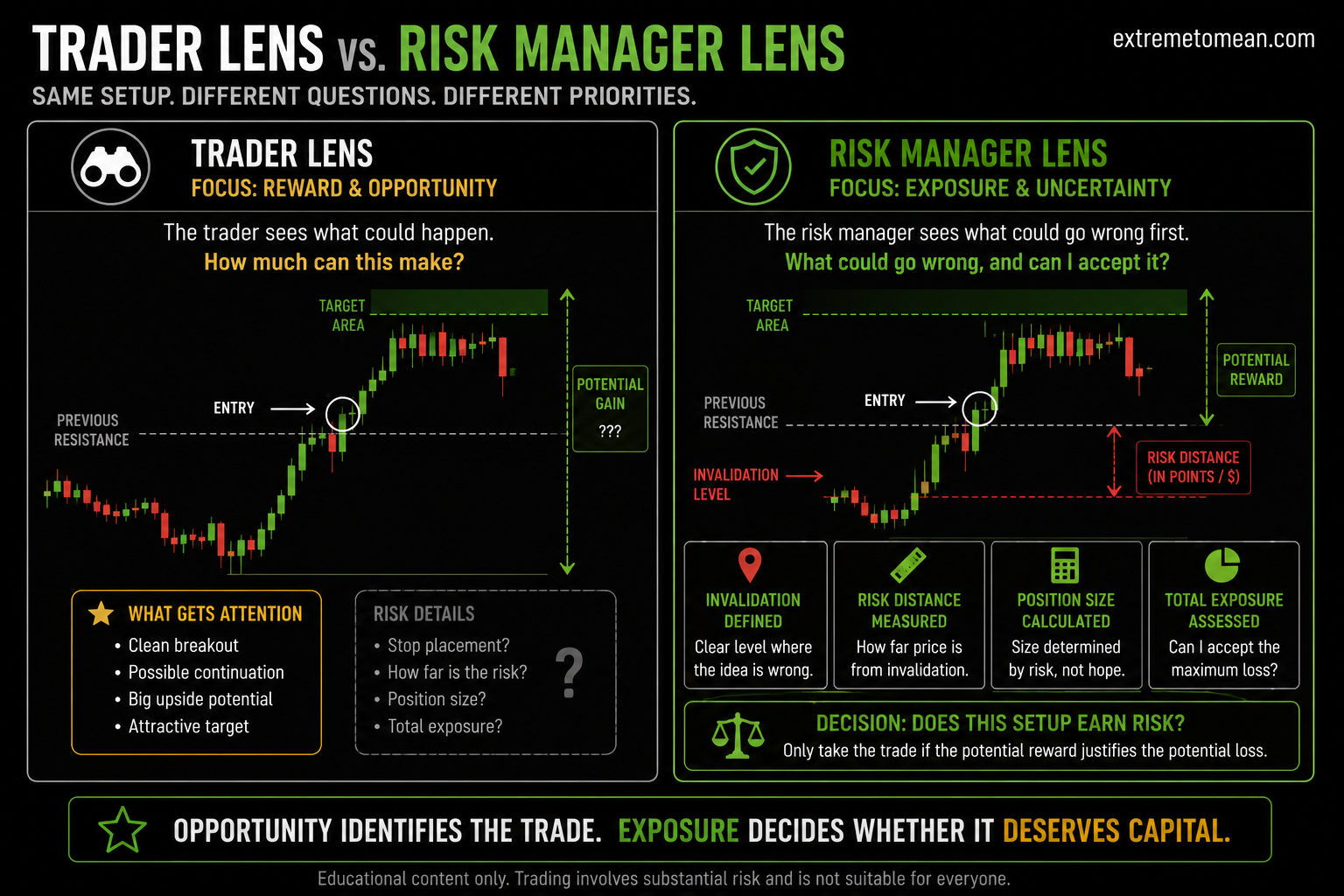
Thinking like a risk manager first does not prevent action or require the trader to expect failure. It prevents action from occurring before the consequences have been understood. The trader remains free to recognize opportunity, but the possibility of reward is not allowed to hide the cost of participation.
Why Reward-First Thinking Feels Natural
Traders do not focus on reward simply because they are careless. Reward is the part of the trade that creates excitement, possibility, and a sense of progress. The target provides something positive to imagine, while entering a position turns analysis into action and creates the immediate possibility of being proven correct.
Risk produces a less comfortable experience because it requires the trader to consider being wrong before the trade has even begun. When a setup looks convincing, that can feel overly negative or unnecessary. The trader may believe that focusing on the possible loss will weaken confidence, create hesitation, or cause the opportunity to be missed.
Confidence that depends on avoiding the possibility of failure is fragile. It often disappears as soon as price moves against the entry, because the trader never fully accepted that outcome before participating. The resulting fear is not always caused by the market movement itself; it is often caused by exposure that was never clearly understood.
A risk-first process does not require pessimism. The trader can still prepare for a favorable outcome, identify a realistic target, and act decisively when the setup qualifies. The difference is that confidence comes from understanding the complete decision rather than assuming the market will behave as hoped.
Risk Is More Than the Distance to a Stop
Traders often reduce risk to the number of points or dollars between the entry and the stop. That distance is essential, but it describes only the price risk per share, contract, or unit. It does not reveal the total account exposure until position size is included.
A five-point stop on one contract does not create the same account risk as a five-point stop on ten contracts. The chart distance remains identical, but the financial impact changes substantially. A trader who considers only the stop distance may therefore underestimate how much the position can actually cost.
Current volatility also affects whether the planned stop is appropriate. A stop that provides reasonable room during calm conditions may sit inside ordinary price movement when volatility expands. The trader may then be exited even though the original market idea has not been invalidated.
Execution uncertainty adds another layer. During fast movement, gaps, thin trading, or major news, the actual exit may occur beyond the stop price. Spread and slippage can also reduce a gain or increase a loss, particularly when the expected movement is small.
The complete exposure includes the distance to invalidation, the chosen position size, current market conditions, possible execution differences, and the trader’s ability to follow the plan. This is why the trade is not ready until the risk is clear. Drawing a stop line is not enough when the trader has not examined what that stop means for the actual position.
Position Size Should Follow the Market Structure
Position size is one of the clearest differences between reward-first and risk-first thinking. A reward-first trader may choose size according to how much they hope to make, then attempt to fit a stop around that preferred exposure. A risk manager begins with the setup, identifies the structural invalidation, and selects a size that keeps the resulting account risk within the plan.
Suppose a trade requires a wider stop because the invalidation point is farther from the entry and normal volatility needs additional room. The appropriate response may be to reduce the position size. The market structure determines the necessary distance, while the trader controls the account exposure by adjusting the number of shares or contracts.
Traders sometimes reverse that process because they want to keep a larger position. They place the stop unusually close so the calculated dollar loss appears acceptable, even though the stop now sits inside ordinary movement. The account risk may look controlled on paper, but the trade has been weakened because the exit no longer represents genuine invalidation.
The stop should not be designed to protect the trader’s preferred size. The position size should be designed to respect the stop required by the setup. When the appropriate size feels too small to make the trade worthwhile, that may be evidence that the opportunity does not fit the account or does not offer enough room.
The same principle applies after a loss. A desire to recover does not improve the next setup, reduce its uncertainty, or make the account capable of carrying additional exposure. Position size should come from the trade being evaluated now, not from the emotional result of the trade that came before it.
The Planned Loss Must Be Acceptable in Practice
A trader may calculate a planned loss and conclude that the account can afford it. That does not always mean the trader can absorb the result without losing decision quality. Financial tolerance and emotional tolerance are related, but they are not always identical.
A loss can create urgency, frustration, self-doubt, anger, or a need to prove that the original analysis was correct. Those reactions may alter the standard used for the next trade. The trader may accept a weaker setup, enter earlier than planned, increase size, or ignore an invalidation because recovering now feels more important than following the process.
The risk manager considers what is likely to happen after the position fails. The planned loss should leave the trader capable of reviewing the result, waiting for another qualified opportunity, and applying the same standards to the next decision. It should not create such intense pressure that the trading plan is immediately replaced by a recovery plan.
This does not mean losses must feel comfortable or emotionally neutral. Losses are part of trading, and even controlled losses can be disappointing. The important distinction is whether the outcome remains manageable enough for the trader to continue behaving deliberately.
The lesson on protecting your next decision develops this principle further. Risk control is not merely intended to help the account survive the current trade. It should also preserve the trader’s ability to make the next decision without being controlled by the previous result.
Risk Management Begins Before the Entry
Risk management is sometimes described as a process that begins after the trader enters. The position is opened, a stop is placed, and the trader watches for a reason to reduce or close the exposure. By that point, however, many of the most important risk decisions have already been made.
The entry location determines the distance to the structural invalidation. That distance influences the appropriate position size, while the available room to the target determines whether the exposure has sufficient opportunity attached to it. Market condition, volatility, spread, and liquidity influence whether the planned entry and exit can be executed reasonably.
A cleaner sequence begins with the market environment and location. The trader then qualifies the setup, identifies the behavior that would invalidate it, and measures the distance from the proposed entry to that boundary. Position size is selected only after that distance is known.
The trader must also identify a realistic target or management destination. If opposing structure sits too close, the trade may not offer enough room to justify the risk. A favorable-looking setup can therefore be rejected before entry because the complete structure does not support participation.
Sometimes this process ends with no trade. The stop may be too far away, the required size may be impractically small, the target may sit too close, or the conditions may make execution unusually uncertain. Rejecting the opportunity under those circumstances is not a failure to find an entry; it is a successful risk decision.
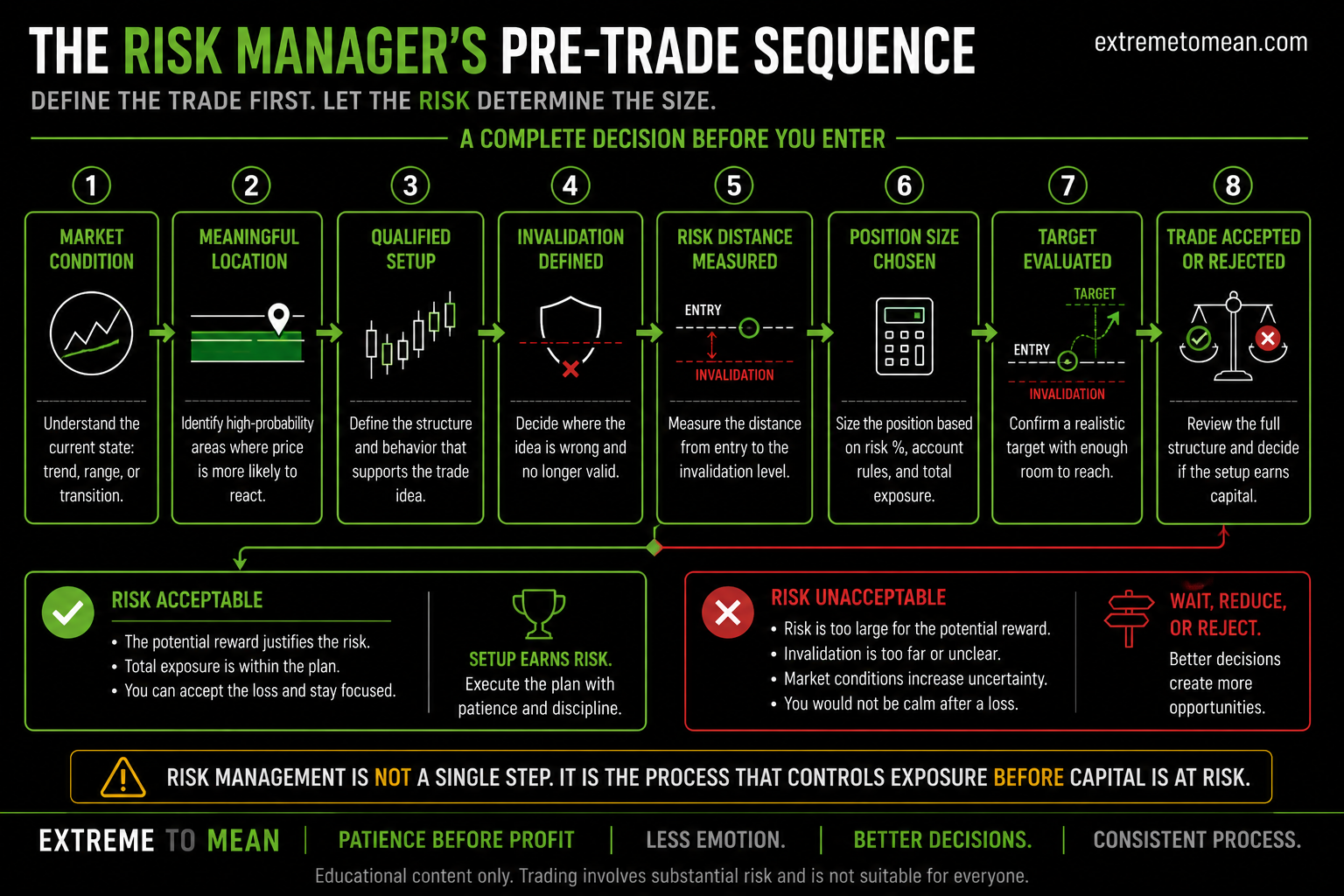
Risk management begins with deciding whether participation is justified. It is much harder to repair poor exposure after the order has already been filled because the trader is then evaluating the decision while money and emotion are involved.
Better Location Can Improve the Risk Decision
Risk management is closely connected to entry location. Where the trader participates affects how clearly invalidation can be defined, how far the stop must be placed, and how much room remains before the target or next obstacle. A late entry may follow the correct direction while producing a substantially weaker trade.
Suppose price has already moved far away from the original setup area. The structural invalidation point may remain unchanged, but the new entry is now farther from that boundary. At the same time, price may be closer to resistance, support, or another area that could interrupt the move.
The trader is now accepting more downside while pursuing less available room. To make the trade appear attractive again, they may tighten the stop, move the target farther away, or increase the position size. Each adjustment can make the written plan look better while making the actual trade less defensible.
This is why where you enter matters more than what you predict. Correct directional analysis cannot repair an entry that creates poor exposure. The risk manager is willing to miss the move when the remaining location no longer supports a clear and controlled decision.
Risk Limits Protect More Than the Account
Daily and per-trade loss limits protect decision quality as well as capital by creating a boundary before frustration, urgency, or fatigue begins changing the trader’s reasons for participating. The account is not the only resource being protected; the trader’s judgment is as well.
A trader funded through firm-specific risk rules has even less room to negotiate that boundary after it has been reached.
As losses accumulate, the purpose of the next trade can quietly change. The first trade may have been taken because it matched the plan, while the next is taken because the account needs to recover. The market may look similar, but the decision is now being driven by the trader’s emotional relationship with the loss.
A risk limit acknowledges that there is a point when continued participation is more likely to produce reactive decisions than careful ones. Reaching that boundary does not mean another valid setup cannot appear. It means the trader may no longer be in the best condition to evaluate or execute it properly.
The same principle can apply after a serious rule violation, unusual stress or extreme fatigue affects trading decisions, or a loss that affected the trader more strongly than expected. A risk manager recognizes that the ability to make a clear decision is itself limited. When that ability has been significantly reduced, stepping away can be the most responsible form of risk control.
Conduct a Risk-Manager Review Before Every Trade
Before accepting a position, the trader should be able to explain both the opportunity and the exposure in plain language. The invalidation should come from market structure or the expected behavior of the setup, not from the amount of loss that begins to feel uncomfortable. The stop should represent the failure of the idea rather than an arbitrary financial boundary placed on the chart.
Once the invalidation is defined, the trader can determine whether the stop distance and intended position size create an acceptable account risk. When the setup requires more room, the size should be reduced instead of forcing the stop closer. If the appropriate size does not fit the trader’s practical constraints, the trade may need to be rejected.
Current conditions must also be included in the review. Scheduled news, unusually fast movement, thin liquidity, wider spreads, or frequent gaps may cause the actual result to differ from the planned calculation. The trader should decide whether that uncertainty is acceptable before entry rather than being surprised by it afterward.
The target must be grounded in a realistic market destination. An attractive reward-to-risk ratio on paper has little value when price must move through several meaningful obstacles to reach the target. The trader should evaluate the room that actually exists, not the room required to make the trade look worthwhile.
The final question concerns the effect of failure. The trader should consider whether the planned loss would create an urge to increase size, revenge trade, chase another move, or abandon the process. A risk-manager review is complete only when the possible consequences can be measured financially and accepted behaviorally.
Instead of beginning with how much the trade might make, the trader should determine what can go wrong, what that outcome may cost, and whether the account and decision-making process will remain stable afterward. That question does not make trading pessimistic. It ensures that the decision includes both sides of the uncertainty.
Final Thought
Thinking like a trader begins with possibility, while thinking like a risk manager begins with consequence. Both perspectives are necessary, but the order matters because potential reward can easily make unclear exposure feel acceptable. Risk should be defined before enthusiasm for the opportunity begins influencing the calculation. Institutions face a larger version of the same discipline when they evaluate holding Bitcoin as a reserve asset, where liquidity needs and concentration limits matter as much as the monetary thesis.
Before selecting position size, identify where the idea is wrong. Before entering, determine whether the market offers enough realistic room to justify the exposure and whether current conditions could make execution materially worse. Before accepting the possible gain, decide whether the possible loss would leave both the account and the trader capable of continuing with discipline.
Risk management is not what happens after a setup has been found. It is the process used to decide whether the setup deserves capital, what amount of exposure is appropriate, and when standing aside is the better decision. When the risk cannot be explained, measured, and accepted, the trade is not ready.
Traders who repeatedly enter before answering these questions should begin with the guidance on having unclear risk. Making risk definition part of the pre-trade process helps ensure that participation begins with a complete decision rather than an attractive possibility. That pre-trade process is covered step by step in defining risk before you trade.
Educational content only. Trading involves substantial risk and is not suitable for everyone.