
Reducing position size can feel like admitting something you do not want to admit. If you once traded three contracts and now need to return to one, the smaller number can feel like lost progress, lower status, or proof that you cannot handle the level you thought you had reached. But contract count is not a trading résumé, and reducing exposure does not erase what you have learned.
Size is a risk setting—not a rank.
Position size changes more than the amount of money won or lost. It changes the emotional weight of every tick, pullback, stop, open gain, and mistake, so a size that looks acceptable on paper can still interfere with execution if normal market movement begins producing abnormal pressure. The important question is not, “How much size should a real trader be able to handle?” It is: At what size can my process still function?
This belongs inside the broader Trader curriculum because the goal is not to make the trade financially meaningless. The goal is to choose exposure that lets the trader evaluate the setup, respect the stop, manage the position, and accept the outcome without the dollar amount overpowering the decision. You can reduce exposure without reducing your skill.
Trading Smaller Is Not the Same as Going Backward
Traders can build an imaginary ladder: simulation, then Micros, then Minis, then multiple contracts, and eventually “real trader.” Once that ladder becomes the scoreboard, stepping down in size feels like losing a level that took months to earn. The problem is that the ladder measures exposure, not decision quality.
Position size should come from account size, stop distance, strategy, risk tolerance, execution quality, and applicable account rules—not pride or embarrassment. More size proves only that more money is moving—not that better decisions are being made.
The real objective is not to climb toward maximum size. It is to find the level of exposure at which your process can still function without normal market movement becoming emotionally overwhelming. A trader using one contract cleanly may be doing better trading work than someone managing five contracts poorly.
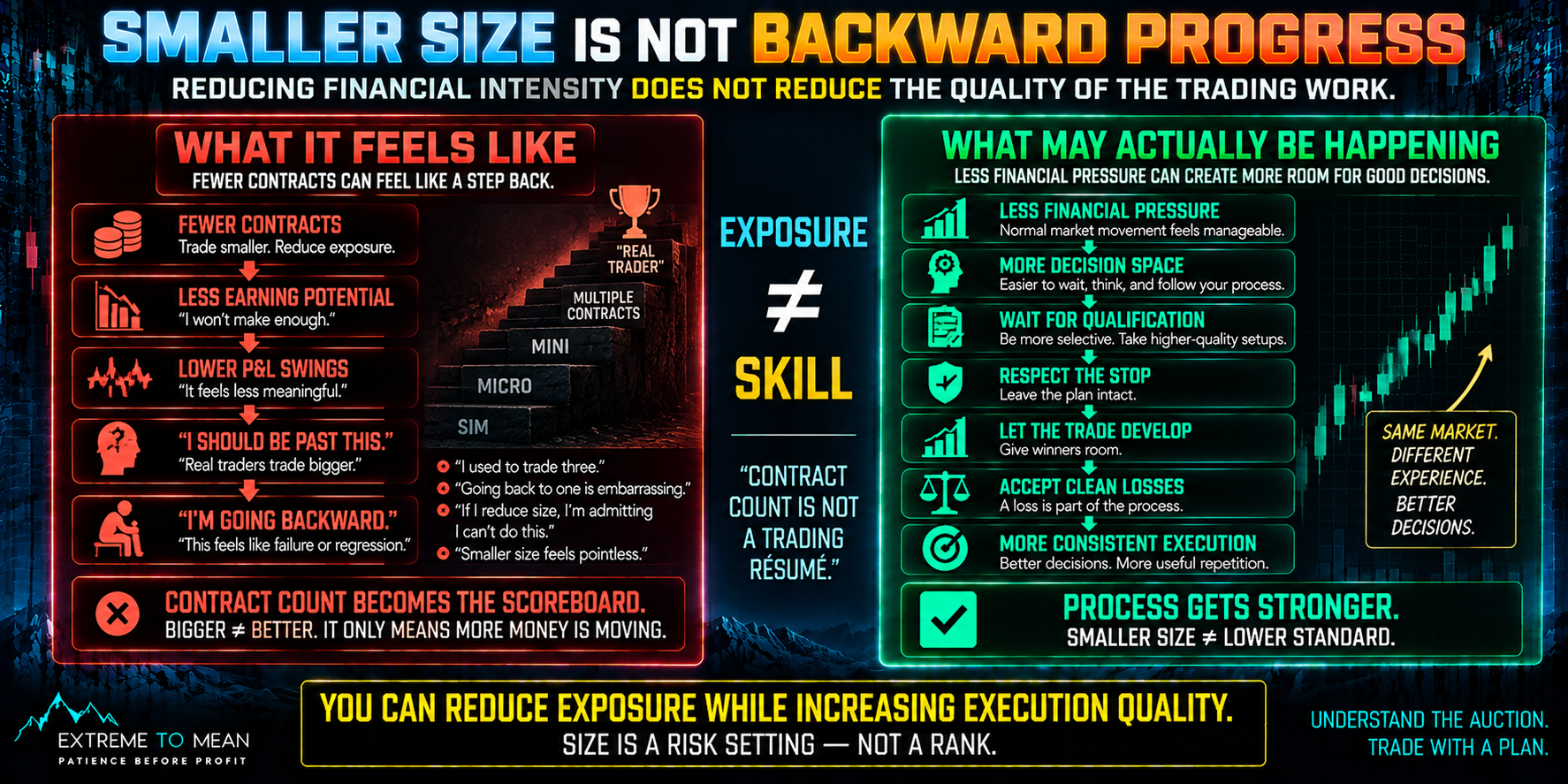
The Same Trade Can Feel Completely Different at a Different Size
Imagine the exact same setup, entry, stop, and chart movement. At one contract, a normal pullback may register as, “The setup is still intact.” At three contracts, that identical pullback may suddenly feel like, “I need to do something right now.”
Nothing about the chart changed. What changed was the dollar meaning of the chart, and that can alter behavior: the stop gets tightened, the winner gets cut early, the trader adds emotionally, or attention shifts from structure to the P&L window. The market can be moving normally while your position size makes it feel abnormal.
That matters because traders often describe this entirely as a discipline problem. Sometimes it is, but sometimes the trader is trying to use willpower to tolerate a financial intensity that is already distorting the decision. Sometimes the trader does not need more discipline; they need less financial pressure on the decision.
A smaller position will not repair a poor strategy or make a weak setup good, but size is worth testing when ordinary trade outcomes are materially changing execution. Less risk can improve execution; it cannot manufacture an edge.
Smaller Size Can Buy Decision Space
Reducing exposure can buy more than a smaller possible loss; it can buy decision space. Lower financial intensity may make it easier to wait for qualification, tolerate normal adverse movement, leave the planned stop alone, let a winner develop, and accept a clean loss without immediately needing the next trade to repair it. When every tick feels financially loud, protecting your next decision may begin with enough room to trade the setup instead of the P&L.
The market risk has not disappeared. A Micro contract may reduce dollar exposure, but the underlying market can remain just as volatile and uncertain. Smaller size changes financial intensity; it does not make the market more predictable.
That distinction matters because the purpose is not to eliminate discomfort forever. Risk is still risk, and losing trades remain part of the process. The purpose of smaller size is to make risk manageable—not to pretend risk is gone.
Reduce the Financial Consequence—Not the Trading Standard
Trading smaller only helps if the process remains serious. “It is only one Micro” cannot become permission to take mediocre setups, ignore stops, or skip review; if the trade is not ready until the risk is clear, that remains true at every contract size. Reduce the financial consequence—not the quality standard.
This distinction also makes smaller size useful as a diagnostic. If the trader reduces exposure and suddenly waits better, respects stops, overtrades less, and lets winners follow the plan, that is evidence that financial pressure was contributing to the problem. If the same rule-breaking continues at tiny size, size was not the whole issue.
Smaller size cannot turn a poorly defined strategy into a good one. If the setup has no measurable edge, the rules remain vague, or the trader continues ignoring them regardless of exposure, different work is required. Smaller size is not only protection; it can also help reveal what the real problem is.
Use Smaller Size to Rebuild Evidence, Not Ego
After repeated rule-breaking, oversized losses, or deteriorating execution, traders may keep trading the size that is creating pressure because reducing it feels like defeat. You do not need to feel fully confident before rebuilding; smaller risk can create the clean repetitions that confidence can grow from. The goal is evidence of stable execution, not confidence first.
A trader who executes one contract cleanly may be operating at a higher level than someone trading five contracts emotionally. The better confidence test is not, “Can I handle five contracts?” It is, “Can I follow my process with the size I am trading?” Handling more money is not the same as handling the trade better.
Consider a trader who executed well with one contract and later increased to three. Soon entries become earlier, stops get tighter, winners come off too quickly, and a normal loss creates hesitation; the trader concludes, “I lost my confidence.” The evidence suggests another possibility: the increased financial intensity is interfering with execution.
Trader A refuses to step down because returning to one feels humiliating. Trader B temporarily returns to one while keeping the same setup requirements, invalidation, management, and review. Trader B did not move backward in skill; they moved backward in exposure so they could move forward in execution.
The next smaller trade may still lose. That does not prove the adjustment failed because the purpose was never to prevent losses; the correct test is whether the setup qualified, the stop was respected, and the trade was managed according to plan. The success of smaller size is not measured by whether the next trade wins; it is measured by whether the next trade is easier to execute correctly.
Do Not Rush Back Up After a Few Winners
The opposite mistake is reducing size, taking three clean winners, and immediately deciding, “I am back.” If recent P&L becomes permission to jump straight back to the old size, the same pressure can return before the process is stable. The purpose of smaller size is defeated if every short winning streak becomes permission to size back up.
A stronger return-to-size rule is behavioral rather than purely financial. Instead of “When I make back $500, I go full size,” look for consistent entries, respected stops, fewer forced trades, accepted clean losses, and planned winner management. Earn size back through behavior—not through one P&L number.
A trading plan made before the open helps keep size changes inside the existing risk framework instead of letting a few wins restore old exposure automatically. Progress should be measured by execution capacity, not the largest contract count you can tolerate briefly. Size should increase through stable behavior, not relief that recent trades were green.
The “Am I Moving Backward?” Test
When reducing size feels like regression, use questions that separate exposure from actual trading ability. The goal is to test whether your process is becoming easier to execute, not whether smaller size feels emotionally satisfying. Ask:
- DID MY KNOWLEDGE DISAPPEAR BECAUSE I REDUCED SIZE? — No.
- DID MY SETUP RULES CHANGE? — They should not.
- DID THE MARKET BECOME LESS REAL? — No.
- AM I TAKING LESS FINANCIAL RISK WHILE PRACTICING THE SAME DECISION PROCESS?
- CAN I WAIT, RESPECT STOPS, ACCEPT LOSSES, AND MANAGE WINNERS MORE CLEANLY AT THIS SIZE?
- AM I TRYING TO RESTORE MY OLD CONTRACT COUNT—or restore my old decision quality?
If the same trading work is being performed with less financial interference, you reduced exposure, not skill. That does not mean the smaller size has to be permanent, and it does not mean larger size is automatically wrong. It means contract count is being returned to its proper role: a risk setting rather than a measure of personal worth.
The ETM Reduce → Stabilize → Repeat → Review → Scale Framework
A useful progression keeps the change purposeful and makes the return to larger size evidence-based. It also prevents one good day from becoming permission to skip the rebuilding process. Use this sequence:
- REDUCE — Lower exposure enough that normal market movement becomes financially manageable.
- STABILIZE — Return to normal setup standards, normal stops, normal patience, and normal decision pace.
- REPEAT — Build a meaningful sample of clean executions rather than judging the adjustment from one or two outcomes.
- REVIEW — Is decision quality actually stable? Are the behaviors that triggered the reduction improving?
- SCALE — Increase only through the existing risk framework and predefined criteria, not because you suddenly feel “back.”
The framework is not a promise that reducing size will improve performance. It is a structured way to test whether financial intensity was interfering with execution and to rebuild from observable behavior rather than ego. Smaller size works better when it has a job.
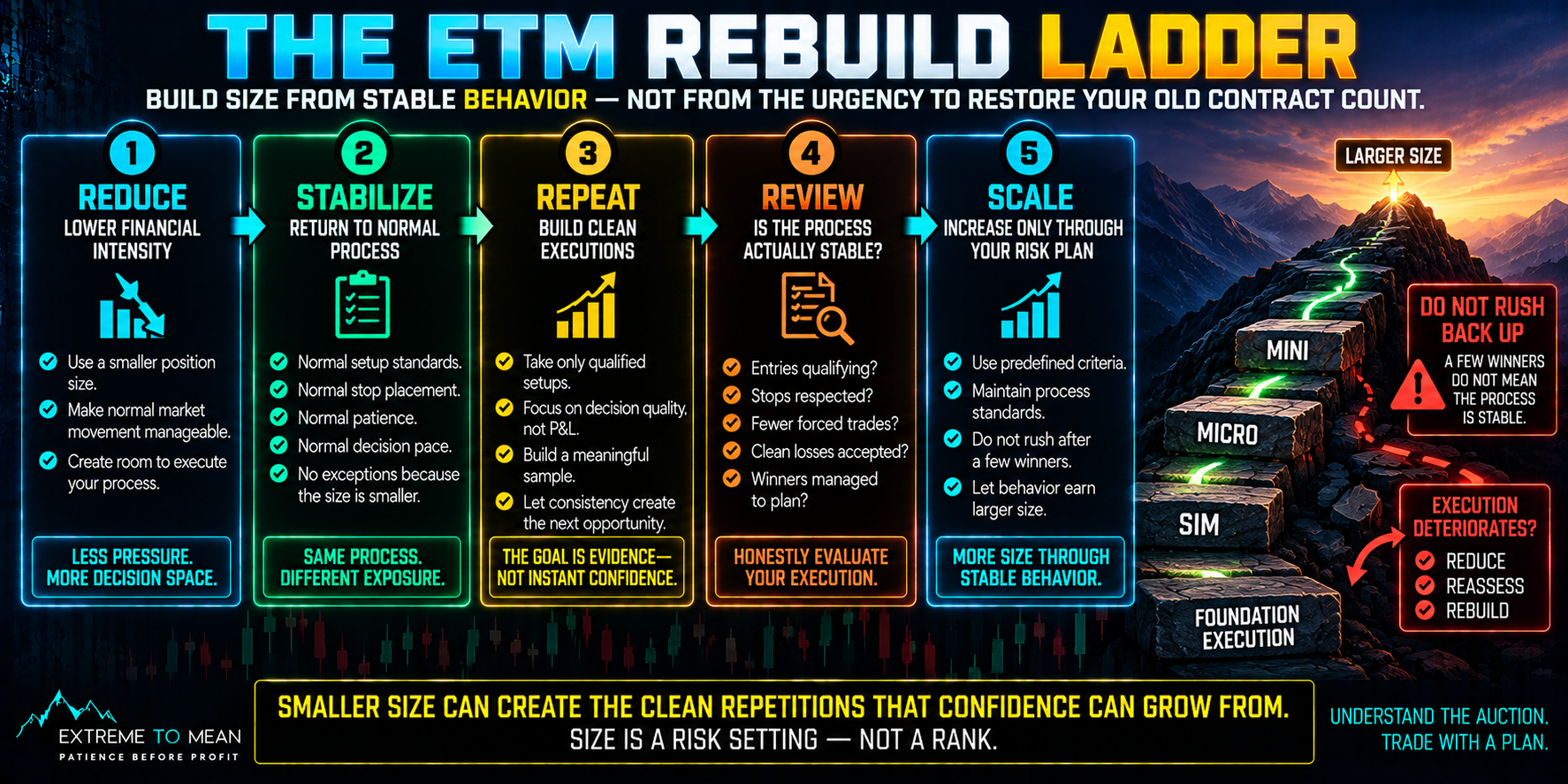
Before reducing size, finish two sentences: “I am reducing size because ___.” and “I will evaluate readiness to increase when ___.” Keep the second answer behavioral and process-based so the return to size cannot be earned accidentally through a lucky streak.
There is also a futures-specific boundary that matters. If one contract still requires more dollar risk than the account or trade plan can responsibly accept, fewer contracts cannot solve the problem, and unclear risk should not be disguised by forcing an unsuitable position. If one contract is still too much risk, no trade is a valid position size.
Final Thought
Trading smaller does not erase your experience, undo what you have learned, or make you less of a trader. It changes the amount of financial pressure attached to the same decision, and that difference can matter when normal pullbacks feel intolerable, clean losses feel catastrophic, or valid winners become difficult to hold. Size is a risk setting—not a rank.
Keep the setup standard, invalidation logic, patience, management, and review exactly as serious as they were before. Then judge the smaller size by whether execution becomes cleaner, not whether the next trade wins or how quickly you can return to the old contract count. The point of trading smaller is not to prove you deserve to trade bigger; it is to prove your process can stay intact.
Progress is not the most risk you can carry. Progress is the quality of the decisions you can make while carrying it. You can reduce exposure while moving forward in execution.
Educational content only. Trading involves substantial risk and is not suitable for everyone.