
Trading review often ends too early. A trader writes, “I chased again,” “I need more discipline,” or “I have to stop doing that,” then closes the journal and expects awareness to change behavior. Recognition matters, but the real work begins when you ask what specifically happened, where the process broke, and what rule would make the same mistake harder to repeat.
That is why this lesson belongs inside The Trader section rather than inside a setup lesson. The goal is not to eliminate losing trades; it is to make controllable errors more visible, less repeatable, and easier to review. The improvement comes from how the trader evaluates and structures the next decision.
Recognizing a Mistake Is Not the Same as Fixing It
A mistake can feel obvious in hindsight because the result makes the problem look simple. You entered late, increased size, moved a stop, ignored a condition, or took a trade for reasons outside the plan. Writing down what happened is useful, but “don’t do that again” is not yet a process improvement because it does not tell you what to do when the same pressure returns.
Traders often fall back on personality labels: impatient, emotional, undisciplined, reckless. Those labels are poor operating instructions because they do not define a different action. Self-criticism describes the past; a process rule changes what happens next.
A better review starts with observable behavior. Instead of “I had no discipline,” write, “I entered after my planned entry was gone because price was moving quickly and I was afraid of missing the move.” That sentence identifies the action, the circumstance, and the trigger rather than turning one decision into a judgment about who you are.
First Decide Whether It Was Actually a Mistake
Do not create a new rule just because a trade lost. A trader can follow the setup, respect the planned risk, execute correctly, and still experience an unfavorable outcome because no process controls what the market does next. If every loss creates another restriction, the plan can become crowded with reactions to noise.
The first review question should therefore be: Was this a controllable process error, or simply a losing trade? Correcting a mistake and correcting a strategy are not the same job. A clean loss may require no behavioral change.
One painful outcome should not send a trader searching for a new indicator or a completely different system. Constantly changing the framework after every disappointment can replace diagnosis with reaction. Before rewriting the strategy, determine whether the problem was execution, context, risk, or simply a normal losing result.
Find the Decision Point Where the Process Broke
The visible damage often appears after the real mistake. An oversized loss may look like a risk problem, but the earlier decision could have been increasing size after two losses because the trader wanted to recover the morning. A late entry may look like an entry problem, but the process may have broken when the trader decided that a valid original idea meant any later price was still acceptable.
If the review stops at “I lost too much,” the trader is describing the outcome. If it reaches “I changed my planned size because prior P&L affected the next decision,” the trader has identified behavior that can be addressed. The useful question is not only what went wrong, but when did the decision begin to break down?
The same applies to chasing, which is why FOMO is the tax you pay for chasing is a useful companion lesson. The emotion may be fear of missing out, but the process failure is more concrete: the original entry disappeared, price kept moving, and the trader acted without reassessing from the new location. Once the decision point is clear, the correction can target behavior rather than emotion alone.
Turn the Mistake Into a Specific Rule
Suppose a trader reviews several sessions and sees the same pattern. Price starts moving quickly, the planned entry disappears, and the trader thinks, “If I don’t get in now, I’ll miss the whole move.” Sometimes the late entry works and sometimes it loses, but the journal keeps saying the same thing: “Stop chasing.”
That note is too vague because it does not define a response. A stronger rule would be: If my planned entry is no longer available, I must reassess the trade from the current price rather than enter automatically because the original idea was correct. Now the trader knows both the trigger and the required action.
This is the value of an if-then structure. “Be patient” is an intention; “if this situation appears, then I do this” gives the intention an observable response. It does not guarantee better outcomes, but it makes the process easier to execute and audit.
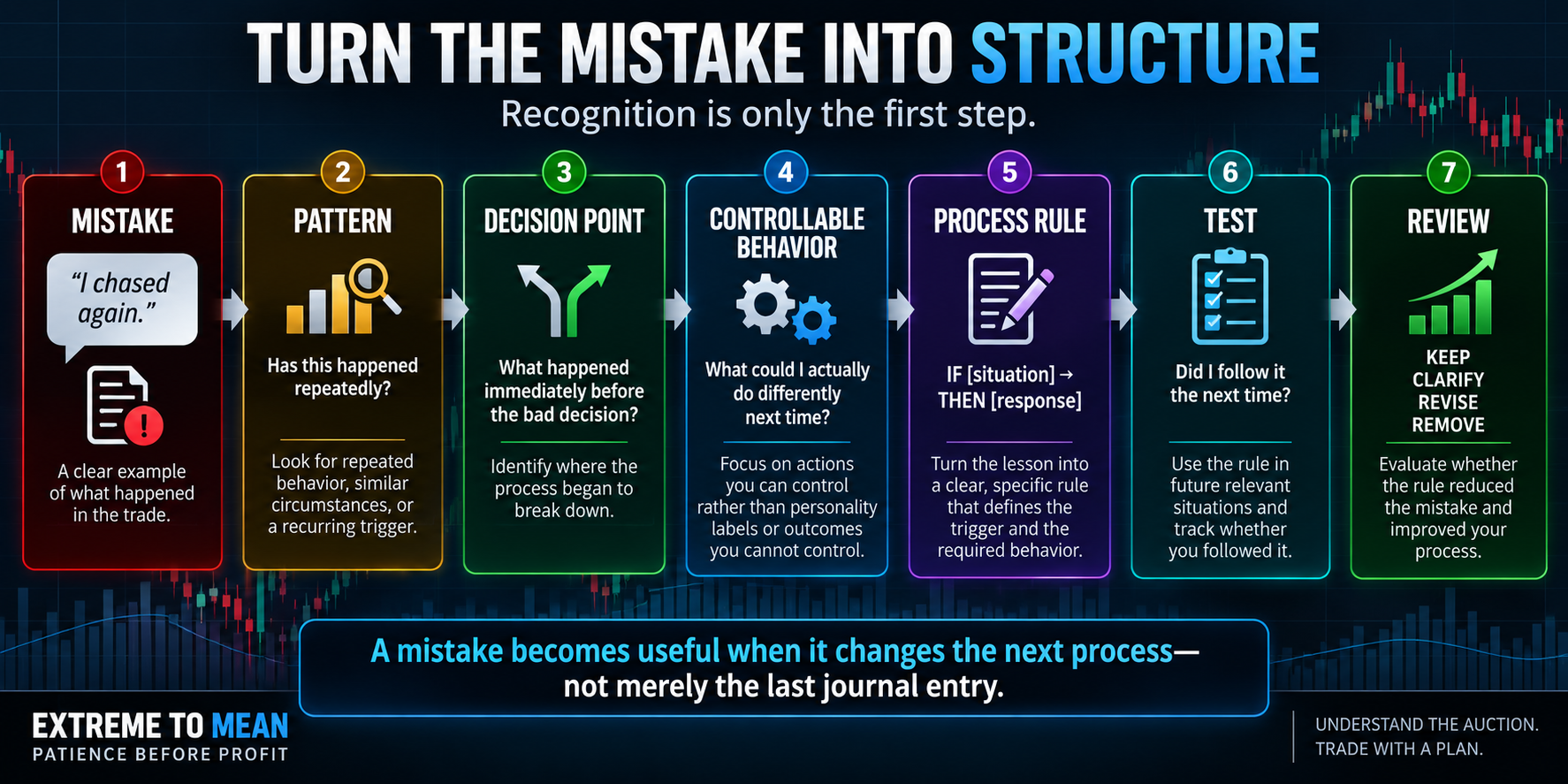
The rule should govern something the trader can control. “Don’t lose during chop” is not useful because the trader cannot command the outcome. A rule about whether conditions qualify, whether size was planned, or whether the trade must be reassessed after the original entry disappears can guide actual behavior.
Make the Rule Observable and Testable
A useful corrective rule should answer a simple question after the next relevant situation: Did I follow it? If the answer requires a long argument with yourself, the rule may still be too vague. Not every market judgment can become binary, but many process behaviors can be made much clearer.
That clarity is one reason your trading plan is a promise made before the open. Rules created while calm give the trader a reference when pressure returns. The point is not blind obedience; it is reducing the room for convenient reinterpretation after the fact.
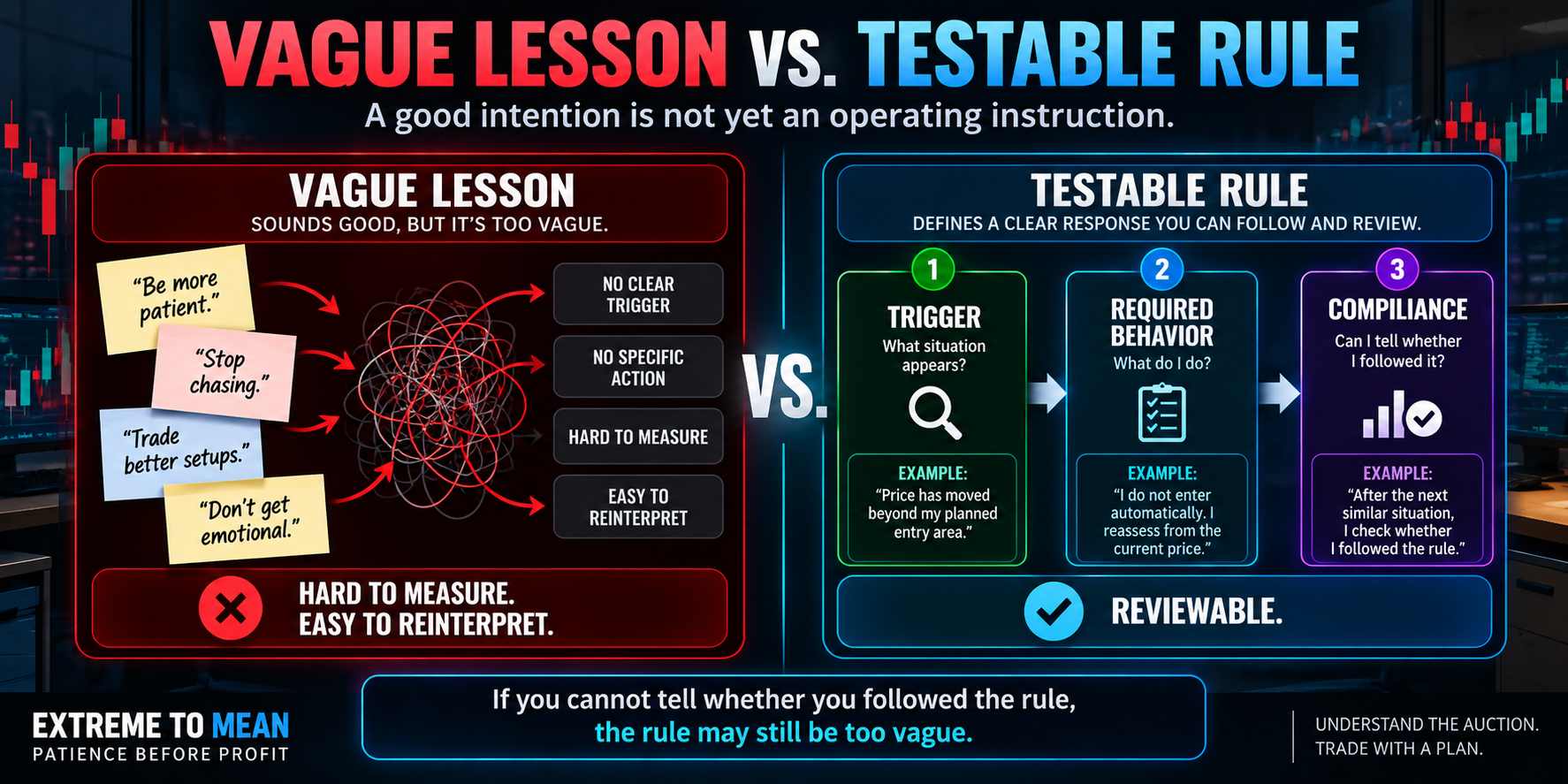
A better question is not merely, “Did I make a mistake?” Ask, “What rule would have made this mistake harder to repeat and easier to identify?” That shifts review from frustration toward design while keeping the focus on decision quality instead of trying to control the market.
Not Every Mistake Needs the Same Solution
One of the easiest ways to misuse this process is to add a new rule after every uncomfortable trade. Repetition matters because a recurring behavior provides stronger evidence that the process has a leak. An isolated mistake may deserve investigation, while a repeated mistake—or a single error with serious enough consequences—may deserve a clear boundary.
The solution depends on what is wrong. If an existing rule was clear and the trader broke it, another nearly identical rule may accomplish nothing; if the rule was vague, clarify it. If the process had no rule for a recurring situation, a new checklist question may make sense.
The strategy itself may also be the issue. If the trader repeatedly follows the rules and a setup continues to perform poorly, adding behavioral restrictions may solve the wrong problem. That calls for data and strategy research rather than another promise to be disciplined.
Test the New Rule—Then Review the Rule Itself
Creating the rule is not the finish line. The trader has to use it in future relevant situations and review whether it addressed the original mistake. A rule can sound excellent on paper and still prove unclear, unnecessary, or disruptive in real conditions.
After a reasonable sample, ask whether the mistake became less frequent, whether the rule was clear enough to follow, and whether it created an unintended problem. If it helped, keep it; if the idea is sound but vague, clarify it; if the diagnosis was wrong, revise or remove it. The trading plan should not become a museum containing every mistake the trader has ever made.
This is where protect your next decision becomes more than a mindset idea. The purpose of review is not to punish the previous decision forever; it is to improve the structure surrounding the next one. Even the corrective rule itself must remain open to evidence.
The ETM Mistake-to-Rule Framework
A practical review can follow six steps: Mistake → Pattern → Decision Point → Rule → Test → Review. Start with what you actually did, determine whether it repeats often enough—or carries enough consequence—to require intervention, and find where behavior departed from the process. Then write a controllable response, test it in future relevant situations, and review whether it helped. Use these questions during review:
- Was this genuinely a mistake, or simply a losing trade?
- What did I actually do—not what do I think it says about me?
- When did the decision begin to break down?
- What triggered the behavior?
- Was the existing rule unclear, absent, or deliberately ignored?
- What part of the decision was within my control?
- Can I write one clear response for the next time this appears?
- Can I tell afterward whether I followed it?
- Does this repeat often enough to justify another rule?
- How will I know whether the new rule improved the process?
The framework keeps review connected to action while protecting against constant rule-changing. Sometimes the cleaner decision is to leave the process alone because the evidence does not justify a change. Improvement should come from repeated evidence, not the emotional weight of the latest trade.
If chasing is the recurring behavior you are trying to convert into structure, the chasing-the-trade problem guide is a useful next step. Carry the same discipline into that review: define the behavior, identify the trigger, and decide what your process requires before the next similar situation appears. That gives you something more useful than another promise to “do better next time.”
Final Thought
A trading mistake is raw material, not a finished lesson. Improvement happens when you identify the controllable behavior, find where the process broke, and turn that evidence into a response you can follow and review.
Do not end the review with “I won’t do that again.” End it with exactly what you will do when the same situation appears again, then let repeated evidence decide whether the new rule deserves to stay. The goal is not to build a rule for every bad outcome; it is to make the next version of the same decision more structured.
Educational content only. Trading involves substantial risk and is not suitable for everyone.