
A Checklist Is a Tool, Not a Trading System
A checklist can be extremely useful because trading decisions are easy to rush. It reminds the trader to examine location, setup quality, risk, timing, target room, and other pieces that can be forgotten when price is moving quickly. Inside the Setup curriculum, that makes the checklist a process-control tool rather than a source of edge by itself.
Checking the right questions does not make a weak trading idea strong. A poor market environment does not become favorable because the trader completed eight required steps, and a bad entry does not become attractive because the paperwork looks clean. The edge still has to come from the underlying trading idea and how well it applies to the market in front of you.
That is closely related to why a setup is not a signal. The checklist can confirm that you remembered to evaluate important pieces, but it cannot guarantee that you interpreted those pieces correctly. A checklist can tell you what you remembered to evaluate; it cannot guarantee that you evaluated it well.
Why Checking Every Box Does Not Mean You Must Trade
The dangerous assumption is that passing the checklist creates an obligation. A trader reaches the last question, sees a row of green checks, and begins treating the process as though it issued an entry command. But minimum qualification and final judgment are not the same thing.
A checklist can establish that no obvious disqualifier has been found. It can show that risk is defined, the setup appears present, location has some justification, and the trade does not violate a hard rule. None of that means the opportunity is necessarily attractive enough to deserve capital.
Two trades can satisfy the same checklist and still look very different. One may be clear, well located, and easy to explain, while another barely satisfies each requirement and leaves the trader searching for reasons to defend it. A checklist should help reject unacceptable trades; it should not pretend that every acceptable trade is equally good.
Hard Rules and Judgment Questions Are Different
Some checklist items are genuinely close to binary. Position size may either be within the trader’s risk rule or not, a prohibited event window may either be approaching or not, and a required stop may either be defined or missing. Those questions can often be answered without much interpretation.
Other questions require judgment. “Is this meaningful location?”, “Does the current environment support this setup?”, and “Is enough opportunity still available?” cannot always be reduced honestly to a green check or red X. Those answers depend on context, evidence, and the quality of what price is actually doing.
This is why market conditions change the quality of a setup. A checklist that treats every question as equally mechanical can create false precision, especially when the most important questions are the ones requiring interpretation. The trader still has to think.
A Checked Box Without Evidence Is Just Rationalization With Paperwork
One of the easiest ways to misuse a checklist is to ask vague questions that can be answered however the trader wants. “Good location? Yes.” “Setup confirmed? Yes.” “Enough room? Sure.” A checklist like that can make rationalization look disciplined because every desired answer now has a box beside it.
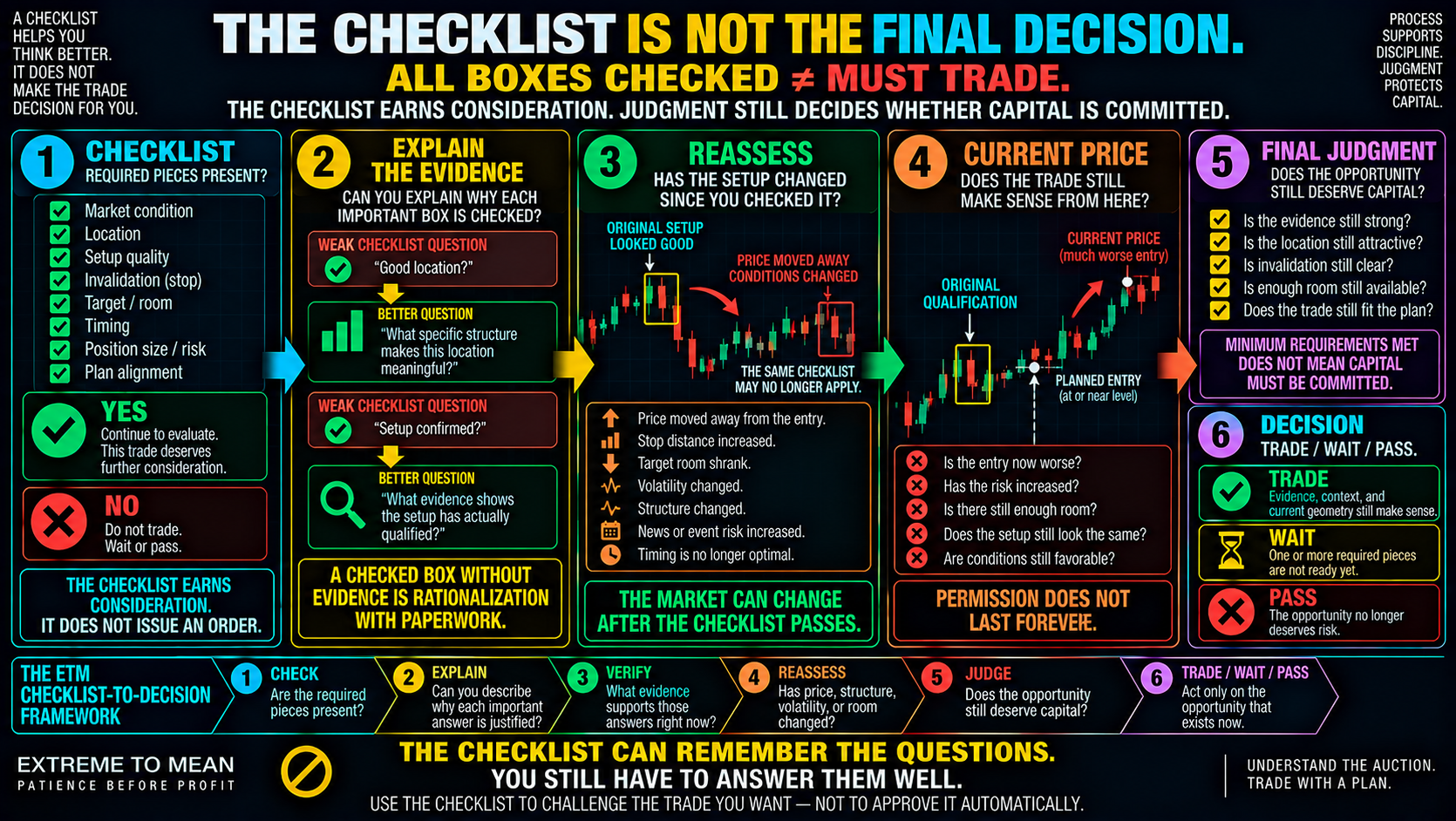
Better checklist questions force the reasoning into words. Instead of asking, “Good location?”, ask, “What specific structure makes this location meaningful?” Instead of “Setup confirmed?”, ask, “What behavior is present now that was not present when the setup was still incomplete?”
The distinction matters because the trader may already want the trade before opening the checklist. If every judgment question can be interpreted loosely enough to produce a yes, the checklist is not challenging the decision; it is documenting the trader’s preference. Use the checklist to challenge the trade you want, not automatically approve it.
The Market Can Change After the Checklist Passes
Imagine a trader has an eight-question checklist covering market condition, location, setup, invalidation, target, timing, risk, and plan alignment. The setup qualifies, every answer is supported, and the checklist correctly says the original trade deserves consideration. Then price moves significantly away from the intended entry before the trader can execute.
The original checklist may still show eight green boxes, but the trade has changed. The entry is worse, the distance to valid invalidation may be larger, and less room remains to the target. The weak response is, “Everything checked out, so I still have to take it.”
That ignores one of the most important ETM principles: where you enter matters more than what you predict. The checklist helped qualify the opportunity that existed at the original price; it did not issue permanent permission to enter after the geometry changed. Qualification must remain attached to the trade that exists now.
A Checklist Must Be Allowed to Say “Not Yet”
Not every failed checklist item means the idea is dead. Sometimes one required condition has not appeared yet, the structure is still developing, or the location remains interesting but the trade has not finished qualifying. In those cases, not yet is more accurate than either yes or no.
That turns the checklist into a waiting tool. Instead of forcing the trader to choose between immediate entry and abandoning the idea completely, it creates space for the market to provide more information. If the missing condition eventually appears while the rest of the trade still makes sense, the opportunity can be reassessed.
This is another reason checklist completion should never be treated as a one-time verdict. Markets evolve while setups form, and the answer to a judgment question can change as price changes. Reassessment is part of using the checklist correctly, not evidence that the checklist failed.
Risk Still Has to Make Sense at the Current Price
A checklist may confirm that invalidation exists, but the trader still has to evaluate whether that invalidation produces sensible risk from the price currently available. A trade that looked coherent five minutes earlier can become unattractive after price runs farther from the level that made the setup interesting. The stop did not necessarily change; the entry may have changed the geometry.
This is why the trade is not ready until the risk is clear. Clear risk means more than having a stop written down; it means understanding where the thesis is wrong and whether the current entry, remaining room, and position size still create a trade worth considering. A box labeled “stop defined” cannot answer all of that by itself.
The checklist should therefore slow the trader down one more time before commitment. Ask whether the trade still makes sense from here, not whether it made sense when the checklist was first completed. That one question can prevent a valid process from turning into stale permission.
Review the Reasoning, Not Just the Boxes
After the trade, “Did I follow my checklist?” is a useful review question, but it is not enough. A trader can faithfully check every box while giving weak, biased, or inconsistent answers. Process compliance matters only when the reasoning inside the process is sound.
The deeper review is: What evidence supported each important answer at the time? If the trader marked location as strong, what made it meaningful; if the setup was considered ready, what specifically had qualified; if the remaining room was considered sufficient, what destination was being evaluated? Those answers reveal whether the checklist improved judgment or merely recorded rationalization.
Over time, that review can make the checklist more useful without making it more mechanical. The goal is not to add endless questions whenever a trade loses, but to identify where the reasoning became vague or where an important distinction was consistently overlooked. Better use of the checklist comes from better thinking, not necessarily more boxes.
The ETM Checklist-to-Decision Framework
The clean process is to treat the checklist as the beginning of the final decision, not the end of it. Work through the required questions, explain the important judgment calls, verify the evidence, and then reassess whether anything has changed before committing risk. Judgment remains part of the process all the way to the entry.
- Check — Are the required pieces present?
- Explain — Can you describe why each important judgment answer is justified?
- Verify — What evidence supports those answers right now?
- Reassess — Has price, structure, volatility, timing, or available room changed?
- Current price — Does the trade still make sense from where you can actually enter?
- Risk — Is invalidation still clear and the exposure still acceptable?
- Judge — Does the complete opportunity still deserve capital?
- Trade / wait / pass — Act only on the opportunity that exists now.
The condensed framework is Check → Explain → Verify → Reassess → Judge → Trade / Wait / Pass. The checklist earns consideration; judgment still decides whether capital is committed. All boxes checked does not mean must trade.
The better question is: “Am I using the checklist to evaluate this trade—or to obtain permission for a trade I already want?” That question keeps responsibility where it belongs: with the trader, using the checklist as evidence discipline rather than as an excuse to stop thinking.
Final Thought
A good checklist makes important questions harder to skip. It can slow impulsive decisions, expose missing information, and make the trader’s reasoning more consistent. What it cannot do is understand the live market on the trader’s behalf.
The market can change after the checklist passes, judgment questions can be answered poorly, and two trades that meet the same minimum standards can still differ dramatically in quality. “Wait,” “not yet,” and “pass” remain legitimate outcomes even after much of the checklist looks good.
The checklist asks whether the trade deserves consideration. The trader still decides whether the evidence deserves capital. That is how the broader Extreme to Mean system should use process tools: not to automate judgment away, but to make better judgment harder to avoid.
Educational content only. Trading involves substantial risk and is not suitable for everyone.