
Why ICT Sounds More Complicated Than It Needs To
The fastest way to understand ICT is to stop memorizing names for a moment and ask what price actually did. Specialized vocabulary can be useful because one term can compress a larger idea, but only when the trader already understands the idea underneath it. If you cannot explain the concept without the acronym, you probably do not understand the concept yet.
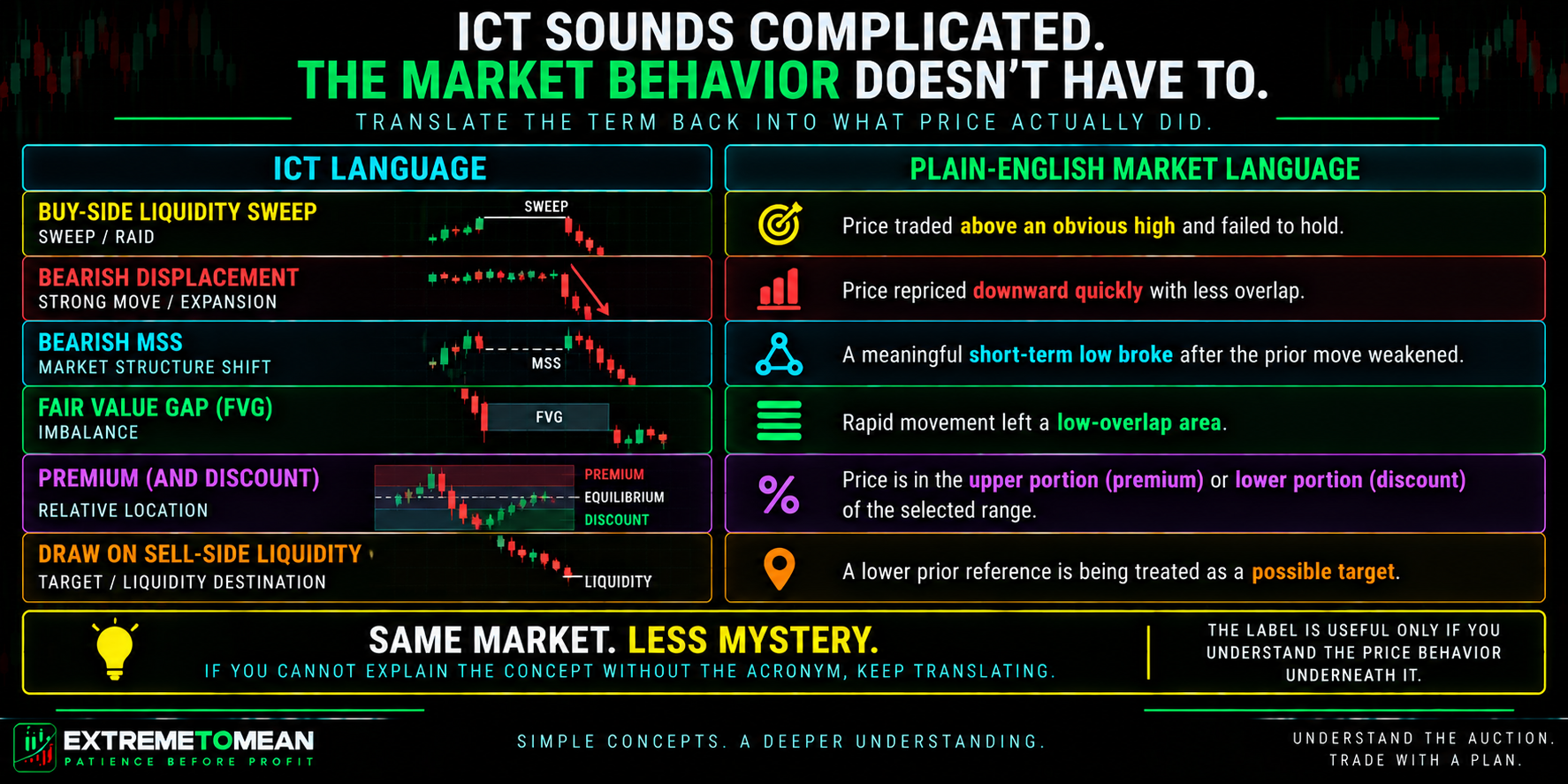
Imagine hearing, “Buy-side liquidity was swept, bearish displacement caused an MSS, and price retraced into an FVG before drawing toward sell-side liquidity.” In plain English, that might mean price moved above an obvious high and failed, selling then accelerated enough to break meaningful short-term structure, and price later retraced into part of that selloff while a lower prior reference remained a possible target. The second version exposes the questions that still matter: does the setup qualify, where is it wrong, and does the risk make sense?
That translation-first approach fits the broader Market curriculum. ICT terminology can organize structure, liquidity, time, imbalance, and location, but the label itself does not create an edge. Knowing the name of the setup is not the same as knowing whether there is a trade.
ICT and Smart Money Concepts Are Related, but Not Identical
ICT refers to a particular branded body of trading concepts and terminology built around liquidity, price structure, time, displacement, imbalances, and recurring reference areas. Smart Money Concepts, or SMC, is now used more broadly online for a larger collection of overlapping ideas and adaptations.
That distinction matters because Smart Money Concepts Explained asks a different question. That lesson evaluates the broader framework—what it gets right, where it makes assumptions, and what traders should verify. This lesson has a more practical job: translate the vocabulary so a beginner can understand what another trader is actually describing.
The vocabulary is not the strategy. A trader can correctly label the chart and still have no defined entry, invalidation, target, or risk. Terms identify information; a trading process decides whether it is useful.
The ICT Terms Beginners Hear Most
The table below is an orientation, not a complete rulebook. The goal is to make the language understandable enough that you can return to the chart.
| ICT Term | Plain-English Translation |
|---|---|
| Liquidity | Areas where meaningful order activity may be concentrated |
| Buy-side liquidity | Orders expected around or above obvious highs |
| Sell-side liquidity | Orders expected around or below obvious lows |
| Liquidity sweep / raid | Price trades through an obvious reference and may fail to continue |
| Displacement | Fast directional repricing with strong momentum and limited overlap |
| Fair value gap (FVG) | A three-candle imbalance associated with rapid movement |
| Market Structure Shift (MSS) | A meaningful short-term structural change |
| Order block | A prior candle or zone near the origin of a directional move |
| Dealing range | A selected high-to-low range used to judge relative location |
| Premium / discount | Upper / lower portion of the selected range |
| Equilibrium | The midpoint of the selected range |
| OTE | A preferred retracement area inside a defined swing |
| Kill zone | A named time window considered especially relevant for setups |
| Draw on liquidity | A reference the trader considers a plausible future destination |
The useful habit is to translate the label before deciding what it means. “Liquidity” becomes an area where activity may increase, “displacement” becomes a meaningful acceleration in price, and an FVG becomes a low-overlap area created during rapid movement. Vocabulary should compress understanding—not substitute for it.
Liquidity, Displacement, and Structure
ICT language places heavy emphasis on liquidity. Around obvious highs and lows, traders may have stops, breakout orders, limit orders, profit-taking orders, and other instructions waiting or becoming active.
If price trades above a prior high and quickly falls back below, an ICT trader may call that a buy-side liquidity sweep or raid. In ordinary language, price broke an obvious reference, attracted or triggered additional activity, and failed to sustain acceptance above it. The sweep is observable; the motive behind the sweep is an interpretation, and the level is not guaranteed to act as a future target.
Displacement describes a noticeable change in pace: price moves aggressively, overlap decreases, and meaningful structure may break. A Market Structure Shift, or MSS, then describes a short-term structural change important enough to challenge the prior directional assumption. The label matters less than knowing which swing mattered and what its break changes about the thesis, which is why context comes before the candle.
FVGs, Order Blocks, and Other Reference Areas
A fair value gap is one way the framework marks an area created during rapid price movement with limited overlap across a short candle sequence. Traders may watch that area if price returns, but the label does not create an obligation for price to fill or reverse there. An FVG is a reference created by fast movement, not an appointment price is required to keep.
An order block is commonly associated with a candle or zone near the origin of a strong directional move. The useful translation is simple: this is an area near where an important prior move began, and the trader wants to observe how price behaves if it returns. The harder-to-prove claim is that the candle itself reveals specific institutional orders that must remain there.
Other labels can name failed references, imbalances, or prior zones that may become relevant again. More terminology does not automatically create more information, especially if every price level can be explained after the move.
Premium, Discount, OTE, and Time
ICT often organizes price inside a selected dealing range defined by a meaningful high and low. The upper portion may be called premium, the lower portion discount, and the midpoint equilibrium. Those labels describe relative location; they do not prove price is fundamentally expensive, cheap, or fairly valued.
OTE, or Optimal Trade Entry, is a preferred retracement concept inside a defined swing. The plain-English idea is that after a directional move, the trader waits for price to retrace into a preferred location before considering continuation. Price reaching that zone is still only location; context, qualification, invalidation, target room, and risk determine whether there is actually a trade.
ICT also gives time of day a prominent role through concepts such as kill zones. The broader principle is reasonable because participation, liquidity, volatility, session openings, and scheduled information change through the day. Time can improve context, but it cannot manufacture a setup, which is consistent with the ETM principle that the market comes first.
Narrative Terms Need Translation Too
Other ICT terms package whole market stories into short labels. A Judas Swing broadly describes an early directional move that fails before a larger move develops the other way, while Power of Three is commonly framed as accumulation, manipulation, and distribution. The labels describe a framework narrative, not proof of illegal or coordinated market manipulation.
A “draw on liquidity” is another example. In practical terms, it means a price area the trader considers a plausible future destination. A target is a hypothesis, not a gravitational law, and price does not owe the trader a visit to the level.
This is why hindsight deserves special caution. After a clean move, it is easy to label liquidity → sweep → MSS → displacement → FVG → OTE → target and make the sequence look inevitable. The better test is whether the same terms could have been defined with the same rules before the outcome was known.
Translate the Setup Before You Trade It
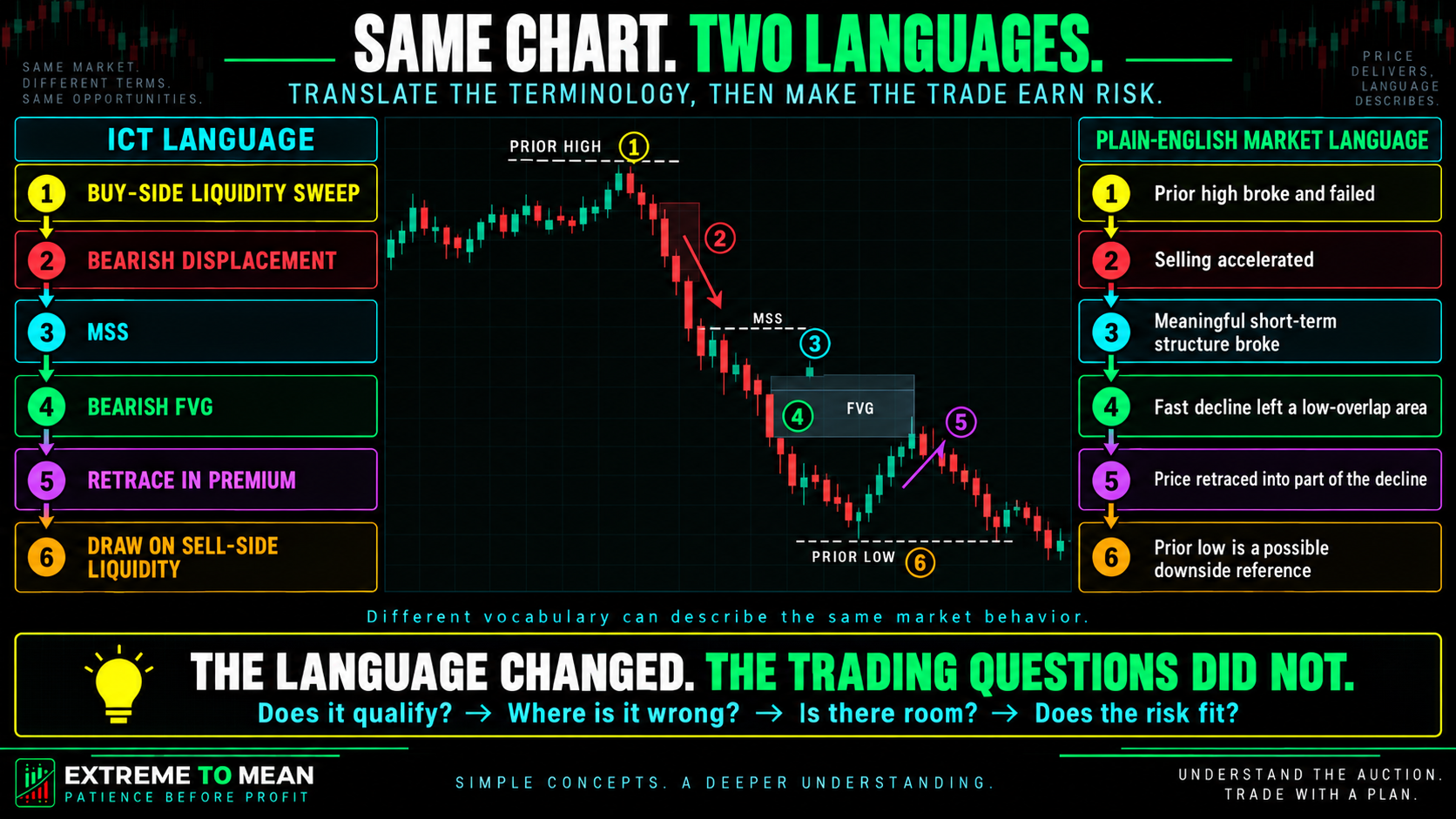
Suppose someone says, “Buy-side liquidity was swept during the kill zone, bearish displacement caused an MSS, price retraced into an FVG in premium, and sell-side liquidity is the draw.” The ordinary-market translation is manageable: price moved above a prior high and failed, selling accelerated enough to break meaningful short-term structure, and price retraced into part of that decline while remaining in the upper portion of a selected range.
Now the actual trading questions can begin. What qualified the failed high, which structural break mattered, why is the retracement location meaningful, where is the bearish thesis wrong, and is the lower reference a realistic destination? The language did not answer those questions; it only organized information that may help answer them.
A practical translation filter is Translate → Contextualize → Qualify → Invalidate → Test → Risk. Start with what price actually did, put it inside the market environment, define what would qualify or invalidate it, then test the idea across many examples. That keeps the trader focused on evaluate → qualify → define risk → decide rather than reciting vocabulary.
Final Thought
ICT terminology can give traders a compact language for liquidity, structure, time, imbalance, retracement, and location. That can be useful when traders already share the framework. The problem begins when knowing the label starts to feel like knowing what price must do next.
A framework should help manage uncertainty, not convince the trader that uncertainty has disappeared. Liquidity does not have to be swept, FVGs do not have to fill, order blocks do not have to hold, OTE does not have to reverse, and a named time window does not create edge by itself. The trade still has to qualify.
The better question is not, “Which ICT term applies here?” Ask, “What did price actually do, what am I inferring, and what evidence would make this worth risking money on?” Translate the terminology, put it back into context, define the trade, and define the risk. That is the same evidence-first discipline behind the broader Extreme to Mean system.
Educational content only. Trading involves substantial risk and is not suitable for everyone.