
Why Smart Money Concepts Create So Much Debate
Smart Money Concepts, usually shortened to SMC, tend to produce two extreme reactions. Supporters sometimes present the framework as though it reveals what institutions are really doing behind the chart, while critics dismiss the whole thing as renamed support, resistance, structure, and price action. Neither position is especially useful for a trader trying to make better decisions.
Many SMC ideas point toward market behavior that genuinely deserves attention. Price can break a prior high and fail, accelerate sharply away from an area, revisit the origin of an earlier move, or change the sequence of highs and lows. The mistake is assuming that observing one of those events automatically proves who caused it or why.
That is the approach we take throughout the broader Market curriculum. Start with what price actually did, place it inside context, and only then decide whether the observation matters to a trade. Before you trade the name, translate the name back into something the market actually did.
What Does “Smart Money” Actually Mean?
In trading discussion, “smart money” usually refers loosely to sophisticated or well-capitalized participants such as funds, institutions, professional trading firms, market makers, or other large participants. Those groups certainly exist, but they are not one coordinated trader with one position and one objective. Different professional participants can be buying, selling, hedging, providing liquidity, reducing exposure, or executing for clients at the same time.
That distinction matters because large participation and knowable institutional intent are two different things. Significant flow can affect price, but a candle does not identify every participant behind it or reveal what each participant intends to do next. Understanding how markets actually move through auction, liquidity, and participation is more useful than imagining retail traders on one side and one unified institutional opponent on the other.
A cleaner hierarchy is simple: market behavior is observable, participant identity is harder, and participant motive is harder still. The farther the explanation moves from the first category toward the third, the more evidence it should require. That does not make interpretation useless; it means interpretation should remain interpretation.
The ETM Evidence Ladder
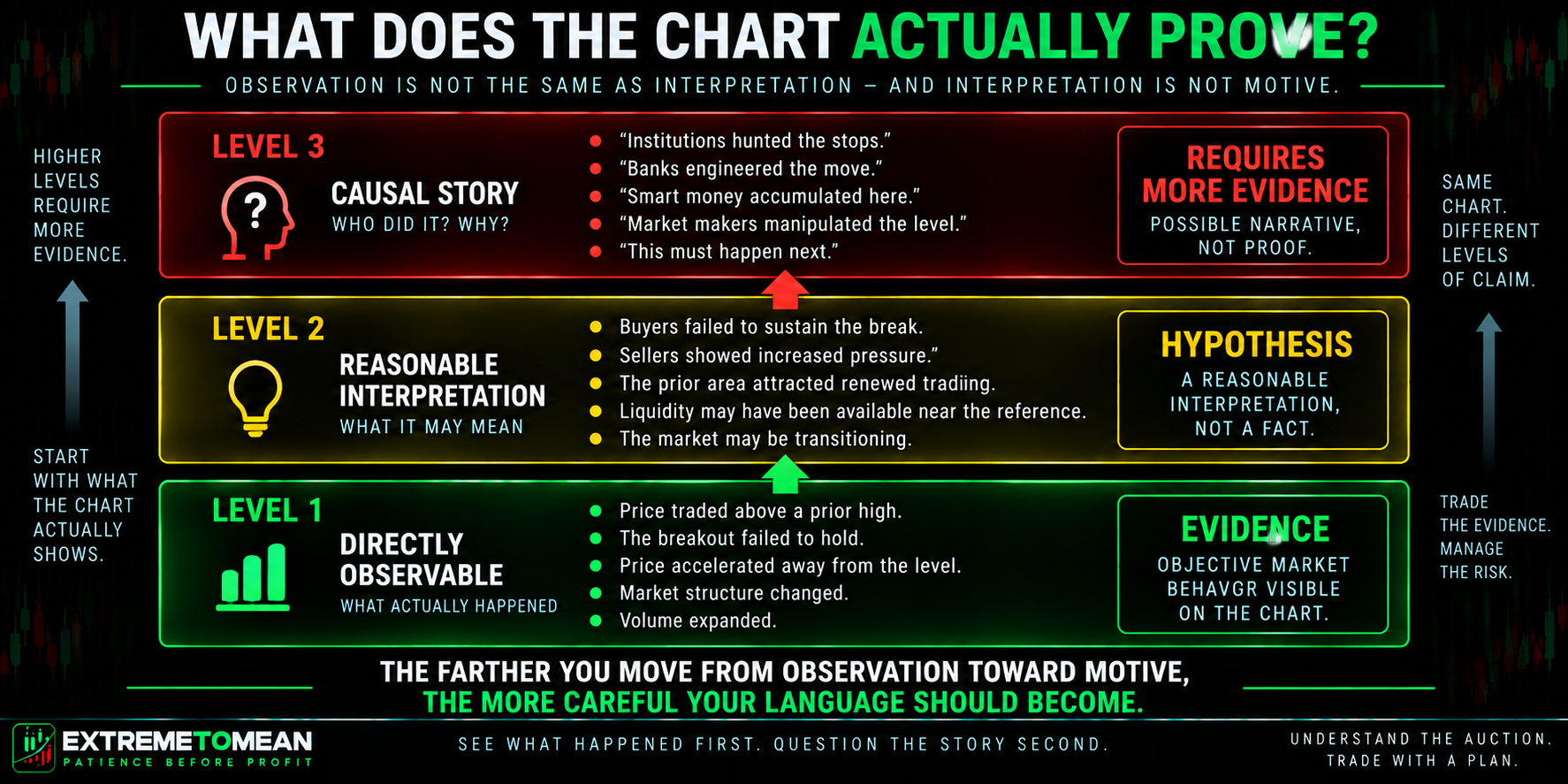
Consider price trading above yesterday's high and then quickly falling back below it. We can directly observe the move beyond the high, the failure to remain there, and the return below the reference. We can reasonably interpret that as failed acceptance or evidence that buyers could not sustain the breakout.
The next step is much stronger: “Institutions intentionally pushed price above the high to trigger retail stops before selling.” That story could describe one possible mechanism, but the chart alone does not prove the actor, coordination, or motive. A useful trading hypothesis does not need to be upgraded into certainty.
The same evidence ladder applies across SMC. Level 1 is what happened, Level 2 is a reasonable interpretation of what the behavior may mean, and Level 3 is the causal story about who deliberately made it happen. The farther you move from observation toward motive, the more careful your language should become.
What SMC Gets Right
One of SMC's strengths is its emphasis on market structure. Sequences of highs and lows, failed continuation, structural breaks, and changes in directional behavior can tell a trader that the current market hypothesis deserves updating. A broken swing can matter without automatically meaning that a complete reversal is now guaranteed.
SMC also puts considerable emphasis on location, which aligns closely with Extreme to Mean. A candle or pattern in the middle of random movement may have little significance, while similar behavior at a meaningful prior high, range boundary, structural area, or stretched location may deserve more attention. This is why context comes before the candle.
Liquidity awareness is another useful part of the framework. Prior highs, lows, range boundaries, and other obvious references can attract order activity because many traders can see them and may place stops, breakout orders, limits, or other instructions around them. The useful question is what happens when price reaches that area—not whether price was destined to visit it.
Finally, SMC draws attention to changes in the pace of the auction. Fast directional movement, expanding ranges, limited overlap, and failed breaks can all provide useful information about changing market behavior. None of those observations requires the trader to know the identity of the participant who caused the move.
Translate the SMC Label Back Into Price
The vocabulary becomes easier to evaluate when the label is stripped away first.
| SMC Term | Observable Translation | What the Chart Does Not Prove |
|---|---|---|
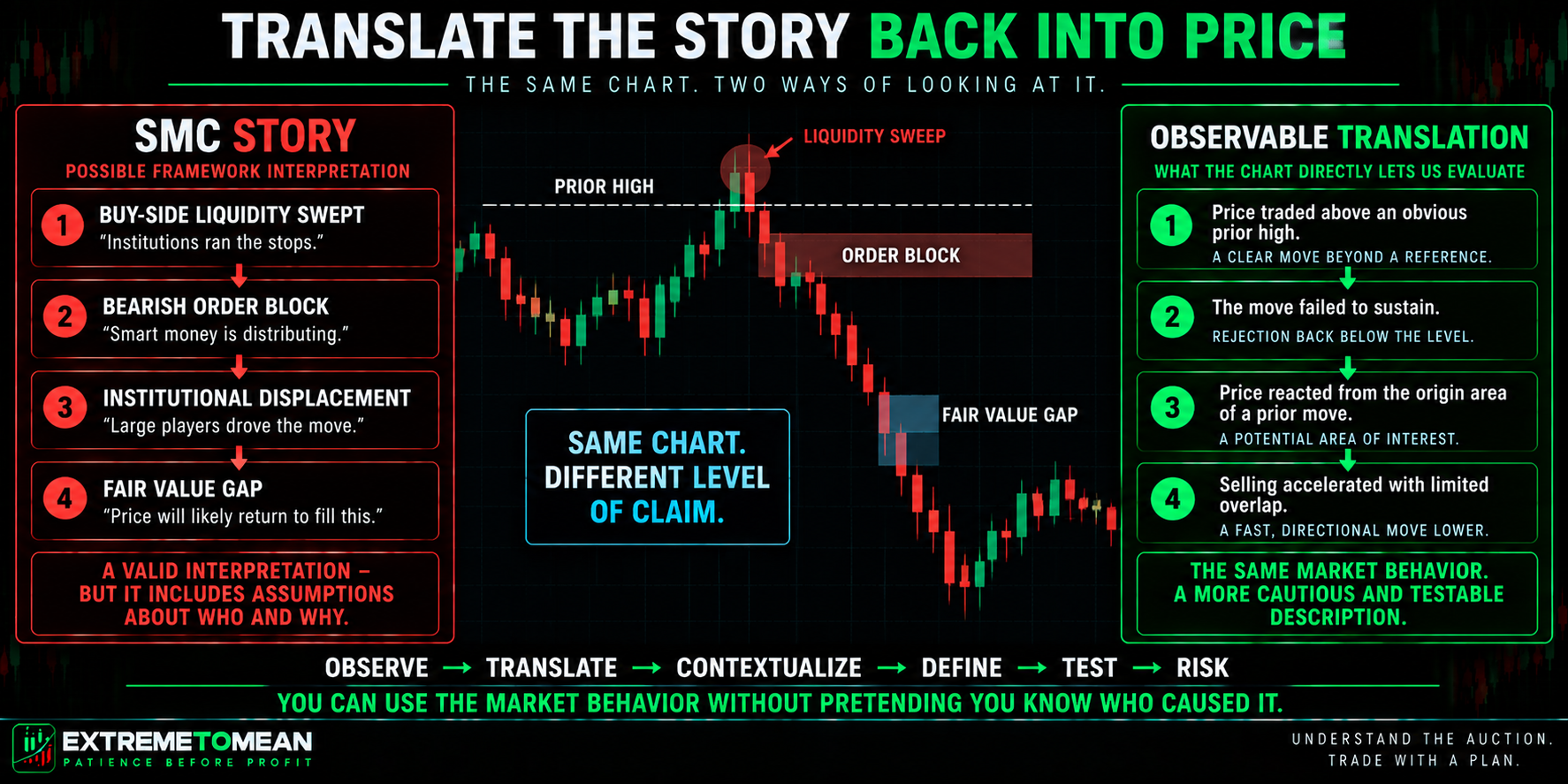
| Liquidity sweep | Price moved beyond an obvious reference and failed to sustain there | A specific institution deliberately hunted retail stops |
| Order block | Price revisited an area associated with the origin of a strong prior move | Institutions left identifiable unfinished orders in that exact candle |
| Fair value gap | A rapid move created limited overlap across a short candle sequence | Price is required to return and fill the area |
| BOS / CHOCH | A meaningful structural reference was broken or prior behavior changed | A new directional trend is guaranteed |
| Premium / discount | Price is above or below the midpoint of a selected range | Price is objectively expensive or cheap |
This translation does not make the SMC terminology wrong. It makes the claim testable because the trader can now identify what was actually observed without needing to prove a hidden actor. Renaming a market behavior does not make it invalid, but a new name does not automatically reveal a new market mechanism either.
This distinction becomes especially useful around liquidity sweeps and failed breakouts. You can trade failed acceptance without needing to prove who wanted the failure. The observation, context, invalidation, and risk can be enough.
Where the Framework Starts Making Stronger Assumptions
The framework becomes less dependable when a useful observation turns into a required future outcome. An imbalance can become a reference without becoming a promise that price must revisit it, and an obvious high can attract activity without guaranteeing a future sweep. The market remains an auction, not a checklist that must complete every marked level.
The same caution applies to order blocks. The origin of a strong directional move may be a useful place to watch if price returns, but the candles do not prove which institution entered there or whether unfilled institutional orders remain. What matters to the trader is how price behaves if the area becomes relevant again.
Terms such as “manipulation” deserve even more care. Price breaking your level, triggering a stop, and reversing is frustrating, but that sequence alone does not prove illegal manipulation or coordinated intent. A stop can become part of the market flow without being the entire reason the market moved.
The better habit is to replace certainty with conditional language. Instead of “price must sweep this liquidity,” ask whether the level is likely to attract activity and what acceptance or rejection there would mean. That mindset fits the larger ETM principle that the market comes first.
Hindsight Can Make Any Framework Look Better Than It Is
After a large market move, the chart becomes remarkably easy to explain. Traders can identify the order block that mattered, the perfect liquidity sweep, the structural shift, the fair value gap, and the target after the result is already known. The important question is whether those same definitions were clear before the move developed.
This is one of the biggest dangers of terminology-heavy systems. If enough zones, gaps, liquidity levels, structural labels, and alternate interpretations are placed on a chart, almost any eventual outcome can be connected to something. A framework that can explain every result afterward may still provide very little help beforehand.
A trading framework should therefore be judged by what it helps you decide under uncertainty, not how convincingly it explains yesterday's chart. Could the setup have been defined before entry? Could another trader apply the same rules without knowing the outcome? Those questions separate research from storytelling.
A Trading Idea Needs to Be Falsifiable
An SMC setup becomes more useful when the trader can describe exactly what qualifies it and what would prove it wrong. If the idea depends on a failed break above a prior high, for example, sustained acceptance above that level may challenge the thesis. The details will differ by strategy, but a framework that cannot define failure cannot manage risk.
This is also why context cannot be skipped. A sweep, FVG, order block, or structural break appearing during a clear trend may carry different implications from a similar-looking pattern inside overlapping chop. Market conditions change the quality of a setup, regardless of the terminology used to describe it.
A label is therefore never the entire trade. The trader still needs location, context, qualification, invalidation, target logic, and acceptable risk. SMC terminology can help organize those observations, but it cannot replace them.
Test the Setup, Not the Belief
Instead of asking, “Are order blocks real?” define exactly what counts as an order block before seeing the result. Record the market condition, entry logic, invalidation, target, and failures as well as the beautiful examples. A concept becomes useful when it is defined clearly enough to test.
The same applies to liquidity sweeps. Define the reference, what qualifies the sweep, what must happen after it, where the idea fails, and what results occur over a meaningful sample. That turns a debate about terminology into a question about observable performance.
This matters because memorable screenshots are not a distribution. A handful of clean examples can demonstrate what a setup looks like, but they cannot tell the trader how often it fails or under which conditions it becomes less useful. Evidence should include the examples that do not work.
The Better Way to Use Smart Money Concepts
A practical process begins with observation rather than narrative. First identify what happened in price, then identify the SMC label if the terminology helps organize it. Translate that label into ordinary market behavior before deciding which part is observation and which part is an assumption about participant motive.
Next, put the behavior back into market context. Is the market trending, balancing, stretched, volatile, or structurally unclear? A good label inside a poor environment does not automatically become a good trade.
Finally, define the trade itself. What evidence qualifies the idea, where is it wrong, what realistic target exists, and does the risk fit? The trader's job remains evaluate → qualify → define risk → decide, whether the chart is labeled with SMC terminology or none at all.
Final Thought
Smart Money Concepts can be useful because they direct attention toward structure, location, liquidity, failed acceptance, imbalance, and changes in market behavior. Those are legitimate subjects for market study. The problem begins when an observation on a chart becomes certainty about invisible institutional motives or a prediction that price must follow a particular script.
The better question is not, “What is smart money doing?” Ask, “What can I actually observe, what am I assuming about why it happened, and what evidence would make this idea tradable or prove it wrong?” That question preserves the useful part of the framework while leaving room for uncertainty.
You can respond to what the market did without pretending you know who made it happen. Keep the observation, question the story, define the trade, test the idea, and manage the risk. That evidence-first approach is also at the center of the Extreme to Mean system.
Educational content only. Trading involves substantial risk and is not suitable for everyone.