
Prediction feels useful because it gives the trading day a simple story before uncertainty begins. A trader decides the market should rally, sell off, fill a gap, reject a level, or continue yesterday's trend, and that expectation creates a sense of preparation. The problem is that a forecast can quickly become something the trader feels obligated to defend. Once price begins moving, evidence that contradicts the prediction can be ignored because changing direction feels like admitting the original analysis was wrong.
Scenario planning solves a different problem. It does not ask the trader to know what happens next; it asks them to decide what observable conditions would make one response more appropriate than another. That makes If-Then thinking a natural part of The Trader curriculum because the skill is about preparing decisions before urgency arrives. The trader's job is to evaluate what the market actually shows, not force the market to validate an earlier forecast.
Scenario Planning Is Not Another Prediction Method
A scenario is conditional by design. Instead of saying, "YM will break yesterday's high and continue," the trader might say, "If YM reclaims the previous-day high and ES and NQ confirm the move, then continuation becomes more credible." The first statement predicts an outcome, while the second defines evidence that must exist before a continuation idea deserves more attention. The distinction sounds small, but it changes the entire decision process.
The scenario also remains incomplete until the trader defines what happens when the expected evidence does not appear. If YM trades above the level but immediately loses it, the continuation thesis has weakened rather than strengthened. If YM remains trapped around the level while ES and NQ disagree, the correct response may be to wait. Conditional planning therefore prepares the trader for several possible markets instead of one preferred market.
A Useful If-Then Rule Has Four Parts
A practical If-Then rule starts with an observable condition. "If the market looks strong" is too vague because strength can mean different things once money is at risk. "If YM reclaims PDH, holds above it, and ES and NQ are confirming comparable strength" gives the trader something that can actually be evaluated. The condition should describe behavior rather than emotion or prediction.
The second part is the response: then what? The response may be to begin evaluating a continuation setup, remain patient for a pullback, invalidate a bearish scenario, reduce interest in a fade, or do nothing. A good response does not have to mean entering a trade immediately. In many cases, the cleanest If-Then rule simply determines which branch of the decision process deserves attention next.
The YM Example: One Level, Several Possible Stories
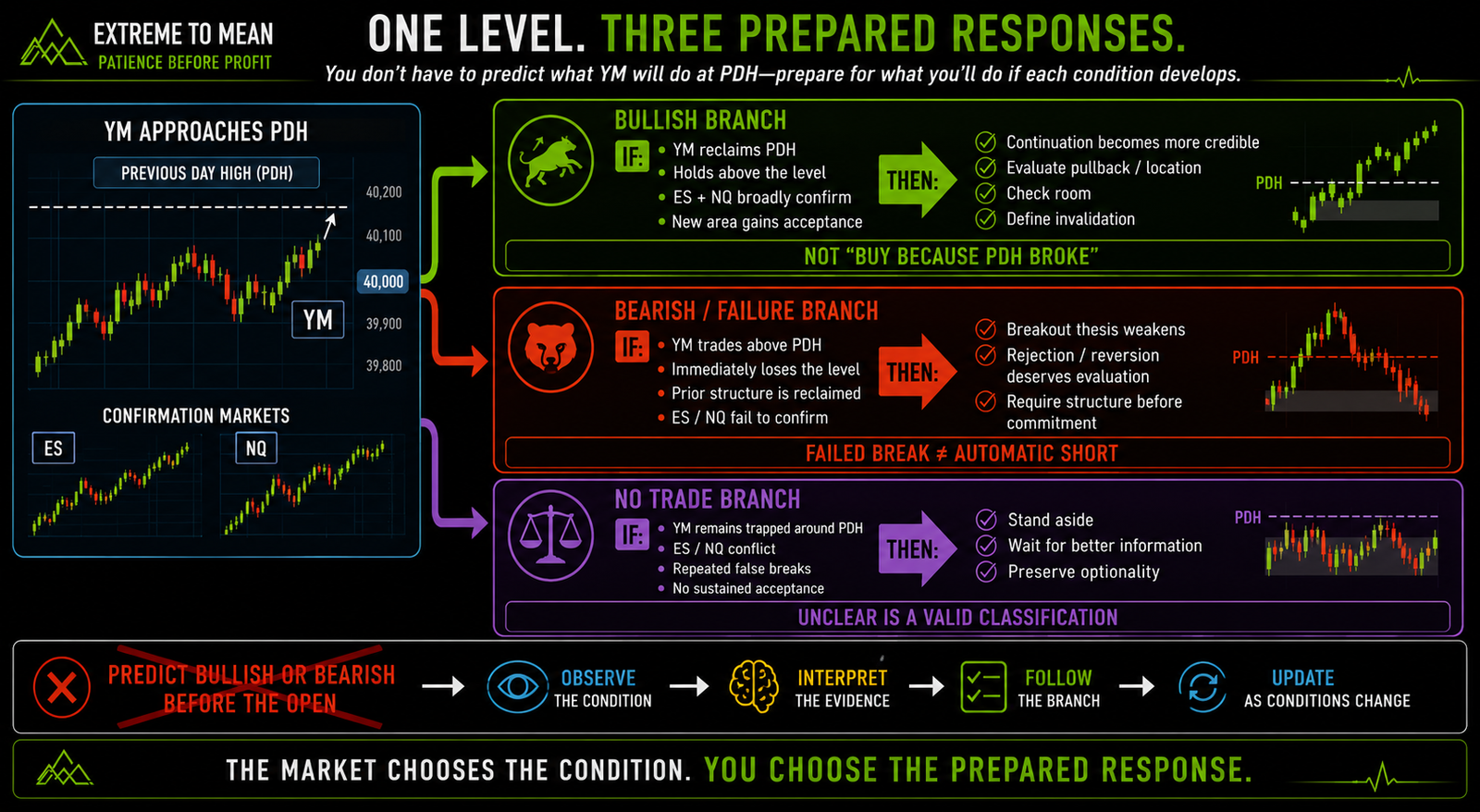
Consider YM approaching the previous-day high. One possible branch is bullish: if YM reclaims PDH, holds above the level, and ES and NQ are broadly confirming, then the continuation thesis becomes more credible. That does not mean "buy immediately"; location, available room, entry quality, and risk still need to be evaluated. The If-Then rule has qualified the environment, not completed the trade.
Now consider the opposite behavior. If YM trades above PDH but immediately loses the level, returns inside prior structure, and related markets fail to confirm the breakout, then the bullish breakout thesis weakens. That evidence can raise a rejection or reversion question, but the failed break is not automatically a short signal either. Each branch should change what the trader evaluates next rather than dictate an automatic order.
Build Three Branches: Bullish, Bearish, and No Trade
A simple three-branch structure prevents the plan from becoming unnecessarily complicated. The bullish branch defines what evidence would make long-side conditions more credible, while the bearish branch defines what evidence would make downside conditions more credible. The third branch is equally important: what would make neither side clean enough to justify commitment? Without that branch, traders often feel pressured to choose bullish or bearish even when the market is providing conflicting evidence.
The No Trade branch turns uncertainty into an acceptable outcome rather than a problem that must be solved. YM might remain trapped around a key level while ES advances and NQ weakens, or the market might repeatedly break both sides of a range without sustaining either move. Nothing requires the trader to convert mixed evidence into a directional opinion. Understanding why doing nothing is still a trading decision makes the third branch as legitimate as the first two.
Conditions Must Be Observable
The quality of an If-Then plan depends on the quality of its conditions. Words such as strong, weak, clean, extended, confirmed, or choppy can be useful shorthand, but they need enough definition that the trader can recognize them under pressure. If the rule changes meaning depending on whether the trader already wants the trade, the condition is not doing its job. The guide to why trading rules break under pressure explains how that flexibility becomes a live-session exception. A scenario should reduce room for improvisation rather than disguise improvisation in professional-sounding language.
Observable conditions can include whether a level is reclaimed or lost, whether price is accepting beyond prior structure, whether related markets confirm, whether a breakout immediately fails, or whether price remains trapped in balance. The goal is not to create dozens of mechanical requirements. It is to define the few pieces of evidence that genuinely change the decision. Specificity improves clarity without pretending that markets can be reduced to a perfect formula.
Every Scenario Needs an Invalidation Branch
A scenario becomes dangerous when the trader defines only what confirms it. If the bullish case says that a PDH reclaim supports continuation, the plan should also state what behavior weakens or invalidates that interpretation. Losing the level, reclaiming the prior range, conflicting cross-market behavior, or failure to make continued progress may all matter depending on the setup. The point is to know beforehand which evidence says the original branch no longer fits.
That process connects directly to the principle behind protecting your next decision. When invalidation is defined before entry, the trader does not have to invent a reason for remaining committed after the evidence changes. Flexibility means moving to another prepared branch when conditions change. It does not mean repeatedly rewriting the original scenario until the current position can still be defended.
Why Improvisation Feels Better in Real Time
Improvising after the market opens can feel intelligent because the trader is responding to live information. Some adaptation is necessary, but unstructured adaptation often allows emotion to make decisions that preparation should have made earlier. Fast price action creates urgency, and urgency makes incomplete evidence feel more convincing. The trader then builds the rule after seeing the movement instead of evaluating movement against a rule that already existed.
A predefined If-Then plan slows that process without making the trader rigid. If the bullish condition has not occurred, there is nothing to act on merely because price is moving quickly. If the bearish branch is contradicted, the trader can stop trying to manufacture a short. This is one reason a trading plan is a promise you make before the open: preparation has its greatest value before pressure begins changing what feels reasonable.
Flexibility Means Moving Between Prepared Branches
Scenario planning should not lock the trader into one interpretation for the entire session. Markets change, and the branch that was most relevant at 9:35 may be invalid by 10:15. A bullish scenario can fail, a bearish scenario can become stronger, or both can disappear as price settles into balance. The plan needs enough flexibility to acknowledge those changes without turning into constant improvisation.
The distinction is whether the new decision comes from new evidence or from discomfort with the current outcome. If the market does something the plan already identified as invalidation, moving to another branch is disciplined adaptation. If nothing meaningful has changed but the trader keeps redefining the scenario because a position is losing, that is story-changing after commitment. Clear conditions make that difference easier to recognize.
A Cleaner Pre-Market Scenario Process
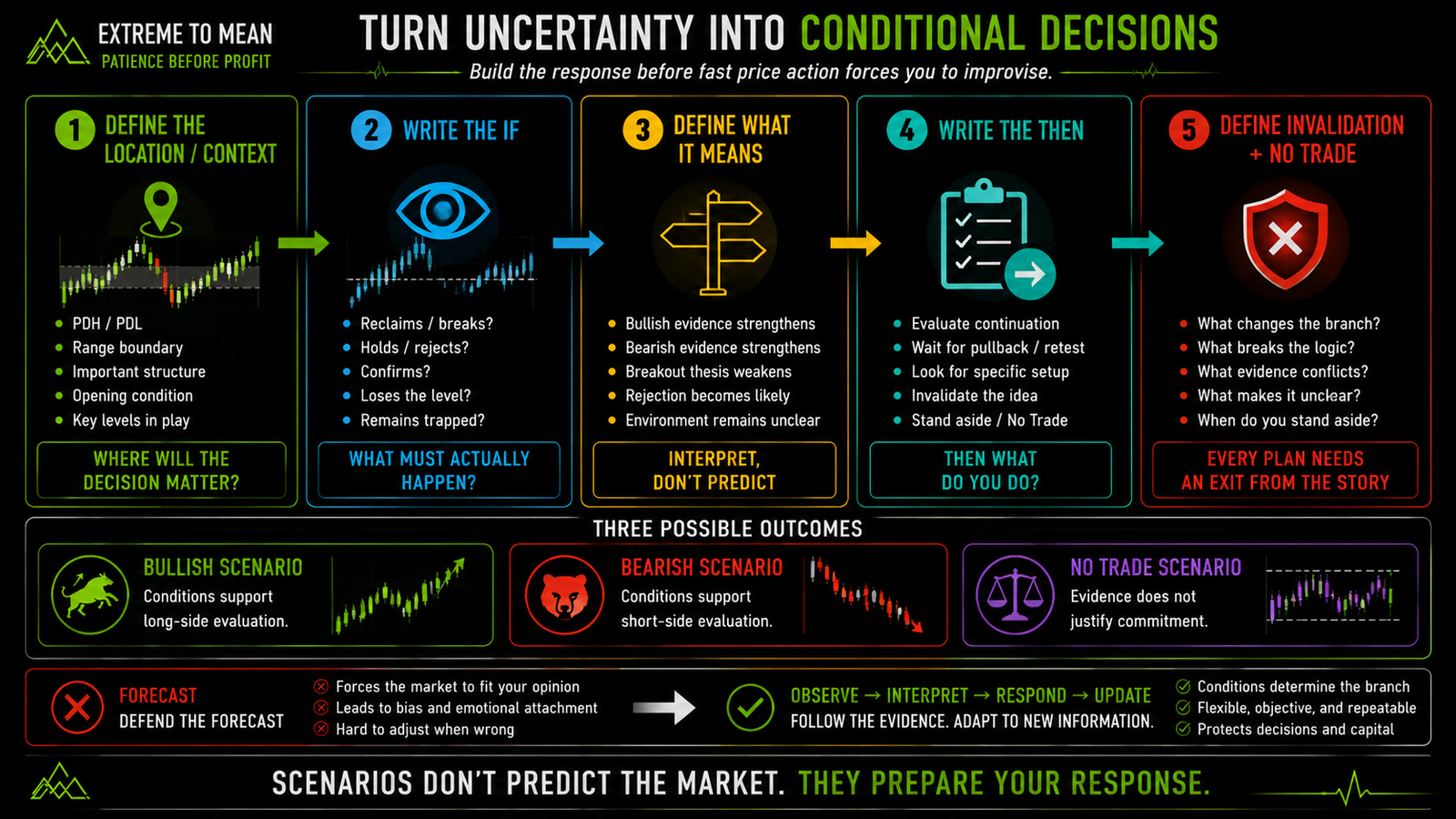
Before the session begins, identify the few locations or conditions likely to affect the day's decisions. Then create one bullish branch, one bearish branch, and one No Trade branch using observable evidence. Each branch should explain what would become more credible, what action becomes appropriate, and what would invalidate that interpretation. This is scenario planning, not construction of an entire trading plan.
The process can remain compact. A trader does not need twenty branches covering every imaginable market path because too many conditions become impossible to use in real time. The goal is to prepare for the most decision-relevant possibilities and accept that unexpected behavior may require standing aside until the market becomes clearer. Good preparation reduces unnecessary improvisation without pretending uncertainty has disappeared.
Better Questions for an If-Then Plan
A useful scenario should be easy to explain before the market starts moving. The following questions help determine whether the rule is genuinely conditional or simply a disguised prediction. They also force the trader to define the No Trade branch before uncertainty becomes uncomfortable. The better question is not "What do I think the market will do?" but "What will I require before I respond?"
- What specific condition am I waiting to observe?
- Is that condition objective enough to recognize under pressure?
- What becomes more credible if the condition occurs?
- What action follows: evaluate, wait, enter, invalidate, or stand aside?
- What evidence would weaken this branch?
- What evidence would invalidate it completely?
- What would make the bullish and bearish cases equally unclear?
- What is my explicit No Trade branch?
- Am I responding to evidence or defending a forecast?
These questions improve post-session review because the trader can compare what actually happened with the prepared branches. Instead of judging preparation by whether the bullish or bearish scenario "won," the trader can ask whether the correct branch was recognized and followed as evidence changed. That creates a cleaner measure of decision quality than forecast accuracy alone. The purpose of scenario planning is to improve consistency of response, not to make the market predictable.
Final Thought
If-Then trading rules accept a reality that forecasting often tries to avoid: the trader does not know exactly what comes next. That uncertainty does not prevent preparation because responses can be planned before outcomes are known. Bullish, bearish, and No Trade branches give the trader a structure for responding to observable evidence while leaving room for the market to develop. The plan becomes conditional instead of predictive.
Prepare the response before the urgency. Define what must happen, what that evidence would mean, what you would do next, and what would invalidate the branch. For a deeper framework on reading structure and context before making those decisions, Decode the Market is the natural next step. The trader does not need to predict the next move; the job is to recognize the conditions that make one response more appropriate than another.
Educational content only. Trading involves substantial risk and is not suitable for everyone.