
Inside The Trader, discipline should not be treated as a personality trait or a test of toughness. A trading rule has to remain clear enough to follow when money is moving, a setup is being missed, a loss is fresh, or open profit is disappearing. Trading discipline is not tested when following the rule feels easy; it is tested when breaking the rule suddenly feels reasonable.
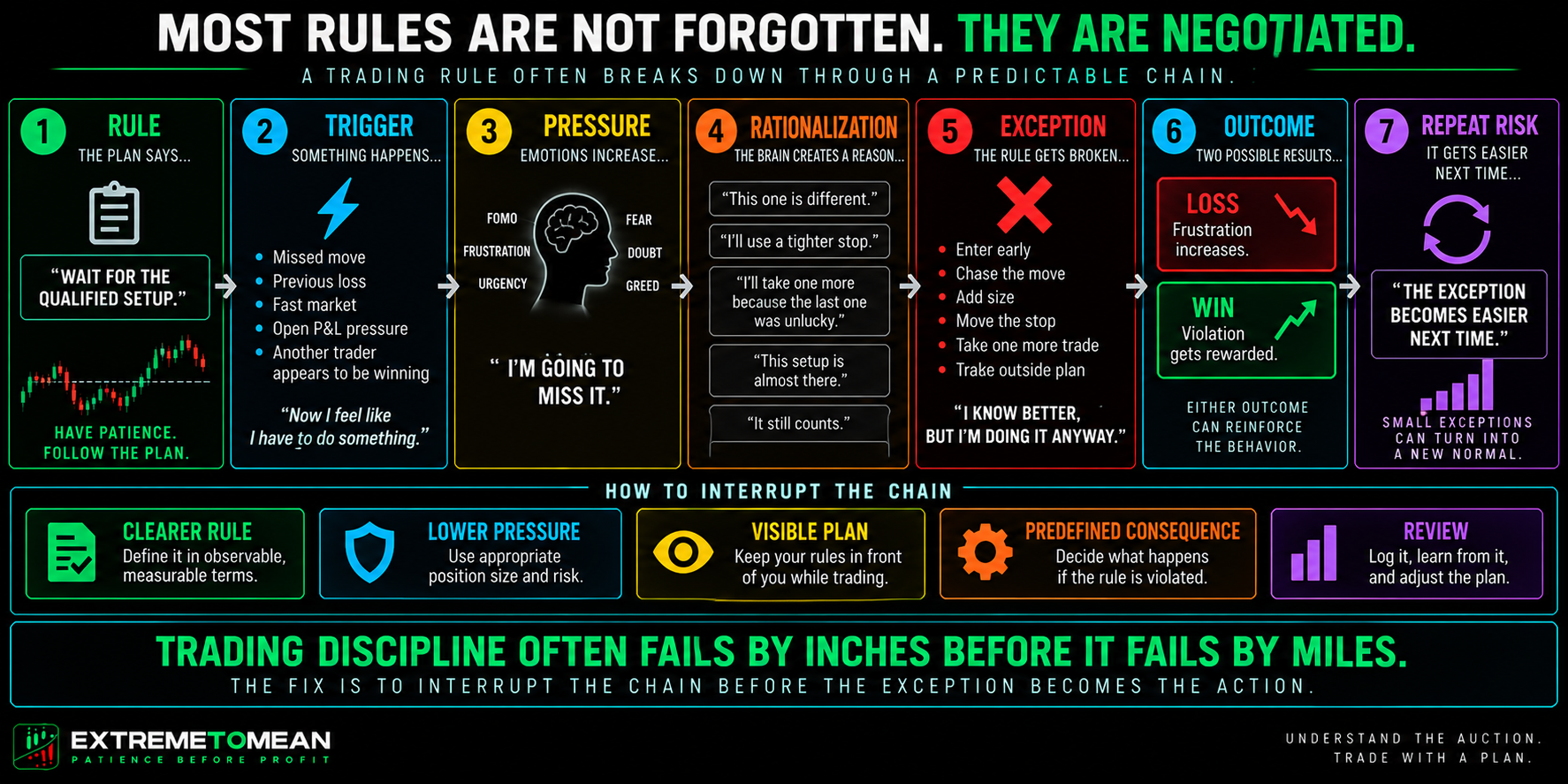
The problem is usually not that the trader forgot the rule. More often, a trigger creates pressure, pressure creates a convincing explanation, and the exception starts to feel logical: “This one is different,” “I can make it back,” or “The setup is almost there.” Most trading rules are broken because the trader creates a convincing exception, not because the rule disappeared from memory.
The Plan Is Written Calmly, but the Rule Has to Survive Pressure
A pre-market rule is written when there is no open P&L, no missed move, no stop approaching, and no need to recover a loss. During the session, the same rule competes with urgency, frustration, confidence, fear of missing out, and the desire to protect open profit. The lesson behind a trading plan as a promise before the open matters because the calm version of the trader is trying to protect the pressured version from improvising.
This difference explains why knowing the correct action is not enough. The live problem is not simply “What is the rule?” but “Will the rule still control the decision when an exception feels attractive?” A trading rule is only useful if it remains clear when the market gives you a reason to want an exception.
Vague Rules Are Easy to Negotiate
Many apparent discipline failures are really rule-design failures. “Wait for confirmation,” “do not overtrade,” “only take good setups,” and “do not trade emotionally” sound responsible, but each can be reinterpreted after price starts moving. If a rule can mean something different after the market moves, it is not protecting the decision.
A stronger rule describes something the trader can actually observe. Instead of “do not chase,” define what makes an entry late for the specific strategy; instead of “wait for the setup,” identify the conditions that make entry eligible; instead of “stop if I am trading badly,” define the session or behavioral condition that ends participation. Wanting to be disciplined is an intention; discipline becomes operational when the intention has a rule and a process attached to it.
Position Size Can Turn Rules Into Suggestions
A trader may follow the exact same setup calmly with one Micro contract and struggle with it at much larger exposure. Normal fluctuation suddenly feels intolerable, the P&L becomes more important than the chart, and the trader starts moving stops, taking profit early, or skipping planned actions. Sometimes the trader is not failing the strategy; the position size is making the strategy emotionally harder to execute.
This means a rule violation after entry can begin with a risk decision made before entry. If the planned loss feels impossible to accept, the trader may give the stop more room, exit prematurely, or begin negotiating with a trade whose structure has not changed. Position size determines more than what you can lose; it influences how hard the next correct decision feels.
Urgency Makes Incomplete Information Feel Complete
When price starts moving quickly, waiting suddenly feels expensive. The trader stops asking whether the setup is qualified and starts asking how to get involved before the move leaves without them, which is the same shift explored in FOMO-driven chasing. Urgency makes incomplete information feel complete.
Fast markets also expose weak process design because complicated or vague rules require interpretation at exactly the moment the trader feels least able to slow down. A process that works only when price moves slowly has not fully accounted for the environment in which it must operate. The cleaner answer is often fewer, clearer decisions defined before urgency arrives—not simply learning to react faster.
Small Exceptions Can Quietly Become the New Rule
Rules often collapse gradually rather than through one dramatic act. The trader enters a little early, adds one extra contract, gives a stop slightly more room, or takes one trade beyond the normal limit, and the exception becomes easier to repeat. Trading discipline often fails by inches before it fails by miles.
Winning rule breaks are especially dangerous because the market can reward the exact behavior the trader is trying to eliminate. An early entry wins, an oversized trade works, or a moved stop survives, and the result becomes evidence that the rule was unnecessary, while a properly executed trade can still lose. A planned loss does not invalidate a good rule any more than a lucky win validates a bad decision.
Rules Need Consequences, Visibility, and Friction
A rule without a predefined consequence is easy to reinterpret as a preference. If a trader exceeds a personal boundary and nothing changes except feeling disappointed later, the plan has not specified what should protect the next decision. The consequence should interrupt the behavioral chain rather than function as punishment.
That might mean ending the session, using a predefined reset process, changing participation according to the trader's existing plan, or requiring review before live trading resumes. The exact response belongs to the individual plan, but the principle connects directly to protecting the next decision. The consequence should protect what happens next—not punish what already happened.
Visibility and friction help for the same reason. A written rule beside the screen, a pre-trade gate, deliberate order entry, preset size limits, or another small obstacle can force the current impulse to compete with the decision made earlier. The rule should be easier to see than the excuse, and the impulsive action should not always be the easiest action available.
Strong Rules Have a Hierarchy
Adding another rule after every bad trade eventually creates a rulebook no one can use while the market is moving. A better structure separates non-negotiable risk boundaries, setup-eligibility rules, management rules, and broader process requirements so the trader knows what actually prevents participation. The trader should know which rules define eligibility and which rules merely improve execution.
It also helps to separate hard rules from judgment rules. A maximum contract count can be binary, while a requirement such as “market structure must be clean” needs definitions, examples, and review rather than fake numerical precision. Good rule design separates what can be measured exactly from what still requires trained judgment.
Review the Trigger and Rationalization, Not Just the P&L
A useful rule-violation log records more than the financial result. Capture the rule that should have governed the decision, what happened immediately before the violation, what action was taken, what the trader said internally to justify it, what followed, and what process change might reduce recurrence. A recurring rule break should become data before it becomes another promise.
The trigger often explains why the trader became vulnerable. An oversized follow-up trade may have followed a stop-out, a chase may have followed a missed opening move, and a moved stop may have followed a sudden increase in dollar discomfort. The mistake tells you what you did; the trigger helps explain why that moment became difficult.
The rationalization may be even more useful because it often repeats. “Just this once,” “I can make it back,” “this setup is too good,” and “technically this still counts” can become recognizable warning language before the actual violation occurs. Your recurring excuse may be one of your most useful early-warning indicators.
The ETM Rule-Following Framework
Use Define → Trigger → Reduce Pressure → Make Visible → Pre-Commit → Add Friction → Record → Review → Adjust → Repeat. The goal is to make compliance easier before the market creates a reason to negotiate with the plan. Better discipline is often engineered before it is demonstrated.
- Define: Write the rule so its meaning is clear.
- Trigger: Identify the situations that usually make it harder to follow.
- Reduce Pressure: Make sure size and risk do not overwhelm the process.
- Make Visible: Put the rule where it can compete with the impulse.
- Pre-Commit: Decide the action and consequence before the session creates pressure.
- Add Friction: Make recurring impulsive actions slightly harder to execute.
- Record: Log the rule, trigger, rationalization, action, and consequence.
- Review: Decide whether the problem came from rule quality, execution, risk, environment, or a recurring behavioral trigger.
- Adjust: Change weak rules outside market pressure and apply revisions prospectively.
- Repeat: Build reliability through repeated execution rather than another promise to “try harder.”
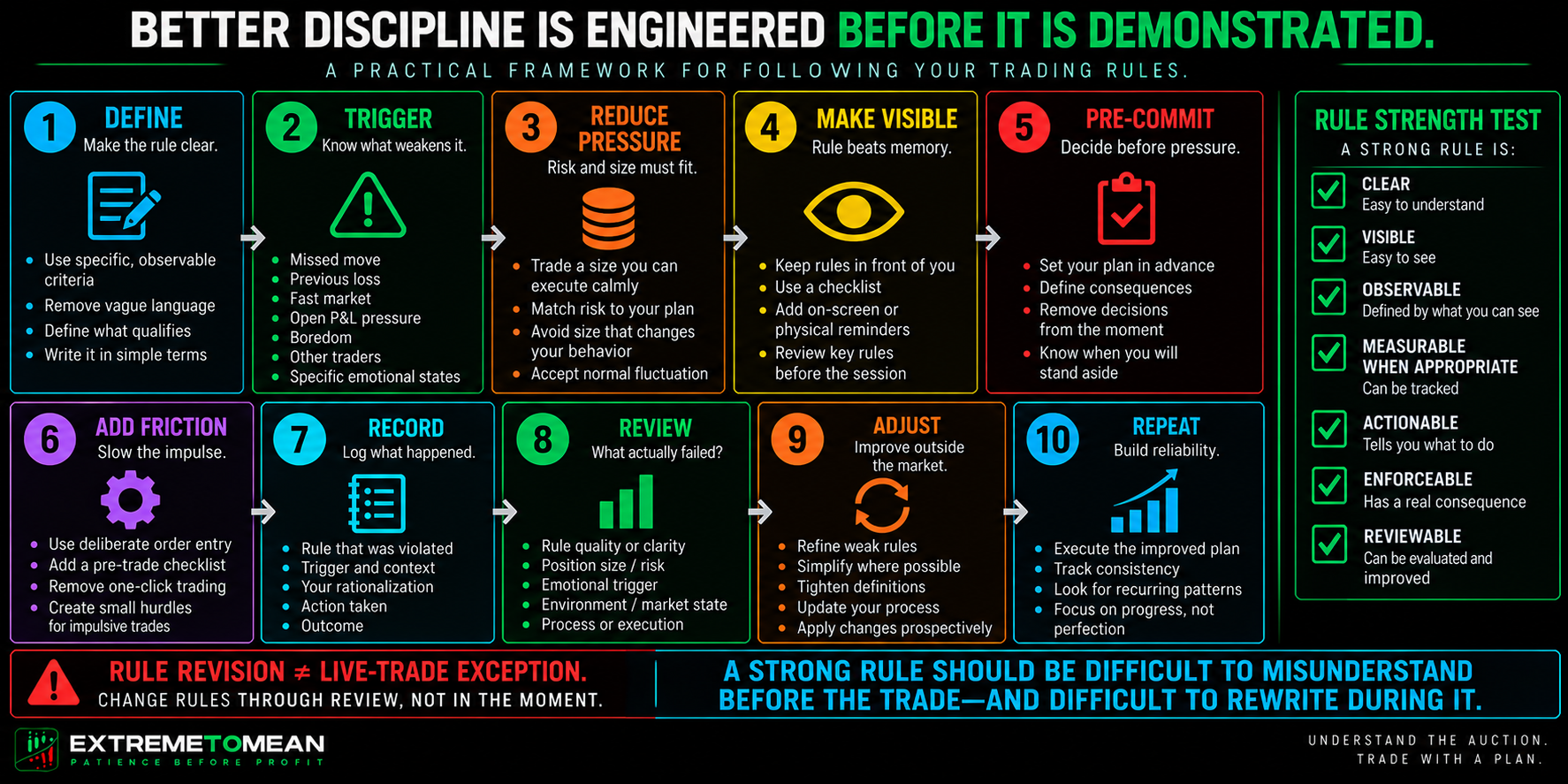
A useful rule-strength test asks whether each important rule is clear, visible, observable, measurable where appropriate, actionable, enforceable, and reviewable. The better question is not “Why am I so undisciplined?” but “What made this rule easy to reinterpret, and what can I change before the next time that trigger appears?” That turns the problem from a judgment about character into something that can actually be reviewed.
Rules can also be changed when evidence justifies a revision, but that decision belongs outside the live trade. A rule revision comes from review, testing, and documented reasoning, while a rule exception appears because the current position suddenly wants to be treated differently. A bad rule should be replaced deliberately—not violated selectively.
Final Thought
Following trading rules is not simply a test of how badly a trader wants to be disciplined. Rule clarity, position size, urgency, previous P&L, visibility, consequences, environmental design, and recurring rationalizations all affect whether the plan remains usable when pressure rises. Knowing what to do and being able to execute it under live conditions are different skills.
The cleaner process is to design for the pressured version of the trader rather than assuming calm intentions will automatically survive the session. Make the rules clearer, reduce unnecessary pressure, identify the triggers that normally create exceptions, and review violations as process data instead of promising to behave better tomorrow. Sometimes the best evidence that the rule worked is the trade that never happened, because doing nothing was still a trading decision.
The goal is not perfect emotional control or flawless execution. It is fewer violations, earlier recognition, cleaner recovery, and rules strong enough to remain useful when the market gives you a persuasive reason to ignore them. That broader process-first discipline is part of what we explore throughout The Patience Principle.
Writing the standard down gives the calm version of the trader a clearer voice when pressure invites an exception. Why written rules beat emotional memory shows how that external reference can support accountability.
Educational content only. Trading involves substantial risk and is not suitable for everyone.