
Because the reference can change as the market develops, a moving mean needs to be defined before a reversion trade is judged.
Many traders treat mean reversion and momentum like rival teams. One side looks for stretched moves to return toward an average. The other side looks for strength to continue. That sounds simple until a trader sees a market ripping higher, waits for a pullback, watches the pullback work, and then sees the broader trend continue higher again.
Was that a mean reversion trade or a momentum market?
The answer depends on the horizon. A move can be stretched on a short-term chart while still being strong on a higher-timeframe chart. A pullback can revert toward a short-term mean without ending the larger move. A trend can remain intact even while smaller moves snap back toward balance. This is why the broader market context lessons matter before a trader decides what kind of opportunity is actually in front of them.
Extreme to Mean is built around patience, location, and the idea that a trade should have a clearer destination before it earns risk. In mean reversion trading, that destination is usually the mean. Momentum trading often asks a different question: can the move keep expanding? Neither question is automatically better. The mistake is asking one question while trading the other.
The Horizon Problem
A trading horizon is the window of time and movement a trader is trying to capture. It is not just the chart timeframe. It includes the expected holding period, the reference point, the target, the risk, and the condition that would make the idea invalid.
A short-term mean reversion trader may be focused on a move from an outer band back toward a short-term average. A momentum trader may be focused on whether price is accepting above a breakout level and continuing in the same direction. Both traders can be looking at the same market, but they are not asking the same question.
That is where the problem begins. Traders often mix horizons without realizing it. They see a strong trend and assume every pullback should be bought. Then they see a stretched short-term move and assume it has to reverse. The chart becomes confusing because they are switching between momentum logic and mean reversion logic without defining which one controls the decision.
A trader using mean reversion needs to know the mean being targeted. Is it a short-term moving average? A session midpoint? VWAP? A prior balance area? A longer-term mean? Without that answer, “reversion” becomes vague. A trader using momentum needs to know what proves continuation is still being accepted. Without that answer, “momentum” becomes another word for chasing.
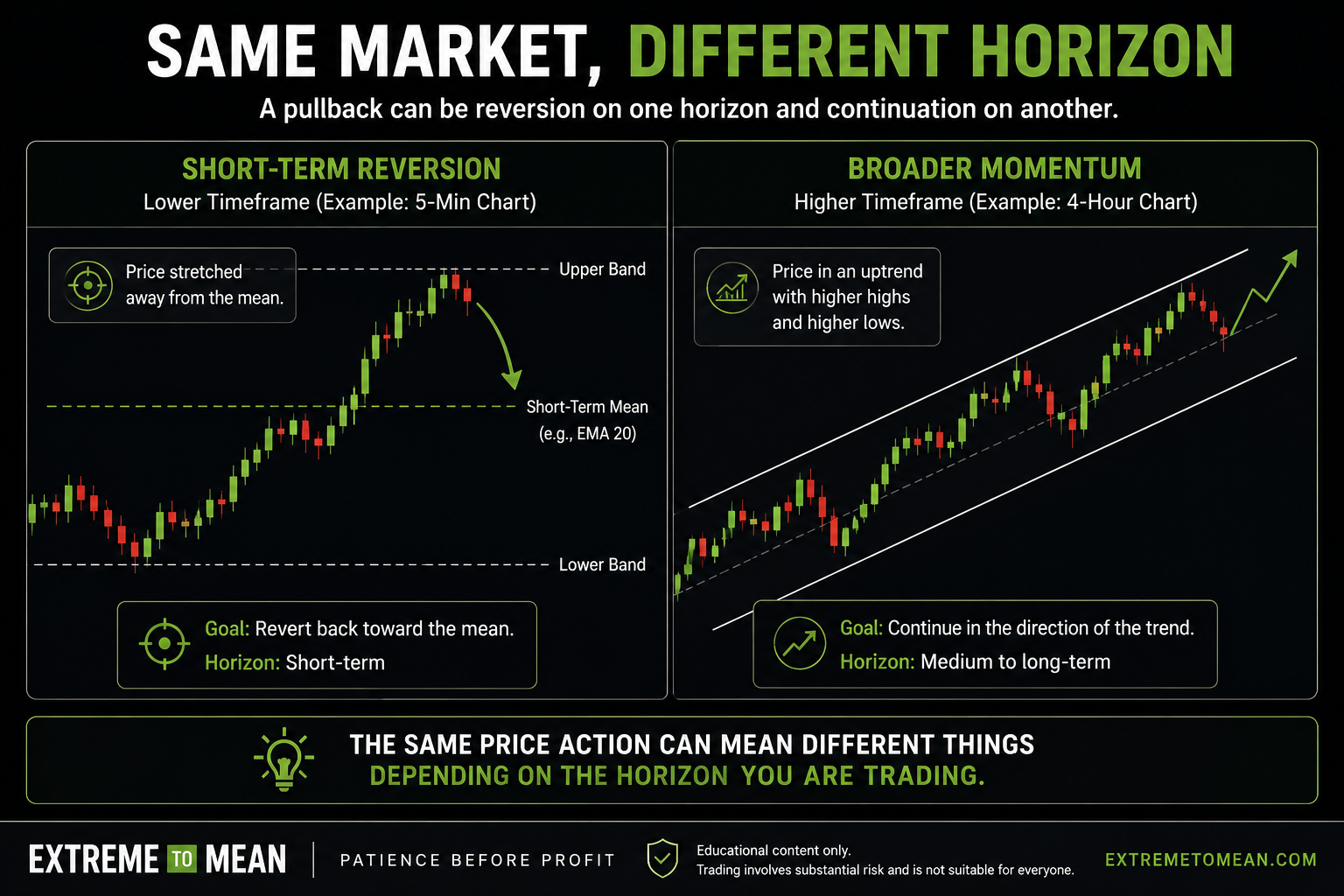
The horizon problem is not academic. It shows up every day when traders enter a position for one reason, manage it using another reason, and exit it emotionally because the original reason was never clear enough.
Mean Reversion Trades With a Destination
Mean reversion is based on the idea that price can stretch away from a reference point and then move back toward it. The reference point is the mean. The mean does not guarantee a return, but it gives the trader something specific to evaluate.
That target matters.
A mean reversion trader is not simply saying, “Price went too far, so it must come back.” That is not enough. A better mean reversion process asks whether price is extended, whether the location is meaningful, whether there is room to revert, and whether the risk can be defined before the trade is taken. This is why understanding what the mean really is is so important. The mean is not just a line on a chart. It is the reference point that gives the trade structure.
This is also where mean reversion differs from random bottom-picking or top-picking. A trader is not trying to prove the market is wrong. The trader is asking whether price has moved far enough away from balance to create a cleaner opportunity back toward a defined area.
The cleaner mean reversion question is: “If price starts to return toward balance, where is it reasonably trying to go?”
That question keeps the trade grounded. It gives the trader a target, a way to judge whether the move is progressing, and a reason to avoid overstaying the idea. The trade is not automatically good just because price is stretched. The stretch still has to appear in a useful location, with a target that makes sense, and risk that is clear enough to respect.
Momentum Trades With Continuation
Momentum is different because the trader is not primarily looking for price to return to a mean. The trader is looking for evidence that price is being accepted in the direction of the move. Momentum trading is built around continuation, pressure, and participation.
In a momentum environment, strength can stay strong longer than a reversion trader expects. Weakness can stay weak longer than a dip buyer expects. Price can remain extended because the market is repricing information, chasing liquidity, responding to news, or rotating aggressively into one side of the tape.
This is why a short against strength can feel logical and still be early. The chart may look stretched, but if the active horizon is momentum, the stretch may be part of the move rather than the end of it. That does not mean momentum is predictable. It means the trader needs to know whether the market is accepting higher or lower prices before assuming a return to balance is ready.
Momentum traders still need structure. They still need invalidation. They still need a risk plan. But the target logic is different. Instead of asking, “Where is the mean?” the momentum trader may ask, “Where is the next area where continuation could slow, fail, or meet supply or demand?”
That is why reversion is not reversal. A short-term move back toward a mean does not automatically mean the larger trend has reversed. It may only mean price is digesting, resetting, or pulling back before the broader direction continues.
Why Traders Mix the Two at the Worst Time
The mistake feels reasonable because markets rarely label themselves clearly. A strong move can look overextended. A pullback can look like the start of a reversal. A breakout can look like a chase. A failed breakout can look like a mean reversion trade. In real time, the trader has to make decisions without perfect information.
That uncertainty creates a common process breakdown: the trader enters with one idea and manages with another.
A trader may enter short because price is stretched above a short-term mean. Then the trade pauses, pulls back slightly, and stops before reaching the target. Instead of managing it as a short-term reversion attempt, the trader starts arguing that the whole trend should reverse. The original trade had a short-term horizon, but the trader expands the story when the trade becomes uncomfortable.
The opposite happens with momentum. A trader enters long because price is breaking higher, but the first pullback creates fear. Instead of judging whether the breakout structure is still intact, the trader suddenly treats a normal pullback as proof that the move is failing. The entry was based on continuation, but the management becomes short-term noise reaction.
This is where decision quality breaks down. The trader is not just wrong about direction. The trader is unclear about the job of the trade. That lack of clarity can lead to chasing, moving stops, exiting too early, holding too long, or adding risk without a clean reason.
A better trader must choose the trading horizon before interpreting momentum or reversion. Is this a reversion attempt back to a nearby mean, or is this a continuation attempt in a broader move? The answer does not guarantee the result, but it gives the decision a structure.
Location Decides Whether the Idea Earns Attention
Mean reversion and momentum both require location. They just use location differently.
For mean reversion, location often means price has stretched far enough away from a reference point that a return toward balance becomes worth evaluating. The trader wants room between the entry area and the mean. If price is already sitting near the middle, there may not be enough room for the trade to make sense. That is why room to revert matters so much in a structured reversion process.
For momentum, location often means price is breaking from, holding above, or accepting beyond an important area. The trader wants evidence that the market is not just poking through a level, but actually finding participation beyond it. A breakout without acceptance can become a trap. A trend without structure can become a chase.
In both cases, location filters the trade. Mean reversion without location becomes guessing where the move ends. Momentum without location becomes buying or selling because price is moving fast. Neither is a complete process.
The better question is: “Does this location match the strategy I am trying to trade?”
If the answer is no, the trader should pause. A stretched market may not be a reversion trade if momentum is still being accepted. A strong market may not be a momentum trade if the entry is late and the risk is unclear. The setup has to earn attention before it earns risk.
A Practical Filter for Mean Reversion vs Momentum
Before deciding whether a move is a reversion opportunity or a momentum opportunity, slow the read down. The goal is not to perfectly classify every market condition. The goal is to stop mixing trade logic.
Use this filter:
- What horizon am I trading: short-term reversion, intraday continuation, or higher-timeframe direction?
- What is my reference point: a mean, a breakout level, a range, a prior high or low, or a higher-timeframe structure?
- If this is mean reversion, where is the target mean?
- If this is momentum, what proves continuation is still being accepted?
- Is there enough room between entry, target, and invalidation?
- Is the trade idea still valid if price moves against me slightly?
- Am I entering because the setup is clear, or because I feel late?
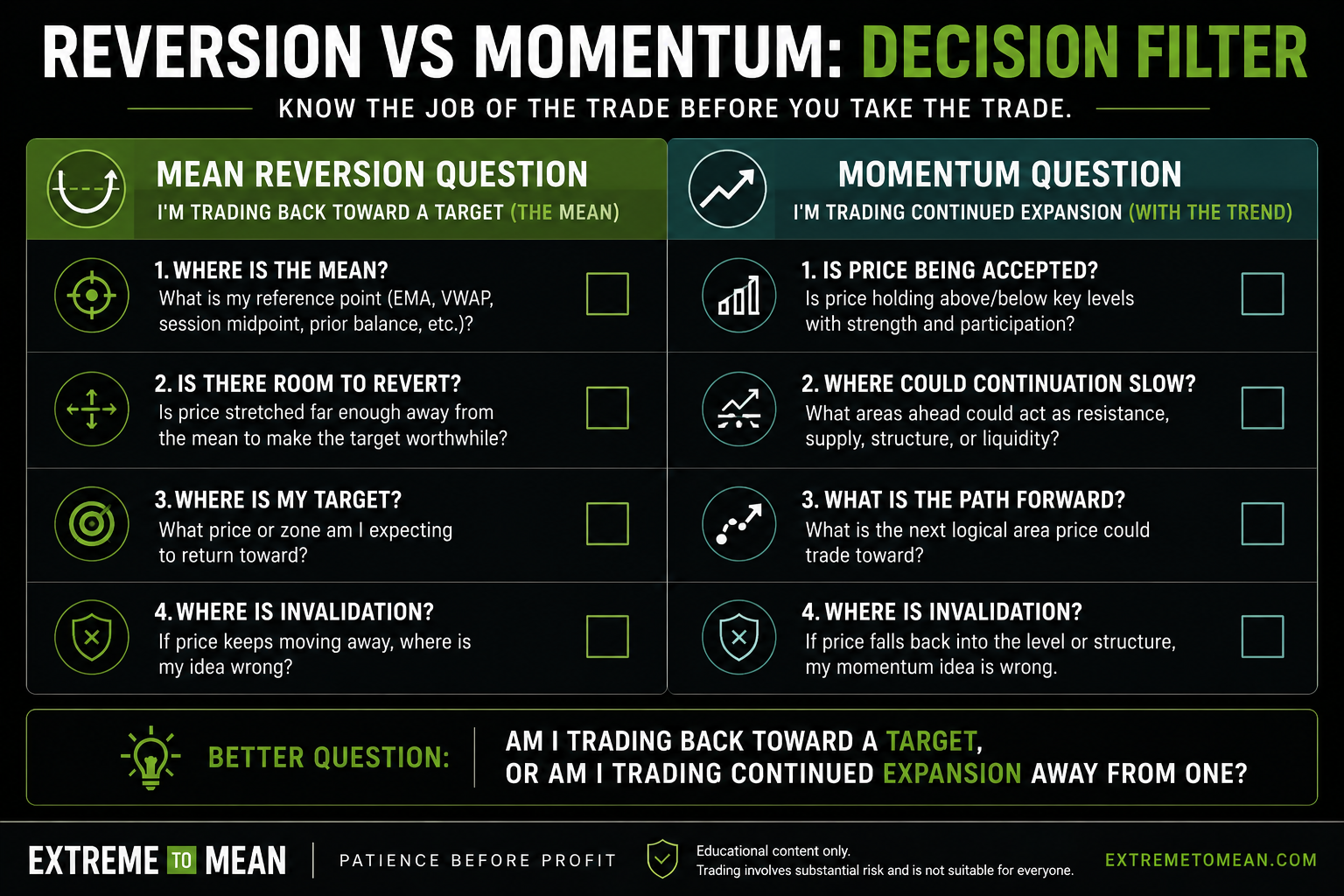
The most important better question is simple: “Am I trading back toward a target, or am I trading continued expansion away from one?”
That question forces the trader to define the job of the trade. If the trade is a mean reversion attempt, the target should not be vague. If the trade is a momentum attempt, the acceptance and invalidation should not be vague. Either way, the trader is evaluating instead of reacting.
For traders who want a more structured way to apply this inside the Extreme to Mean approach, the full TMT System is the better next step. The point is not to predict every move. The point is to build a repeatable process for deciding when the market, location, setup, and risk are clear enough to consider action.
Final Thought
Mean reversion and momentum are not always enemies. They are often different answers to different questions across different horizons. A market can revert on a short-term chart while continuing on a higher-timeframe trend. A momentum move can pause, pull back, and still remain intact.
The trader’s job is to define the horizon before taking the trade. If the plan is mean reversion, know the mean and the room to return. If the plan is momentum, know what continuation looks like and where the idea fails.
Do not trade a reversion setup with momentum expectations. Do not trade a momentum setup with reversion fear. Know the job of the trade before you ask the market to pay you for it.
Educational content only. Trading involves substantial risk and is not suitable for everyone.