
Many traders hear that price “always comes back to VWAP” and begin treating the line as a promise. The belief feels reasonable because balanced sessions often rotate around a central area, and successful VWAP reversions are easy to find after the fact. The danger is that this shortcut removes timing, structure, and risk from the decision. A possible return to the mean becomes an expected outcome, and extension becomes an automatic signal.
The lessons in The Setup treat setup recognition as the beginning of evaluation rather than the end. A trader still needs to understand where price is, what kind of market is present, what behavior supports the idea, and where the trade becomes wrong. VWAP can help organize those questions because it provides a widely watched intraday reference. It cannot answer them by itself.
What VWAP Actually Measures
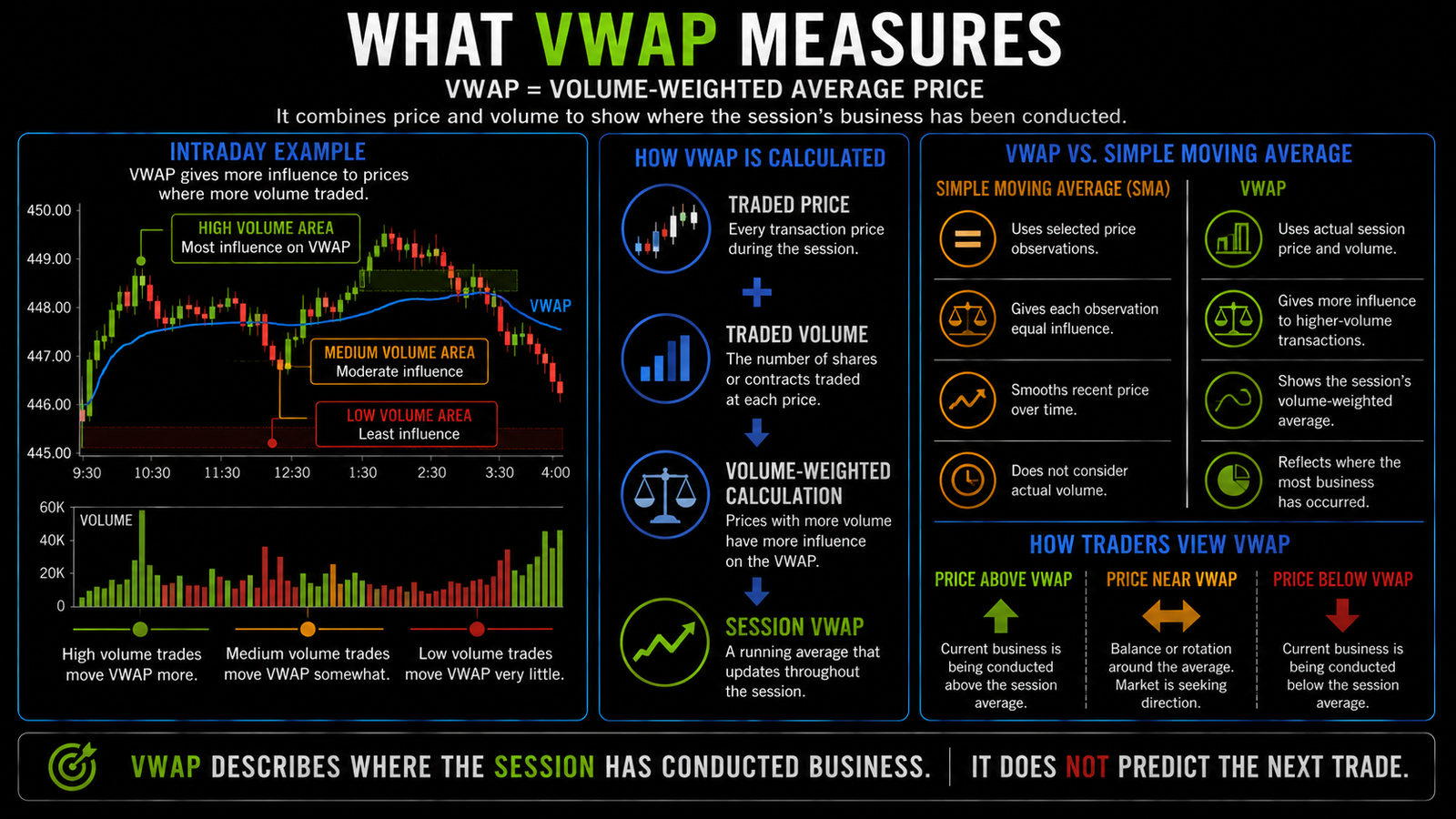
VWAP stands for volume-weighted average price. It combines the prices traded during the session with the amount of volume completed at those prices, giving more influence to transactions where more business occurred. The result is a running estimate of the session’s average traded price, weighted by participation. In plain English, VWAP shows where a meaningful share of the session’s business has been conducted.
VWAP differs from a simple moving average because a simple moving average generally gives equal importance to each selected price observation. VWAP changes according to both price and traded volume, and it develops as new transactions occur. The comparison of session VWAP and Anchored VWAP explains why the reset or chosen starting point matters when two traders compare readings.
Early in the session, VWAP may move quickly because relatively little information has accumulated. Later, the line may become more stable as more volume is included in the calculation. It should be treated as a changing session reference—not as a fixed support level, resistance level, or prediction of the next move.
Why VWAP Matters to Day Traders
Day traders use VWAP to evaluate relative session location. Price holding above VWAP may suggest that current business is being conducted above the session average, while price remaining below it may suggest the opposite. An Anchored VWAP begins from a trader-selected event or structural point instead. Repeated acceptance on one side can help describe directional control, while frequent movement through VWAP can suggest balance, rotation, or uncertainty.
VWAP can also provide a reference for pullbacks, extensions, and possible reversions. A trader may compare the current price with the session average and ask whether the move is becoming stretched. That question follows the principle that location is the first filter. The mistake begins when the trader treats awareness of extension as proof that an entry is ready.
The line is useful because it helps describe the session. It is not useful when it replaces the rest of the decision process. Price can touch VWAP, cross VWAP, reject VWAP, or remain far from VWAP without producing a qualified trade.
How VWAP Mean Reversion Works
VWAP mean reversion refers to price moving back toward the session’s volume-weighted average after trading away from it. The move may begin because directional pressure weakens, opposing participation appears, or the market starts returning toward balance. VWAP can therefore serve as a possible destination for an intraday reversion idea. It does not create an obligation for price to reach that destination.
A full reversion reaches or crosses VWAP. A partial reversion retraces only part of the distance. A failed reversion begins moving toward VWAP but loses progress before reaching it. Price may also remain extended and establish a new area of value away from the earlier average. The trader must distinguish among these possibilities rather than assuming that every move toward the mean should finish at the line.
The broader concept of what Extreme to Mean really means is not that every extreme must reverse. An extreme identifies a condition worth evaluating because price has moved away from a reference or area of balance. The trader must then determine whether the move is exhausting, continuing, or repricing the market. Extension creates attention before it creates a trade.
Why Distance From VWAP Is Not an Entry Signal
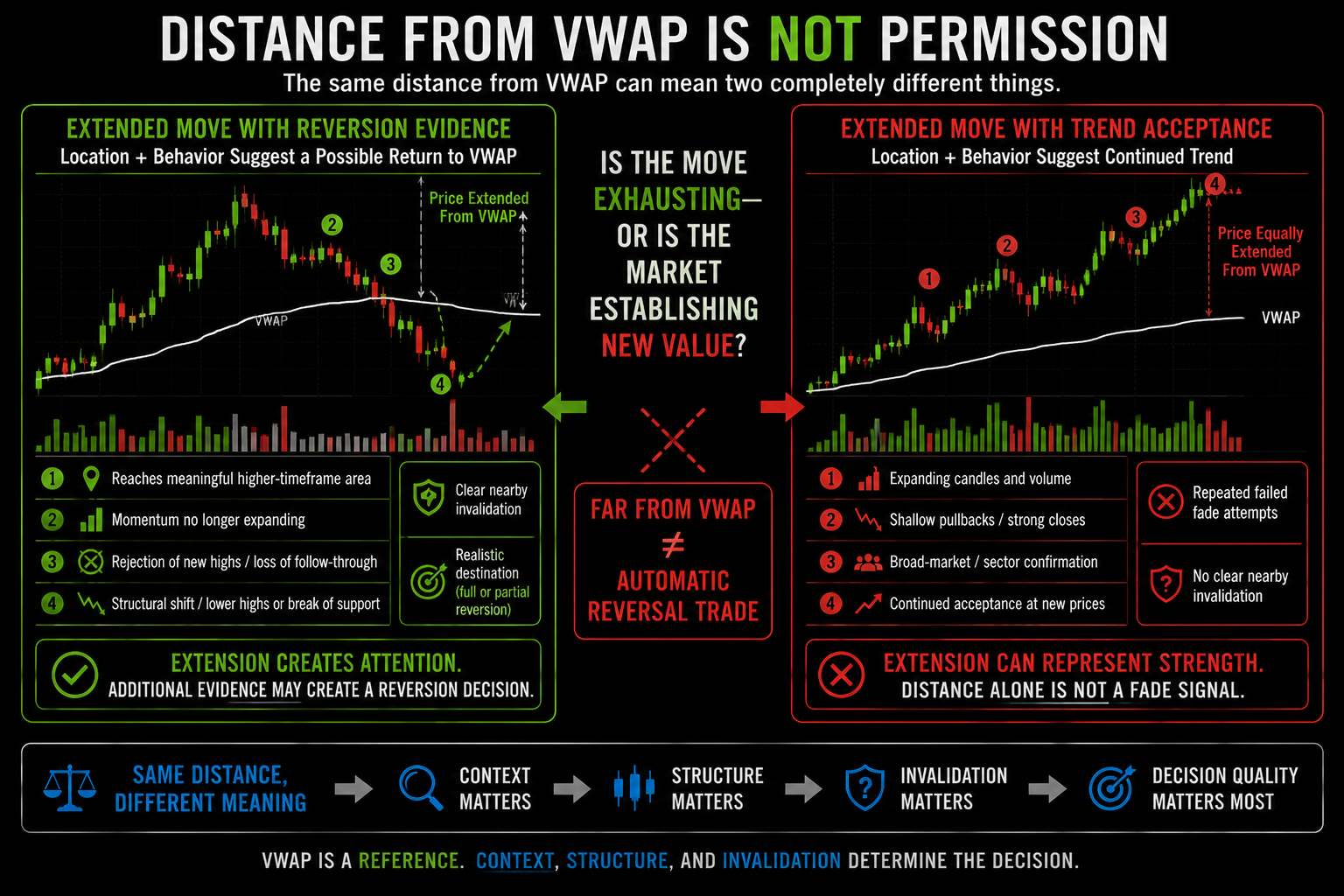
Being far from VWAP does not prove that the trend is finished. It does not guarantee that a reversal is imminent, that the risk is small, or that price must return during the same session. Distance tells the trader where price is relative to a session reference. It does not tell the trader when the market will turn.
There is also no universal number of points or percentage that makes price “far enough” from VWAP. A distance that is unusual for one instrument, session, or volatility environment may be normal in another. Fixed thresholds can become misleading when range and participation expand. Extension must be judged relative to the market that is actually trading.
Consider a trader who repeatedly shorts a strong rally because each new high appears farther from VWAP. The first entry fails, so the trader adds at a greater distance and argues that the new position is even better. Price continues accepting higher values, related markets remain firm, and each pullback stays shallow. The trader is using extension to defend a fading thesis while the market is using extension to demonstrate strength.
The same mistake appears when fading a sustained decline. Price can remain below VWAP for hours while sellers continue making progress and weak bounces fail. A chart can look visually stretched while the market is still repricing lower. Extension may eventually contribute to a reversion, but it cannot identify the turning point by itself.
Why Price Can Stay Far From VWAP
Price can remain extended when strong directional order flow continues to overwhelm the opposing side. A high-impact news event, macro surprise, institutional repricing, or broad risk shift can cause the market to search for a new area where participants are willing to conduct business. In that process, the earlier session average may become less relevant than the new information. VWAP continues calculating the session’s history while price responds to changing conditions.
Trend-day structure can reinforce that extension. Pullbacks may remain shallow, ranges may expand in the trend direction, volume may increase, and related indexes or sectors may confirm the move. Price may open away from prior value and continue accepting the new area rather than rotating back. Under those conditions, distance from VWAP can represent strength rather than exhaustion.
Expanding volatility also changes what “far” means. A distance that looks unusual during a quiet session may be normal during an aggressive repricing event. A move can be extended on a short timeframe while remaining supported by a larger directional process, which is why mean reversion and momentum can describe different horizons. The trader must know which reversion is being considered and which structure still controls the market.
When a VWAP Mean Reversion Trade Becomes More Reasonable
A VWAP reversion becomes more reasonable when the location is meaningful beyond distance alone. Price may reach a higher-timeframe area, prior session boundary, established support or resistance zone, or another location where the current move has a logical reason to pause. Momentum may stop expanding, and additional effort may begin producing less progress. The extreme starts showing evidence of response rather than merely looking large.
The market may reject the extreme and begin shifting structure back toward balance. Price might fail to hold new highs or lows, reclaim a broken area, or begin forming swings toward VWAP. Broader conditions should not be strongly opposing the idea, and fresh news should not still be driving aggressive repricing. These conditions do not guarantee a successful reversion, but they give the thesis observable support.
The trade must also have clear risk and a realistic destination. The trader needs a specific behavior or price area that proves the idea wrong, a position size that fits that invalidation, and enough room for the trade to develop. VWAP may be the full target, but a partial reversion may be more realistic when nearby structure limits the path. The entry reason must be stronger than “price looks far.”
When Not to Fade Price Back Toward VWAP
A VWAP fade is especially dangerous during strong trend-day behavior. Fresh high-impact news, expanding range, increasing volume, broad-market confirmation, and repeated failed reversal attempts all suggest that the directional move may still be active. Fading in those conditions asks the trader to stand against continued acceptance. Distance alone cannot compensate for the absence of structural evidence.
The idea should also be rejected when no nearby invalidation point exists or when higher-timeframe structure strongly opposes the fade. A stop that keeps moving because price becomes “even more extended” is not a stable risk boundary. A target that requires the entire trend to reverse may also be unrealistic for the timeframe.
Chasing after much of the reversion has already occurred creates a different problem. The remaining destination becomes smaller while the logical invalidation may still be wide. A correct directional idea can still become a poor trade when the available room no longer justifies the exposure.
Four Questions Before a VWAP Reversion Trade
Before acting, reduce the idea to four connected questions. The answers should describe one complete trade rather than provide four separate excuses for participation. When one answer remains vague, the setup may require more evidence or may not be ready.
- Location: Where is price relative to VWAP and meaningful market structure?
- Context: Is the market balancing, trending, or actively repricing?
- Invalidation: What specific behavior proves the reversion idea wrong?
- Destination: Is VWAP—or a partial move toward it—a realistic target for this timeframe?
The better question is not, “Is price far enough from VWAP?” It is, “What evidence shows that this extension is losing control, and where is that conclusion wrong?” That question forces the trader to evaluate behavior rather than distance alone. It also allows patience when the location is interesting but the market has not yet produced a trade.
Risk and Invalidation
The stop should represent where the reversion thesis fails. That point may sit beyond the extreme, beyond a rejection structure, or beyond another condition required by the setup. It should not be selected only because the trader prefers a particular dollar amount. The market logic defines the invalidation, and the risk plan determines whether the position can fit.
Farther from VWAP is not automatically a better entry. Greater distance may create more theoretical room, but it can also reflect stronger momentum, wider volatility, or a market that is aggressively establishing new value. Repeatedly adding to a losing fade because price is “even more extended” can turn a contained idea into a major loss. Exposure is increasing while the original thesis is receiving less support.
The trader must also decide whether the objective is a partial or full reversion. A partial target may use nearby structure, a prior consolidation, or a portion of the distance to VWAP, while a full target assumes price can return to the session average. The chosen destination should justify the exposure without requiring an unrealistic reversal. When the invalidation, position size, or destination cannot be explained clearly, the trade is not ready until the risk is clear.
Common VWAP Mean Reversion Mistakes
VWAP mistakes often begin with giving the line more authority than it deserves. The trader sees a familiar reference and treats it as a complete trading strategy rather than one input inside a larger decision process.
- Treating VWAP as an automatic buy or sell signal
- Fading every extension without evaluating the market state
- Ignoring higher-timeframe structure, news, and broad-market confirmation
- Entering without evidence that momentum or structure is changing
- Moving the stop because price has become “even more extended”
- Assuming price must return to VWAP before the close
- Confusing a VWAP cross with a complete market reversal
- Using a target that requires more reversion than the timeframe supports
- Adding repeatedly to a losing fade
- Taking the trade without a clear reason it is wrong
These mistakes share one underlying problem: observation is being treated as permission. Price can be far from VWAP, cross it, reject it, or hold near it without producing a qualified setup. The line helps the trader describe location and behavior. The rest of the process determines whether risk belongs there.
How VWAP Fits Extreme to Mean
VWAP fits Extreme to Mean because it provides a practical reference for thinking about distance, balance, and session location. The philosophy is not built on blindly fading anything that looks stretched. An extreme creates a question about market behavior. It does not create an obligation to participate.
Patience is required while the market proves whether the extension is exhausting or continuing. The trader may observe reduced momentum, rejection, and a structural shift, or may instead see expanding pressure and continued acceptance. The trader’s job is to filter those conditions rather than react to visual distance. Clean risk matters more than predicting the exact turning point.
The goal is not to catch every move toward VWAP. It is to participate only when location, context, structure, destination, and invalidation form one coherent trade explanation. A trader who cannot identify where the idea fails should address the broader problem of having unclear risk before using VWAP as an entry reference. Sometimes the best VWAP decision is to recognize the extension and do nothing.
Frequently Asked Questions
What does VWAP mean?
VWAP means volume-weighted average price. It calculates the session’s average traded price while giving greater influence to prices where more volume occurred. Traders use it as a reference for where business has been conducted during the session. It is not a prediction of where price must go next.
Does price always return to VWAP?
No. Price may return fully, retrace only part of the distance, remain extended, or establish a new area of value away from VWAP. Strong trends and repricing events can finish the session far from the line. A return is possible, not required.
How far from VWAP is considered extended?
There is no universal distance that applies to every instrument or session. Extension should be evaluated relative to the instrument’s current volatility, session range, market structure, and the behavior occurring at the extreme. A fixed number of points or percentage can be misleading when conditions change.
Is VWAP a buy or sell signal?
No. VWAP is a reference for location, balance, and session behavior. A trade still requires context, structure, timing, invalidation, and acceptable risk. A touch, cross, or extension should not be treated as automatic permission.
Can VWAP be used for mean reversion?
Yes. VWAP can serve as a possible mean or destination in an intraday reversion idea. The trader should still evaluate whether the move is exhausting, whether structure is shifting, and whether the target is realistic for the timeframe. Distance alone is insufficient.
What invalidates a VWAP mean reversion trade?
Invalidation depends on the setup, structure, and timeframe. It should identify the price behavior that proves the expected reversion is no longer supported. Continued acceptance beyond the extreme or renewed directional progress may invalidate the idea. The boundary must be defined before entry.
Is VWAP useful on trend days?
VWAP can provide useful context on trend days by showing the relationship between price and the session average. The danger is assuming that a large distance must create a fade. Strong trend days can remain extended for long periods while pullbacks stay shallow and participation continues in the trend direction.
Final Thought
VWAP provides context by showing the session’s volume-weighted average price. Extension creates attention because price has moved away from that reference. Neither observation determines that a reversal must begin. Structure, context, destination, and invalidation create the actual trade decision.
The goal is not to build a mechanical rule that fades every large distance. It is to distinguish between an extension receiving continued acceptance and one beginning to lose control. Sometimes price reverts fully, sometimes it retraces partially, and sometimes it never returns during the session. The trader’s responsibility is to evaluate those conditions rather than demand the mean.
VWAP is a reference, not a prediction. Extension is a location, not permission. When the setup cannot explain why a reversion may begin, where the idea becomes wrong, and whether the destination justifies the exposure, the correct VWAP trade is no trade.
Educational content only. Trading involves substantial risk and is not suitable for everyone.