
Many trading mistakes begin before the entry because the trader has not decided what kind of movement the position is supposed to capture. A setup may be identified on a short-term chart, but the trader begins managing it according to a longer-term expectation as soon as price becomes uncomfortable. The position remains open, yet the original trade gradually disappears.
A scalp may become a day trade because the planned exit was missed. A day trade may become a swing because the stop is threatened, while a swing trade may be judged by every five-minute candle even though its thesis came from daily structure. Each change introduces rules, expectations, and risks that were not part of the decision made at entry.
Choosing a time horizon does not guarantee that the trade will work. It gives the decision a consistent structure by defining the movement being targeted, the chart that controls the idea, the time ordinary development may require, and the type of uncertainty the trader is accepting. Without that structure, almost any price movement can become a reason to alter the plan.
The broader market approaches and time-horizon curriculum begins with this distinction because strategy rules make little sense until the trader knows what kind of trade those rules are intended to govern. The same instrument can support several trading approaches, but one position cannot be managed as all of them at once.
A Time Horizon Defines the Trade
A time horizon is the period over which the trader expects the idea to develop. It influences how long the position may remain open, how much movement is being pursued, which chart carries the most important information, and how often management decisions may be required. The horizon therefore shapes the entire trade rather than merely describing its duration afterward.
The same market can display several forms of movement simultaneously. It may be rising on the daily chart, pulling back on the hourly chart, balancing on the fifteen-minute chart, and breaking lower on the one-minute chart. None of those observations must be incorrect because each timeframe is showing a different layer of the same auction.
Understanding what a chart timeframe actually means helps prevent those layers from being treated as competing predictions. A smaller chart magnifies short-term movement occurring inside the broader structure, while a larger chart compresses many smaller movements into a wider view. The trader must decide which layer controls the current trade and which charts provide only supporting context.
That decision creates a hierarchy. The controlling timeframe defines the thesis and invalidation, while smaller charts may help refine the entry or observe immediate behavior. When the trader does not establish that hierarchy, every chart can become a reason to enter, exit, hold longer, or abandon the original plan.
Scalping Targets Very Short-Term Movement
Scalping is the shortest of the four major trading horizons. A position may remain open for seconds or several minutes while the trader attempts to capture a small piece of immediate price movement. The opportunity is usually based on short-term structure, momentum, liquidity, or a quick reaction around a meaningful location.
Because the expected movement is small, execution carries unusual importance. Spread, commissions, slippage, fill quality, and a slightly delayed decision can consume a meaningful portion of the potential result. An execution difference that would be minor in a multi-day trade may determine whether a scalp remains usable at all.
Scalping also creates a high decision frequency. Even when the number of completed trades is controlled, the trader may repeatedly decide whether to enter, wait, reduce, exit, or stand aside as conditions change. That pace leaves little time to interpret new information or recover from an emotional reaction before another decision is required.
The speed does not make scalping simple. It requires the location, trigger, invalidation, target, size, and maximum acceptable loss to be defined before price begins moving rapidly. When those decisions are left until after entry, ordinary market noise can feel urgent enough to control the trade.
Scalping is therefore most compatible with traders who can monitor the market closely, execute consistently, and remain selective despite frequent movement. The shorter holding period reduces some forms of exposure, but it increases sensitivity to execution, costs, fatigue, and overtrading.
Day Trading Focuses on the Current Session
Day trading generally involves opening and closing a position within the same trading session. A day trade may last several minutes or several hours, but the plan is built around intraday structure rather than a move that must continue across multiple sessions. The trader usually intends to finish the session without carrying the position overnight.
This horizon gives the trade more time than a scalp, but the session itself becomes part of the analysis. The opening period covered in what the first hour tells you about the rest of the day, midday slowdown, scheduled economic releases, changing liquidity, and approach of the close can all alter the character of price movement. A setup that develops cleanly early in the day may lose momentum as participation changes.
A day trader may use a higher intraday timeframe to define the structure and a smaller chart to refine the entry. Once the position is open, it should be managed according to the session-based idea rather than every fluctuation on the fastest chart. The smaller timeframe can provide detail without being allowed to replace the structure that justified the trade.
The day trader must distinguish between normal development and actual invalidation. Exiting during every minor pullback can prevent the position from having enough time to work, but holding through clear failure turns patience into avoidance. The plan should define what behavior is expected during the session and what evidence would show that the idea is no longer developing properly.
A day trade should also have a session-based reason for ending. The trader should not hold after the close simply because the expected intraday result did not occur, and the behavior covered in Power Hour trading can help clarify what the final hour is actually showing. Extending the position introduces overnight risk and converts the trade into a different decision requiring different analysis, size, and management.
Swing Trading Targets Movement Across Sessions
Swing trading attempts to participate in movement that develops over several days or weeks. The trader is no longer focused only on the current session but on a broader structural move that may require time and several ordinary pullbacks to develop. Daily and hourly charts often carry more weight because the thesis must survive the noise of individual sessions.
This approach usually creates fewer decisions than scalping or day trading, but each decision remains exposed to uncertainty for longer. The market closes, reopens, reacts to news, and moves through short-term volatility while the position remains active. The trader must be able to tolerate that development without allowing every intraday fluctuation to redefine the trade.
Overnight gaps are an important part of swing-trading risk. Price can reopen beyond the previous close or beyond the planned stop, which means the actual exit may differ from the expected level. Scheduled events and changing conditions can also affect the position while the trader is unable to respond immediately.
Position size and stop placement must reflect the wider structural movement. A stop suitable for a day trade may sit inside ordinary swing volatility, while a position sized for a tight intraday stop may create excessive account exposure when the correct swing invalidation is farther away. The trader controls that risk by adjusting size rather than forcing a narrow stop onto a broader idea.
Patience in swing trading means allowing enough time for the controlling structure to develop without becoming attached to the thesis. A longer holding period does not eliminate invalidation or justify ignoring new evidence. It simply means that the decision should be governed by the swing structure rather than every small reaction inside it.
Position Trading Pursues Large Structural Moves
Position trading operates over the longest horizon of the four approaches. Positions may remain open for weeks, months, or longer while the trader attempts to participate in a large structural, economic, or macro-driven movement. Daily, weekly, and monthly charts commonly define the primary thesis.
Short-term volatility may still matter for entry timing or risk adjustment, but it does not control the central idea. A brief intraday decline may be important to a scalper while representing ordinary noise within a position trade. The position trader must understand which changes are temporary and which ones materially weaken the larger thesis.
Although position traders usually make fewer decisions, each decision must account for a longer period of uncertainty. Economic conditions may change, market leadership may rotate, trends may weaken, and assumptions that supported the entry may become outdated. The trader must review the thesis without reacting to every short-term fluctuation or remaining attached to an idea that no longer fits the evidence.
The wider horizon often requires greater tolerance for normal price variation and smaller position sizing. Structural invalidation may be much farther from the entry than it would be in an intraday trade, creating more risk per share or contract. The position size must be adapted to that distance rather than chosen according to the size of the potential reward.
Fewer decisions do not mean less discipline. Long-duration trades can create emotional attachment because the trader has invested substantial time, attention, and conviction in the thesis. A position trade still needs a clear reason to remain open and a clear condition that would show the larger idea is no longer valid.
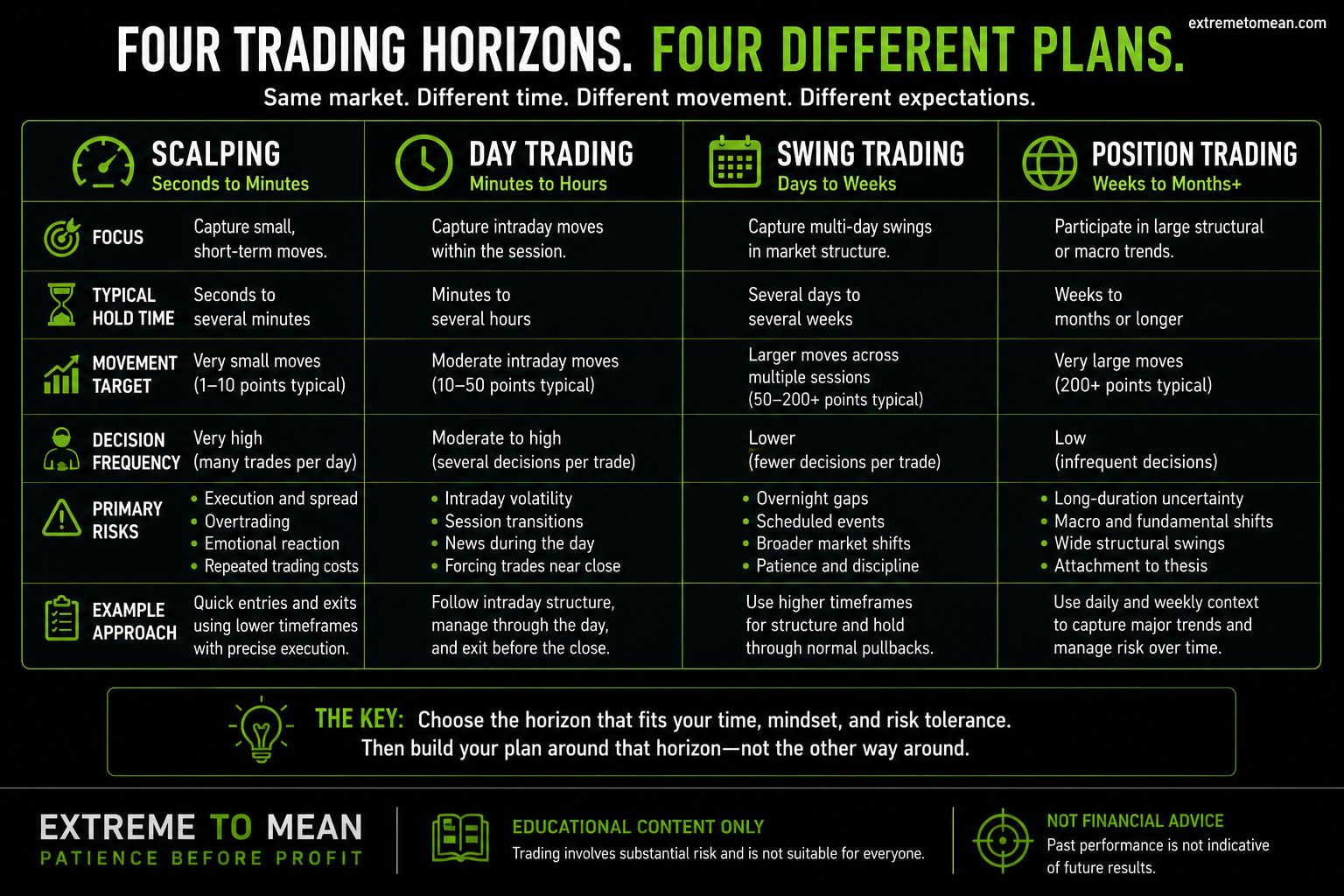
The four approaches organize the same market around different types of movement. Their holding periods are visible differences, but the more important distinctions involve the controlling structure, expected development, position size, decision frequency, and forms of risk.
The Same Setup Changes Across Horizons
A pullback, breakout, rejection, or reversion can appear on every timeframe, but the familiar shape does not make it the same trade. A broader day-trading strategy comparison separates the market behavior each approach is designed to use. A breakout on a one-minute chart may create a brief scalp while remaining almost invisible on the daily chart. A reversal on a fifteen-minute chart may be only a routine pullback within a larger swing trend.
A daily breakout may support a position-trading thesis even while several intraday charts show temporary weakness. The smaller charts are not necessarily disproving the larger idea; they may be showing normal movement within it. The trader must know which timeframe defines the position and which charts are being used only for context or execution.
This extends the principle that the same setup does not mean the same trade. The horizon changes the controlling structure, intended movement, relevant invalidation, expected holding period, and amount of time the market is allowed to respond. A visual pattern should never be interpreted without those surrounding conditions.
Without a timeframe hierarchy, the trader can always find a chart that supports a preferred action. A small bullish candle may become a reason to hold a failing short, while a minor bearish candle may become a reason to exit a healthy swing trade. The chart selection begins following emotion rather than the plan.
A cleaner process assigns specific jobs to each timeframe before entry. The guide to using multiple timeframes without creating conflicting signals develops that hierarchy: the controlling chart defines the idea and failure point, while smaller charts may refine execution and larger charts provide context. That structure allows additional information to improve the decision without constantly changing its identity.
Risk Changes Form Across the Horizons
Shorter trades are sometimes described as safer because the position remains open for less time. Longer trades are sometimes described as easier because fewer decisions are required. Both descriptions ignore the way risk changes as the horizon changes.
Scalping limits the time spent in the market but increases sensitivity to execution, repeated costs, rapid decisions, and overtrading. Day trading usually avoids overnight exposure, yet it still includes intraday volatility, session transitions, news events, and pressure to act before the session ends. A short holding period reduces some risks while concentrating others.
Swing trading provides more time for the move to develop but introduces gaps, overnight news, scheduled-event exposure, and wider structural movement. Position trading reduces decision frequency while extending the period during which economic conditions, market structure, and the original thesis may change. The trader remains exposed to fewer immediate decisions but more long-duration uncertainty.
Risk therefore does not disappear when a different horizon is chosen. It changes form, and the plan must account for the particular form being accepted. A trader should not select an approach because it appears to remove discomfort or eliminate uncertainty.
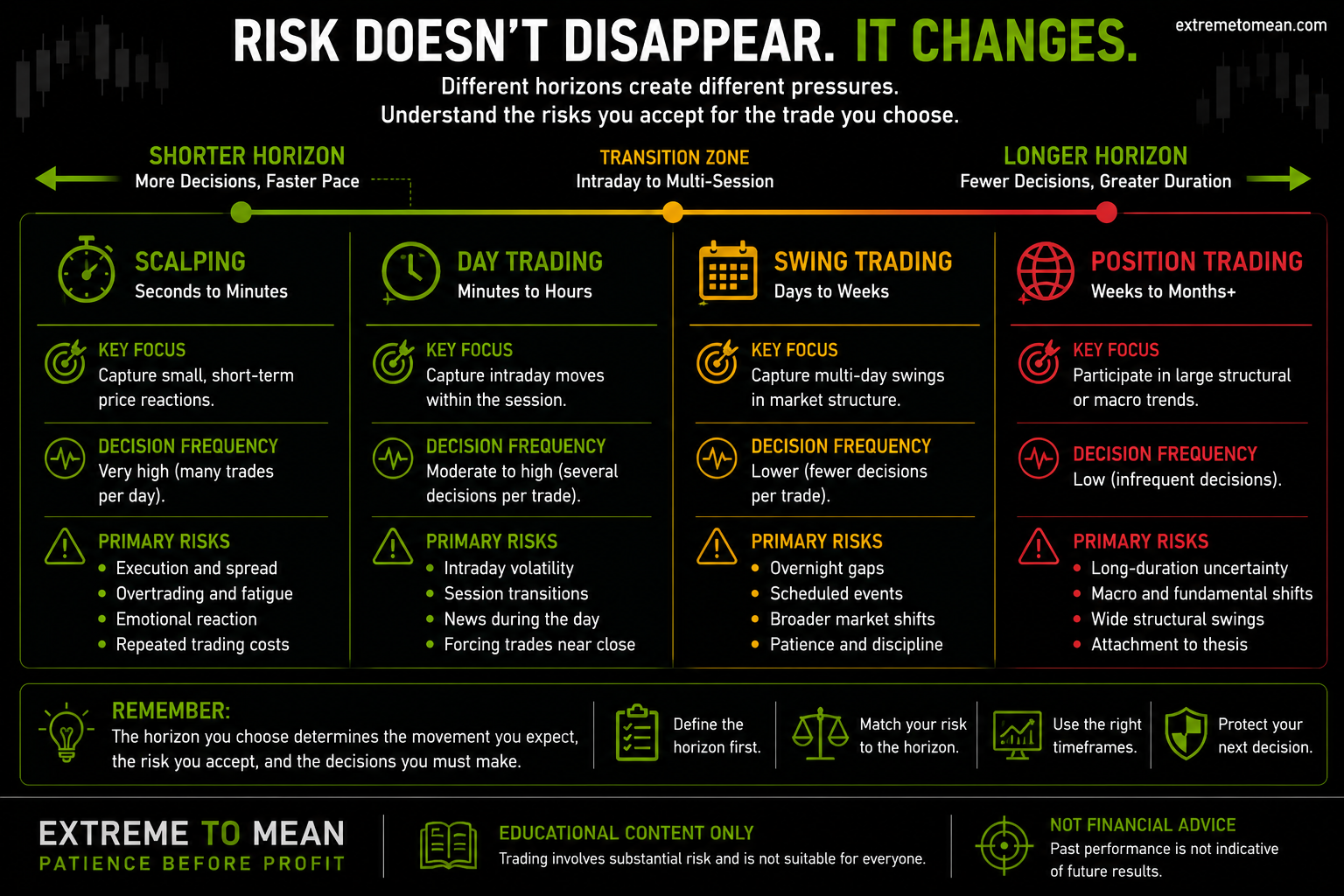
The better objective is to choose a form of uncertainty that can be managed through a clear process. The trader must understand whether the main pressure will come from execution speed, session development, overnight exposure, long-term thesis risk, or a combination of those factors. Every horizon requires defined risk even though the source of that risk differs.
Decision Frequency Changes the Pressure
Shorter horizons usually require more frequent decisions because price moves quickly relative to the distance being targeted. A late entry, hesitation, or inconsistent exit can immediately change the trade. The trader may also encounter many movements that look actionable but do not meet the full setup requirements.
That repetition can produce fatigue and reduce selectivity. After watching many short-term fluctuations, the trader may begin reacting to movement simply because the chart is active. The challenge is not only executing quickly but also remaining patient enough to reject weak opportunities.
Longer horizons usually require fewer decisions, but those decisions must remain stable across a longer period. A swing or position trader may need to tolerate several sessions of uncertainty without repeatedly adjusting the stop, target, or thesis. The pressure comes less from speed and more from waiting without unnecessary interference.
Neither form of pressure is automatically easier. Some traders struggle with the speed and repetition of scalping, while others struggle to leave a longer-duration position alone through normal movement. The approach should be selected according to the trader’s actual strengths and limitations rather than an idealized image of how they would like to behave.
Schedule also matters. A trader who cannot monitor the market continuously may find that scalping or fast day trading creates decisions that cannot be managed responsibly. Someone who checks charts compulsively may find it difficult to hold a multi-week position without allowing short-term movement to control the plan.
Mixing Horizons Breaks the Plan
The most common horizon mistake is not choosing the wrong label at the beginning. It is changing the label after the trade has started because the original plan has become uncomfortable. The new horizon is then used to delay an exit rather than to describe a genuinely new analysis.
A scalp becomes a day trade when the first exit is missed. The day trade becomes a swing when price approaches the stop, and the swing becomes an investment when realizing the loss feels too difficult. Each change allows the trader to hope that additional time will solve a problem the original plan was supposed to control.
More time does not automatically improve a trade. When the new horizon requires a different stop, target, position size, controlling timeframe, and thesis, the trader is no longer extending the original position according to plan. They are creating a new decision while still carrying the exposure from the old one.
That distinction matters because the new decision may never have qualified on its own. A trader who intended to scalp may be holding a size that is completely inappropriate for a swing stop. The account is now exposed to a longer period and wider movement without the analysis or risk controls that should accompany that horizon.
A trade should not be promoted to a longer timeframe merely because it failed to work on the original one. Extending the holding period can be legitimate only when that possibility was defined before entry and supported by the appropriate size, structure, and management rules. Otherwise, changing horizons is usually avoidance disguised as flexibility.
Choose the Horizon Before the Entry
A cleaner process begins before the order is placed. The trader should know what type of movement is being targeted, which timeframe defines the structure, how long ordinary development may require, and what market behavior would invalidate the idea. The position should be designed around those answers rather than classified after the result begins unfolding.
The expected holding period must match the stop and position size. A trade intended to survive broader movement usually requires more structural room and therefore may require less size. The target should also reflect the opportunity available on the controlling timeframe instead of an arbitrary dollar goal.
Monitoring requirements should be considered honestly. A plan requiring constant intraday decisions will not fit a schedule that allows only occasional chart review, while a long-duration plan may be unsuitable for a trader who cannot stop reacting to every small fluctuation. The method must fit the trader’s real environment rather than an aspirational routine.
A practical horizon-selection review should answer:
- Movement: What type and size of price movement is the trade attempting to capture?
- Controlling timeframe: Which chart defines the setup, structure, and invalidation?
- Holding period: How long may the trade reasonably need to develop?
- Risk: What stop distance, position size, and execution risks belong to that horizon?
- Management: How frequently must the position be monitored or adjusted?
- Ending condition: What event, price behavior, or time limit will close the trade?
These questions prevent the trader from selecting a fast approach for excitement, extending a losing position to avoid an exit, or choosing a method whose demands do not fit daily life. The best horizon is not the one that appears to offer the greatest number of opportunities. It is the one that matches the movement being pursued, the risk that can be defined, and the decisions the trader can realistically manage.
The lesson on mean reversion versus momentum across different horizons explains why the same market movement can support different conclusions when traders are operating on different clocks. A short-term reversion and a longer-term continuation can both be present, but they require separate plans.
The free trading tools and checklists can help define the intended timeframe, risk, target, and management rules before the position begins. Writing those elements down makes it easier to recognize when a trade is being managed according to its original horizon and when emotion has started changing the plan.
Final Thought
Scalping, day trading, swing trading, and position trading are four different ways of organizing a trade around time. Scalping targets small and immediate movement with high execution sensitivity, while day trading focuses on opportunities that begin and end within the current session. Swing trading allows broader structure to develop across several sessions, and position trading pursues larger moves over weeks or months.
None of these approaches is automatically superior. Each creates a different combination of opportunity, decision frequency, uncertainty, execution demands, and risk. The appropriate choice depends on the movement being targeted and the trader’s ability to manage the demands attached to it.
Choose the horizon before choosing the entry. Let that horizon determine the controlling timeframe, expected movement, stop, target, position size, monitoring requirements, and ending condition. A trade should not change identities simply because its original outcome became uncomfortable.
Educational content only. Trading involves substantial risk and is not suitable for everyone.