
Many stock and futures traders watch the VIX but rarely look at volatility in the Treasury market. That omission matters because rates influence financing conditions, asset valuation, liquidity, and the way risk moves across markets. When uncertainty about rates rises, equity price action can become more sensitive to economic data, central-bank expectations, and Treasury supply. MOVE gives the trader one way to observe that uncertainty before turning it into a directional opinion.
The lessons in The Market category emphasize that one market should be interpreted inside a broader environment. MOVE describes expected movement in rates, but not the cause, direction, or final effect. A higher reading may strengthen a warning when other markets confirm it, while an isolated increase may remain a rates issue. The trader’s job is to evaluate the relationship rather than react.
What the MOVE Index Measures
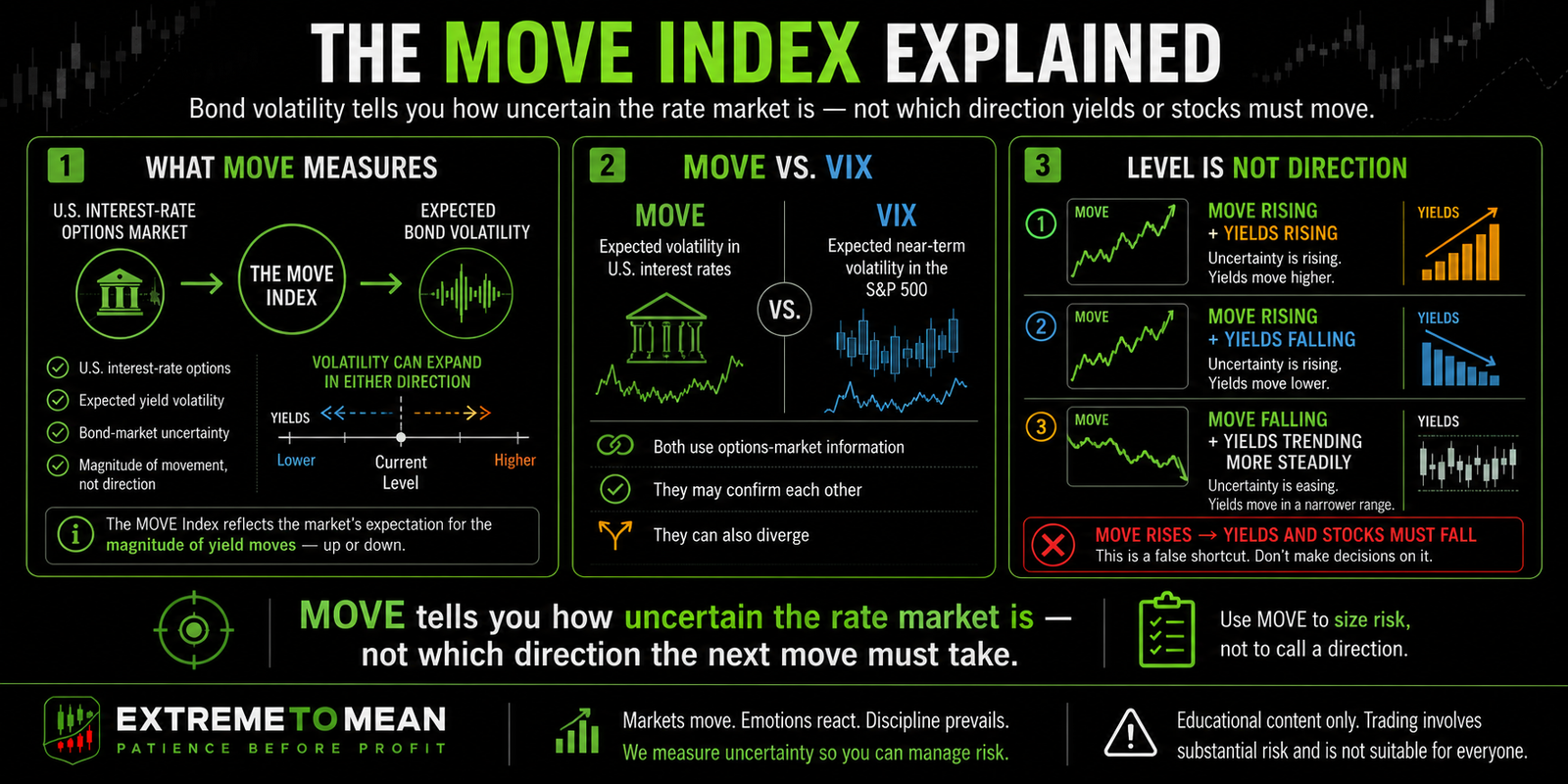
The ICE BofA MOVE Index is a benchmark of implied volatility in U.S. fixed-income and interest-rate markets. It measures U.S. bond-market yield volatility through a basket of options connected to U.S. interest rates. Because option prices reflect the movement market participants are preparing for, MOVE is forward-looking rather than a record of volatility that has already occurred. A rising index means the options market is pricing a wider range of possible rate movement.
The word implied is important. MOVE does not measure the day’s realized change in one Treasury yield, and it does not function like a chart of the 10-year yield. It summarizes uncertainty embedded in options across the interest-rate market. Traders can therefore see bond volatility increase before cash Treasury yields produce their largest move.
Why MOVE Is Called the Bond Market’s VIX
MOVE is often described as the bond market’s counterpart to the VIX because both indexes translate options prices into measures of expected volatility. VIX focuses on expected near-term movement in the S&P 500, while MOVE focuses on expected movement in U.S. interest rates. Either index can rise without the other because uncertainty may be concentrated in one asset class. When both rise together, the market may be repricing risk more broadly.
MOVE Level Is Not Yield Direction
A rising MOVE Index does not tell the trader that Treasury yields must rise. It also does not predict that yields must fall in a flight to safety. The index measures expected magnitude, so fast moves in either direction can be associated with higher bond volatility. The directional question must be answered by the yield curve and Treasury price behavior.
The same separation applies to stocks and futures. Higher bond volatility can accompany falling equities, rising equities, sector rotation, or unstable two-way trade depending on why rates are moving and how other markets respond. A falling MOVE Index does not guarantee a calm or bullish stock session either. It only indicates that expected rate volatility is becoming less elevated.
Why Stock and Futures Traders Should Care
Treasury yields influence borrowing costs, discount rates, currencies, and the relative attractiveness of different assets. Greater uncertainty around rates can make equities and futures more sensitive to economic data, central-bank communication, and Treasury supply. MOVE helps reveal when that rate environment is becoming less stable. Even traders who never buy bonds can benefit from understanding that change.
Bond volatility can also interact with liquidity. Greater Treasury-yield volatility can occur alongside poorer Treasury-market liquidity and less orderly trading. Not every MOVE increase creates a liquidity event. A rapid rise matters more when price and other liquidity-sensitive markets confirm the same stress.
What Rising and Falling MOVE May Mean
A rising MOVE reading means the options market is assigning more uncertainty to future rate movements. The change may reflect disagreement about inflation, growth, monetary policy, Treasury issuance, or the market’s ability to absorb new information. A falling reading suggests a narrower range of expected rate movement, even while yields continue trending. Neither change identifies the correct directional trade by itself.
The speed of the change matters alongside the level. A gradual rise may show uncertainty building, while a sudden jump may reflect rapid repricing around new information. The reading should also be compared with its recent range because the same number can carry different meaning in different regimes. The cleaner question is whether bond uncertainty is expanding, stabilizing, or retreating.
When MOVE Confirms a Broader Risk Warning
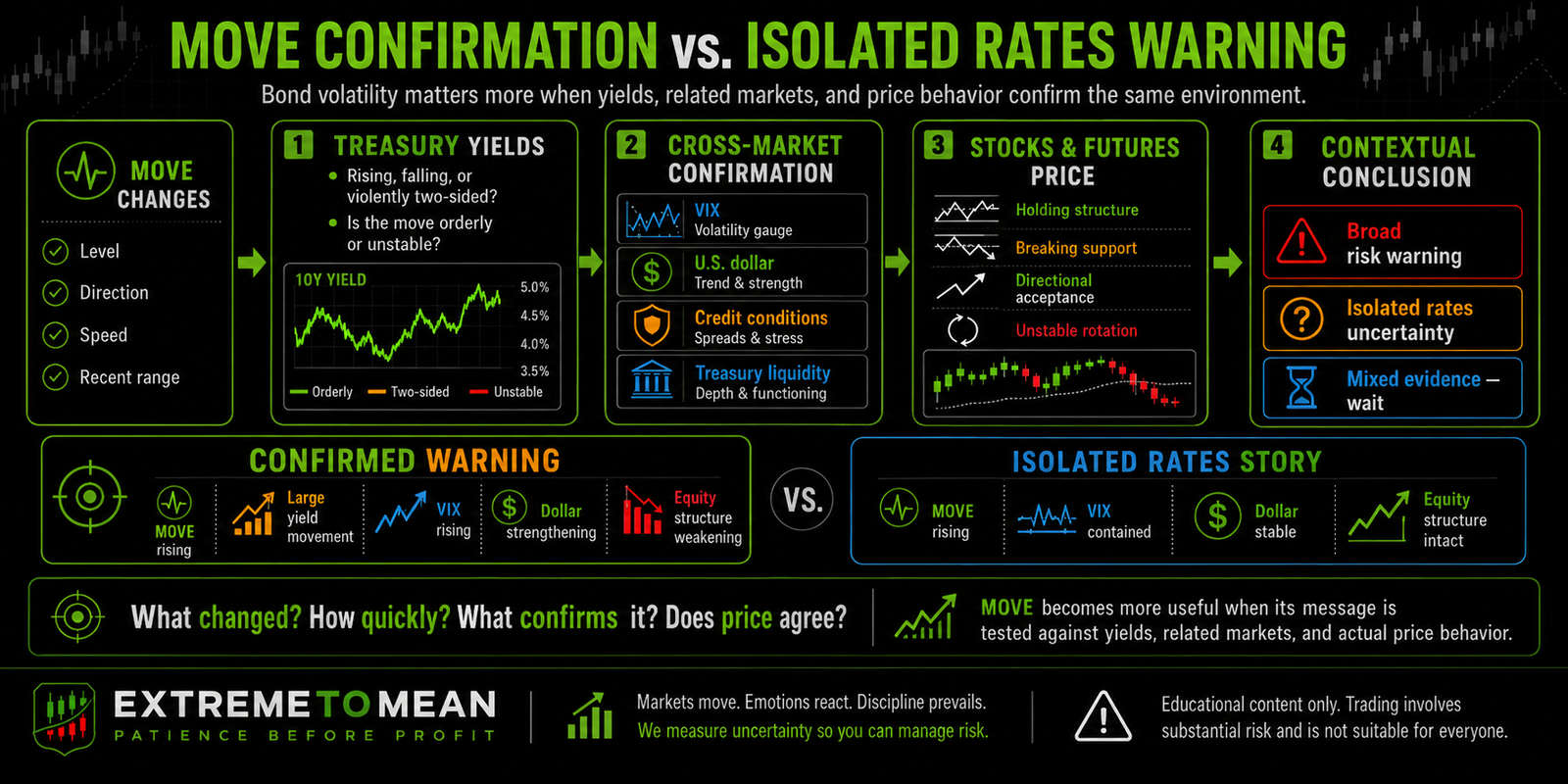
Suppose MOVE rises quickly while Treasury yields are making large moves, the dollar is strengthening, VIX is rising, and stock-index futures are failing to hold important support. These markets are not providing identical information, but together they suggest a broader repricing of risk. In that environment, MOVE strengthens the warning because related markets and price behavior agree. The trader may respond by demanding clearer setups or better location rather than predicting an automatic collapse.
Confirmation must still be judged through the market being traded. A futures trader needs to see whether volatility is producing directional acceptance, unstable reversals, or temporary headline movement. The principle that context comes before the candle prevents MOVE from replacing price structure. The chart still determines whether a specific trade has qualified.
When MOVE Is Mostly an Isolated Rates Story
Now suppose MOVE rises around a Treasury auction or policy debate, but VIX remains contained, the dollar is stable, and equity futures continue holding structure. The bond market is expressing uncertainty, but that uncertainty has not clearly spread into the broader risk environment. Treating the MOVE increase as an automatic short signal would overstate the evidence. The trader should monitor for transmission rather than assume it has already occurred.
Non-confirmation does not make MOVE irrelevant. Rates volatility may eventually affect equities, or the issue may remain concentrated in Treasuries. The useful conclusion is that the market picture is mixed. Patience allows price and related markets to clarify whether the rates warning is becoming a broader condition.
Read MOVE With Yields, the Dollar, Liquidity, and VIX
MOVE should first be paired with Treasury yields because the two answer different questions. Yields show direction, while MOVE describes expected uncertainty around that movement. A rising 10-year yield with rising MOVE suggests a less stable repricing than a rising yield with falling MOVE. The combination provides more information than either series alone.
The dollar, VIX, credit conditions, and Treasury liquidity can show whether rate uncertainty is spreading. None of these relationships is mechanical, and correlations can change. The goal is to distinguish one shared environment from separate problems. Price remains the final check because the traded market must accept or reject the warning.
The article on how the stock market actually moves explains that markets respond through auctions, liquidity, and changing participation rather than through one indicator. MOVE may describe pressure building outside the equity chart, but stock and futures prices must still show whether that pressure matters. The indicator provides context before the setup earns risk. It should never replace the setup.
A Simple MOVE Reading Routine
A practical routine begins with change rather than a fixed threshold. The trader should ask what MOVE did, how quickly it changed, and whether the move is unusual relative to its recent behavior. The next step is to identify what happened in Treasury yields and whether the move is directional or violently two-sided. Only then should the trader look for confirmation in the dollar, VIX, liquidity conditions, and price.
- What changed? Did MOVE rise, fall, or remain elevated?
- How quickly did it change? Was the move gradual, sudden, or tied to a known event?
- What are yields doing? Are they rising, falling, or moving sharply in both directions?
- What confirms it? Are the dollar, VIX, liquidity, or credit conditions telling a similar story?
- Does price agree? Are stocks or futures accepting the warning, rejecting it, or remaining mixed?
- What changes the conclusion? Which market behavior would show that the original reading is incomplete?
The better question is not, “Is MOVE high enough to sell stocks?” It is, “What type of rate uncertainty is present, what other markets confirm it, and how is price responding?” That sequence supports the principle that market conditions change the quality of a setup. A setup appearing during broad cross-market stress should not be evaluated as though surrounding conditions were ordinary.
Common Mistakes When Reading MOVE
The first mistake is treating MOVE as a directional forecast. Another is comparing it with stocks while ignoring Treasury yields, the prior trend, the speed of the change, or confirmation from other markets. A low reading also does not remove equity volatility, credit stress, geopolitical risk, or company-specific pressure. The lesson that the market comes first requires MOVE to remain one part of the complete environment.
From One Indicator to a Cross-Market Framework
MOVE is most useful when it helps the trader connect bond volatility, Treasury yields, the dollar, equity volatility, liquidity, and stock-index price behavior. Those relationships can strengthen a conclusion, reveal disagreement, or show that uncertainty remains isolated. Better market reading comes from understanding the connections rather than collecting standalone indicators. MOVE remains one contextual input rather than a complete trading system.
Readers who want to develop that broader approach can continue through Decode the Market. The book connects macro conditions with the behavior visible on the chart. MOVE belongs inside that process as a measure of interest-rate uncertainty. It should not replace structure, risk, or trade qualification.
Final Thought
The MOVE Index measures expected volatility in U.S. interest-rate markets. It shows whether uncertainty around Treasury yields is expanding or contracting, but it does not tell traders which direction yields, stocks, or futures must move. Its value comes from showing when the bond market is becoming less certain. Directional meaning must come from yields, related markets, and price behavior.
The goal is not to turn MOVE into an automatic risk-on or risk-off signal. Ask what changed, how quickly it changed, what confirms it, and whether price agrees. Rising MOVE may strengthen a broad warning or remain an isolated rates story. The trader’s job is to recognize the difference before using that context.
Educational content only. Trading involves substantial risk and is not suitable for everyone.