
The hardest story to resist is not obviously ridiculous. It is the one that may actually be true.
The story earns attention. The setup earns risk.
New markets create a special problem for traders because genuine change and speculative excess can exist at the same time. A technology may be useful, adoption may be accelerating, institutions may be participating, and an industry may genuinely be changing, yet none of those facts tells you whether buying the instrument at today's price is a good trade.
That is why this lesson belongs inside The Trader. Narrative becomes dangerous when it stops being context and starts granting exceptions to location, timing, sizing, invalidation, and qualification. You can be right about the future and completely wrong about the trade in front of you.
Why New Markets Make Old Rules Feel Optional
A genuinely new opportunity can make ordinary discipline feel outdated. The trader thinks, “This market did not exist a few years ago,” or “The normal rules cannot apply because this changes everything.” Sometimes the first part is correct: new products, regulation, technology, participation, and liquidity can absolutely change how a market behaves.
But adaptation is not the same thing as abandonment. A new market may require different assumptions about volatility, liquidity, session behavior, or position size, yet the trader still needs a reason to enter, a place where the idea is wrong, and an amount of risk that fits the trade. The product can be new; risk is not.
This is where your trading plan is a promise made before the open becomes especially relevant. A compelling narrative should not receive an automatic exemption from standards that exist specifically to protect decision quality under pressure. New information may require new analysis, but it does not require weaker risk management.
The Most Dangerous Narratives Often Contain Something True
Obvious hype is relatively easy to dismiss. The difficult stories are built around real developments: useful technology, genuine adoption, large companies entering a market, changing consumer behavior, or infrastructure that did not previously exist. Those facts deserve analysis rather than cynicism.
The mistake begins when factual progress is converted into certainty about price. Real adoption and speculative excess can coexist, and a market can become crowded or extended even while the underlying story continues improving. A narrative does not become safe simply because part of it is true.
That distinction also keeps the trader from becoming reflexively contrarian. Discipline does not mean automatically betting against whatever is popular; a popular thesis can be correct and price can continue higher. The job is to stop the story from answering questions that only the current trade can answer.
A Long-Term Thesis Is Not a Short-Term Trade
A trader may reasonably believe, “This technology will matter over the next five years.” That tells us something about why the market deserves attention, but it does not answer whether the current entry has good location, whether structure supports the trade, or whether risk can be defined today. “Eventually” and “now” operate on different clocks.
Narratives compress those clocks psychologically. A development that may take years to unfold begins to feel like an immediate obligation because the trader imagines tomorrow's adoption, market size, or institutional participation and imports it into today's decision. Distant possibility becomes present urgency.
A cleaner process separates thesis from trade. The thesis asks whether the market may matter over a longer horizon; the trade asks whether this entry, at this price, with this risk, deserves capital now. A good story can survive a bad entry; your account may not.
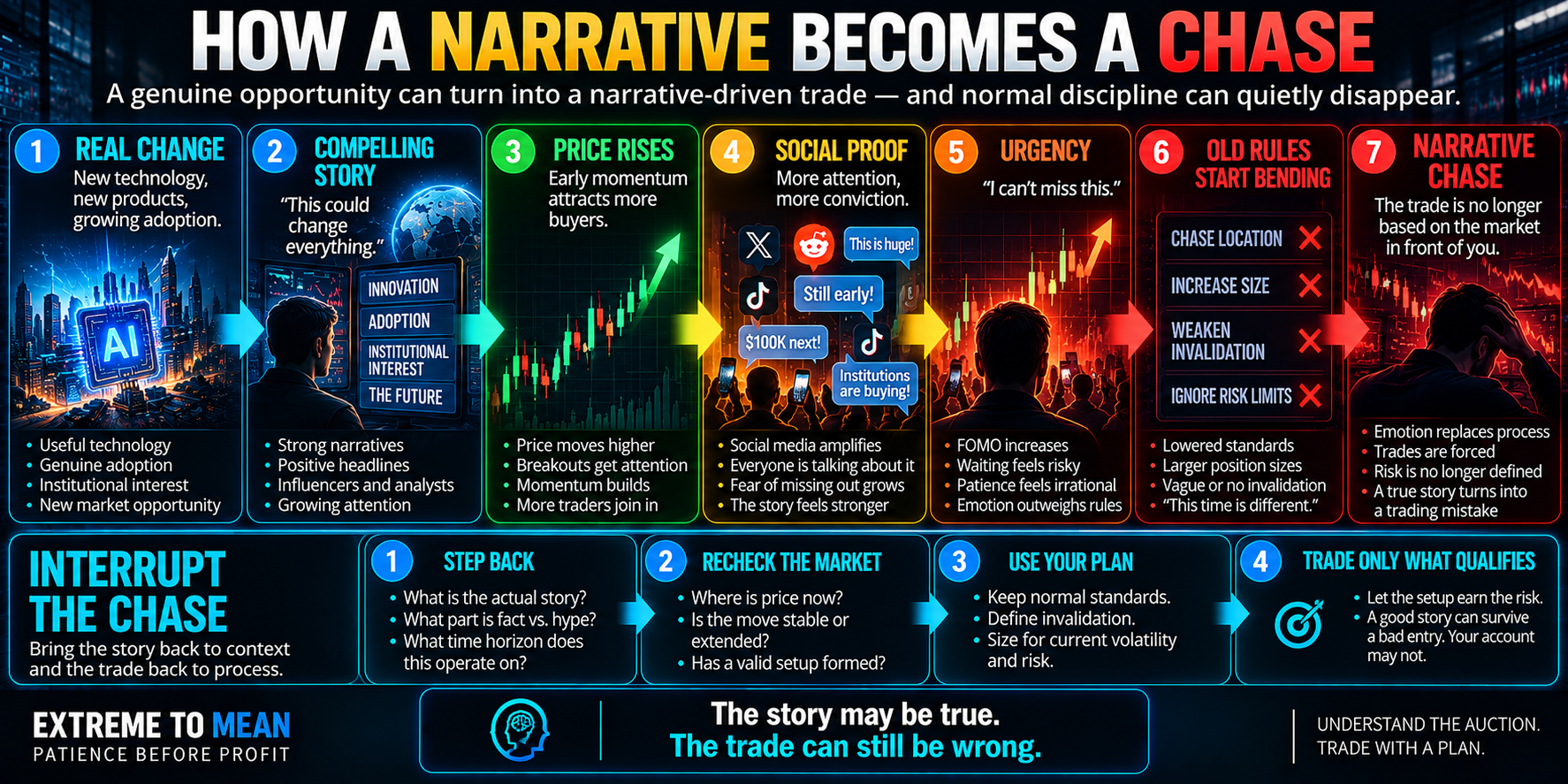
How Narrative FOMO Turns “Missing a Trade” Into “Missing the Future”
Normal FOMO says, “I might miss this move.” Narrative FOMO is more powerful because it says, “I might miss the next once-in-a-generation opportunity.” A single missed entry suddenly feels like permanent exclusion from an entire technological or economic future.
That framing makes patience feel irrational. If the trader believes the opportunity is irreplaceable, waiting for location or qualification can feel like a luxury reserved for ordinary markets. The more irreplaceable the opportunity feels, the more replaceable normal rules begin to feel.
This is a different layer of the problem described in FOMO is the tax you pay for chasing. The chase is no longer justified merely by fast price movement; it is rationalized by the story surrounding that movement. Narrative chasing turns one missed trade into the fear of missing an entire future.
Why Conviction Can Distort Location, Size, and Invalidation
The stronger the story feels, the easier it becomes to stop asking where you are buying it. A market can have extraordinary long-term potential and still be extended, far from useful structure, or offering poor risk relative to the available invalidation. Narrative strength cannot rescue weak location.
That is why location remains the first filter. A trader who would normally reject a late entry may suddenly accept it because adoption is accelerating, headlines are positive, or everyone appears to agree with the thesis. The story has not improved the entry; it has changed the trader's willingness to tolerate it.
Conviction can distort size in the same way. “This could be enormous” can make normal exposure feel inadequate, but the size of the story should not determine the size of the position. Conviction can justify attention; it cannot turn oversized risk into good process.
Invalidation is where narrative attachment becomes especially dangerous. Price moves against the position, yet the trader says, “The long-term thesis has not changed,” which may be completely true. A thesis can remain intact long after the trade itself should have been closed.
A New Market Still Has Old Risk
“This time is different” should not automatically be mocked because sometimes the market really is different. New technology can alter industries, new financial products can change access, and regulation can reshape participation. The responsible conclusion is not that nothing changes; it is that difference must be demonstrated and still does not repeal the consequences of a bad entry.
Limited history should actually increase humility. Newer markets may have fewer observed regimes, changing relationships, and less mature reference points, which creates more uncertainty rather than less. Less history should create more humility—not more certainty.
The instrument may be new, but the psychology chasing it is ancient. Greed, urgency, confirmation bias, FOMO, fear, and overconfidence do not become new behaviors because the ticker or technology is new. Old discipline matters precisely because newness gives those familiar emotions a powerful new justification.
Translate the Story Into Observable Evidence
A narrative is most useful when it can be translated into something observable. “Adoption is accelerating” should lead to questions about what evidence supports that statement; “institutions are entering” should lead to questions about participation, liquidity, or actual market behavior. “This is the future” still has to end with, “What makes today's trade qualify?”
If the narrative cannot be translated into observable evidence, it should not control the trade. Even when the narrative can be supported, it belongs primarily in context: it can explain why the market deserves attention and why participation may be changing. It still does not become an entry signal.
A useful diagnostic is: Would I take this exact trade if I had never heard the story? If the answer is no, the trader should determine what the narrative is replacing—location, structure, timing, invalidation, or simply patience. That question converts excitement back into evaluation.
Thesis vs. Trade: Keep the Two Separate
Imagine a fictional market developing around a genuinely useful technology. Adoption is increasing, major companies begin participating, and price has already doubled; Trader A sees a sharp breakout and buys late with a larger-than-normal position because “this is clearly the future.” When price pulls back sharply, Trader A refuses to exit because nothing about the technology has changed.
Trader B may believe exactly the same long-term story. But Trader B looks at the current price and says, “Interesting market, bad location,” then waits for a place where structure is clearer, invalidation is definable, and risk makes sense. Maybe that trade eventually appears, or maybe it never does.
Trader A needed the story to become a trade. Trader B allowed the story to remain context until the market earned the risk. The trade is not ready until the risk is clear, regardless of how exciting the long-term thesis sounds.
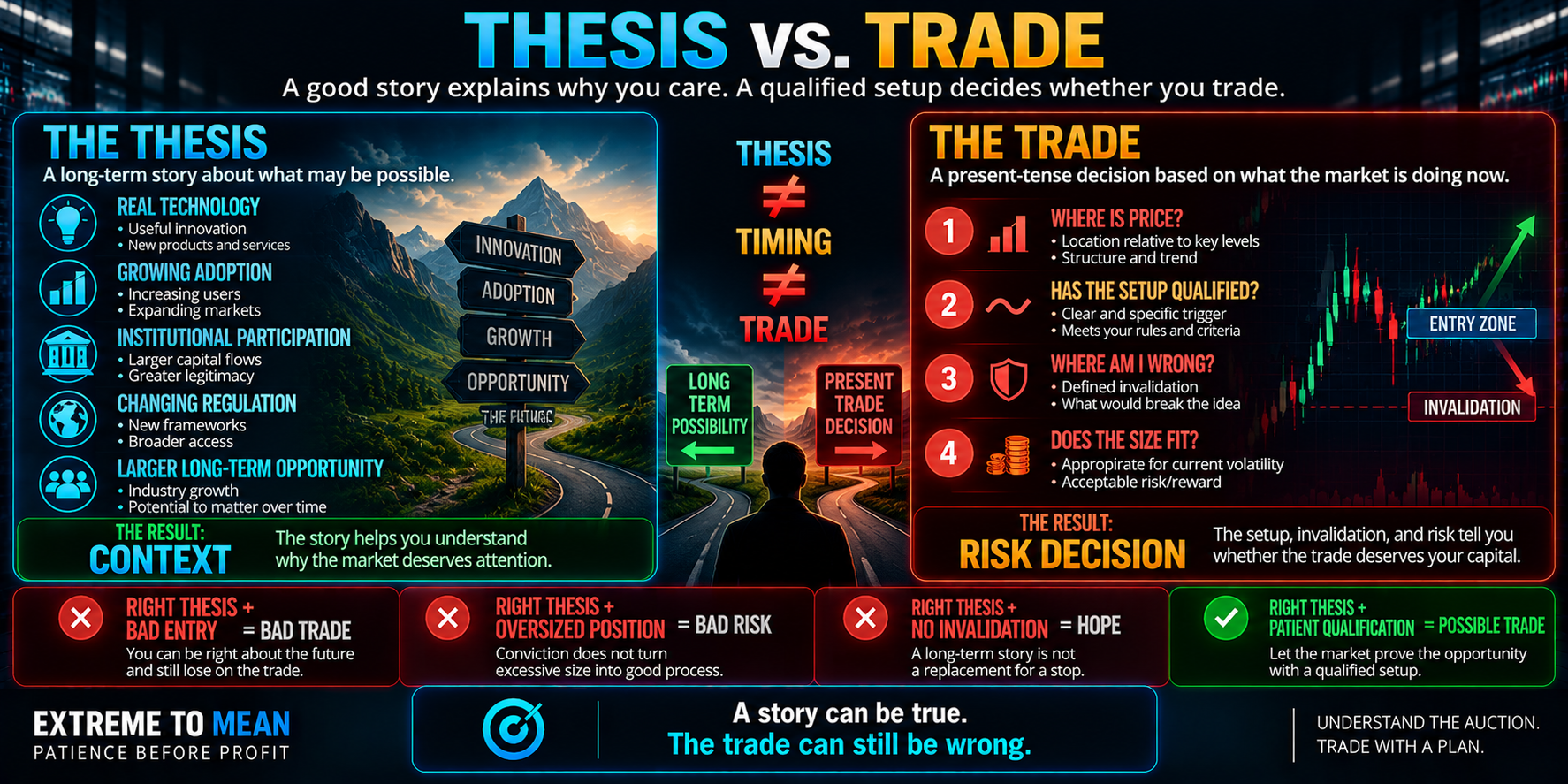
A right thesis can therefore coexist with a bad trade. Right thesis plus bad entry is still a bad entry; right thesis plus excessive size is still bad risk; right thesis plus no invalidation is hope rather than a complete trade. Being early enough to be right later can still be too early for the trade you actually took.
The Narrative Chase Check
Before allowing a new-market story to influence a trade, ask:
- What exactly is the story?
- Which part is observable fact, and which part is expectation?
- What time horizon does the narrative operate on: years, months, or today?
- Is the story explaining context, or am I using it as an entry signal?
- Where is price relative to meaningful structure and location?
- Would I take this trade if I had never heard the narrative?
- Is my position larger because my conviction is larger?
- Can I define trade invalidation without saying, “The long-term thesis is still intact”?
- Am I afraid of missing one trade—or missing history?
- If I wait, what exactly am I afraid will disappear?
The goal is not to remove narratives from trading. Stories can help organize research, explain changing participation, and identify markets worth monitoring. The goal is to keep a useful story from taking control of decisions it cannot answer.
For traders who recognize that the story has already turned into urgency, the chasing-the-trade problem guide is the natural next step. Chasing becomes easier to recognize once the trader separates “I want exposure to this idea someday” from “this entry deserves risk now.” The market can remain interesting without requiring immediate participation.
The ETM Story → Translate → Verify → Qualify → Risk Framework
Use STORY → TRANSLATE → VERIFY → QUALIFY → RISK. Start by stating the narrative clearly, then translate it into observable implications and verify which parts are facts versus expectations. Only after that should the actual trade be judged on location, structure, timing, and invalidation.
Risk comes last because the emotional size of the story should never determine the financial size of the position. Adapt volatility assumptions, liquidity expectations, or execution to the market when necessary, but do not abandon the process because the opportunity feels historic. The story earns attention; the setup earns risk.
Final Thought
New markets are difficult precisely because the story can be compelling and true at the same time. A technology can gain adoption, a product can matter, and an industry can genuinely change while the current price still offers a poor entry with unclear risk.
Narrative chasing begins when the possibility of a historic opportunity convinces the trader that normal discipline is too slow. Keep the story in its proper place: use it to decide what deserves research and attention, then return to the same questions that protect you everywhere else—where is price, what has qualified, where are you wrong, and how much risk makes sense?
The market may be new. The need for patience is not.
Educational content only. Trading involves substantial risk and is not suitable for everyone.